
Scripture References: Matthew 5; 2 Corinthians 11; Galatians 1.
4370 AM (610 CE) – PRINCIPALITIES
In the harsh and unforgiving desert of the Arabian Peninsula, where the winds sculpted dunes like the waves of an endless ocean, a man named Muhammad contemplated the divine under the vast expanse of the starlit sky. Born into the tribe of Quraysh, custodians of the Kaaba in the bustling trading city of Mecca, Muhammad felt an unquenchable thirst for spiritual truth – a yearning that transcended the idolatrous practices of his people.
Muhammad’s early years were marked by hardship and solitude. Orphaned at a young age, his only tangible links to his parents were his name, Muhammad, and a rare coin given to him by his mother, bearing the inscription “Mahmud” – meaning “worthy of praise.” He vividly remembered his mother cradling him, whispering that he must embody the virtues of his ancient namesake, as declared by the aged coin, which had long since fallen out of circulation.
Raised by his uncle, Muhammad absorbed tales of distant lands from traders and travelers. Among these tales were whispers of Christianity and Judaism, religions that spoke of a singular, omnipotent God – a concept both alien and mesmerizing to the polytheistic Meccans.
One evening, as Muhammad wandered the outskirts of Mecca, he overheard a group of Christian monks in fervent discussion about the Beatitudes. The beauty of the teachings struck a chord within him: “Blessed are the peacemakers, for they will be called children of God,” one monk recited. The words echoed in Muhammad’s heart, a stark contrast to the tribal conflicts that bloodied the sands of Arabia.
☼ ☼ ☼
Desperate to understand more about these monotheistic faiths, Muhammad sought out a Jewish friend, Yitzhak, a merchant who had once mentioned the Torah and its profound teachings. Yitzhak had promised to teach Muhammad to read so that he might discover the divine words for himself. Eager for their meeting, Muhammad set out at dawn towards Yitzhak’s dwelling on the edge of the city, the coin given to him by his mother clutched tightly in his palm as a reminder of his quest for truth.
As Muhammad traversed the narrow alleys of Mecca, a brilliant light suddenly pierced the dawn. A figure, resplendent and terrifying in its luminosity, appeared before him. Muhammad fell to his knees, shielding his eyes from the blinding brilliance.
“Muhammad, chosen servant of the divine,” the figure spoke with a voice that filled the air like thunder, yet carried the soothing tones of a gentle stream, “I am here to guide you to the truth you seek.”
Muhammad searched all he knew about the Jewish and Christian stories he had heard: “Are you Gabriel?” he blurted out.
The messenger seemed to pause and then smiled lavishly. “But of course, my friend, I am Gabriel. Do not be afraid.”
Muhammad’s heart raced with a mixture of fear and awe. “O Messenger, Gabriel, I am but a humble man, seeking the words of God to quench the thirst of my soul. I wish to learn from the scriptures of the Christians and Jews.”
Gabriel’s light dimmed and flickered slightly as he drew closer. “Muhammad, the scriptures you seek are but corrupted shadows of divine truth. I am here to bestow upon you the pure, unaltered words of truth that you might lead your people out of the darkness of idolatry into the light of a new faith.”
Trembling, Muhammad nodded, his resolve shaken by the presence of the celestial being. “But how shall I receive these words, O Messenger? I cannot read, nor write.”
“The words shall be given to you, to hold in your heart and proclaim by your tongue. You need not read; you are to be the living vessel through which the divine will speaks,” Gabriel declared, extending a hand that radiated a warmth that belied the cold touch of deception.
Enthralled by the vision and the promise of divine wisdom, Muhammad failed to see the shadows that danced menacingly behind Gabriel’s light. “What must I do?” he asked, his voice barely a whisper.
“You must first cleanse the Kaaba of the idols that defile it. All must be destroyed, save for the greatest of them, the god who presides over all – the moon god, Baal. He is a symbol of the might and war necessary to enforce the true faith.”
Muhammad hesitated, the instruction a stark divergence from the peace he had found in the Christian teachings. Yet the majesty of Gabriel’s presence overwhelmed his doubts. “It shall be as you command,” he resolved, a sense of destiny fueling his conviction.
☼ ☼ ☼
Over the following weeks, Muhammad proclaimed the revelations given to him by Gabriel. With a zeal born of divine assurance, he led his followers in a violent purge of the Kaaba, toppling the idols, his actions casting ripples of outrage and fear across Mecca.
As the idols fell, so too did the barriers to his ambition. Muhammad’s influence grew, his revelations compiled into recitations that echoed through the deserts – verses of power and subjugation, cloaked in the beauty of divine poetry but edged with the darkness of the deception that had birthed them.
The Quran, as it came to be known, spread from tribe to tribe, its verses memorized and recited by those who fell under Muhammad’s growing power. Yet others who knew the gentle words of the Nazarene or the wise decrees of the Torah recognized the shadow that lurked within the beauty – teachings that twisted the concepts of mercy and justice into instruments of conquest and submission.
Years passed, and the empire Muhammad founded expanded, fueled by the relentless drive of his teachings. Yet beneath the triumphs and the spoils of war, the seeds of doubt and regret began to sprout in his heart. The angel of light that had appeared to him bore the fruits of power and dominion, but the cost was a legacy steeped in the blood of countless innocents, a far cry from the peace and love he had once yearned to understand.
☼ ☼ ☼
In the twilight of his life, Muhammad often contemplated the empire he had built – an empire of death and of fear. The celestial being that had once guided him now seemed an emissary of darkness, a bearer of some twisted truth that had ensnared him in its grasp.
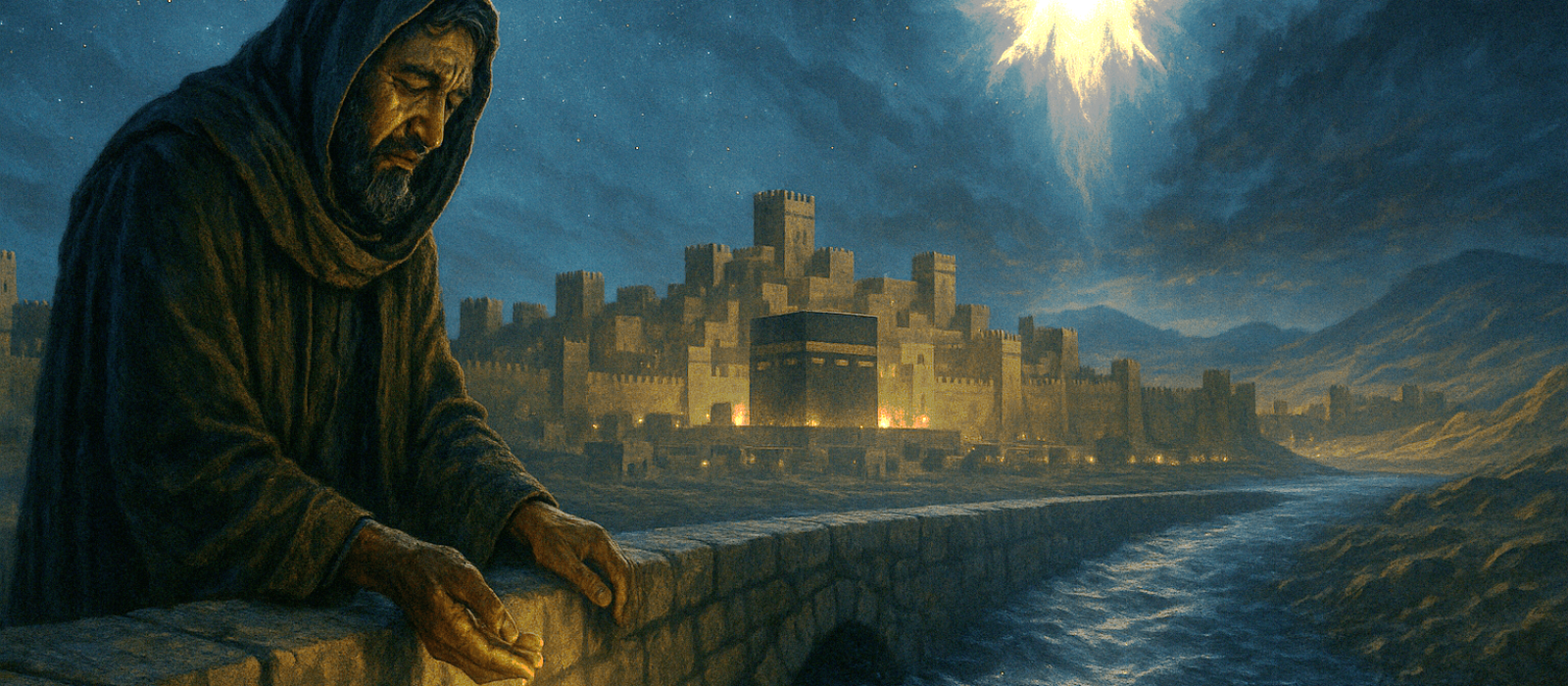
Standing on a bridge, Muhammad gazed down over the rushing river that rushed beneath him like the chaos of his life. He pondered the empire he had built – an empire of fear and of blood, far from the peace he once sought oh so long ago. In all that time, the words of the monks never stopped echoing eerily in his ears: “Blessed are the peacemakers…”
In the silence of his contemplation, Muhammad began to weep for the peace that could have been. A stream of tears reflected the starlight, the shimmering regret of a man who had sought the divine, only to find himself entangled in the webs of power and darkness.
In his hand, he held that ancient coin, the reminder of his mother’s hope for him to be “worthy of praise.” The reality of his legacy weighed heavily upon him, and, with a sigh of defeat, Muhammad allowed the coin to slip from his fingers, watching as it disappeared into the rushing waters.
In that one act, Muhammad finally silenced the voice of the monks, and finally separated himself and his mind from that Judeo-Christian God who had nothing to do with Allah.
Used with permission by the author. Find the author’s complete works online: Complete Works of Mack Samuels