
Shavuot: From Omer to Outpouring
In ancient times, the Jewish people cut down an omer of barley and brought it to the Temple as an offering on the second day of Passover. From that “wave offering,” the Torah commands us to count seven full weeks—linking the Exodus to the giving of Torah at Shavuot.
Although we can no longer bring the Omer Offering (since the Temple was destroyed in 70 C.E.), this season remains a time of character reflection before Shavuot, when Jewish tradition holds that Moses received the Torah at Sinai. Counting from the day after the Passover Sabbath, Israel learns that redemption from slavery is incomplete without God’s guide to holiness—His Word.
Names and Meanings: Bikkurim and Shavuot
The names reveal the meaning. “Bikkurim” speaks of offering thanks for firstfruits—barley early in the season, and later, the firstfruits of the wheat harvest. “Yom HaBikkurim” marks the early barley; “Bikkurim” (without Yom or Ha) thanks God for the early wheat harvest.
Bikkurim is one of the shelosh regalim, the three pilgrimage festivals when Israel’s males were to appear in Jerusalem.
“Three times a year all your males shall appear before the Lord your God in the place which He chooses: at the Feast of Unleavened Bread, at the Feast of Weeks, and at the Feast of Tabernacles;…”
Greek-speaking Jews and many Gentiles call the day “Pentecost” (fiftieth), counting fifty days from the early barley celebration to the designated celebration of the early wheat harvest. For Messianic believers, gratitude for God’s present provision grows faith for the greater harvest to come.
“Moreover, my God will fill every need of yours according to his glorious wealth, in union with the Messiah Yeshua.”
Temple Worship and Leavened Loaves
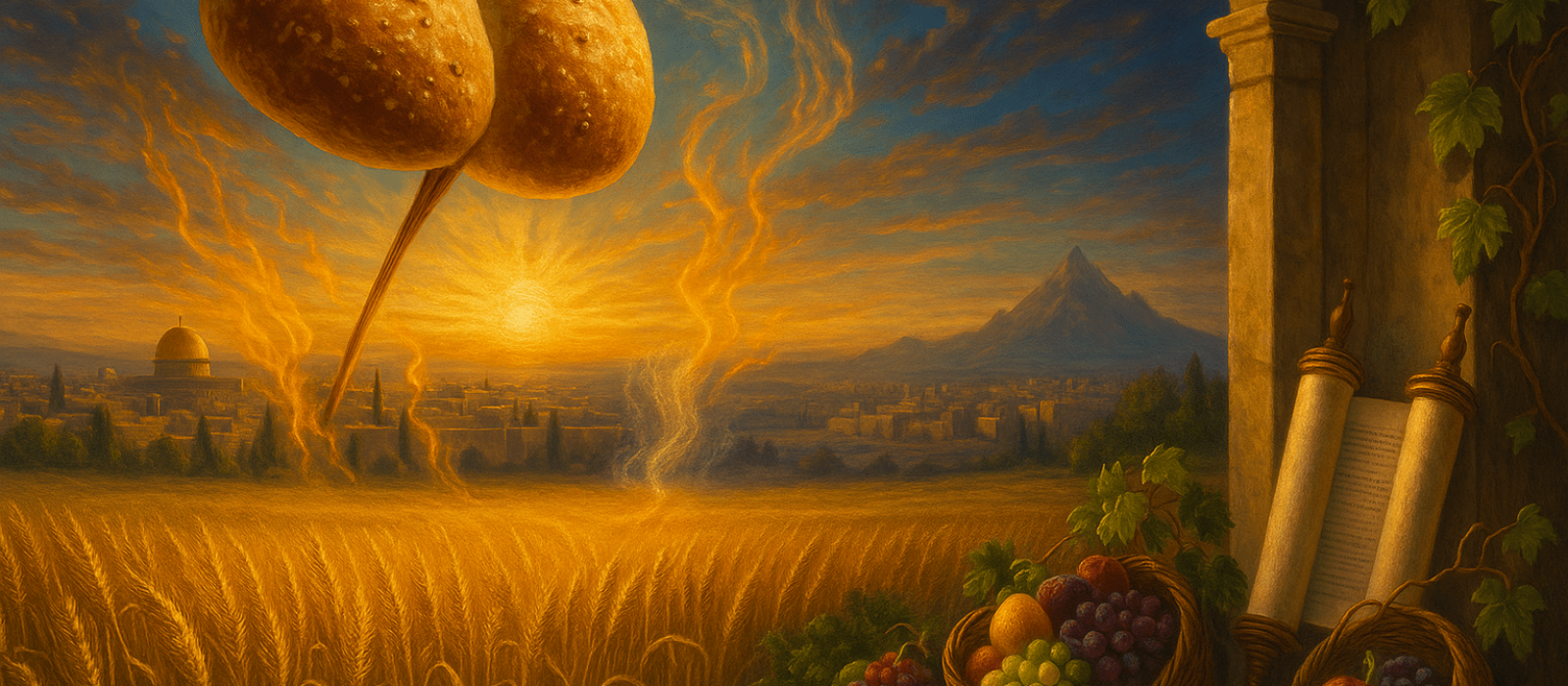
Torah centers Shavuot in sacrificial worship. A portion of the wheat offering was baked into two loaves of leavened bread—distinct from the matzah of Pesach—and lifted in all directions, declaring that provision comes from Adonai. The leaven symbolizes the worshiper’s inner condition—leaven “puffs up,” a picture of our self-centeredness in need of atonement. Sacrificed animals illustrated substitutionary atonement.
“For the life of the flesh is in the blood, and I have given it to you upon the altar to make atonement for your souls; for it is the blood that makes atonement for the soul.”
These sacrifices foreshadow Messiah. Torah’s offerings were repeated annually; Yeshua’s atoning blood is the perfect, once-for-all sacrifice. In Him, our standing with HaShem is secured, and traditional sacrificial service—now impossible without the Temple—is rendered spiritually complete in the Messiah.
Shavuot as Z’man Matan Torateynu
Since the Temple’s destruction in 70 C.E., Shavuot has also been observed as Z’man Matan Torateynu—the Time of the Giving of Our Torah—because Israel arrived at Sinai in the third month after Passover.
“In the third month after the children of Israel had gone out of the land of Egypt, on the same day, they came to the Wilderness of Sinai.”
Reading Exodus 19–20 reveals repeating “ascents and descents,” life from barrenness, and the number three—classic Messianic patterns. Moses goes up and down Sinai three times; God’s words are given on the third day of the third month; and “the Word was with God… the Word became flesh.”
“The Word was with God… And the Word became flesh and dwelt among us…”
Marriage Imagery and Custom
Traditional Jewish thought likens Sinai to a wedding: the Torah is the ketubah between God and His people. In Messianic understanding, this points to union with Yeshua and, through Him, with the Father.
Communal customs include adorning synagogues with greenery and firstfruits, reading Exodus 19–20 and Ezekiel 1, and the Book of Ruth—set at harvest time. Many observe Tikun Leil Shavuot, studying Torah through the night; some communities hold confirmations for teens completing years of learning.
Hints of Messiah in Ruth and the Firstfruits
Rabbinic discussions (Sanhedrin 93b) note Ruth’s six measures of barley (Ruth 3:15) and connect them to six notable descendants, including Daniel, David, and the Messiah. Home tables are dressed in festive linens; Yom Tov candles are lit; Kiddush over wine or grape juice and HaMotzi over challah are recited; and dairy delicacies—cheesecake, blintzes, ice cream—recall “a land flowing with milk and honey,” the Torah’s sweetness, and Sinai’s immediacy.
Pentecost in the Brit Chadashah
Shavuot appears throughout the Newer Testament: Rabbi Sha’ul times his travels for the feast, and Acts 2 records the Spirit’s outpouring in Jerusalem—audible wind, visible fire, and speech in many languages. As at Sinai, the nations “hear” the Word.
“When the Day of Pentecost had fully come… Suddenly a sound came from heaven like a rushing mighty wind… tongues as of fire… and each heard them speak in his own language.”
Jewish tradition holds that Torah at Sinai was given in seventy languages; Acts mirrors this in Spirit-given speech, gathering Jews from every nation. The two leavened loaves lifted at Shavuot can picture reconciliation—traditional Judaism and Messianic faith held together on one cloth in unity before God.
Harvest, Evangelization, and Hope
Yeshua’s parables tie wheat and harvest to salvation. Firstfruits anticipate the greater ingathering; Acts 2’s three thousand are a foretaste of the end-time harvest.
“The Kingdom of Heaven is like a man who sowed good seed… Let both grow together until the harvest… gather the wheat into my barn.”
James echoes the theme of firstfruits among creation, and Romans 11 points to Israel’s national turning—an anchor of hope for reconciliation in Messiah.
“…that we should be a kind of firstfruits of all that he created.”
“Out of Tziyon will come the Redeemer; he will turn away ungodliness from Ya‘akov… when I take away their sins.”
Wind, Fire, and the Ruach
Ezekiel’s visions of wind and fire frame Sinai and Jerusalem. Imagine pilgrims leaving the Temple after morning service, having heard Ezekiel 1, and then encountering the same motifs in Acts—the Ruach moving again among His people.
“I looked and saw a windy storm approaching from the north… flashing fire… gleaming amber from within the fire.”
“I will put my Spirit in you and cause you to walk in my statutes…”
With Spirit-empowered witness, Peter preaches Yeshua; three thousand respond—the firstfruits of a great harvest. Shavuot, then, sings of revival: firstfruits now, fullness later, and unity in Messiah as Jews and Gentiles are reconciled.
“…I will pour out on the house of David and on those living in Yerushalayim a spirit of grace and prayer; and they will look to me, whom they pierced…”
May Shavuot renew our gratitude for redemption and our hunger for revelation—counting the Omer with expectant hearts until the Ruach brings the latter harvest in Messiah Yeshua.