
Scripture References: Jeremiah 8; Matthew 15
4440 AM (680 CE) – AS A MATTER OF RECORD
In the bustling streets of Medina, the air was thick with the dust and din of a city in full swing of growth and transformation. It had been a full century and a half after the death of the Prophet Muhammad. Medina, a city that once housed the Prophet himself, was now a sprawling metropolis of traders, scholars, and the devout, all drawn by the spiritual magnetism of the Prophet’s final resting place.
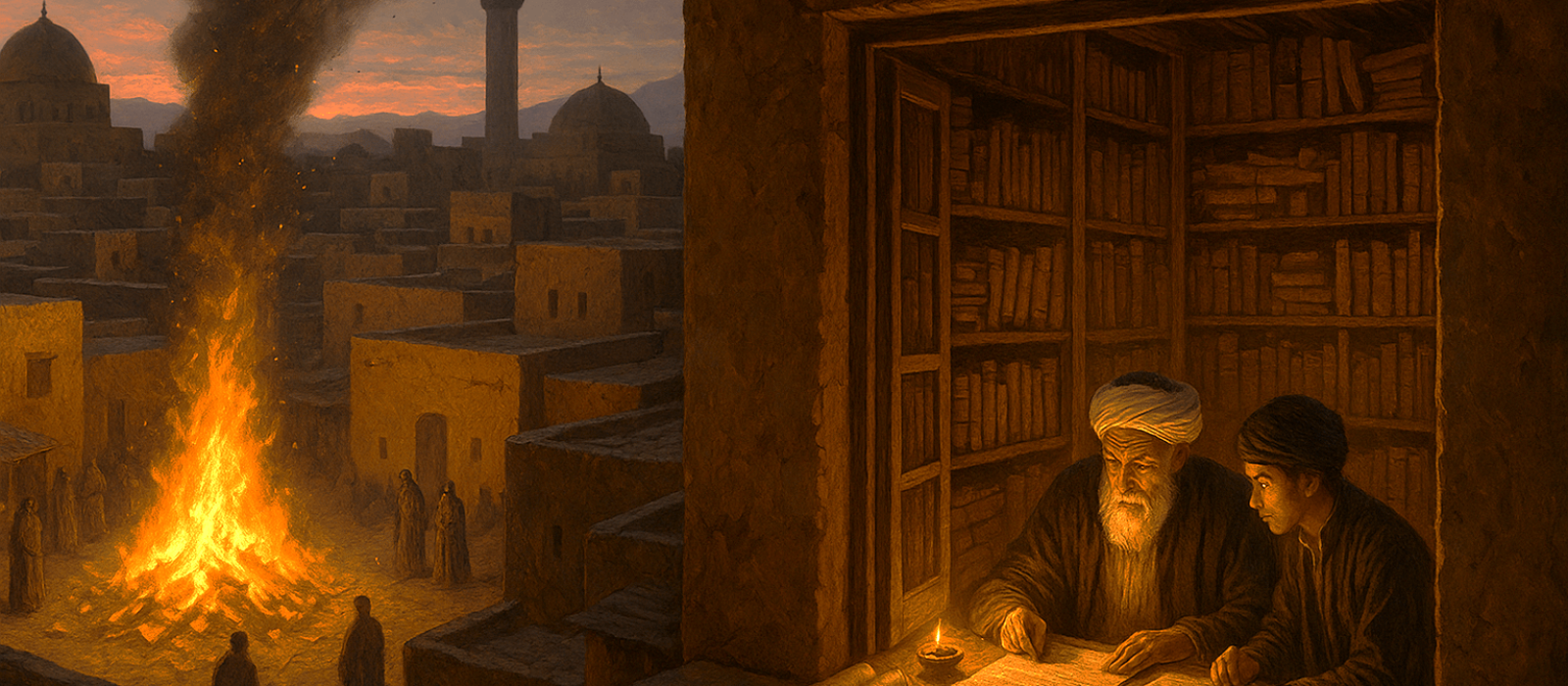
In the heart of this ancient city was the house of Al-Hakim ibn Jabir, a respected scholar known for his devoutness and his fervent pursuit of compiling the sayings and practices of the Prophet – a collection that would come to be revered as the Hadiths. The task was monumental, not just in its scale but in its implications for shaping the emerging fabric of Islamic law and culture.
Al-Hakim, an aging man with a flowing beard speckled grey and eyes that sparkled with intellect, was acutely aware of the responsibility that rested upon his shoulders. Every day, his modest home was visited by scores of people from all walks of life: traders who had traveled the ancient incense routes, scholars from as far as the newly conquered lands of Andalusia, and simple folk who carried with them oral traditions passed down through generations.
Among these visitors was a young man, Zaid ibn Thabit, a keen student of Islamic jurisprudence, whose lineage traced back to one of the Prophet’s own scribes. Zaid had come to Medina driven by a zeal not just to learn, but to contribute to Al-Hakim’s ambitious project. He believed that in the myriad strands of memory and oral tradition, there lay the unmined gold of the Prophet’s true teachings.
As the months passed, Zaid became an integral part of Al-Hakim’s circle, meticulously recording, verifying, and cataloging various accounts. The process was painstaking: every Hadith had to be scrutinized for its isnad – the chain of narrators – and its matn, the content of the saying itself. Each chain was examined with a detective’s eye, tracing narrators back to the Prophet’s time, ensuring they were people of sound character who could not have met or colluded.
Yet, as the work progressed, Zaid noticed troubling discrepancies. Some narrators, eager to align the divine teachings with contemporary politics or personal beliefs, embellished stories, adding elements that served more to reinforce current power structures than to preserve the purity of the Prophet’s words. Practices like child marriage, fiercely debated among scholars, found their way into collections, backed by dubious Hadiths that were politically expedient yet weak in their transmission chains.
☼ ☼ ☼
One evening, as the sun dipped below the horizon, painting the sky with strokes of crimson and gold, Al-Hakim summoned Zaid to his private study. The room was lined with scrolls and parchments, the air heavy with the scent of ink and aged paper.
“Zaid,” Al-Hakim began, his voice a mixture of fatigue and resolve, “I have watched you grow not just in knowledge but in understanding. The path we tread is fraught with challenges. Tell me, what weighs on your mind?”
Zaid hesitated, then spoke with a cautious honesty, “Master, I fear our efforts to preserve the Prophet’s teachings are being compromised. Some narrators, driven by current norms or personal gain, have introduced elements into the Hadiths that I cannot find corroborated in the Quran or in more reliable accounts.”
Al-Hakim’s eyes narrowed slightly, a testament to the gravity of Zaid’s words. “Go on,” he urged.
“For instance, the issue of child marriage,” Zaid continued, “I find no strong Hadith from the Prophet that conclusively supports this, yet it is being preached as divine sanction based on weak narrations favored by powerful clans.”
Al-Hakim leaned back, stroking his beard thoughtfully. “Your observations are sharp, Zaid. And it is our duty to sift the truth from falsehood, no matter how unpopular it may make us. We must remember, our allegiance is to Allah and His Messenger, not to the whims of the powerful.”
Thus began a quiet but profound rebellion within the walls of Al-Hakim’s study. With renewed vigor, Al-Hakim and Zaid dedicated themselves to a more rigorous scrutiny of the Hadiths. They sought older, more obscure chains of narrators, often finding that the most authentic sayings were preserved not in the centers of power but on the fringes of the Islamic world, carried in the hearts of those who had no political agenda.
Their work was not without its dangers. As their collection grew, so too did the opposition from powerful factions within Medina who sought to mold the religious narrative to their advantage.
It would be nice to say that Al-Hakim, bolstered by Zaid’s youthful fervor and the quiet support of the truly devout, was able to press on without interruption, and that their recorded truth would be transmitted untarnished.
But, years later, long after Al-Hakim and his protégé had gone to sleep with their fathers, when Al-Hakim’s collection was finally compiled, only the politically expedient Hadiths were kept. The rest of his work, along with the many other versions of the Quran that did not agree with those in power, were burned in a very public demonstration of resolve.
Even still, this work was called “The Hadiths, as compiled by Al-Hakim.” These were the Hadiths that would go on to shape the intellectual and spiritual contours of Islam for centuries to come, a legacy borne from the struggle between truth and power, memory and manipulation – a narrative forever etched in the annals of Islamic scholarship.
Used with permission by the author. Find the author’s complete works online: Complete Works of Mack Samuels