
Related: Genesis 22–25 (covenant context and Abraham’s family).
2225 AM (1535 BCE) – THE DEAL
The journey for Eliezer was … uneventful. There were no robbers nor were there thieves. No murderers lurked in the shadows nor did other wicked people discover Eliezer on the way there. The biggest danger Eliezer faced was the absolute monotony of this very uneventful trip.
The food and larder packed were more than sufficient, and the springs all along the way were lush with fresh water. Nevertheless, Eliezer spent the time in constant petition to Adonai.
And then, to Eliezer’s sudden astonishment, he found himself at the last oasis of his journey, just outside Nahor, deep inside the land of Ur.
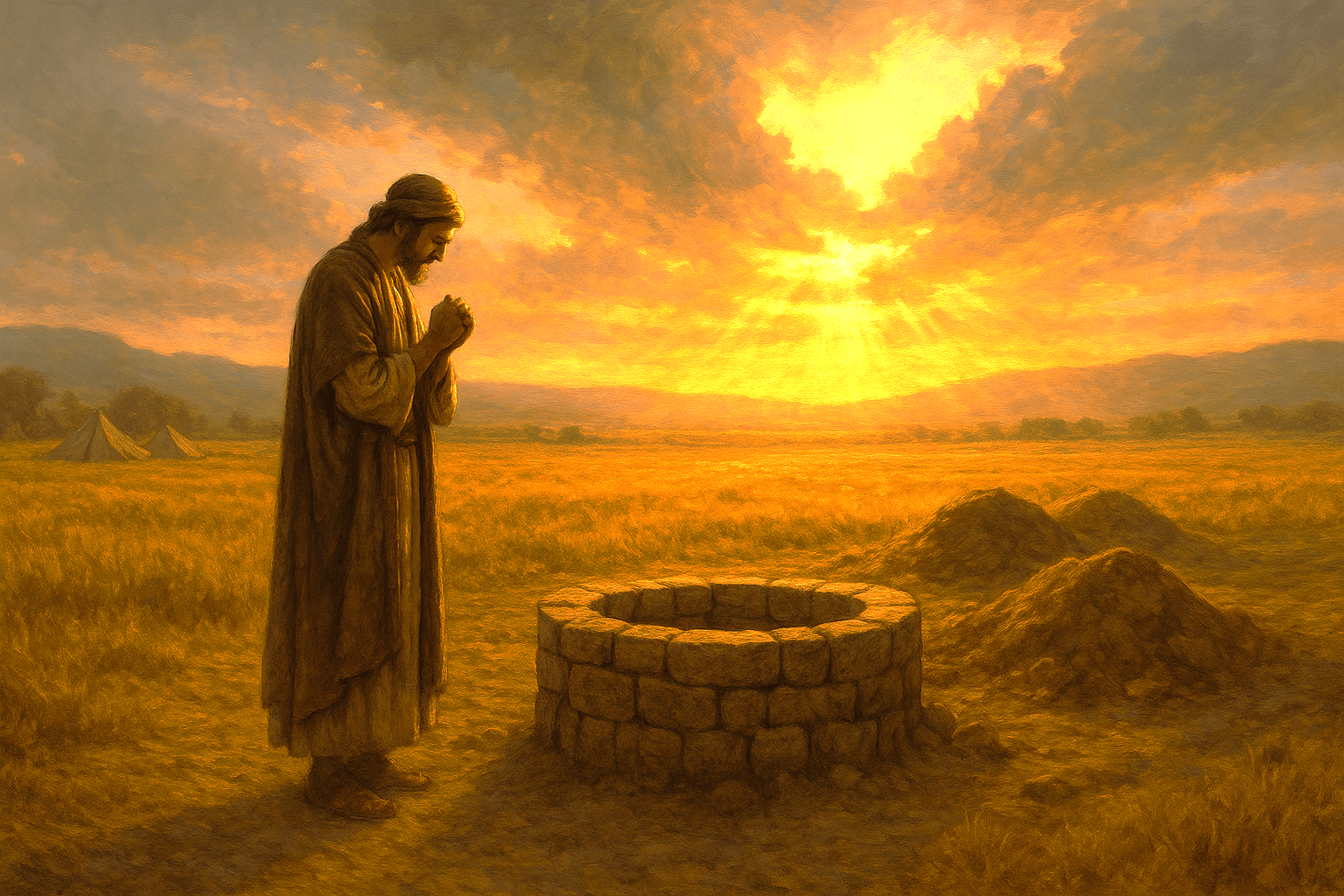
Eliezer dismounted from his camel and had all the camels kneel. Looking up, the sun was already dipping behind the city wall. This would bring almost immediate relief from the oppressive heat. Still, Eliezer was very thirsty.
However, a man like Eliezer—while a servant and slave to Abraham—was by no means a simpleton. There were things men simply did not do, and men simply did not draw water. That was something women were expected to do. It would certainly not make a good impression on any would-be family to find him panting alongside his camels. Besides, Eliezer had plenty of gold and silver he could use to pay for such services.
But, as he looked around, he noticed that there was absolutely nobody anywhere. Where were the women? Or the townspeople in general? Anyone he could pay—
And then, it hit him. It was a still, small voice—a whisper, but deafeningly clear. The voice in his mind prompted Eliezer, “You must ask for a drink …”
“Yes,” Eliezer mused to himself, stroking his beard, “yes, I will ask for a drink. And …” His thoughts drifted for a moment, as his mind conceived of what needed to be done.
“I will ask for a drink, and if she offers to water my many camels, well … wouldn’t that be the kind of wife that would be perfect for Isaac?”
Eliezer continued quietly in contemplation and prayer to Adonai, when he heard a small access gate to the city open.
Eliezer looked up and blushed! For out of the gate came the most beautiful young lady that Eliezer had ever seen.
“Excuse me,” he said to her, “would you lower your jug into the well and allow me a drink?”
Her jug was perched high on her head, and her pace slowed as he began to speak to her. She was alone, and it startled her to have a man speak to her so suddenly.
She looked up at Eliezer and saw him. She looked into his eyes and saw kindness, and she relaxed. “Why of course, sir!” she replied with a stunning smile.
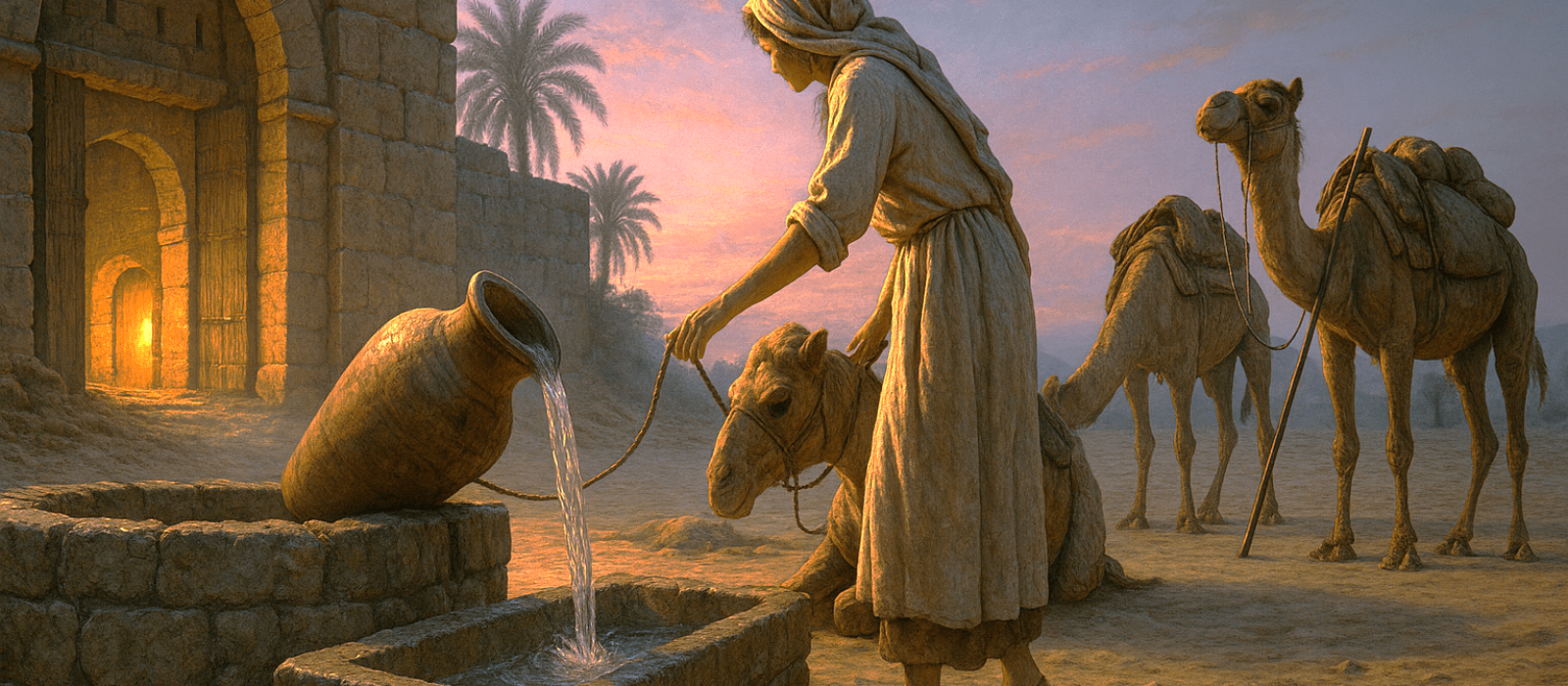
She took the jug from her head and walked to the well. She effortlessly tied the rope to her jug and dropped it. With a sploosh, the jug landed hard into the water. She then pulled hard with the strong enthusiasm that comes only with the young.
As she hoisted, she suddenly stopped—the rope taut and stressed. Looking up at Eliezer, she blurted, “Sir! Let me water your camels too!” Without waiting for a response, she continued hoisting the heavy-laden jar.
She knew well that she would have to drop and lift her jar at least another forty times before each camel, along with Eliezer, would have gotten their fill.
But she was strong and young and fast! She brought each camel, one at a time, from its kneeling position with its load to a standing position, leading each camel to the trough in turn. Four or five jars were needed to satiate each animal. She would then lead it back and have it once again kneel in its original position.
Eliezer watched all of this. He was amazed at her strength, how she managed all the animals, and, of course, her stunning beauty. She was like spring itself. As she finished the last of his camels, Eliezer asked, “Who are you?”
She looked up, wiping the dust-laden sweat mingling beautifully on her forehead. When she smiled, her teeth were like diamonds and her lips like ribbon. “I am Rebecca, the daughter of Bethuel, son of Milcah, the wife of Nahor, Abraham’s brother.”
Eliezer put his hand to his chest as his heart suddenly quickened. He paused to regain his breath, but he could not contain his joy. He took a gold nose ring and placed it in her nose, along with gold bracelets for her wrists.
Rebecca reached up with her hand, felt the gold ring in her nose, and watched the golden bracelets dancing around her wrists. It seemed far too extravagant a payment for watering camels.
Then Eliezer broke out in sing-song praise, “Blessed be ADONAI, God of my master Abraham, who has not abandoned His faithful love for my master; praise be Adonai, because He has guided me to the house of my master’s kinsmen.”
Rebecca smiled her diamond smile and said, “Well then, please, come meet my parents. We have plenty of room for you and your camels. You must stay with us! I will go get my uncle!”
Before Eliezer could say another word, Rebecca had disappeared.
☼ ☼ ☼
Moments later, Eliezer heard the water gate open again, and he saw a man approaching. The man introduced himself as Laban.
“Oh, you, whom Adonai has clearly blessed—welcome and welcome, my friend!” Laban spoke with a grand bow and gauche tone. He spoke with a grandeur that rang shallow to Eliezer’s ear. Laban continued, “Let me get your camels! Why are you standing out here in the cold? Come! Come! Stay with me and be my guest.”
With two quick claps of his hands, Laban signaled his servants to rush ahead to the camels. They started taking them toward Laban’s stables. Laban and Eliezer followed.
After liberating the gifts from the backs of the camels—the gifts that were brought as a dowry—Eliezer followed Laban into his house.
The family was busy preparing the evening meal in the main living space, which had a large table decorated with all the regional favorites. The smell was amazing. Eliezer’s stomach ached with hunger. They set him down at the head, next to Laban, as everyone else took their seats. A servant attempted to place a large, exquisitely filled plate in front of Eliezer.
But Eliezer’s hand shot out to block the server from placing the plate down. Eliezer spoke harshly, “Stop! I will not eat until I have said what I have come to say.”
The silence was awkward, as everyone turned to Eliezer in astonishment.
Eliezer continued, “I am the servant of Abraham. I have travelled from deep within Canaan to get here. I asked Adonai, the God of Abraham, to help me find a wife for Isaac, and He has chosen Rebecca.”
Laban nervously glanced at Rebecca, then back to Eliezer.
Eliezer recounted the story of his oath to Abraham, his travels, and his petition to Adonai. He told of Rebecca and how she impressed him when she watered his camels. Lastly, Eliezer spoke of the dowry Abraham had sent with him.
Laban’s attention noticeably perked up.
“So now,” Eliezer said in conclusion, “if you intend to show lovingkindness to my master, tell me. But if not, tell me, so that I can search elsewhere.”
Laban thought over what Eliezer was suggesting. Laban’s thoughts kept drifting back to the cases of gold sitting in his barn, calling to him. Realizing he was daydreaming, he looked back to Eliezer. Their eyes met.
Laban replied, “Since this comes from Adonai, who are we to say anything to you, either good or bad? Rebecca is here in front of you; take her and go. Let her be your master’s son’s wife, as Adonai has said. It’s all settled then!”
With that, Laban snapped his fingers and motioned for the servants to continue serving. Plates were placed before everyone, and they feasted and celebrated this new marriage arrangement late into the night. Eliezer brought in gifts for Rebecca and her family, and he spoke prayers of blessings and praise all through the night.
☼ ☼ ☼
The rooster crowed, but it was in vain. Eliezer had never slept so well as he did that night. It was as if a burden—a millstone hanging around his neck—was suddenly tossed away into the sea. It was the bustling of the household that ultimately caused Eliezer’s soul to return to the world of the living.
Eliezer stirred, and he was suddenly filled with enthusiasm as last night’s memories flooded his consciousness. This enthusiasm made Eliezer feel as if he were once again Rebecca’s age. But then he tried getting out of bed and was reminded of his actual age.
Collecting his things, Eliezer went into the main living space, where Rebecca and her family were gathering for breakfast.
The enthusiasm once flowing through Eliezer drained away as he watched everyone lazily chatting and eating. There were no noticeable preparations being made for their return trip.
“Eh-hem,” Eliezer said in a commanding voice. “I should like to be departing back to Canaan … shortly, that is.”
Rebecca’s mother smiled sweetly. “Oh, dear Eliezer, surely Rebecca could stay with us just a few more days. Maybe a week?”
Eliezer’s cheeks burned with fury. In a response betraying his true state, Eliezer boomed, “Please, don’t delay me now! Adonai has made my trip successful! I have an oath to fulfill. I must get back to my master! You understand?”
“Hmph,” Rebecca’s mother said, the thin veneer of her hospitality starting to splinter. “I know—let’s let the girl decide.” Turning to Rebecca, she asked sweetly, “Well, my dearest, what do you think? Will you go with this man?”
Once again, Eliezer fumed. Did they know no shame? How could they be ignorant of custom and tradition and law? They had already accepted the dowry! This young child, though not yet united with Isaac, was in fact his legal wife. It was not her decision to make.
Eliezer’s brow furled with a continuous betrayal of his consternation. Rebecca noticed. And to her credit, she felt the shame that her mother did not. She understood the politics. She knew what her mother was asking.
Rebecca did not answer her mother. Rather, she spoke directly to Eliezer, “Sir, I would be most willing to accompany you back to Canaan this very hour.”
Laban and Milcah showered Rebecca with praises and blessings. They finally sent Rebecca away with her maidservant and watched as Eliezer and their best water carrier disappeared over the horizon.
Used with permission by the author. Find the author’s complete works online: Complete Works of Mack Samuels