

2224 AM (1536 BCE) – THE FIRE
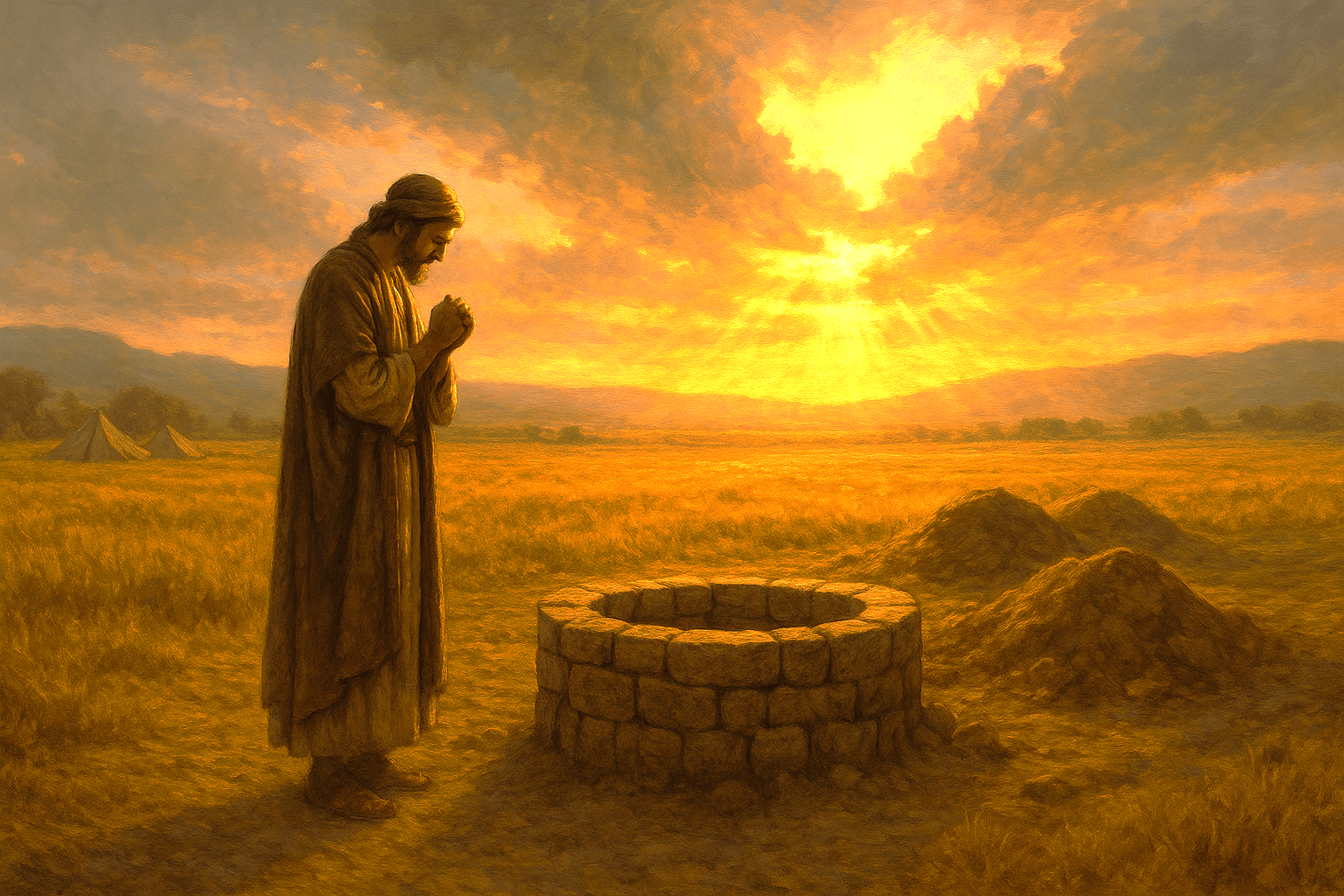
Abraham thought about his wife, Sarah, who he had just buried in the tomb at Machpelah, near Mamre, near where he met with Adonai. “Just buried?” Abraham mused to himself, realizing that a whole year had actually passed since Sarah had left him to rest with her ancestors. A whole year, and Abraham was still missing Sarah as if she had died the day before, missing what she brought to his life.
Where was the joy? The music? Festive evenings? Where were their friends and neighbors? Oh, what joy there was with Sarah! And her cooking! She was as beautiful as the day Abraham had married her, when he was that brash, young man, so many years ago, back in the land of Ur, the land of his ancestors.
Not so young now. So much had happened. So much had changed. He had more than just grown old … he was wiser, stronger, and all because of Sarah. Oh, how a wife makes or breaks a man! And now, Abraham felt completely broken.
Sarah was Abraham’s life companion on earth, along, of course, with Elohim in heaven (though sometimes also on earth). And while Abraham could still sense that Elohim was there, Sarah was completely gone … as was his reason for living.
Or was it?
And then something snapped in his mind. A feeling? A thought? An awareness. It became obvious to Abraham what must be done.
The canvas of Abraham’s tent door snapped open with a wild rustling, as the centenarian emerged with a new fire kindled in his eyes.
There would be music. There would be love. There would be the sound of laughter and children — the sounds of life.
Once again, Abraham was alive. Once again, a call to arms!
“A wife!” Abraham shouted, “Isaac … needs … a wife!”
☼ ☼ ☼
Eliezer of Damascus, the life-long friend and servant of Abraham, was startled awake in the early hours by the voice of Abraham’s shouting. He quickly dressed in his robe and sandals.
The desert cold of dawn bit harshly, as Eliezer left his tent to tend to whatever his master required. Abraham was already standing at the meeting place, very still, watching as several servants tended to a small fire that would soon be a warming blaze. Well-worn wrinkles cut deep into Abraham’s dark and weathered face, as the lights of the fire danced on his rocky expression, his thoughts ablaze with possibilities.
Eliezer took in the whole scene, as he briskly approached. He glanced humbly, yet expectantly, at Abraham, waiting for his instruction.
“Ahh, Eliezer,” Abraham said with a welcoming gesture, “I need you to do something for me. I need you to return to the land of Ur, to my family, and find a wife for my son Isaac. As you know, I cannot go. I cannot leave this land that Adonai has promised me. You, Eliezer, my friend, you must go for me. You must go and find me a wife … for my son! Now, swear an oath that you will do this for me!”
Eliezer was stunned. He opened his mouth to speak and then closed it. The morning fog clouded his sensibilities. Were there no suitable women in the surrounding lands? Did he have to travel such a vast distance? For a wife? For Isaac?
“My master,” Eliezer started, “What if I do this, and I find someone, but she is unwilling to return such a great distance? Should I take your son back to be with her?”
Abraham’s stony expression finally broke into a firm and dispassionate plea, “No, Eliezer, No.”
Eliezer flushed as Abraham’s eyes contemplated him. After so many years, how could Eliezer not understand? How could he not know Adonai’s promises and his expectations for the Hebrews?
With a castigating sigh, Abraham finally responded, “Eliezer, see to it that you don’t ever return my son to the land of Ur. Adonai, the God of heaven, who took me from my father’s house and from my home and my people and my land, said that he will give this land to my descendants. Do not take Isaac back. If it happens, as unlikely as it is, that she will not come back, then I will release you from this oath.”
Eliezer signaled his understanding with a bow and a quick nod. Abraham lifted the edge of his robe. With a shaking hand placed on Abraham’s thigh, Eliezer swore his oath.
☼ ☼ ☼
The weight of Eliezer’s task weighed heavy on his shoulders. He was more than anxious. His very life hung in the balance, for to fail would mean to break an oath, and to break an oath would mean certain death.
Eliezer’s anxiety overwhelmed his senses. He desperately tried to load enough camels for the trip that would be weeks in duration. How many camels did he already have? Ten? And there was still so much they had yet to load.
Eliezer began to weep.
The task was more than just one man could possibly do. He was a household slave, not a warrior. Who would protect him from robbers and thieves, the murderers and all the other wicked people who watch the roads to plunder a caravan of goods?
Eliezer continued his weeping, slowly falling to his knees, in desperation, surmising his fate, finally landing with his face in the dust. “Oh, Adonai!” he called to the Creator of the heavens and the earth, “God of my master, Abraham, please, give me success!”
Eliezer prayed and lamented, pleaded and extolled, until finally he rose to his feet, dusted himself off, and departed for the land of Ur.
Used with permission by the author. Find the author’s complete works online: Complete Works of Mack Samuels