
5717 AM (1957 CE)– SUEZ CRISIS
It was around 3 AM in Peki’im, when the phone rang in the house of David and his father Yitzak. David shot up in bed. Quickly whipping the covers back, he ran to the kitchen. Picking up the receiver, he answered hastily, “Captain Halevi.”
Rivkah walked in, already dressed for her work as a nurse in a medical unit working out of the IDF base in Safed. She heard an indistinct voice murmuring through the phone’s receiver. Moments later, David spoke quickly, “Understood,” as he hung the receiver and looked at Rivkah. “We are being called in,” he said anxiously, “…now.”
Rivkah nodded. “OK. I’ll let Mom and Dad know.”
David left the kitchen to get dressed and packed his gear for what could be a few days or a few weeks. Rivkah went into her in-laws’ bedroom. She knocked gently and opened the door slightly and stuck her head in. “Yitzak? Rivkah? We have to go.”
Yitzak was already awake from the phone ringing. After all, this had been the norm for months now. “Alright,” Yitzak answered, “we’ll get the kids to school. You two drive safely.”
Rivkah smiled and closed the door. She went to the children’s bedroom. It was more a dormitory than a bedroom, with beds for each of her three children all crammed in such a tiny space. She leaned over her four-year-old Shimon and kissed him. She then repeated the maneuver for Leah, her very own six-year-old version of Queen Hadassah.
“You have to leave?” a voice said behind Rivkah. It was Ezra, her oldest child at only eight years old.
“Yes,” she responded, as she turned to him and kissed him as well. “But we will be back, Hashem willing. Now go back to sleep,” she said, as she coaxed her eldest back under the covers.
☼ ☼ ☼
Quietly leaving their room, she joined David in the living room. She grabbed the keys and went out to start their 1948 Peugeot D4B van. It was the biggest thing David had been able to find that would fit all seven of them. Rivkah called it the family tank. However, today, it was just the two of them.
David threw his gear in the back as Rivkah turned the motor over. The starter struggled with a sickening wuv-wuv-wuv sound. After several attempts, the engine finally sputtered to life as David closed the rear door and jumped into the passenger seat. She put it into gear, and they headed out.
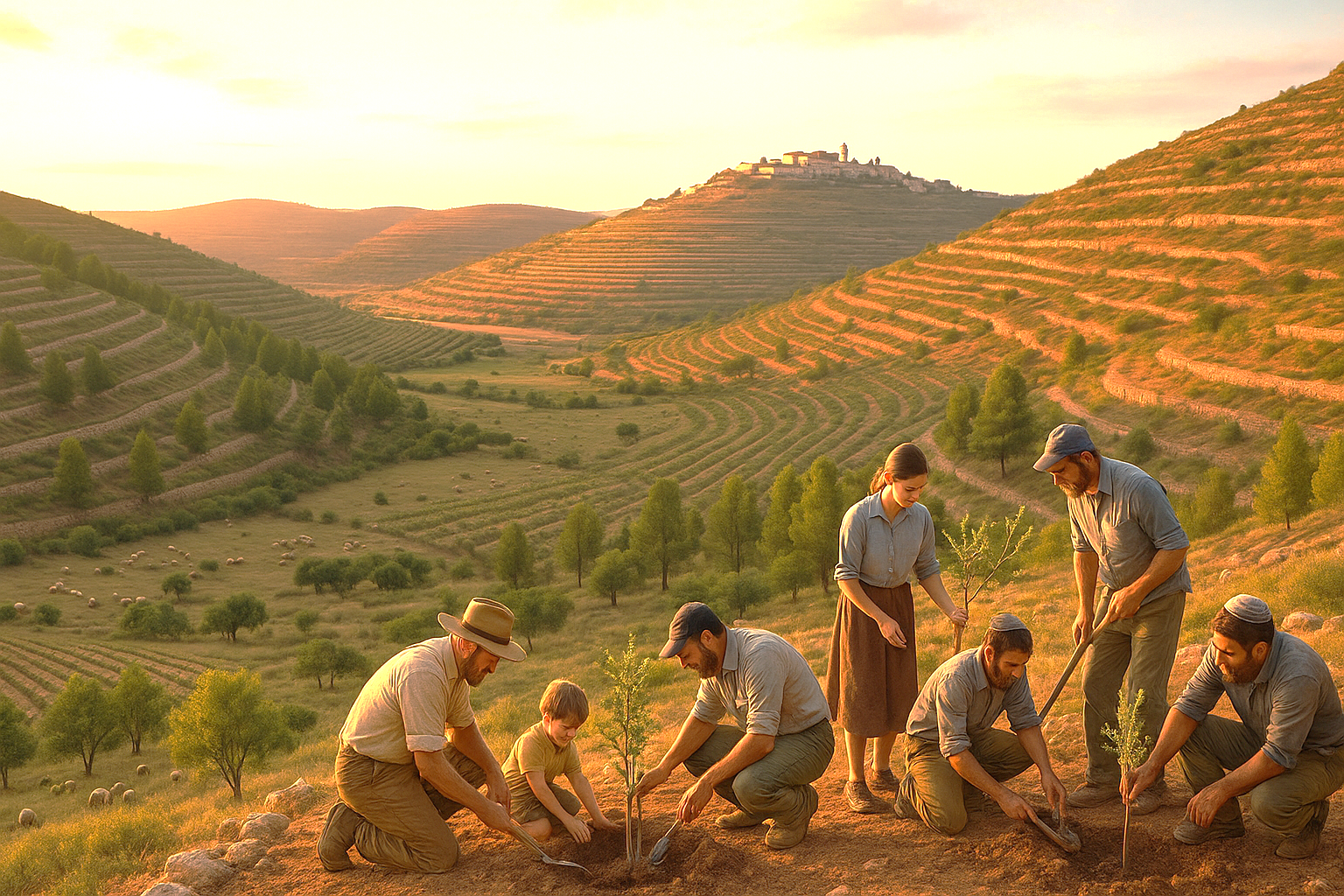
For years they had enjoyed working in Safed. David had made captain so quickly and now commanded his own company of tanks. Soon after they married, they had built a couple of rooms onto Yitzak’s house for them and the children, as was the tradition of Peki’in as far back as anyone remembered. The time they spent commuting the fifty minutes to Safed allowed them to talk and grow close.
But now, all they felt was anxious, dire anticipation. Ever since Egypt’s president Gamal Abdel Nasser’s nationalization of the Suez Canal, there had been increased Fedayeen attacks on Israeli civilians, not to mention the numerous reports of the Egyptian military buildup on the border, causing no shortage of unease within the IDF.
The Peugeot pulled up to the gate. The guards recognized Rivkah and David and saluted David as they waved him through. Rivkah knew exactly where David needed to be, dropped him off, and then headed to the medical unit to prepare for the worst.
☼ ☼ ☼
Major Eitan Shamir, the battalion commander overseeing all the tank companies, waited expectantly for his company commanders to join him. This, of course, included David, but David’s “brother” Nadir Haddad as well (though few ever asked why they had different last names).
Another captain was Captain Yonatan Ashkenazi, a man of such extreme discipline that Nadir would often quip, calling it “methodical caution.” Yonatan kept his distance from Nadir and David, as he saw them as risk takers, overly zealous and too daring. The three would often exchange heated words, but it never came to blows. They were all very young for captains, but they knew who the real enemy was.
Captain Elior Tzur, on the other hand, was quite a bit older than the whole lot of them. Elior was the peacemaker. He would smooth the tension in the battalion, often talking sense into David and Nadir, and Major Shamir appreciated it. Elior was the glue.
The four captains sat in the briefing room as most of their men hung out just outside waiting for orders. All four captains perked up when, from outside the briefing room, the Major’s adjutant announced, “Amod Da! HaMeFaQed BaCheder, Rav-Seren Eitan Shamir!” (that is: “Attention! The commander is in the room, Major Eitan Shamir.”). The bustling outside immediately died down to the extent that boots could be heard walking across the concrete floor. Suddenly the door to the briefing room opened and all four captains instantly stood at attention, holding their salutes. As the Major walked in, he walked around the table and stood at its head.
“At ease,” he said finally, and the captains sat down. Shamir took a slow breath, his eyes scanning the room. The weight of the moment was palpable. He wasn’t here to give them a history lesson – these men were seasoned warriors – but they needed to understand why they were called in, in the dead of night.
“Gentlemen, this is it. We’ve been preparing for months, but the waiting is over. Orders just came down from Tel Aviv – we are moving south.” He paused to let the words sink in.
Shamir placed a map of the Sinai Peninsula on the table, unfurling it with deliberate precision. The main Egyptian defensive positions were circled in red. His finger traced a line from Israel’s southern border to the heart of the Sinai.
“As you know, Egyptian forces are on full alert. The Soviet-backed buildup we’ve been monitoring along the Gaza Strip and Sinai is not just for show. Our intelligence confirms that Nasser has moved his best armored units – including Soviet-supplied T-34s and SU-100 tank destroyers – closer to the Mitla and Gidi passes.” His tone darkened. “And they are not just waiting defensively. If we sit idle, we invite war on their terms. Israel is not going to allow that to be an option for any of them. That is why, as of 1900 hours last night, Israeli ground forces engaged the Egyptians. We’ve had engagements all night. The first wave made their push just before sundown. They met heavier resistance than expected at Rafah and Abu Ageila. We’re moving out before sunrise to reinforce and finish the job. Our mission is to reinforce the battle already in motion.”
His finger stabbed at the map, tracing the route south from Be’er Sheva toward the Sinai. “The Egyptians have dug in at Abu Ageila and Rafah. The leading elements of our forces are pushing through, but we’re already taking losses – reports indicate at least a dozen tanks knocked out near Rafah. Some of our boys are cut off. We need to get there before they’re overrun. We’re bringing in more armor support to prevent them from digging in any further and to replace losses. We are needed. We do not stop moving. We do not hesitate. We hit them fast, and we hit them hard.”
He pointed to Captain Yonatan Ashkenazi.
“Yonatan, your company is spearheading the advance. You push forward, clear any roadblocks, and keep the momentum up. If you slow down, we’re finished.”
Yonatan gave a quick, no-nonsense nod. “Understood, sir.”
“Elior, you’re running flank cover for Yonatan. If they try to ambush the column or cut us off, it’s your job to eliminate the threat. Keep your eyes open – this will be anything but clean.”
Elior’s jaw tightened, his hands gripping the edge of the table. “We’ll handle it.”
Shamir turned to David and Nadir Haddad.
“David, Nadir – you’re covering our western flank. The Egyptians have armor near Kusseima, and they’re looking for an opening. If they punch through, our supply lines are gone. That does not happen. Do you understand me?”
Nadir flashed a half-smirk, but his eyes were deadly serious. “We’ll hold them off, sir.”
David nodded gravely. “We won’t let them flank us, sir.”
Shamir’s tone hardened. “You all know what’s at stake. The Egyptians are fighting like hell, and they are throwing everything they have at us. If we lose momentum now, we risk turning this into a prolonged fight. We do not have that luxury.”
His eyes met each of his captains in turn.
“Your orders are simple: Drive… fast. Kill anything in your way. And get our men through safely.”
The Major took a final glance around the table. “No hesitation. No half-measures. Mount up and move out.”
A moment of silence followed – then, in one voice, the captains snapped to attention, “Yes, sir!”
☼ ☼ ☼
Rivkah was stacking and organizing mountains of medical supplies. She toiled alongside numerous other nurses, preparing and stocking trucks to leave. They had been briefed on the situation, but she could not think about the implications. She was hardly in a unique position; many of her colleagues were also married to, or were girlfriends of, many of the men on that base.
The deep, heavy sounds of dozens of diesel engines caused the pace of the work to slacken. The earth began quaking as these machines of war began moving off, passing the supply depot in which they were working. Many peeked out the bay door as a mixture of M3 and M5 Stuarts, M4 Shermans, and the French AMX-13 came rumbling by.
The sergeant major, their boss, had also stopped working and was gawking at the tanks passing. As they passed, she realized the work had stopped. “Back to it, ladies. Sounds like they are going to need this ASAP!”
☼ ☼ ☼
The roar of the tanks was deafening, even with state-of-the-art radio headsets. Columns of armor thundered out of Safed, rolling down the highways in an unrelenting march. The desert heat baked the metal plating of their vehicles, filling the interiors with an oppressive heat. The scent of oil, dust, and sweat thickened with each passing mile.
David Halevi adjusted his periscope, his hands slick from sweat despite the cool morning air. The roads blurred past, each passing mile bringing them closer to the battlefield.
The column made its first stop in Be’er Sheva, six hours into the journey. The crews climbed from their tanks, their faces weary, their uniforms stained with grease and dust. They had three hours to eat, refuel, and regroup.
David and Nadir sat near one of the supply trucks, ration kits in hand. Nadir grinned, lifting his canteen.
“Remind me why we didn’t sign up for the Air Force?” he quipped.
David smirked, taking a sip from his own canteen. “Because you have to be this short before they will let you fly,” he quipped, holding his hand at Nadir’s chest.
Nadir feigned offense, wiping the grime from his forehead. Despite the levity, the tension was real. Every man there knew what lay ahead. The Egyptian army was waiting for them.
☼ ☼ ☼
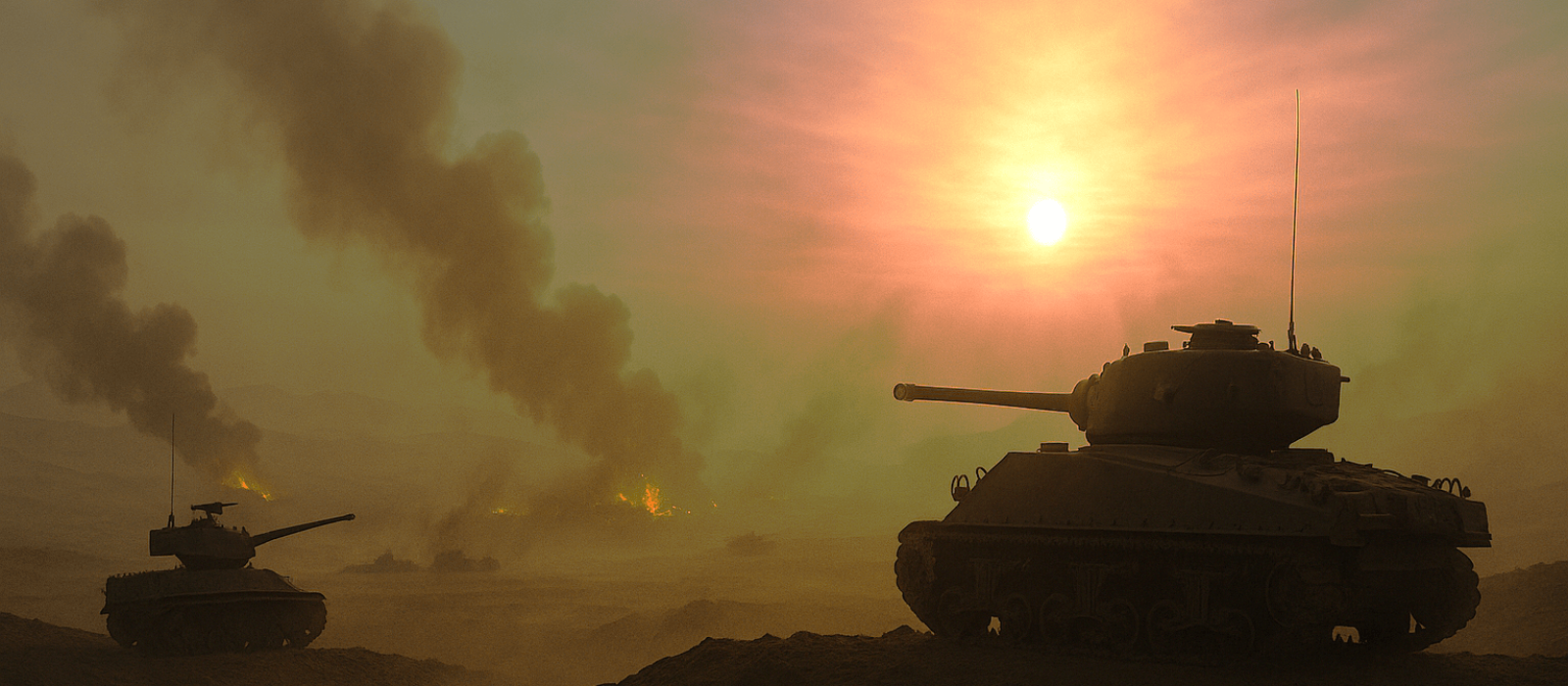
They arrived at Kusseima just before dawn. The desert stretched endlessly before them, an ocean of golden sand and jagged rock. In the distance, dark plumes of smoke curled into the sky, marking where the first clashes had already begun.
David switched on his radio, scanning the horizon. “Nadir, report.”
A burst of static crackled before Nadir’s voice came through, calm but clipped: “Scouts confirm enemy armor west of Kusseima – T-34s, SU-100s, heavy infantry presence. Dug in tight.”
David exhaled. “It was never going to be easy.”
Over the radio, Major Eitan Shamir’s voice cut through the static. “Tank Battalion 4, listen up. The Egyptians are dug in at Kusseima with armor and entrenched infantry. Our job is to break them. Ashkenazi’s company will take them head-on. Tzur’s unit will push from the north. David, Nadir – you’re flanking from the west. Take out their anti-tank emplacements and force them into a crossfire. Hold your flank at all costs. Israel is not going to allow that to be an option for any of them. That is why, as of 1900 hours last night, Israeli ground forces engaged the Egyptians. We’ve had engagements all night. The first wave made their push just before sundown. They met heavier resistance than expected at Rafah and Abu Ageila. We’re moving out before sunrise to reinforce and finish the job. Our mission is to reinforce the battle already in motion.”
“Understood, sir,” David replied, gripping the edge of the hatch. He turned to his gunner, Sergeant Ben-Ami, whose hands flexed over the targeting controls.
“We’re moving in,” David said.
The first Israeli tanks fired, and the battlefield erupted into fire and twisted steel.
Egyptian artillery roared, sending explosions rippling through the sand. Flames consumed the first Israeli tank to take a direct hit, its turret flipping end over end. Machine-gun fire rattled against the armored plating as Israeli tanks rolled forward.
David’s Sherman, Ezra’s Vengeance, moved in with Nadir’s AMX-13s darting ahead, their smaller frames weaving between the dunes.
“Infantry, on the ridge!” Nadir called.
David swung the turret. Egyptian soldiers crouched behind sandbags, setting up recoilless rifles.
“Fire!”
Sergeant Ben-Ami let loose a round. The explosion ripped the ridge apart, sending bodies and boulders tumbling down the hillside.
Almost immediately, T-34s emerged from the haze, their cannons flashing. One Israeli tank exploded, sending flames licking into the sky. Another took a hit to its tracks, grinding to a halt.
“Pivot left!” David ordered.
His tank fired twice – both shells striking home, turning an Egyptian T-34 into burning wreckage. But the Egyptians weren’t deterred. They regrouped to begin a counter-offensive.
A deafening rumble echoed across the dunes as a second armored column emerged – a coordinated push of T-34s, SU-100 tank destroyers, and infantry half-tracks advancing in perfect formation. The low, guttural growl of diesel engines filled the air, growing louder with each passing second.
From David’s vantage point, the desert seemed to ripple like a living thing, the sun glinting off the incoming armor. Through the periscope, he could see the black-and-white markings of the Egyptian 4th Armored Division leading the charge.
“They’re not pulling back!” Nadir’s voice crackled over the radio. “They’re counterattacking – full force!”
David tightened his grip on the controls. “Of course they are,” he whispered to himself.
The Egyptians had no intention of yielding Kusseima without a fight. The dust kicked up by their advancing armor swirled into a storm, obscuring the battlefield in a golden haze. Artillery shells streaked overhead, their shrill whistles piercing the air before exploding in more bursts of fire and steel.
“Enemy tanks closing in! 600 meters and closing fast!” one of the tank commanders reported.
“All units, brace!” David ordered, his pulse hammering in his ears.
A T-34’s main cannon flashed, and an Israeli Sherman exploded in a ball of fire – its ammunition cooking off in a sickening chain reaction. The force of the blast sent a turret flipping end over end before crashing into the sand like a fallen meteor.
“Damn it!” David cursed, watching another of their tanks get disabled, smoke billowing from its hatches.
“Hold formation!”
The Israeli gunners returned fire.
Ben-Ami adjusted his sights. The gun recoiled violently as Ezra’s Vengeance fired a shell straight into the lead T-34. The round pierced through the front armor, detonating inside the crew compartment. The enemy tank lurched forward, caught fire, then stopped dead.
But the Egyptians kept coming.
Two SU-100s crested the ridge, their long-barreled cannons aiming directly at David’s position.
“Tank destroyers, two o’clock!” Nadir called out.
David’s gut twisted. The SU-100s were designed to obliterate armor at long range – one good hit, and his entire tank would be a smoldering wreck.
“Ben-Ami, now!” David barked.
The gunner fired first, but the shot glanced off the front plate of the SU-100, sending sparks into the air.
The Egyptian gun fired a fraction of a second later.
David barely had time to react before a shell slammed into the sand just meters away, sending a massive shockwave through the hull. The tank rocked violently, and for a moment, David’s world blurred into chaos.
His ears rang with a piercing whine, and his vision swam from the impact.
“Status?!” David shouted.
Ben-Ami shook his head, dazed. “Missed us by a hair, but they’re reloading!”
“Not for long,” David growled.
He switched to his radio. “Nadir, suppress those SU-100s! We need time to reposition!”
From the right, Nadir’s AMX-13s darted forward, weaving between cover as they loosed shells toward the enemy tank destroyers. Their smaller cannons lacked the raw power of the Shermans, but they were fast and relentless – a pack of wolves harassing a lumbering beast.
One of Nadir’s rounds struck an exposed ammunition crate near the SU-100, igniting it in a massive fireball.
The first enemy tank destroyer went up in flames.
The second, realizing its vulnerability, reversed down the ridge.
☼ ☼ ☼
As the night fell, the battle never truly stopped. Tracer rounds lit up the dark sky, and the rhythmic pounding of artillery filled the silence. David hadn’t slept in over 30 hours. He leaned against the inside of the turret, rubbing his eyes.
“How much fuel do we have left?” he asked.
“Enough for another push,” his driver, Corporal Shai, responded.
David sighed. “Then that’s what we’ll do.”
Over the radio, Major Shamir’s voice rang through.
“New orders. An Egyptian armored column is pushing in from the southwest – tanks, infantry, and half-tracks. If they break through, they cut off our division. You stop them here, or we all die in the desert. Understood?”
“Yes, sir!”
Dawn broke with thunderous cannon fire. The Egyptian T-34s charged in formation, flanked by infantry carriers. Machine-gun fire rattled from the rooftops of ruined structures, bullets pinging off Israeli armor.
“Hold your ground!” David yelled into the radio.
The first Israeli shots rang out.
A T-34 took a direct hit, its turret exploding. Another was struck in the treads, grinding to a halt as its crew bailed out.
David’s tank fired. The shell pierced an Egyptian fuel truck. The resulting explosion engulfed two more enemy vehicles in flames.
With the armor clash momentarily stalled, Egyptian half-tracks lurched forward, unloading waves of infantry with RPGs and machine guns.
David spotted the first wave scrambling through the dunes.
“Infantry incoming! 100 meters!”
Flashes of gunfire erupted from the ridge. Bullets pattered off the Shermans’ thick plating, ricocheting with metallic pings.
An RPG streaked toward them.
BOOM!
The explosion sent sand blasting into the air, the force rattling the tank.
“They’re trying to get close!” Ben-Ami called out.
“They won’t get the chance.”
David switched to coaxial machine guns. The Sherman’s .30-caliber opened up, sending a stream of rounds into the advancing Egyptian infantry. The first ranks dropped. The rest dove for cover, firing from behind the dunes and rocks. From the other side, Nadir’s AMX-13s maneuvered fast, cutting off the enemy advance. The infantry had no choice but to retreat – leaving behind wrecked vehicles and fallen comrades.
David swung his periscope. Nadir’s AMX-13 had taken a direct hit. The light tank lay in flames, smoke curling from its hatches.
“Nadir, report!”
Silence.
David gritted his teeth. “All tanks, push forward!”
The Israeli armor surged ahead, pressing the counterattack.
One last Egyptian T-34 turned its turret toward David’s tank.
Time froze.
But it was David’s gunner who fired first.
The round pierced the T-34’s hull, igniting its ammunition.
The enemy was in full retreat.
David wiped the sweat from his brow, the adrenaline still pounding in his veins.
Over the radio, Major Shamir’s voice broke through.
“Enemy reinforcements are thinning out. This is our chance! We press forward!”
David exhaled, his pulse still racing.
“Understood, sir.”
He turned to Nadir’s channel.
“Still alive over there?”
Silence.
Then static.
Then Nadir’s voice – weaker than it should be. “Yeah… but my tank isn’t.”
David’s heart dropped. “What happened?!”
Through the smoke and wreckage, David could still see Nadir’s AMX-13 burning. David didn’t think. He acted. “I’m coming!”
David jumped from his tank, dodging pockets of smoldering wreckage. Nadir was pinned inside. Smoke poured from the hatches, and the rest of his crew was dead.
“Come on, brother, we have to go!” David yelled, hauling him up.
Nadir winced, blood trailing from a gash in his forehead. Together, they staggered away from the burning wreckage. Suddenly, a secondary explosion erupted, sending debris and the staggering brothers flying.
They landed on their faces and covered their heads as shards of metal and flames landed all around them. Collapsed in the sand and panting, Nadir muttered, “I really… hate… tanks.”
David laughed weakly, his chest still heaving. “Yeah? Well, they seem to hate you too.”
☼ ☼ ☼
The morning sun had fully risen over the battlefield by the time the last Egyptian forces withdrew. Smoke still hung low over the desert, swirling in the wind, carrying the acrid stench of burning metal and diesel fuel. Bodies – both Israeli and Egyptian – were scattered across the dunes, silent witnesses to the carnage that had unfolded over the past two days.
David leaned against the side of his Sherman, the heat from the armor seeping through his uniform. His hands trembled slightly as he lit a cigarette, his eyes were locked on the smoldering wreckage of Nadir’s AMX-13 in the distance. The light tanks had proven their worth, but they weren’t made to take a direct hit.
A medic crouched over Nadir, checking his pulse. The Druze captain was conscious but weak, his bandaged forehead already crusted with dried blood.
“Captain Haddad is stable, but he needs immediate evacuation,” the medic reported.
David nodded, taking a final drag from his cigarette before crushing it under his boot. He crouched next to Nadir.
“Well, brother, you got your wish – no more tanks for a while.”
Nadir groaned, barely cracking a smile. “Yeah… tell that to the next poor bastard who has to drive one.”
Nadir, half-conscious on the stretcher, turned his head and smirked. “Well, that was fun. Let’s never do it again.”
The medics carried Nadir toward the field ambulance, his stretcher bouncing slightly over the uneven ground. David followed them a few steps before stopping. Nadir was leaving the field, but David was not.
David chuckled dryly, watching as the field ambulance kicked up a trail of dust, taking his friend out of the war.
Major Shamir’s voice crackled over the radio strapped to David’s chest. “Halevi, report.”
David straightened instinctively. “Haddad is being evacuated, sir. His company’s command structure is shot.”
“I see. OK. Effective immediately, you’re in charge of what’s left of his tanks. Keep your flank secure.”
David exhaled, rubbing his face. “Understood, sir.”
☼ ☼ ☼
For the next two days, David’s exhausted men held their ground. The battlefield had moved past them, Israeli forces pushing deeper into the Sinai. The sounds of distant artillery still rumbled like an approaching storm, but the front had shifted southward, away from Kusseima.
David’s remaining tanks dug into defensive positions, preparing for a possible counterattack that never came. Egyptian forces had been decimated, their command structure fractured. Still, the war wasn’t over until it was officially over.
The men barely slept. They rotated in shifts, keeping their guns trained on the horizon, scanning for movement. By the morning of November 6th, the radio finally brought news of a different kind.
“All units, stand by. Command has issued a ceasefire order. I repeat, all units, stand by. Command has issued a ceasefire order. Prepare to withdraw to the nearest Israeli border.”
A murmur of disbelief rippled through the men.
David lowered his radio, rubbing his temple. What the hell is this? They had fought, bled, lost brothers in the sand, and now – just like that – they were pulling out?
There was no cheering, no triumphant declarations of victory. Just a long, exhausted silence. David’s convoy rolled back into Safed under a pale afternoon sky. The same base they had left in a storm of urgency now seemed strangely quiet, detached from the war they had just fought.
They all climbed out of their tanks and began securing their vehicles. David’s muscles were stiff from days of battle. As soon as he completed his tasks, he took his leave to check in on Nadir.
The hospital was bustling. David was met with the familiar scent of antiseptic and the distant hum of medical equipment. Wounded were everywhere, their bodies wrapped in bandages, their eyes hollow from what they had seen.
He knew where to go. David entered the infirmary, scanning the rows of cots. He spotted Nadir lying on his side, a thick wrap around his head, his arm in a sling.
And sitting beside him – her hair tucked into a white nurse’s scarf, her sleeves rolled up – was Rivkah.
David let out a breath he didn’t realize he had been holding.
Rivkah turned at the sound of his boots on the tile. For a moment, her face betrayed no emotion – then her eyes softened, and she quickly crossed the room, wrapping her arms around him.
“Welcome home, soldier,” she murmured against his chest.
David rested his chin on her head, inhaling the faint smell of soap and linen. He had long forgotten what clean smelled like.
“I hear you stole my tanks,” Nadir called out weakly from the cot.
David chuckled, pulling back from Rivkah and settling into the chair beside his brother-in-arms.
“Only borrowed them, really. Turns out, you left them in terrible shape. You are welcome to have them back.”
Nadir smirked, wincing slightly as he adjusted his position. “That’s what happens when you actually use them as directed.”
For a while, the three of them sat in comfortable silence. Then Rivkah broke it. “So, was it worth it?” she asked quietly.
David looked at her, surprised, and then at Nadir. Neither answered right away. David ran a hand over his face, exhaling. The war had been quick, decisive – but was it just? What was the point? They had fought to protect Israel from another war. They had fought against an enemy that had blockaded them, provoked them, threatened them. And yet, what had changed? How much time did they buy themselves before the next war? A few years? A decade? Was it really just the beginning of the next war, rather than the end of this one?
Finally, Nadir spoke. “It doesn’t matter if it was worth it. We did what had to be done. And we will do it again, if we must. The alternative is unacceptable. You understand?”
David nodded slowly, not entirely convinced. “Yes, Nadir, I do, and we will. I just…” David looked at Nadir and then at Rivkah, tears forcing their way through his tired eyes. “I just want to live.”
Used with permission by the author. Find the author’s complete works online: Complete Works of Mack Samuels