
Scripture References: 1 Samuel 18–20; Psalm 122:6
5708 AM (1948 CE) – WAR OF INDEPENDENCE
“You are no Jethro!” Nadir said to David in jest.
“How do you mean?” David retorted, slightly annoyed at his Druze friend.
“Well, I mean, Jethro never embarrassed himself in front of the whole classroom. Certainly not in front of our headmaster, Mr. Thackery! Your garden has tomatoes that are less red than Mr. Thackery’s face was! I don’t know how you do it! After everything the British have done since the Balfour Declaration, you tell Thackery that if Mark Twain said the land was so empty that the British should let in all the Jews fleeing the Nazis? The Nazis? Really, David?”
David loved his good friend Nadir, though maybe not at this exact second. They had known each other as long as they had known life. But Nadir could be quite contemptuous, when he wanted, and he always seemed to know where David’s goat was tied. David peered down the long dirt path that led from the British-mandated primary school they attended to their tight-knit community.
David just sighed, attempting to defend himself. “Mark Twain said it was barren, not empty. There is a difference. Nadir! He meant it needs people to rebuild it. So why won’t the British let my people in? Isn’t that what the Balfour Declaration promised? Have you even read Mark Twain?”
“Naw,” Nadir smirked. “I don’t have to. I just need to know what Mr. Thackery tells me about it. I am sure the test will not ask about whether there was ‘No People’ or not. I mean, really, David! What do you call us? Our community? What, did Mark Twain just snap his fingers and, poof, no people?” Nadir looked around comically, their path being basically rocks and dirt and not much else. “Well, I mean, it’s possible, I guess. Maybe you could write our good friend Twain and ask him why the British keep sending ships full of Jews away, if the land’s just sitting here waiting for them. I mean, my Ummi could use the help with dinner!”
“You know what?” David interrupted sternly. “Twain wrote about how neglected the land was, and how it seemed like it was just waiting for people to come back and rebuild it.”
“And you are not people? I am not people? Our families are not people?” Nadir jested further. But then he stopped and looked at David. “Or do you mean it waits only for the Jews to return?”
“Nadir! That’s not fair! You know what I mean. Don’t twist my words. My family has lived here since the fall of the second temple. All the way back to my great, great, great grandfather, Ezra ben Benaya, has my family been trying to rebuild. And while we thought the Romans and Christians were bad, we suffered as dhimmis at the hands of the many Caliphates from Baghdad to Damascus to Cairo. And then the Turks took their turn killing most of our men and half our population, as did the Crusaders. The Mamluks and Ottomans … I mean, thank Hashem for the British. They are not ideal, but they are not killing us indiscriminately … I mean, not directly. Anyway, I am just so tired of it all.”
“David, David! You speak as if I don’t know history! The Druze are not very welcome either, as you well know. My family has seen as much horror as yours … well, almost.”
“But, Nadir, the whole world has turned against us! Since the fall of the first temple, Jews have always been killed everywhere for what reasons? No one can say, outside of readily disprovable blood libels.”
“I know,” Nadir began gently. “The Druze do not have many places to go, nor many friends. And the Islamists certainly do not like us, even though Muhammad is our prophet as well.”
“And so are Jethro and Moses and Isa and Ali ibn Abi Talib,” David smirked, the tension of the mood instantly dissolving into lightheartedness.
“Fair. I suppose,” Nadir smiled. “I guess there are just those who have a purist ideal of how things should be. Remember that Jethro didn’t help Moses claim the land of Palestine by holding up his hands and blurting out, ‘This is mine!’ He led Moses to see the bigger picture. Maybe it’s time for you – and the British – to see the bigger picture as well. The land isn’t waiting for just one people. It’s all of us trying to survive. Together.”
As Nadir spoke, they crested the last hill. It would be a downward slope all the way back to their community. Nadir kicked a rock, and it bounced a ways ahead of them.
“Well, look at you, Nadir, a friend and a philosopher!” David answered Nadir. “What else does this philosopher know?”
Nadir smiled wickedly at David. “I know you will be late for Shabbat. I also know I will beat you home!”
With that, Nadir began sprinting down the hill toward home, with David right on his heels.
☼ ☼ ☼
David grasped the door handle of his modest home and froze. Completely out of breath, he tried desperately to compose himself and his breathing. Such hijinks was not smiled upon in his very conservatively Jewish home. Besides, it was nearly Shabbat, a time for reverence. Finally, after some moments, David entered. He was immediately accosted with the sweet smell of Challah. His Imma was busy in the kitchen, and the static voices echoing from the radio told him where his Abba was.
The sounds of stodgy British voices came crackling to life, “…while the United Nations continues debating the UN Partition Plan, Resolution 181, which proposes dividing Palestine into Jewish and Arab states, with Jerusalem under international control. Intense lobbying by Zionist leaders Chaim Weizmann and David Ben-Gurion is attempting to secure support from the two key nations: the U.S. and the Soviet Union. Meanwhile, Haj Amin al-Husseini, the Grand Mufti of Jerusalem, told the BBC, ‘This plan to partition our land is not only an affront to the rights of the Arab inhabitants of Palestine, who constitute the overwhelming majority, but also a grave injustice that disregards our historical and cultural bonds to this land. The Jews are so few and therefore have no claim to any part of Palestine! Therefore, we reject this UN proposal outright, as it seeks to impose a foreign entity upon our soil and disrupt the fabric of our lives and our heritage. We call upon all nations valuing justice and self-determination to stand with us in opposition. We will never accept the partition of our homeland, nor the creation of a state based on dispossession and inequality.’”
“Yitzhak Halevi! Turn that off. It’s Shabbat!” Ravkah said, as she set the Shabbat candles next to the Challah, which was already on the table.
With a click, Abba complied with Imma’s wishes. David had sat with his father and had been listening intently, but the sudden absence of sound caused him to look at his father, whose face had a look of a man who had much on his mind.
Turning to David, Yitzhak almost blurted, “So the Arabs say we are few, and therefore, we have no claim to the land. Yet, why are we few? Is it for lack of children? Lack of babies? Or because they killed all our children, killed all our babies? Israel’s population would be in the tens of millions today, if not for constantly being murdered by the Christians and the Muslims and the British.”
That last remark was seething in bitterness. David’s face flushed with the knowledge of exactly what his father meant. Was that not the discussion that David and Nadir had just earlier? Was that not the discussion that most people had nearly all day, every day?
Anger welled in David. “And what about the violence in the streets of Jerusalem? The bombings? The retaliation? The escalation? The nations have never been kind to us. Why would they suddenly give us a home now? They would sooner throw us into the Mediterranean!”
David’s father looked up in surprise. “Indeed.”
Packing his pipe with tobacco, he struck a match and took several long puffs.
David continued, “The Arabs are not going to let the resolution stand, even if it does pass. They will start a war. And what are we? You said it yourself. We are so few.”
Yitzhak eyed his boy, who was clearly growing up into a man, and a thoughtful one at that. “If they start a war, then we will finish it. Otherwise, well, we will have to see. Besides, isn’t it in the Messiah’s hands? Isn’t it his job to deliver to us this land flowing with milk and honey? Is it really for us to take back Israel by force?”
This, too, was a common point of contention spoken about by many believing, faithful Jews. Then Abba raised his hands. “Besides, look at me. I am old and frail,” he acknowledged.
“And you smoke too much,” Ravkah added. “Besides, if Hashem wills it, the nations will act. We must have faith, Yitzhak. Now come, it’s time for candles.”
☼ ☼ ☼
The light of the sun pierced the small space between the curtains, illuminating the fine dust that always hung in the air. Yitzhak sat at one end of the small, wooden table. David sat to his left, with Miriam, the younger daughter, to his right. Ravkah stood at the other end. Before her were two candles representing observance and remembrance. She struck a match and lit them both.
With her eyes closed, Ravkah wafted the light three times, as if to spread it through all of creation, covered her eyes with her hands, and then spoke the prayer common to kindling Shabbat:
“Baruch Atah Adonai, Eloheinu Melech Ha’olam, Asher Kid’shanu B’mitzvotav V’tzivanu L’hadlik Ner Shel Shabbat.” (Blessed are You, Lord our God, King of the Universe, who has sanctified us with His commandments and commanded us to light the Shabbat candles.)
Silently, she mouthed a silent prayer for her family’s health, peace, and for the restoration of Israel. Finally, she said, “Amein” (which means, “so shall this truth be”).
To which, the family responded, “Amein. Shabbat Shalom.”
Ravkah sat down, and Yitzhak took a silver cup set apart specifically for this day. It was filled to the brim with wine. Holding it from below, carefully, so as not to spill even a single drop of joy, Yitzhak began to sing Kiddush. This was the traditional song for the blessing of the wine, to a well-known melody the whole family knew. The song started with giving thanks to Hashem for the fruit of the earth, for creating the world in six days and for designating Shabbat as a day of rest on the seventh, as well as for delivering them from Egypt.
Quickly, the family joined in. They sang together, in wonderment and joy. When they were done, Abba sipped, passed the cup to David to sip, and on it went until it returned to Yitzhak.
Then the family, one by one, got up and washed their hands ceremonially at the sink, followed by another prayer.
Finally, when everyone was seated, Yitzhak lifted the two Challah loaves, whose twelve golden braids represented each of the tribes of Israel. Again, the whole family joined singing the Hamotzi prayer for the bread:
“Baruch Atah Adonai, Eloheinu Melech Ha’olam, Hamotzi Lechem Min Ha’aretz.” (Blessed are You, Lord our God, King of the Universe, who brings forth bread from the earth.)
Then Yitzhak tore a chunk from one of the loaves, tore a piece from that and passed the chunk to the next person. Each person would tear off a piece from the chunk and rub it in salt that was laid on the table for this purpose. This added a lovely salty taste to the otherwise somewhat sweet bread. This reminded them that they needed to nourish the community with the many flavors of Torah.
Finally, the family then sang Shalom Aleichem, which they did to welcome their Shabbat bride into their home. This was followed by many other songs, traditions, and prayers, …along with dinner… late into the night.
☼ ☼ ☼
It wasn’t until the first day of the week that David got back to Nadir. They spent the time wandering expanses around the community, or playing this sport or that. No matter what they did, their conversations always seemed to move toward the Balfour Declaration, Resolution 181, the Arabs, and the coming conflicts.
“So,” David began, “would you side with the Arabs?”
The question caught Nadir off guard.
“I don’t know. Would you?” Nadir wryly responded.
“You know what I mean. Who will the Druze side with?” David pondered to Nadir with a glance.
It was a new question to Nadir, and he had to think it through. “Well, we are very loyal to our country. I suppose that is Britain now. But if the resolution passes, then where we are now would be Israel. So, the Druze will fight for Israel.”
“Just like that?” David said, as he continued to wonder aloud. “Don’t you need to ask your Sheikh?”
“No, that is what our Sheikh would say,” Nadir responded with his usual mischievous smile.
David pressed, “You know that because that’s what he has already said?”
“No,” Nadir responded with that Cheshire grin, “I just know that is what he would say.”
“So, what, Nadir, you will just sign up for the Palmach or the Irgun?”
“No, David, straight to the Haganah!”
“But they have strict age limits. We would have to be eighteen. We are barely sixteen. They would never let us in,” David responded dismissively.
Nadir eyed David. “We?” was all Nadir would answer.
David stopped and looked at his friend. He did say “We.” Why had he said “We?” David looked at Nadir, blushing. “Well, uh, I mean, I certainly could not let my best friend go into battle all by himself.”
“Nor should you!” Nadir said, slapping David hard on the back.
David winced.
“But we have got to toughen you up!” Nadir said coyly.
“Oh yeah?” David countered, “you and whose army?”
Nadir put his finger to his chin and looked up, as if thinking, then spouted, “Hmm. Well, I don’t need an army.”
With that, Nadir leaped at David, taking them both to the ground, where they spent the remainder of the afternoon grappling and wrestling with each other.
☼ ☼ ☼
A month later, Resolution 181 was signed. The Arabs called it the Nakba, or catastrophe. Neither Nadir nor David got their family’s blessing. Rather, they decided to sneak away to join the Haganah. They told their families that they were going on a short expedition before the resolution took full effect. But a few days after they had left, they had posted letters from Safed, a Haganah stronghold, to their families explaining everything. They said they had to defend their nation, and that Safed might let them visit, being only a day’s walk.
But Safed wasn’t their true destination. Together, they walked another day to Haifa. Per usual, they spent their time talking. In this instance, they contrived a cover. The two days of walking seemed like a brief moment. And by the time they were able to connect with a Haganah unit, they wondered whether their rehearsed cover would be enough.
As they travelled, they knew to watch for insurgents and to stay off the main roads. But when they approached Haifa, they were forced onto larger roadways. As they worked their way around a corner, they were confronted with a checkpoint. They glanced at each other knowingly, and they slowly approached, not knowing who was manning the outpost. Were they Jews? Arabs? British? Well, they definitely weren’t British.
Suddenly, several guards pointed their guns at them, and one shouted, “Atzoru! Atzoru! Mi atem? Mi atem!?” (Stop! Stop! Who are you? Who are you?)
After a tense few moments, it was Nadir who finally answered, “Anachnu Yehudim mi-Peki’in. Eh, banu lehitztaref la-Haganah!” (We are Jews from Peki’in. We have come to join the Haganah.)
One of the guards motioned to another, who was wearing a portable radio, and handed over the receiver. The first guard spoke on the radio for a few strained moments. After a few more uncomfortable moments, the guard talking on the radio motioned for Nadir and David to move forward. The other guards continued to train their weapons on them as they approached.
Holding up his hand, the guard motioned for Nadir and David to stop. They were now standing under a light, and the guard asked, “Atem rotzim lehitztaref la-Haganah?” (You want to join the Haganah?)
Nadir and David glanced at each other with a nod and affirmed to the guard that they did. The guard exchanged glances with his own guards and signaled one with a nod. He dropped his rifle and went behind the boys, handcuffing each.
Once bound, the guards put a hood over their heads and put the boys in a jeep. There they sat for several hours. A kind-sounding guard offered the boys a drink. Thankfully, they both accepted the offering. Then the jeep started, and they were whisked away to where only Hashem would know.
☼ ☼ ☼
David woke up to the clang of a creaky metal door. He vaguely remembered the jeep ride, and his hands were still bound. The hood was also still on his head. His head pounded fiercely. He lay on the floor, and he was shivering. Where were his clothes? David felt strong arms pick him up by the shoulders and set him in a wooden chair.
Suddenly, the hood was removed, and a Haganah officer stood in front of him, along with a couple of guards. The room looked like a simple prison cell. Everything was concrete – walls, ceiling, floor. Only the rusty steel door, the single light bulb in a steel cage at the center of the ceiling, and the crusty drain on the floor were not concrete.
“So,” the officer said in Hebrew, “you want to join the Haganah?”
He let the question linger, as his eyes looked at the boy, darkened by the sun and aged by the wind. They had gone through all his possessions already, and they wanted answers. His eyes demanded answers.
David licked his dry lips and mustered his courage. “Yes,” he said simply.
The officer scoffed, “Yes?” He looked at the guards with a laugh. “Did you get your parents’ permission?” he asked dismissively.
“My … parents?” asked David. His face flushed red, and he worried his angst would betray their story. “Uh … no. My parents are dead. My whole family is dead. Our home was burned to the ground. My brother and I were all that survived. Abba and Imma, they…”
David paused for effect. But with the memory of abandoning his parents, even for a just cause, his tears were real enough.
“As far as we know, there are no more Jews living in Peki’in. We are almost of fighting age, and we have nothing else. We have to defend our homeland.”
This answer gave the officer pause. His blank expression meant that he was deep in his mind thinking, considering. Finally, his eyes came alive again, and they bore down on David.
“Your accent. It sounds from the north. But it sounds Arab. I think you are Arab spies. Saboteurs. I think you are lying, and we should take you out back and have you shot.”
David’s face flushed again. Nadir and David had talked about a scenario where they might be tempted to tell the truth, but they decided it would be far more dangerous to do so, since Nadir really was mostly Arab … and a Druze.
David steeled his mind. “No,” he bleated, “we are not saboteurs. We are here to fight for our country. Even die for our country, if needed. And if you have to take us out back and shoot us, if that is how Hashem thinks our service is best utilized, then so be it. It will be a short service, but I will die with pride knowing I did all I could for Israel.”
The officer did a double take, as he, once again, glared at David, his smile drained away like the many hopes once held by David and Nadir. The officer replaced the hood, and all that David heard was the clank of the steel door.
☼ ☼ ☼
Hours passed.
David was hungry. And thirsty. His lips were cracked from two days in the sun. His body was tired from the traveling. His head still pounded. His butt hurt, as did the back of his legs, from sitting so long. He dared not get up, for fear of … well, just out of raw fear.
More hours passed.
David woke up on the floor. He had fallen asleep … or passed out. The floor was a relief to his butt and legs, but his shoulder was sore, and he was cold. He decided it was warmer on the wood than on the concrete. Carefully, he got back up, and he sat back down.
Even more hours passed.
No food, no water. David was in an outright panic. But Nadir and David had discussed this. No matter what they did, or did not do, he must not complain or yell out. Do not ask for anything. You are there to serve them, not the other way around.
“This will be part of the vetting.”
Nadir’s words echoed eerily through David’s head. But patiently he sat waiting, hungry, thirsty. Finally, thankfully, the relief of darkness once again overtook him.
☼ ☼ ☼
David woke up. He was in a bed. It was warm. He was in a medical unit. His hand was cuffed to the bed’s rails. He tried to sit up, and the cuffs jingled. This drew the attention of a guard. Soon, the officer stood before David, saying nothing.
“Brothers, you say?” he accused harshly, with a wry edge to his voice.
“Yes,” David responded.
The officer motioned to a nurse, and she pulled back a curtain, revealing Nadir in the bed next to him, also cuffed, but asleep.
“Here’s the deal. We believe you. Hashem only knows why, but we do. Nadir gave similar answers, and you both showed great determination and tenacity. You will need that moving forward. But I must be honest with you, your life is in your own hands. You and your brother will be sent for basic training. It will last a minimum of six weeks. The boys in you will be torn out mercilessly, and you will be rebuilt as men. So, bavakasha, please understand what you are asking of us, and know what we are asking of you. You ship out tomorrow. I am Commanding Officer Baruch. It’s nice to meet the two of you.”
☼ ☼ ☼
Almost a year later to the day, David and Nadir were no longer boys. The rigors of training, the brutality of combat, and the relentless demands of war had transformed them. Their faces were harder, their bodies stronger, and their eyes carried the weight of men who had seen too much. Among their peers, they stood out – not just for their skill, but for their unshakable resolve to protect what little they had left of home and heritage.
All-out war had engulfed Israel, and Haifa was a city in flames. The streets were battlegrounds, the air thick with the acrid stench of smoke and gunpowder. Operation Bi’ur Hametz was underway – a desperate bid to secure Haifa and drive out the Arab forces entrenched in its neighborhoods.
The objective was clear but daunting: deliver ammunition and medical supplies to Haganah units holding fragile positions in contested areas like Wadi Nisnas. For David and Nadir, their orders were to help secure a convoy headed deep into enemy-held territory. Reports had come in over the radio: the defenders were low on ammunition, and their wounded lay untreated. Every second counted. Delay could mean the difference between holding the line and losing the neighborhood.
Resupplying under fire was fraught with peril. Routes deemed “safe” turned deadly in moments. Gunfire erupted without warning, and burning vehicles often littered the narrow streets, used as barricades or traps. Convoys were trained to never stop. Plow through. Push forward. No matter what. If a vehicle was disabled, the trucks behind were instructed to shove the wreckage aside with brute force. Stopping meant death – for the driver, the mission, and those depending on the supplies.
It was grueling. It was grotesque. It was war.
☼ ☼ ☼
“Do you drive stick?” an officer barked, his voice clipped and impatient as equipment was being loaded onto the trucks.
David snapped to attention, his voice steady despite the tension humming in the air. “Sir, yes, sir! We learned in basic training and during convoy tactics, sir.”
The officer turned his sharp gaze to Nadir. “And you?”
Nadir, always quick with his tongue, grinned. “Like riding a bike,” he said before catching himself and adding a belated, “Sir!”
The officer’s stern expression didn’t waver, though a flicker of amusement might have crossed his face. “Good. You both know the briefing. You know the route. It’ll be an hour, maybe longer, to get these trucks where they’re needed. Let me make myself clear – these trucks will arrive. No excuses. No failures. Do you understand?”
David and Nadir answered in unison, their voices firm and resolute. “Sir, yes, sir!”
The officer nodded curtly and moved down the line, barking orders at the next group of fighters.
☼ ☼ ☼
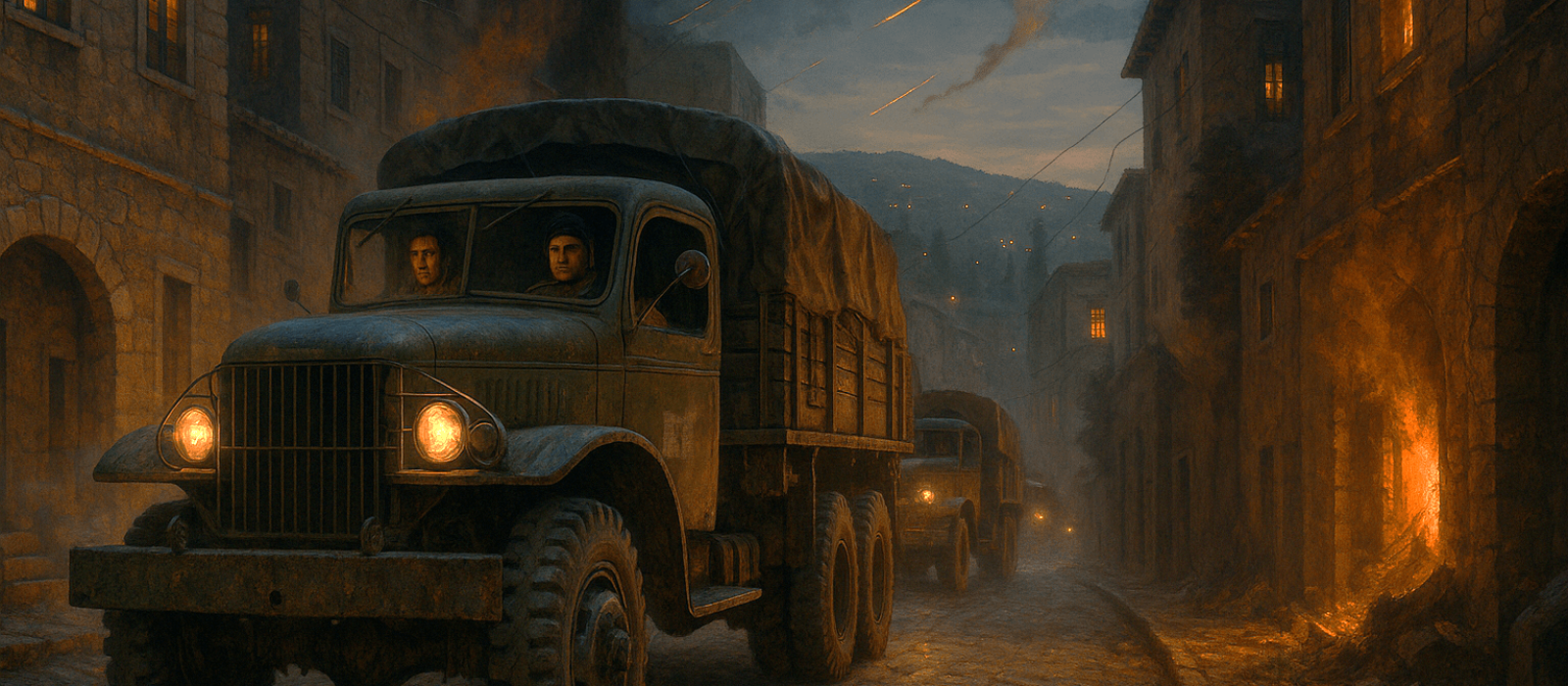
David and Nadir sat across from each other in the back of a GMC CCKW Deuce and a Half, their rifles resting on their laps. They had been positioned at the rear, amidst the crates of ammunition and medical supplies. Their job was clear: keep watch, stay alert, and shoot anything or anyone that threatened the convoy from behind.
The truck’s canvas canopy offered scant protection, its fabric rippling with each gust of wind. It obscured their positions from prying eyes, but everyone knew it wouldn’t stop a bullet. The crates around them, however, were a cold comfort – at least they were thick enough to slow down some rounds.
Nadir sat with the ease of a man who had accepted the chaos of war. His rifle rested casually in his hands, but his sharp eyes never stopped scanning the alleys and rooftops as the truck rumbled forward. David, by contrast, sat rigid. His hands gripped his rifle so tightly his knuckles turned white and sweat trickled down his face despite the cool evening air. His stomach churned with every bump in the road, every shadow that moved in his periphery.
The convoy departed the Haifa Port under the cover of twilight, winding its way through the city’s battered streets. Their route took them up Ofir Street and onto Okaf Krayot Way, weaving through neighborhoods torn apart by the fighting. Fires burned in the distance, their orange glow casting eerie shadows against the smoke-filled sky. The air was thick with soot, stinging their eyes and clogging their throats.
The convoy’s pace was maddeningly slow, forced to navigate around rubble and abandoned vehicles. Every turn felt like a trap. Every intersection was a potential ambush. The rhythmic growl of the truck’s engine was punctuated by the occasional crack of distant gunfire, each shot making David flinch despite himself.
☼ ☼ ☼
The convoy rolled up to the first of three checkpoints. Radios were alive with the staticky relish of progress, along with updates on which roads were blocked and where the enemy had been sighted. Routes to the second checkpoint were updated, and the convoy roared away in hopeful thunder.
☼ ☼ ☼
Maybe it was the rocking of the vehicles on the cobblestone roadways, or the constant adrenaline wasted by fear, but David’s hypervigilance had given way to a drowsiness that he fought to subdue.
Suddenly, the truck jolted violently, and David’s heart leapt into his throat. A tire had hit a piece of debris, sending the vehicle lurching to one side before regaining its balance. From up ahead, a loud bang rang out, followed by frantic shouts. The convoy ground to a halt for a brief moment – long enough for David to hear the distinctive crack of rifle fire nearby.
“Eyes up!” Nadir hissed, his voice low but urgent. He adjusted his grip on his rifle, leaning toward the back of the truck, ready to return fire at the first sign of movement.
David nodded, swallowing hard. His hands shook as he raised his weapon, his finger hovering over the trigger. Every shadow seemed to shift, every flicker of light felt like an enemy creeping closer.
“Stay calm,” Nadir whispered, his tone steady despite the tension, “If they come, we’ll see them. Breathe, David. Just breathe.”
The sounds of screeching metal and gunfire gave way to the sounds of engines and tires. As the convoy moved past the blockade, David could see one of their trucks lay abandoned, engulfed in flames. Bodies lay scattered, some burning. The smell was unforgettable, the act unforgivable. The fear David had once known was giving way to anger. But that, too, he knew, had to be kept in check.
Another blast, and their vehicle shook. The convoy came to a grinding halt, as gunfire once again erupted. From the ominous sounds around them, they just knew the convoy would not be going anywhere anytime soon. Without a word, they both leapt from the vehicle and headed for cover opposite the sounds of gunfire.
The truck in front of them had hit a mine that had tipped the lead truck onto its side. The blast blew out the windshield of their truck, killing the driver.
“Crap,” Nadir said, seeing the driver.
David just shook his head, “Let me guess, not so much like riding a bike.”
“Not so much. But, hey, you will do great. I will cover you!” Nadir said, as he attempted to lay down cover fire. They did not know how, but they were now the lead vehicle.
David went into the cab of the truck from the passenger’s side and gently pulled the soldier to the middle of the seat. Climbing over, he sat in the driver’s seat and grabbed for the key. The truck lurched forward.
“CLUTCH!” shouted Nadir, as he exchanged gunfire.
Remembering to depress the clutch, David started the truck, put it in first, and pressed the gas simultaneously as he released the clutch slowly. The truck lurched forward hard, but they were moving. When he got the RPMs up, he went to second gear.
David looked in the mirror. The other trucks were falling in behind them.
“Nadir!” David shouted, “Where the hell am I going!”
Nadir was hanging on the running board of the truck. He jumped in and slammed the door shut. Hastily, he grabbed a laminated map of the city routes marked out in wax, “Uh … turn left!”
☼ ☼ ☼
The truck jolted over broken pavement as David fought to keep it steady, his knuckles clenched on the steering wheel. Nadir leaned out the window, shouting directions over the cacophony of engines and distant gunfire. The air was thick with smoke, and the orange glow of fires reflected off shattered windows and brutalized steel facades.
Ahead, the road narrowed into a street bordered by buildings on either side, their walls pockmarked with bullet holes. As the convoy entered the contested neighborhood of Wadi Nisnas, a sharp whistle pierced the air. David flinched instinctively, his heart hammering, but no explosion followed.
“That’s them!” Nadir shouted, pointing to a group of figures waving them down near a fortified building, as the sound of more bullets whizzed by.
The Haganah fighters were stationed behind makeshift barricades – sandbags piled high, overturned carts, and steel drums hastily welded into cover. Some wore uniforms, others civilian clothes, but all were armed, their rifles trained on the road ahead. A lookout perched on the roof above waved a red flag frantically, signaling the convoy to stop and unload.
David brought the truck to a grinding halt, the brakes screeching in protest. He exhaled shakily, barely realizing he’d been holding his breath.
“Get out! Move!” barked a soldier with a scar running down his cheek, motioning them toward the barricades.
David and Nadir jumped out of the cab, ducking instinctively as another distant explosion echoed behind them. Fighters swarmed the truck, prying open the tailgate and quickly unloading the crates of ammunition and medical supplies.
In minutes, everything was unloaded.
☼ ☼ ☼
The scene was chaos, but it was controlled chaos. Wounded fighters sat slumped against the barricades, their faces pale and bloodied. Medics worked quickly, their hands steady despite the chaos around them. Crates of ammunition were cracked open, and fresh magazines were distributed to fighters preparing for the next wave of combat.
“You two!” shouted the scar-faced soldier, pointing at David and Nadir, “Get those crates to the roof! We’ve got snipers pinned down, and they’re out of rounds!”
David hesitated, looking at the ladder leading to the rooftop. Nadir nudged him, “Come on, you heard him!”
Together, they hauled a crate of ammunition up the ladder, their muscles straining under the weight. The rooftop offered a grim view of the battlefield – plumes of smoke rising from burning vehicles, shattered buildings, and the occasional crack of a sniper’s rifle echoing in the distance.
“Ammo!” Nadir shouted, sliding the crate toward a Haganah sniper perched behind a low wall. The sniper didn’t look up, his focus locked on his scope, “Load me up!” he barked.
David quickly tore open the crate, his hands trembling as he handed the sniper fresh rounds.
As the last of the supplies was distributed, the scar-faced soldier returned, “You did good,” he said gruffly, his voice carrying an edge of exhaustion, “I am Commanding Officer Mizrachi. It was very nice to meet both of you. Unfortunately, we are not done yet.”
David and Nadir exchanged a wary glance, “What’s next?” David asked.
The soldier nodded toward the barricades, “You’re staying here. We’re holding this position, and we’re gonna need every hand we can get. We have a building to evacuate.”
☼ ☼ ☼
The neighborhood of Wadi Nisnas had become a tinderbox. Fighting raged in the narrow streets, with Haganah units desperately holding off Arab forces trying to retake the area. Intelligence reached David and Nadir’s unit that a group of Jewish families, along with a few wounded fighters, were trapped in an apartment building near the front lines.
“This is a critical mission,” their commanding officer said, his tone grim, “Get those people out, or they’re as good as dead. The enemy knows they’re there, and they won’t hold back.”
David and Nadir exchanged glances. They both knew the risks, but there was no hesitation.
“Understood, sir,” David replied, his voice steady.
The team moved out under the cover of darkness, using the ruins of cars and rubble-strewn alleys for concealment. Gunfire crackled in the distance, and the acrid smell of smoke stung their noses. As they approached the building, it became clear just how dire the situation was. The structure – once a modest apartment block – was riddled with bullet holes, its facade blackened by fire.
“They’re pinned down on the second floor,” Nadir whispered, his sharp eyes scanning for threats, “We’ll have to move fast.”
David nodded, signaling the team forward. Inside, the air was thick with dust, and the muffled cries of children mixed with the steady rhythm of distant explosions. The families were huddled in a corner, their faces pale with fear. A young woman cradled a baby, her eyes wide with desperation.
“We’re here to help,” David said, lowering his rifle, “We’re getting you out.”
The evacuation was methodical but tense. David and Nadir guided the families down the crumbling staircase, keeping their movements swift and silent. The wounded fighters were carried on makeshift stretchers, their groans muffled to avoid drawing attention.
As the group reached the street, an explosion shattered the fragile calm. A mortar shell hit the far end of the block, sending a shockwave through the air. Chaos erupted as gunfire rained down from nearby rooftops.
“Take cover!” David shouted, positioning himself between the families and the source of the attack. Nadir returned fire, his aim precise and unwavering.
“Go!” Nadir yelled, covering the group as they scrambled toward safety. David stayed close to the rear, ensuring no one was left behind. But just as they neared an alley that led to the evacuation point, a second explosion rocked the ground. Nadir was thrown to the pavement, his world spinning as pain lanced through his leg. As he fell, his shoulder was likewise pierced.
“Nadir!” David’s voice cut through the ringing in his ears.
Ignoring the bullets whizzing past, David sprinted to Nadir’s side. Blood seeped from jagged wounds in Nadir’s thigh and shoulder. His face was pale with shock.
“Can you move?” David demanded, crouching low to avoid the incoming fire.
Nadir gritted his teeth, shaking his head, “Go, David. Get them out.”
“Not without you,” David said firmly. He hoisted Nadir onto his shoulders in a fireman’s carry, his legs straining under the weight.
The trek to safety was agonizing. David’s muscles burned, and his breath came in ragged gasps, but he didn’t falter, until an enemy bullet ripped through David’s side, causing them both to fall. Behind them, the sound of gunfire faded as the Haganah reinforcements arrived to cover the retreat. By the time the medics reached them, David and Nadir lay in a crumpled pile, dead to the world.
☼ ☼ ☼
The injuries of both Nadir and David required immediate surgery, and they were transported to a field hospital. Once stable, they were sent to the base infirmary, where they could recover.
It was David who woke in the infirmary. Familiar faces loomed in front of him. It was the Commanding Officer Baruch, the one who accepted them into the Haganah. Standing next to Baruch was the other Commanding Officer Mizrachi, the one with the scar. David was confused. Why were they there? What happened? David was convinced it had to be Nadir!
The panic must have shown on David’s face. Baruch smiled, “The more things change, I swear the more they stay the same.” He motioned to a nurse, who pulled back a long curtain. There, sleeping peacefully next to David, was Nadir, “This time, however, I believe some commendations are in order for the two of you.”
David tried to sit up, but the pain was too intense.
“David, don’t. We can talk later. Take some advice from your brother, Nadir, over there, and get some rest.”
☼ ☼ ☼
When David woke again, he saw the face of a young nurse. Her dark hair was tucked neatly under a scarf, and her eyes shone with warmth and kindness.
“You’re awake,” she said, her voice soft. “I’m Rivkah. You’ve been through quite an ordeal.”
David looked over to Nadir’s bed. “How is he?” As David tried to speak, his voice was dry and raspy. Rivkah helped him sip water, her touch gentle.
“Oh, he will make it. The shots were clean. Fair to say you got the worst of it. The bullet nearly took out parts of your kidney, your stomach, and even your liver. Nearly, but it didn’t. But the doctors had a time stitching you up,” she said, lifting his smock to inspect his stitches. They were tender and seeping. He was embarrassed, and she noticed. “Don’t worry, I’ve done this before. You are in good hands.”
☼ ☼ ☼
Over the weeks that followed, as Rivkah tended to David’s recovery, a bond grew between them. They spoke of their lives, their families, and their dreams. For David, Rivkah became a beacon of hope amidst the darkness of war, and she comforted him long after his brother, Nadir, had been discharged.
Meanwhile, word of David and Nadir’s bravery spread through the ranks. Both were lauded for their bravery and for the lives they saved, especially considering their age. While the Haganah had no formal system of medals at the time, they would later both receive the Medal of Courage and the Medal of Distinguished Service, retroactively, as a prelude to the many honors and accolades they would accumulate through their military careers.
☼ ☼ ☼
With the war winding down, David and Rivkah’s relationship blossomed. When David proposed, it was with a mixture of nervousness and joy. Rivkah’s answer was immediate and heartfelt, “Oh, yes!”
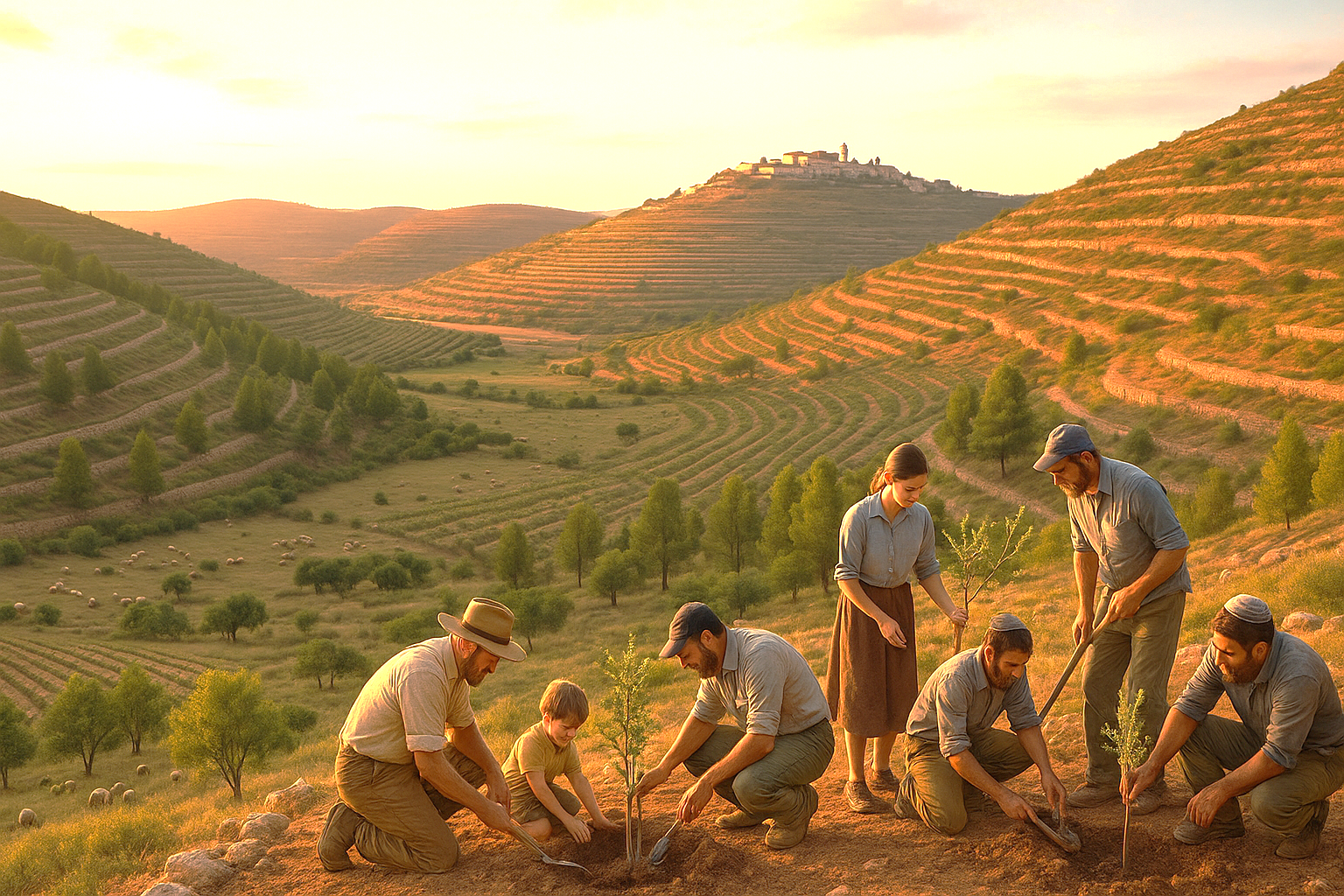
The wedding took place in Peki’in, under the shade of olive trees that had stood for centuries. The entire community turned out to celebrate, their spirits lifted by the occasion. Nadir stood proudly as David’s best man, cracking jokes and keeping the mood light.
“I saved his life, you know,” Nadir said during his toast, earning a round of laughter, “I figured the least he could do is let me eat his wedding cake.”
David smiled, raising his glass, “To friendship,” he said, his voice thick with emotion, “And to the future.”
The night was filled with music, dancing, and the sound of laughter. For a brief moment, the horrors of war felt distant, replaced by the simple joy of family and community. As the couple had stood under the chuppah, surrounded by loved ones, David couldn’t help but feel a sense of hope. The road ahead would be difficult, but for now, they had something worth fighting for.
Used with permission by the author. Find the author’s complete works online: Complete Works of Mack Samuels