
Suggested Scriptures: Psalm 121; Psalm 83; Zechariah 12:2–9.
5727 AM (1967 CE) – SIX DAY WAR
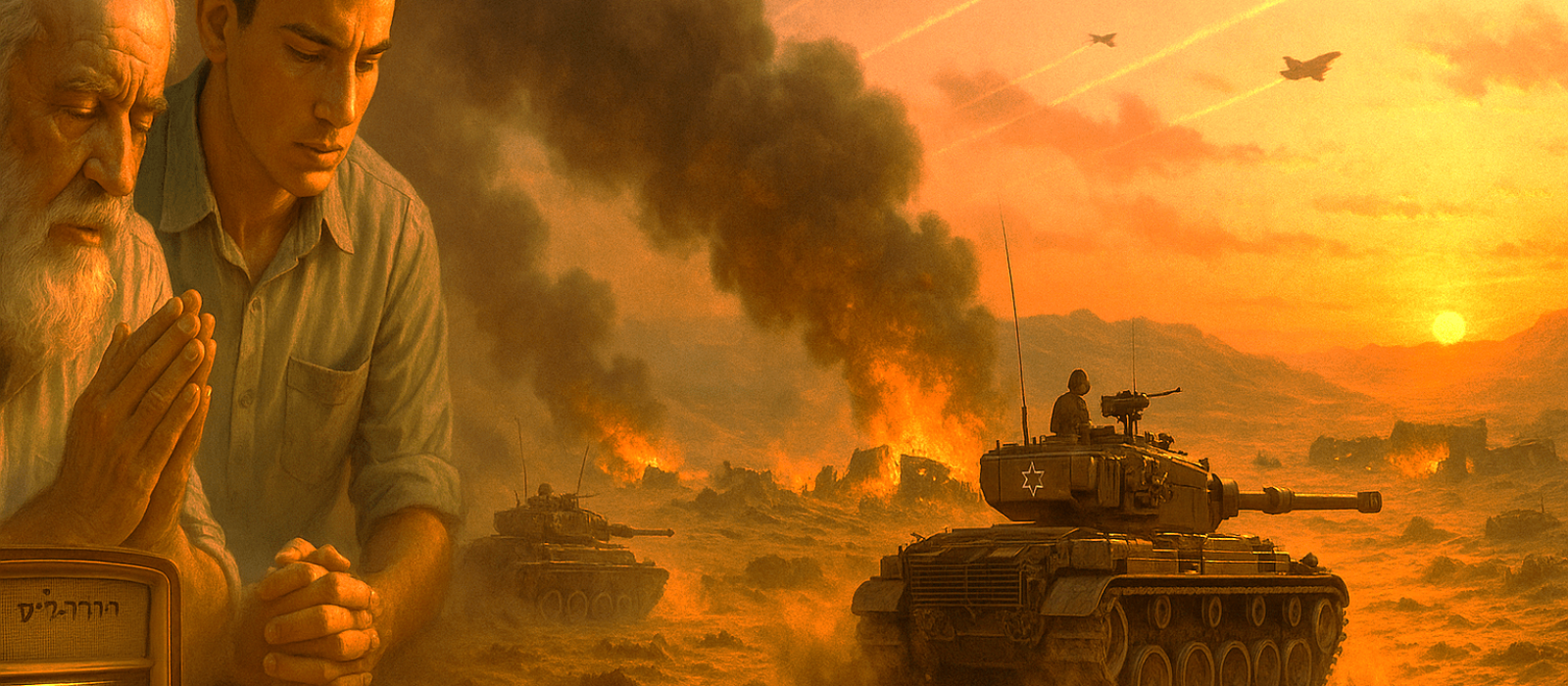
The familiar crackle of static filled the warm evening air as the old Kol Yisrael radio hummed to life. The wooden cabinet, worn smooth from years of careful tuning, sat on the table between David and his father, Yitzhak. Yitzhak puffed deeply, and a thin plume of pipe smoke curled toward the rafters, mingling with the scent of aged tobacco and the faint aroma of Rivkah’s cooking drifting in from the kitchen.
The voice on the radio was urgent, clipped. No music, no commercial breaks – just the cold, hard reality of war inching ever closer.
“This is Kol Yisrael. We interrupt regular programming with breaking reports of increased Syrian aggression in the north. Heavy shelling has been confirmed along the Golan Heights. Reports indicate at least three Israeli settlements have sustained damage, with multiple civilian casualties. The IDF has responded with retaliatory strikes, but military officials warn that tensions continue to escalate.”
David leaned forward, his elbow resting on his knee, eyes locked on the radio. His father, Yitzhak, sat beside him, holding the long wooden stem of his pipe between his fingers. He exhaled slowly, watching the smoke drift toward the ceiling before responding.
“It’s happening again,” David muttered, his voice laced with the heavy wisdom of someone who has already seen too many wars.
Yitzhak said nothing. His eyes flickered to the corner of the room where Ezra sat, his eldest grandson, barely seventeen, arms crossed, face unreadable.
Ezra was listening just as intently, but Yitzhak could see the telltale tension in his shoulders. He had always been perceptive, always watching, growing up in the shadow of men who had carried rifles before they carried books.
The radio crackled again.
“Meanwhile, in the south, Egyptian forces have been observed massing in the Sinai Peninsula. Military analysts believe this move signals a coordinated threat, as President Nasser has declared that ‘Egypt will not stand alone’ in its struggle against Zionist aggression. Israeli leadership has issued a strong warning, citing the blockade of the Straits of Tiran as an act of war. Defense Minister Moshe Dayan has placed the IDF on high alert.”
David tapped his own pipe against the ashtray, his jaw tightening. It was only a matter of time. Egypt had been testing Israel’s patience for months, and now it was clear – they weren’t going to back down.
Ezra broke the silence, “Does that mean war?”
His voice was steady, but David heard the weight behind the words.
Yitzhak, still staring into the depths of his pipe, sighed deeply, “If history is any guide….”
David finally turned toward his son, meeting his gaze. Ezra looked so much like him at that age – dark hair, sharp eyes, the same unspoken questions burning behind them. But unlike David, Ezra had never known war firsthand. Not yet.
“You’ll get your orders soon,” David said evenly, keeping his voice calm, “They’ll need every able-bodied soldier, if it comes to that.”
Ezra nodded, but David could see the pulse in his throat quicken. He wasn’t afraid – not exactly – but there was something else. Anticipation? Resolve? Maybe he wanted to prove himself. Maybe he didn’t yet understand what it meant to kill or be killed.
The radio droned on, now listing reserve units being mobilized, naming settlements that had already suffered mortar fire. David knew his own orders would come soon.
Then Rivkah came into the living room, her eyes darting between her husband, father-in-law, and son. She didn’t have to ask what the news was. She already knew.
“Food’s ready,” Rivkah said softly, but the tension in her voice was unmistakable.
David glanced at his father. Yitzhak puffed his pipe once more, then nodded, standing with a groan, “Come, Ezra. Your mother has been cooking all afternoon.”
Ezra hesitated but then followed his grandfather toward the table.
David lingered for a moment, staring at the radio as if expecting it to tell him what to do. It never did.
Rivkah stepped closer, touching his arm.
“You’ll be leaving soon,” she murmured.
David nodded once.
“I’ll help pack your things later,” she said, and without another word, she walked away.
The radio crackled again. The world was moving toward war.
☼ ☼ ☼
David took a deep breath, pushing himself up from his chair, leaving the radio’s persistent hum behind. The war would come whether they sat there listening or not.
He followed his father and son into the modest dining area, where the smell of freshly baked challah and slow-cooked lamb filled the air. The table was crammed with people, chairs tucked tightly together, elbows almost touching – but it was a happy kind of crammed, a warmth that filled the house, making it feel alive.
Leah and Shimon jostled for their usual seats beside Rivkah, their giggles breaking through the heavy atmosphere. Miriam, their nine-year-old, helped her mother pour drinks, her little hands careful as she passed out glasses of water. The twins, Ilana and Eli, only six, squeezed onto a bench meant for two, their faces already streaked with soup where they had ‘helped’ taste-test before dinner.
At the head of the table sat Yitzhak, his once broad shoulders slightly hunched, his beard now fully white. He had slowed down these past few years, especially after Rivkah Sr. passed away four years ago. She had been 72, her body finally yielding to time. She had gone peacefully – a quiet departure in her sleep, her frail hands still folded in prayer, a book of psalms resting on the nightstand. There was no pain, no sudden tragedy – just the slow fading of a life that had so vibrantly shaped their home for decades. The hole she left behind had never quite closed.
David still looked for her at the table sometimes.
He could almost hear her voice if he closed his eyes.
“Eat, eat! You think this food just appears? If you leave my table hungry, I have failed you as a mother!”
David sighed as he took his seat across from Yitzhak. His father cleared his throat, speaking as if he had been reading his mind, “Your mother would have wanted us to eat,” he said simply.
David nodded, grateful for the unspoken understanding between them.
Rivkah ladled soup into bowls, her hands still swift and practiced, though now she spent far more time caring for Yitzhak and their growing children than at the medical base in Safed.
She had officially moved into the medical reserves after Rivkah Sr. passed away, trading her active duty nurse’s uniform for the quiet life of caretaker – for Yitzhak, for their children. It had been a difficult decision, but David needed to be on base more often, and someone had to hold the home together.
It wasn’t a sacrifice, she often said. It was choosing where she was needed most.
Now, the sounds of the children’s chatter softened the weight in the air.
Ezra tore a piece of challah, dipping it absently into the soup. David watched him, wondering if he had looked the same all those years ago, just before the War of Independence.
“So,” Ezra finally spoke, breaking the silence, “What happens now?”
Rivkah’s hand tightened on her spoon, but she said nothing.
David set his utensils down, looking his son directly in the eye, “Now, we wait for orders. When the time comes, you’ll report for duty like every young man in Israel does. We all do our part.”
Ezra nodded, as if he had expected nothing less. But then his gaze flickered toward his grandfather, “And you, Saba? What was it like when you went to war?”
Yitzhak exhaled slowly, “It was different then,” he said, “We were outnumbered, barely armed. Some of us fought with old rifles, some with nothing at all. I wasn’t much older than you when I first saw battle. But it was very different. Israel wasn’t a state. The Balfour Declaration was intended to give the Jews the land of Israel for a homeland. Instead, the British took it upon themselves to divide Israel into Palestinian and Jewish quarters, based on where people lived, and rule like a violent monarchy often does – punitively and with favoritism. And I assure you, the favoritism wasn’t toward the Jews, but the Palestinians. The Palestinians could carry guns and set off bombs, but the British would hang Jews dropping chewing gum on the sidewalk!”
“Stop it,” David interrupted. Turning to Ezra, “It certainly was bad, but that didn’t happen in Peki’in. Jerusalem, for sure, but not the chewing gum part. Abba, really!”
“David, David. Perhaps I … elaborate a bit too vividly. It was a long time ago. But, before I met your mother, I helped, you know, a little here and there. Sometimes there in Jerusalem, and sometimes all hell would break loose when I was there. What could I do but fight?”
Ezra leaned forward, fascinated despite himself, “Weren’t you afraid?”
Yitzhak chuckled, shaking his head, “Of course! Of course! Only a fool wouldn’t be afraid. It’s what keeps you focused! Yes, it’s what keeps you alive.” His eyes darkened slightly, “But whether you are afraid or not, you must fight anyway.”
David watched the exchange quietly, his mind drifting. His father had fought against the British, then the Arabs, then the Egyptians. David had fought for Israel’s independence, for the Suez Crisis, and even just to keep the peace. And now, Ezra was about to face his own war. History always seemed to repeat itself like an old, scratched record, whether one wanted to listen to its tired melody or not.
Leah, his six-year-old daughter, stirred beside her mother, “I don’t want Ezra to go to war,” she mumbled.
Everyone stopped talking and simply looked at the innocent child. Rivkah reached out, smoothing her daughter’s hair, “No one wants war, MOKTEK SHELI,” she murmured.
Shimon, the youngest, only four years old, looked confused. He had no concept of what war truly meant, “But Abba is going too?” he asked.
David felt a lump in his throat. He had left for battle before – many times – but somehow, this one felt heavier. “Yes,” he answered simply.
Shimon frowned but said nothing else.
Rivkah, still poised and composed, finally spoke, her voice quiet but firm, “The food is getting cold,” she said, ending the discussion.
☼ ☼ ☼
A sharp knock on the house door roused David out of his slumber. His bags were already packed, and he was already dressed, asleep on the sofa. It was 2 a.m. He knew exactly who it was.
David ran a tired hand over his face, stretching his sore muscles before pushing himself up. The room was dimly lit by the faint glow of a small night lamp Rivkah had left on near the kitchen. He exhaled and reached for his boots.
Another knock.
“Coming,” he muttered, pulling open the door.
There stood Nadir, dressed in his civilian clothes, hands stuffed deep into the pockets of his coat. He looked almost apologetic, but the usual glint of humor was shining from his eyes. He didn’t need to say anything.
David slung his duffel bag over his shoulder and stepped outside. The night air was cool and silent, a stark contrast to the storm brewing beyond Israel’s borders.
Nadir nodded toward the old Peugeot van, its headlights dimmed, “She’s still running,” he said with a small grin, patting the van’s hood, “What a workhorse! Ezra said it just needed a new alternator, but it should still keep for a while. The wonders of the desert – very little rust.”
David huffed, “He’s got a talent for fixing things that should have long been dead.”
Nadir shrugged, “Runs in the family, don’t it?”
David turned back toward the house, staring at it in silence for a moment. He wouldn’t wake them. Not Rivkah. Not the children. He had done that before, in other wars, and the look in their eyes haunted him. He had already said his goodbyes earlier that evening.
If Hashem willed it, he would return. With a sigh, David walked to the van.
“Alright,” David said, opening the passenger door, “Let’s go.”
Nadir put the vehicle into gear, and the Peugeot groaned as it rolled forward, its old frame shuddering as it rumbled down the road. They drove in silence for a long while.
☼ ☼ ☼
The road from Peki’in to Safed was eerily empty at this hour. During the day, it bustled with farmers, merchants, and schoolchildren. Now, it felt abandoned, as if the whole country was holding its breath.
David sat in the passenger seat, staring out the window at the rolling hills, trying not to think about what was coming. The war would be brutal. That much was certain. The Egyptians were waiting, the Jordanians were ready, and the Syrians had the high ground. And this time, David was not just a company commander – he was responsible for an entire battalion.
His hands clenched around his knees.
“You’re quiet,” Nadir said, his voice low.
David glanced at him, “Just thinking.”
Nadir snorted, “Dangerous habit.”
David exhaled through his nose, “You sure you don’t want to come with me?”
Nadir shook his head, eyes still on the road, “Not yet. I’m in the reserves now, remember? If they need me, they can call me. But until then… Leila would kill me if I went looking for a fight.”
David smirked, “Smart man.”
“I try.”
They passed through a checkpoint just outside of Safed. The IDF soldiers waved David through immediately, recognizing him and the old workhorse. As they pulled into the base, the first light of dawn began to stain the horizon a deep orange. The tank yards were already alive with movement – mechanics scrambling to perform last-minute repairs, officers shouting orders, engines roaring to life.
David stepped out of the van and slung his bag over his shoulder.
Nadir didn’t move.
David turned back, “Take care of things in Peki’in. Check in with Rivkah and the kids. Make sure they don’t need anything.”
Nadir looked up at David, “Don’t worry. We already have plans for Shabbat. But, uh,” Nadir’s expression became overtly serious, “Bring them all home, David.”
David nodded, his throat uncomfortably dry. He gazed back through the open window, “I will. Just take care of them while I’m gone.”
Nadir smirked, “I always do.”
Without another word, David turned and walked toward the command post, with the sounds of the Peugeot fading into the distance.
☼ ☼ ☼
Before Dawn – Peki’in, Israel
The dim glow of the radio dial flickered against the dark kitchen walls. The air inside the Halevi home was thick with the aroma of fresh-brewed tea and tobacco smoke. Yitzhak, pipe clenched between his teeth, sat at the kitchen table, carefully packing the bowl with slow, deliberate movements. Across from him, Ezra leaned forward, hands clasped, eyes locked on the radio speaker. The tension between them was silent but palpable.
The voice of the broadcaster crackled through the static, “This is Kol Yisrael. It is now six o’clock. The government has confirmed a full military mobilization. Reports from Tel Aviv indicate that Israeli forces are on high alert following Egypt’s illegal blockade of the Straits of Tiran. Jordan and Syria have joined in a defense pact with Egypt, and significant troop movements have been observed along the Golan Heights and West Bank. Residents are urged to remain indoors as the situation unfolds. We will update as more information becomes available.”
Ezra exhaled sharply, “So, it’s happening.”
Yitzhak took a long drag from his pipe, his weathered hands steady despite the storm brewing outside their home.
Then, the broadcaster’s voice changed, suddenly clipped and urgent, “Breaking news. Reports confirm that Israeli aircraft have launched a large-scale strike against enemy airfields. Our forces are currently engaging Egyptian and Jordanian positions. This is not a drill. I repeat – this is not a drill.”
Yitzhak’s grip on the pipe tightened.
Ezra stood, the chair scraping against the tile, “Abba,” he murmured, as if speaking David’s name into existence would summon him home, but David was already in Safed. And he was now at war.
☼ ☼ ☼
Dawn – Safed Military Base, Northern Israel
David stood with his men on the open parade ground, the rising sun turning the sky above them into a canvas of deep orange and blood-red streaks. The air smelled of grease, sweat, and the faint trace of exhaust fumes from idling tanks. Every man around him had been waiting for this moment.
His radio crackled to life, “Command confirms: Operation Moked is underway. The Egyptian Air Force has been neutralized. Sinai operations are green-lit. Repeat, Sinai operations are green-lit.”
David didn’t need further confirmation. He turned to his battalion, their faces drawn tight with anticipation.
“Mount up,” he ordered.
Tank hatches slammed shut. The roar of diesel engines filled the base as the first columns rolled forward. Dust churned beneath the weight of steel treads as the armored battalion prepared to descend into war.
Colonel Eitan Shamir’s voice came over the radio.
“Lt. Col. Halevi, you are spearheading the advance. Orders will follow en route. Move out.”
David turned toward his crew, his hand resting on the hot steel of his Sherman’s turret.
“All units, roll out.”
☼ ☼ ☼
Across the vast desert expanse, the Israeli Air Force had already delivered the first, and perhaps the most decisive, blow of the war. Egypt’s airfields were burning.
Mirage III fighters strafed enemy bases with pinpoint precision.
Runways were cratered, preventing takeoffs.
Hangars and parked aircraft exploded in chain reactions.
The Egyptian Air Force – thought to be the largest and most formidable in the Arab world – was effectively gone before they even had a chance to fight.
The same fate awaited Jordanian and Syrian airfields.
By mid-morning, over 450 enemy aircraft had been annihilated.
Israel now controlled the skies.
☼ ☼ ☼
Yitzhak had not moved from his chair.
The radio was still on, the broadcaster speaking hurriedly about devastating airstrikes against Egyptian airbases.
He glanced at Ezra, who sat rigid, eyes glued to the radio dial. His grandson had heard what he had heard.
“It means the war has started,” Ezra said, voice almost reverent.
“It means David is already fighting,” Yitzhak corrected.
Ezra swallowed, hands clenched into fists.
Yitzhak reached across the table, gripping his grandson’s forearm, “He’s prepared. You know that.”
Ezra nodded. He did. But that didn’t mean he wasn’t afraid. His father was at war. And by this time next year, he would be, too.
☼ ☼ ☼
9:00 AM – The Desert Highway, En Route to Sinai
David’s tank rattled over the open desert, the convoy kicking up thick plumes of dust in its wake. His battalion was headed south, following the planned assault route through Be’er Sheva, on their way to break Egypt’s defensive lines in the Sinai Peninsula.
The radio remained active, filled with updates from command and occasional bursts of static.
“Sinai front is wide open,” one commander reported, “The Egyptians have no air cover left. Tanks are pushing forward.”
David turned to his gunner, Sergeant Ben-Ami, who was adjusting the sights on their main gun.
“You hear that?”
Ben-Ami nodded, “No MiGs to worry about. Just their tanks now.”
David exhaled, shifting his grip on the hatch rim. Good. That meant they only had to fight the enemy in front of them – not above. A crackle of static, then Colonel Shamir’s voice cut through the noise.
“Tank Battalion 4, listen up. Egyptian forces are entrenched near Abu-Ageila. Intel suggests minefields, anti-tank emplacements, and heavy resistance. We will not stop. We will not slow down. We break their line, we take Sinai. Understood?”
David felt the tension in his gut settle into something harder.
“Understood, sir.”
The desert stretched ahead, endless and golden, but their path was clear. The next forty-eight hours would decide the fate of Israel’s southern front. David gripped the rim of the hatch, squinting toward the horizon, “All units, prepare for contact.”
☼ ☼ ☼
The Sinai Front – June 5, 1967, 10:45 AM
The wind howled across the open desert, sending ripples through the golden sand. The heat shimmered above the steel plating of the tanks, distorting the horizon as David’s battalion pushed deeper into the Sinai. The road had disappeared miles ago, leaving only the churned tracks of the armor ahead of them as they advanced toward Abu-Ageila – a name that had been circled on every IDF map for months.
Over the radio, voices came through, clipped and urgent. Israeli forces had already begun engaging the enemy along the main approach. Command reports painted a brutal picture – minefields, artillery, anti-tank positions, and a determined Egyptian force dug in deep. The battle had already started.
David adjusted his radio headset, his throat dry, “All units, eyes up. We’re hitting the western flank. Expect dug-in infantry, anti-tank positions, and whatever armor they haven’t thrown at the main force yet. Keep the formation tight – anyone strays, they die alone.”
A chorus of acknowledgments crackled back. His men were ready.
To his right, Sergeant Ben-Ami grinned, wiping sweat from his brow, “Feels familiar, doesn’t it, Sgan-Aluf?” he quipped, using David’s rank.
David smirked, his fingers tightening on the rim of the turret hatch, “Yeah. Like déjà vu. Except last time, we weren’t leading a whole damn battalion.”
Ben-Ami chuckled, but the humor didn’t reach his eyes. He turned back to the targeting controls, his gaze sharp as he scanned the terrain.
Ahead, the distant boom of artillery rolled through the desert. Smoke plumes billowed against the horizon, and even from here, David could see the glint of Egyptian armor shifting in the dunes ahead.
They were getting close.
☼ ☼ ☼
11:15 AM – Contact with the Enemy
11:15 AM – Contact with the Enemy
A deafening roar erupted across the battlefield as the first Israeli shells screamed toward Abu-Ageila. Fireballs erupted in the distance, consuming Egyptian bunkers and machine-gun nests. The counterattack was immediate – enemy artillery thundered back, sending sand and shrapnel raining down.
“Incoming!” someone yelled over the radio.
David barely had time to brace before a shell landed near their flank, the shockwave rattling his bones. His Sherman lurched sideways, treads grinding against the sand.
“Keep moving!” David barked, “Stay spread out!”
From the Egyptian side, T-34s and SU-100 tank destroyers rolled forward, their cannons flashing in rapid succession. A direct hit sent an Israeli AMX-13 spiraling into flames, its turret flying clear off the chassis. The few surviving crew scrambled out, running for cover.
David gritted his teeth, gripping the turret rim so hard his knuckles turned white, “Ben-Ami, take the shot!”
Ben-Ami locked onto an advancing T-34. The Sherman’s main gun roared, sending a shell screaming through the air. The round punched through the enemy tank’s front armor. Flames erupted from its hatches as the Egyptian crew bailed out, their uniforms in flames.
Another T-34 fired back, and David’s tank jerked violently as the shell slammed into their side plating. The armor held, but barely.
“Damn it, that was close!” David shouted.
“They’re aiming for command units!” Ben-Ami growled, “They know who’s in charge!”
David switched radio frequencies, “All units, pivot south! We’re flanking the artillery positions – we take them out, the rest of our forces can move in!”
The tanks veered off course, engines roaring as they rumbled toward the Egyptian rear lines.
☼ ☼ ☼
12:30 PM – The Infantry Assault
The closer they got, the clearer the enemy defenses became – long trenches carved into the desert, reinforced bunkers, anti-tank gunners crouched low behind sandbags, waiting for them.
“Infantry, ridge line!” someone called.
David’s gut twisted. This was where things got bloody.
“Machine guns, suppressive fire! Hit them before they can set up!”
The .50-caliber machine guns mounted on the Shermans opened up, stitching the Egyptian positions with bursts of lethal fire. Soldiers crumpled, but not before several RPGs were launched toward the Israeli line.
One slammed into an AMX-13, blowing off its left tread. The light tank veered sideways, smoke pouring from its chassis.
Another Israeli tank exploded as an anti-tank gun found its mark.
David hissed through his teeth, “Ben-Ami, get those anti-tank guns before they turn us into scrap!”
Ben-Ami lined up his shot, “Firing!”
The Sherman’s cannon roared, and the Egyptian gun position disintegrated in a ball of fire.
Israeli paratroopers surged forward, clearing the trenches in brutal close combat. The sound of rifle fire, the screams of the wounded, and the acrid stench of burning diesel filled the air.
David’s radio crackled, “Abu-Ageila’s defenses are weakening. The main force is pushing through. We need to secure this flank now!”
☼ ☼ ☼
1:15 PM – The Breakthrough
A massive explosion lit up the desert as Israeli artillery finally found its mark – the main Egyptian ammunition depot.
The shockwave nearly knocked David off balance. A chain reaction of blasts erupted through the enemy camp as fuel trucks, ammo crates, and vehicles went up in flames.
The Egyptian line collapsed.
David’s battalion surged forward, crushing the remaining resistance.
☼ ☼ ☼
David stood atop his Sherman, scanning the wreckage. Dozens of burning Egyptian tanks littered the desert, their crews either dead or captured. Israeli soldiers moved through the trenches, clearing out any remaining holdouts.
“Casualties?” David asked as his radio operator approached.
“Heavy, sir. But we’ve secured Abu-Ageila. Our forces are already pushing west.”
David exhaled, wiping sweat from his brow.
His radio crackled to life, “New orders incoming. Israeli forces are moving toward the Sinai passes. Stand by for redeployment.”
David’s jaw clenched.
The war wasn’t over yet.
☼ ☼ ☼
June 5, 1967 – Nightfall, Somewhere in the Sinai
The fire flickered low, casting long shadows across the sand. The Israeli tanks were parked in a staggered formation, their dark silhouettes blending into the dunes. The night air was cold, a stark contrast to the blistering heat of the day.
David sat on an overturned ammunition crate, his back against the steel hull of his Sherman. The adrenaline of battle still pulsed through his veins, but exhaustion was beginning to settle into his bones. His crew sat nearby, some whispering quietly, others simply staring at the desert sky, lost in their own thoughts.
David reached into his jacket and pulled out a small, folded piece of paper and a pencil. The paper was already creased from the many times he had done this before, during past wars, past battles – letters home, meant to be read only if he did not return.
But this time was different. He wasn’t writing a farewell. He was writing to the living.
My Rivkah,
I am alive.
I know by now you must have heard about the war, about the battles, about the victories. The world will say it was fast, a whirlwind of history changing overnight, but here, on the ground, it is slower than you might think. Time stretches between the echoes of gunfire. Each moment feels like a lifetime.
We took Abu-Ageila today. The Egyptians fought hard, but we fought harder. They had numbers, they had fortifications, but we had something else. We had no choice but to win.
I will not lie to you – my hands have taken life again. Some part of me wonders if I will ever feel clean. But then, I think of you, of our children, of the home we built. And I know I would do it all again. I would kill a thousand more men before I let anyone take that from us.
Leah will say I should not fight. She is too young to understand, and I pray she never has to. Ezra will ask about the battles, about the tanks. He will not ask if I am afraid. But he will know.
Tell him I am proud of him. Tell him I hope his hands never shake the way mine do when the fighting stops.
Kiss Miriam and the twins for me. Tell Shimon his father is coming home.
And you, my love. If Hashem wills it, I will see you soon. If not, know that I fought with everything I had.
All my love,
David
David let out a slow breath and folded the letter carefully. He reached into his pocket, pulling out the small metal tin where he kept the letters he never sent.
But this one – this one, he would send.
He stood, shaking out his stiff muscles, and walked toward the nearest field officer coordinating the supply lines.
“I need this letter sent to Peki’in,” he said, handing it over.
The officer nodded, “We’ll get it out with the next supply convoy. You need anything else?”
David hesitated, then shook his head, “No. Just that.”
He turned and walked back to his tank, where his crew was already settling in for whatever little sleep they could manage before the next battle.
David climbed onto Ezra’s Vengeance, running a hand along the hatch before slipping inside. The desert was silent. But in the distance, he could already hear the low rumble of engines. The next fight was coming.
☼ ☼ ☼
June 6, 1967 – Dawn, Abu-Ageila
The desert was eerily quiet. The smell of burning fuel still hung in the air, mingling with the acrid stench of gunpowder and death. David stood beside his Sherman, Ezra’s Vengeance, running a hand along the warm steel of its turret. His battalion had barely had time to breathe since breaking the Egyptian lines at Abu-Ageila.
A convoy of supply trucks rumbled past, kicking up dust in the pale morning light. Some carried fuel, others ammunition, and a few were packed with fresh infantry replacements – wide-eyed, still clean, and looking entirely too young.
David exhaled slowly. More bodies for the machine.
The radio at his side crackled to life, “All units, stand by for new orders.”
David lifted the receiver, “Halevi here. Go ahead.”
Colonel Eitan Shamir’s voice came through, clipped and urgent, “Battalion 4 is being reassigned. The Egyptian retreat is in disarray, but their command is attempting to regroup at the Mitla and Gidi Passes. We’re pushing west to cut them off.”
David straightened. The Mitla and Gidi Passes – two of the most vital choke points in the Sinai. If the Egyptians held those mountain corridors, they could stall the Israeli advance and possibly counterattack. If Israel took them, the road to the Suez Canal would be reopened.
“Understood, sir,” David said, already mentally preparing for the next push, “When do we roll out?”
“One hour. Top off your fuel and shells, and be ready. We move at first light.”
☼ ☼ ☼
June 6, 1967 – 07:00 AM, En Route to the Passes
The sun climbed higher, turning the sky into a blinding sheet of white. David’s tanks churned forward in a cloud of dust, engines growling like restless beasts.
Reports from forward scouts indicated Egyptian remnants were falling back to the passes, desperately trying to organize a final line of defense. Israel couldn’t let them.
David adjusted his headset, listening to the chatter on the radio.
“They’re pulling back fast,” one of the recon units reported, “We spotted convoys heading west – some tanks, a lot of trucks. Looks like they’re trying to fortify positions in the mountains.”
David gritted his teeth. That meant one thing – a bottleneck fight. The terrain would favor the Egyptians, forcing Israeli tanks into narrow corridors where anti-tank teams could ambush them from above. It was a trap waiting to happen.
He switched channels, “Ben-Ami, what do you think?”
His gunner’s voice came through, thoughtful, “They’ll have AT guns and probably dug-in tanks covering the roads. If we try to force our way in without infantry support, we’ll get chewed up.”
David exhaled through his nose. He had no intention of walking into an ambush.
☼ ☼ ☼
09:30 AM – First Contact
The Mitla Pass loomed in the distance – a jagged scar in the rocky terrain, lined with sheer cliffs and narrow ridges. The Egyptian retreat had turned into a full-blown defensive stand.
T-55 tanks crouched behind boulders and ridgelines. Machine-gun nests lined the valley walls. Anti-tank positions sat hidden in rocky alcoves, waiting for Israeli armor to push forward.
David’s scout vehicles took the first hit.
A bazooka round streaked from the ridgeline, slamming into the lead half-track. The explosion rocked the valley, sending flaming debris into the air.
“Ambush!” someone shouted.
Egyptian machine guns erupted, spraying the exposed Israeli column. The sound of ricocheting bullets filled the air as Israeli troops scrambled for cover.
David slammed his hand against the turret, “All units, fan out! Get out of the kill zone!”
His Shermans and AMX-13s broke formation, veering off the road and into the rocky outskirts. Cannon fire roared as the first Israeli tanks returned fire, sending shockwaves through the valley.
David spotted the first T-55, half-hidden behind a rock outcrop. He barked into the radio.
“Ben-Ami, target – two o’clock, behind that ridge!”
Ben-Ami didn’t hesitate. The Sherman’s main gun belched fire, sending a high-velocity round straight into the Egyptian tank’s turret. The explosion ripped through the armor, sending smoke and flames bursting out of the hatches.
But the Egyptians had numbers and elevation.
A second T-55 fired, the shell slamming into an Israeli AMX-13, flipping it onto its side like a toy. Another Israeli tank exploded as an Egyptian anti-tank gun scored a direct hit.
David growled, gripping the radio tighter, “They have the high ground! We need those machine-gun nests cleared!”
A moment later, the crack of Israeli mortars echoed across the valley. Explosions tore into the Egyptian ridgeline, sending rock and bodies tumbling down.
☼ ☼ ☼
11:00 AM – Turning the Tide
The battle dragged into its second hour, neither side yielding. The Egyptian defenses were fierce, but their coordination was faltering. Radio intercepts confirmed their commanders were panicking.
David seized the opportunity.
“We push now! All units, advance!”
The Shermans and AMX-13s surged forward, blasting through the last Egyptian strongpoints.
Ben-Ami took out another T-55 with a well-placed shot, while Israeli paratroopers flanked from the cliffs, clearing out remaining infantry positions.
An Egyptian supply truck burst into flames as an Israeli bazooka team found its mark, sending enemy troops scattering.
☼ ☼ ☼
12:30 PM – The Pass Falls
The last Egyptian tank fired one final desperate shot before being engulfed in flames. Its crew barely had time to bail before they were captured.
Israeli troops stormed the pass, securing every ridge, every tunnel, every machine-gun nest.
The Mitla and Gidi Passes belonged to Israel.
☼ ☼ ☼
1:00 PM – The Aftermath
David climbed out of his tank, stepping onto the scorched ground. Bodies littered the battlefield, the smell of charred metal and burning oil thick in the air.
The Egyptians had lost hundreds of men, dozens of tanks, and their hold on Sinai. Their retreat was now a rout.
A radio transmission crackled to life.
“Sinai operations successful. Command reports Egyptian forces are in full retreat toward the Suez Canal. Israeli forces are ordered to pursue and secure all remaining positions.”
David exhaled, wiping the sweat from his brow.
They had won the battle.
But the war wasn’t over yet.
☼ ☼ ☼
The sky over the Sinai had turned an eerie shade of orange as the sun dipped toward the horizon, casting long, jagged shadows across the battlefield. The air smelled of burnt oil and cordite, the remnants of the day’s fighting still thick in the air. The Israeli advance had slowed – not due to resistance, but exhaustion.
David stood beside his Sherman, his helmet tucked under his arm, his eyes fixed on a small cluster of bodies lying just beyond the wreckage of an Egyptian tank.
His men had found them hours ago.
At first, he had thought they were Egyptian soldiers. But when the dust settled, the truth hit him like a hammer to the chest.
They were Israeli tankers.
Their burned-out Sherman was barely recognizable, its turret blown clean off. The crew had been thrown from the wreckage, their bodies still covered in soot and sand.
David recognized one of them immediately.
Lieutenant Avi Carmi.
Barely twenty. Fresh from officers’ school. He had only been with them for three weeks.
David had taken him under his wing, given him advice, told him to trust his crew, to trust himself. And now, here he was – his face half-buried in the sand, his hand still clutching a radio handset. Like he had been calling for help that never came.
David knelt beside the body, his jaw clenched so tightly that his teeth ached.
One of his men stepped up, “We should move him, sir.”
David exhaled through his nose, nodding, “Get the stretcher.”
They carefully lifted Avi onto the canvas, his limbs stiff from rigor mortis. David didn’t look away. He owed him that much.
Just then, a familiar voice broke through the silence.
“Still trying to save the world?”
David turned. Nadir stood a few feet away, his hands on his hips, his face streaked with dust and sweat. His uniform was different – lighter desert fatigues. The reserves had been called up.
David forced a breath, nodding, “I’m glad you could make it. It’s just…”
Nadir held his hand to his chest, “It’s in God’s hands. We are just spectators.”
David looked down at Avi’s body, then back at Nadir. His old friend understood without asking. They stood there for a long moment, the desert wind kicking up small twisters of sand around their boots.
Finally, Nadir sighed, shaking his head, “We knew this war would cost us dearly, David.”
David swallowed, his throat dry, “Knowing doesn’t make it easier.”
Nadir exhaled slowly, “No. Of course not. It never does.”
For a moment, neither spoke. Then, the radio on David’s belt crackled, interrupting their moment. New orders. The final push was about to begin.
David took one last look at Avi, then turned to Nadir, “You ready?”
Nadir grinned despite the exhaustion in his eyes, “Sooner we get started, the sooner we get home.”
David smirked, clapping his friend on the shoulder, “Then let’s finish this damn war.”
☼ ☼ ☼
The orders came through just after sundown. This was it.
The Egyptian forces were in full retreat. Their lines had crumbled, their air force was obliterated, and their command structure was collapsing. But there was still one last obstacle.
The dust of the Sinai still clung to David’s uniform as the orders came through. The war wasn’t quite over yet. Egypt had been defeated. The West Bank was secured. But the Syrians still held the high ground in the north, and they weren’t giving it up easily.
The Golan Heights loomed over Israel like a fortress. For years, the Syrian military had used its towering cliffs to shell Israeli settlements below. Now, in the last days of the war, Israeli command had decided: the time had come to take it. It would be the hardest fight of the entire war.
David’s battalion was reassigned to join the northern offensive. Nadir’s reserve unit was called up as reinforcements. The Syrian defenses were formidable. Minefields, bunkers, anti-tank guns, and artillery. And the only way to the top was through a steep, rocky ascent.
As the tanks began their climb, the sky lit up with artillery fire. Explosions tore through the earth, sending fire and shrapnel raining down. The Syrian gunners had been waiting for them, and they weren’t missing their shots.
David’s tank shook violently as a shell slammed into the ground just ahead. “Keep moving!” he barked into the radio.
Nadir’s voice crackled through the static, “This is madness! How the hell do we advance uphill while getting pounded from above?!”
David gritted his teeth, “We don’t stop. That’s how.”
Shell after shell rained down as the Israeli tanks powered forward. Infantry units advanced alongside them, dodging machine-gun fire and mortar blasts.
Ahead, a Syrian bunker loomed – machine guns flashing, mortars firing.
“Take out that bunker!” David ordered.
His gunner, Ben-Ami, swiveled the turret, locking onto the concrete fortification.
BOOM.
The first shell hit the bunker’s wall, sending dust and debris flying. A second shot tore through the machine-gun nest. As the smoke cleared, Israeli infantry rushed forward, storming the position.
Another explosion – this time, behind David. He turned just in time to see one of Nadir’s tanks take a direct hit. For a moment, David’s heart stopped. “Nadir! Do you copy?!”
Static. Nothing. Then, coughing, “I’m fine! I’m fine! Damn near pissed myself, though.”
David let out a shaky breath, “Stay alive, brother.”
Nadir laughed weakly, “That’s the plan. Never a dull day here at your local IDF playground.”
☼ ☼ ☼
The battle raged for hours.
One bunker at a time.
One trench at a time.
One hill at a time.
Finally, as the sun began to set, the last Syrian forces broke.
They ran, and how. The Israeli flag was raised over the Golan Heights. The war was over. At 6:30 PM on June 10, 1967, a ceasefire was declared. Israel had won.
Again.
In six days, they had shattered the armies of Egypt, Jordan, and Syria, and the West Bank, Sinai Peninsula, Gaza Strip, and Golan Heights were in Israeli hands. Jerusalem was reunited.
But the price had been steep.
David climbed out of his tank, staring at the battlefield that had nearly claimed him and Nadir.
He looked up toward the now-silent Syrian gun positions. No more shells would fall on Israeli villages. No more children would have to run to bomb shelters.
He exhaled and whispered a prayer of thanks to Hashem, his Creator.
Nadir limped over, grinning despite his battered uniform, “Well,” he said, “we made it.”
David smirked, “Yeah. We made it.”
They were alive, and for that, they were grateful.
☼ ☼ ☼
Two days later, David stepped off the transport truck in Peki’in. The first person he saw was Ezra. The boy ran forward, gripping his father in a tight embrace, no longer the stoic young man trying to hide his emotions. Then came Leah, then Shimon, then all his children, clinging to him, laughing, crying.
And then – Rivkah.
She stood at the edge of the road, hands clasped over her mouth, tears in her eyes. David walked to her, placed his hands on her face, and kissed her.
“I got your letter,” she whispered sweetly in his ear.
Behind them, Nadir was met by Leila, their two children hanging onto his legs. He let out a tired chuckle, lifting them into his arms.
Yitzhak watched from the porch, pipe in hand, nodding silently.
No words were needed.
David turned back to Rivkah, whispering against her forehead, “I’m home.”
☼ ☼ ☼
Used with permission by the author. Find the author’s complete works online: Complete Works of Mack Samuels