
Scripture References: Leviticus 16; Isaiah 58; Psalm 27; Psalm 121
5734 AM (1974 CE) – YOM KIPPUR WAR
The crackling hum of Kol Yisrael radio no longer filled the Halevi home, its worn wooden casing now perched atop a color television – a symbol of the changing times. The age of information had begun, but in the Halevi household, tradition clung desperately, as stubborn as the old radio itself. The family still gathered around it for the news, the same way they always had. Mostly.
But today, David sat at the dining table, methodically cleaning one of his father’s old pipes, a ritual that brought him a measure of calm before Yom Kippur. Across from him, Yitzhak struck a match, his wrinkled hands steady as he lit the fresh-packed tobacco. Wisps of smoke curled lazily toward the ceiling, mixing with the distant scent of Rivkah’s cooking.
From the living room, the muffled sounds of an American television show played in the background – something about spies and explosions. The kids had argued about which program to watch, and Leah had lost interest quickly, opting to help her mother in the kitchen instead.
As the explosions on the TV came to an end, a news show came on, catching David’s and Yitzhak’s attention. They both leaned in their chairs and could just make out the talking head on the screen discussing the six-year anniversary of the Six-Day War and the start of the War of Attrition.
Had it already been six years?
“Tonight, in honor of Yom Kippur, we reflect on one of the most decisive battles in Israel’s history. It has been six years since the Six-Day War changed the map of the Middle East forever. But as we prepare to enter the Day of Atonement, we must also ask – what have we learned? Have we secured the peace we sought?”
David glanced toward the living room, listening as black-and-white footage flickered across the screen. He could picture it already – grainy images of tanks rolling through the Sinai, soldiers raising the Israeli flag over the Western Wall, the solemn faces of young men staring into the camera, some of whom never made it home.
Leah, seated cross-legged on the floor, turned toward the dining table. “Abba, did you know any of them?”
David took a slow breath. “Some.”
The program continued.
“Though victorious, Israel’s challenges did not end with the war. In the years that followed, our nation has endured border skirmishes, terrorist attacks, and above all – the War of Attrition. The enemy has not accepted our existence. They still refuse peace. And now, on this holiest of days, we must remember: our struggle is not over.”
David exhaled through his nose, setting the pipe down. “So much for diplomacy,” he muttered.
Yitzhak scoffed, shaking his head. “So much for common sense.” He exhaled a slow stream of smoke. “They’ll never admit defeat, David. They don’t have to. And now, even if they wanted to, the Russians would never let them.”
The TV show played an old news bulletin from the radio. David and Yitzhak remembered listening to it live.
“This is Kol Yisrael with the latest update. The Arab League continues to reject any peace negotiations, holding to the Khartoum Resolution: No peace with Israel. No recognition of Israel. No negotiations with Israel.”
David rubbed his brow. The War of Attrition was a conflict that was never really a war but had cost hundreds of lives. The Egyptians had never accepted their defeat in ’67, and so they bled Israel, little by little, shell by shell, raid by raid.
“It’s different this time,” Yitzhak said after a moment, his voice quieter.
David frowned. “How?”
His father tapped his pipe against the edge of the table. “The Americans are watching closely. Nixon and Kissinger don’t want another war, but they also don’t want to lose their influence. They’re pushing for peace talks, but the Arabs won’t have it. And neither will the Soviets. If this escalates –” He hesitated. “Well, it won’t just be us and them anymore. We will have the Americans.”
David leaned back, stretching his sore shoulders. “I don’t know. Maybe. The War of Attrition has been over, what, three years? And they are still licking their wounds, as if we were the ones forcing them to attack and kill our women and children.”
Yitzhak studied him, his sharp eyes narrowing. “You’re expecting another war.”
David didn’t answer right away. He just stared at the radio, at the way the red dial glowed faintly in the dim light.
Finally, he said, “I’m expecting the same thing I always do. It took them a decade. It’s been six years. Do the math. By the time Nixon is out of office, who knows?”
☼ ☼ ☼
The day before Yom Kippur was always quiet. A time for reflection. The children helped clean the house, Rivkah prepared the small meal they would eat before the fast, and David made his rounds through the village, as was tradition, seeking forgiveness.
Atonement was sacred. Every year, the same ritual: you ask for forgiveness from those you’ve wronged before you ask for it from God.
David found himself at the door of Sergeant Ben-Ami’s house. They had served together for years. They had seen men die together. He knocked.
Ben-Ami opened the door, surprised, but quickly understood. He wiped his hands on his trousers and stepped outside. “David?”
David hesitated, then said, “If I’ve wronged you in any way, I ask your forgiveness.”
Ben-Ami blinked, then chuckled, “You? Wrong me? You kept me alive, you stubborn son of a—” He paused, then smirked, “Fine. I forgive you, even if you have nothing to apologize for.”
David smiled, but it faded quickly. “For what it’s worth, I still think about Avi Carmi.”
Ben-Ami’s smirk faded as well. “So do I.”
☼ ☼ ☼
October 6, 1973 – Yom Kippur (Day of Atonement).
The streets of Peki’in were empty. The whole country was at rest. The radio had gone silent. The air was still. It was Yom Kippur.
David stood outside his home, dressed in a simple white shirt, the traditional color of atonement, his prayer shawl folded neatly over his arm. He was preparing to leave for Kol Nidre, the evening prayer.
Then he saw it.
The distant, faint trail of Israeli fighter jets streaking north.
His stomach dropped.
The ground trembled.
Then—sirens.
The silence of Yom Kippur was shattered in an instant. A loudspeaker crackled to life across the village. Phones in all the houses began ringing almost simultaneously. The call was the same: “All military personnel, active and reserved, report immediately to your designated base! Israel is under attack! Repeat: Israel is under attack!”
David turned sharply toward the house. Rivkah had already stepped outside, her face pale but composed. She had seen war before.
“Go,” she said, simply.
David nodded.
Ezra, now twenty-three, just home from the university for this sacred day, stepped forward. “I’m coming with you.”
David’s heart clenched, but there was no time to argue.
“Get in the truck,” he said.
Rivkah grabbed his arm, her fingers digging into his sleeve.
“Come back to me,” she whispered firmly.
David looked into her eyes, then kissed her forehead. “I always will.”
Then he climbed into that old Peugeot. David turned the engine over, the machine faithfully starting. Suddenly, David and Ezra heard the sound of the rear doors opening and closing. It was Nadir and Ben-Ami.
Without a word, they all raced away toward war.
☼ ☼ ☼
The Peugeot rumbled onto the Safed base, its tires kicking up loose gravel as they rolled past the checkpoint. The guards barely checked them – there was no time. Soldiers were already running in all directions, hastily pulling on uniforms over their Yom Kippur whites, half of them still fastening boots as they rushed toward waiting vehicles. The base was chaos.
Men were shouting. Radios blared updates from the front. Overhead, the roar of Mirage III fighters taking off toward the Golan Heights cut through the air like thunder.
David killed the engine and pushed open the door. “Come on.”
They climbed out, barely dodging a jeep skidding to a halt beside them. An officer leaned out, sweat streaming down his face. “Lt. Col. Halevi!”
David turned. The man barely glanced at Ezra before locking eyes on him. “They’re waiting for you in the command tent. It’s bad.”
David nodded, already moving.
Ezra hesitated. He looked at his father, then at the distant motor pool, where mechanics scrambled to prep vehicles for deployment. His voice was steady. “What about me?”
David turned, scanning the storm brewing in his son’s eyes. This wasn’t a seventeen-year-old boy anymore. Ezra had served his two years. He had spent them learning every machine the IDF had. He had earned his place.
But this was different.
This was war.
David gripped his shoulder. “You report to the motor pool, Ezra.”
Ezra’s jaw clenched. “I can fight.”
David exhaled. He had seen too many fathers lose sons.
“Listen to me,” he said, his voice low but firm. “This isn’t about proving yourself. This is about doing what you’re good at. We need tanks to run. If the tanks stop, we lose.”
Ezra’s eyes flickered with defiance, but then he nodded.
David released him. “Go.”
Ezra hesitated only a moment before running toward the motor pool. David watched him go.
Nadir’s voice cut in. “He’s your son. He was always going to argue.”
David didn’t look away. “He’ll live.”
They turned toward the command tent, where a group of officers were already gathered around a map, their faces grim.
The air inside the command tent was stifling, thick with cigarette smoke and sweat. The only sound was the frantic scribbling of intelligence officers updating troop positions, the buzz of radios relaying scrambled reports, and the constant movement of men coming and going.
At the center of it all stood Brigadier General Eitan Shamir, his uniform half-buttoned, the veins in his temple pulsing.
He looked up. “Halevi. Haddad. Good. We don’t have time for pleasantries. The situation is a disaster.”
David and Nadir stepped forward.
Shamir jabbed at the map spread across the table. It was covered in red markers – Egyptian divisions pushing into Sinai, Syrian battalions storming the Golan Heights.
Shamir didn’t mince words. “At exactly 2:00 PM, Egypt launched a full-scale assault across the Suez Canal.”
“Simultaneously, Syria attacked from the north. They’ve hit the Golan Heights with 1,400 tanks.”
“Israel’s front-line defenses have been shattered. The Bar-Lev Line is overrun. Our northern outposts are barely holding.”
Nadir cursed under his breath.
David’s stomach tightened.
Shamir didn’t stop. He pointed at the Sinai. “The Egyptians are pushing deeper. They have Russian-made SAM batteries covering the skies. Our Air Force is struggling to provide support.”
“They have thousands of men, modern T-62s, and for the first time, they’re not stopping at the canal. They’re coming to fight.”
Then he pointed north.
“The Syrians want the Golan. They’re throwing everything they have at us. Our forces are outnumbered 8 to 1. If they break through, they’ll flood into Galilee.”
Silence hung in the air for a moment.
Shamir looked straight at David. “You’re being deployed to Sinai. The 143rd Armored Division needs reinforcements. The Egyptians have momentum, and if we don’t stop them now, they’ll take Be’er Sheva next.”
David nodded sharply. “Understood.”
Then Shamir turned to Nadir. “You were in reserves, right?”
Nadir frowned. “Yeah. Why?”
Shamir exhaled. “Because the reserves are already being called up. You’re going north.”
David and Nadir froze.
“What?” David said.
Shamir’s eyes hardened. “Halevi, you’re going south. Haddad, you’re going to the Golan.”
Nadir cursed. “Come on, Eitan, send me with David.”
Shamir shook his head. “We don’t have that luxury.”
David clenched his jaw. “The Syrians are throwing artillery down the Golan. He’ll be—”
“I know exactly what he’ll be,” Shamir snapped. “You both have your orders.”
The two men stared at each other.
Nadir smirked, shaking his head. “Every damn war, huh?”
David exhaled through his nose. “Yeah.”
Shamir was already moving. “Your tanks are prepped. The 143rd is staging near Be’er Sheva. Get moving.”
David nodded. “What’s our objective?”
Shamir’s voice was stone-cold.
“Stop the Egyptian advance. At all costs.”
☼ ☼ ☼
David and Nadir walked in silence toward their vehicles. The sky was growing darker, the horizon painted in streaks of orange and red. It reminded them both of the last war.
David’s tank crew was already waiting. Ezra’s Vengeance was ready to roll.
Nadir turned, rubbing the back of his neck. “Golan Heights.”
David nodded. “Sinai.”
Silence.
Then Nadir smirked. “Well, try not to get yourself killed.”
David huffed a dry laugh. “I was about to say the same to you.”
They clasped hands.
Nadir leaned in, lowering his voice. “Make it back, David.”
David squeezed his grip. “You too.”
Then, without another word, they parted ways.
David climbed into his tank.
The radio crackled. “143rd Armored Division, move out.”
☼ ☼ ☼
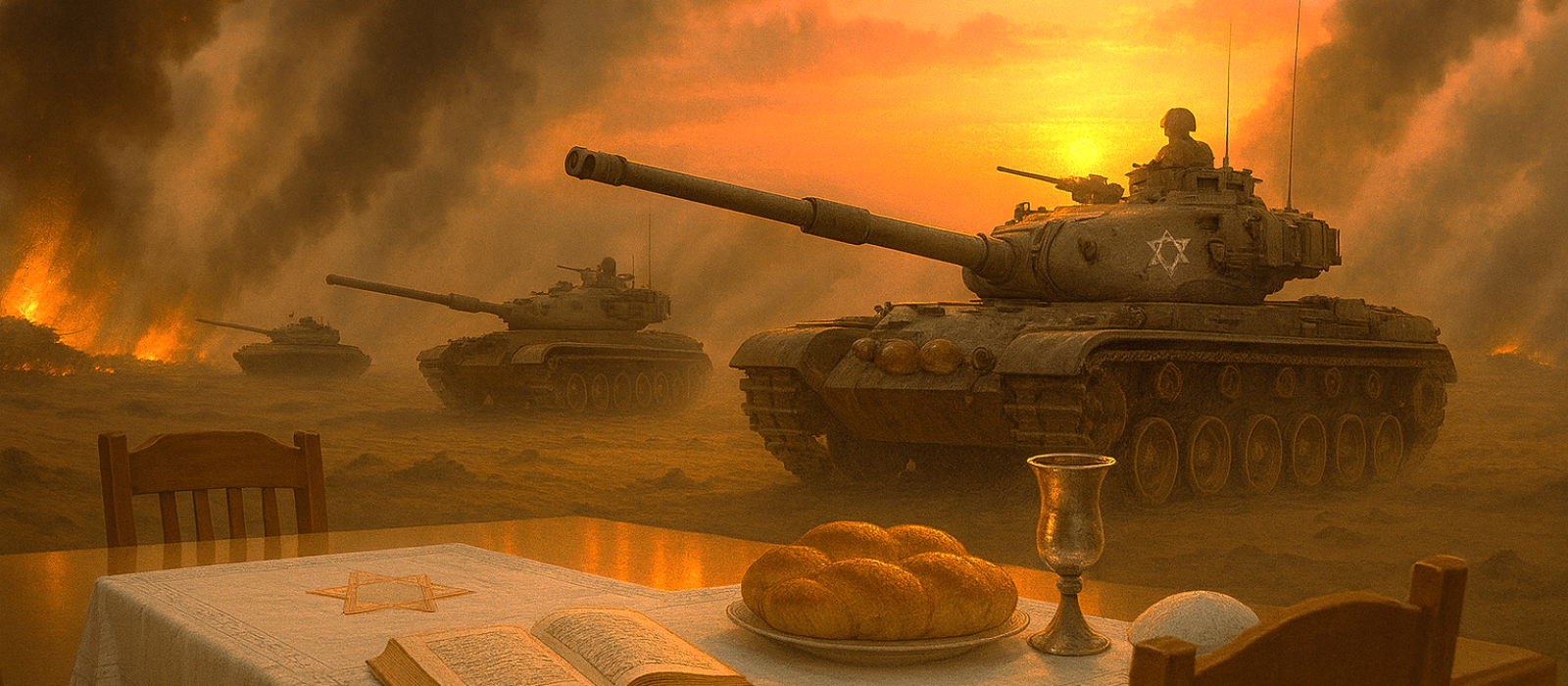
The sun had barely crested the desert horizon when the 143rd Armored Division reached its staging area near Be’er Sheva. The air was thick with diesel fumes, and the low rumble of engines idling filled the makeshift camp. Tanks sat in staggered formation, their steel plating coated in the fine, reddish dust of the Negev.
David stood near his Sherman, Ezra’s Vengeance, strapping on his helmet and radio headset. Around him, tank commanders from the brigade gathered around a field map spread over the hood of a jeep.
General Ariel Sharon stood at the center, his piercing gaze sweeping across the men. He was gruff, confident, and had a reputation for throwing conventional strategies out the window.
He didn’t waste time.
“We’re not here to wait for orders from Tel Aviv,” Sharon growled, pointing at the map of the Sinai. “The Egyptians have five divisions across the Suez. We’re up against T-62s, infantry, and God knows how many artillery batteries. They’ve already overrun most of the Bar-Lev Line, and they’re pushing east.”
David folded his arms, eyes locked on the red markers spread across the map. Egyptian tanks had penetrated deeper than intelligence had initially reported.
Sharon continued.
“We’re counterattacking. Hard. Fast. No hesitation. Our objective is to push them back toward the canal before they can dig in.”
One of the commanders, a young major, shifted uneasily. “Sir, reports indicate they have anti-tank guided missiles – Sagger missiles. If we rush in blindly, they’ll pick us off.”
Sharon exhaled sharply. “We don’t have the luxury of waiting. We hit them before they can regroup. We keep moving. If we stop, we die.”
David’s gut twisted. It was 1967 all over again – but this time, they weren’t the ones striking first.
Sharon’s gaze locked onto him. “Halevi, you’re leading the right flank push toward the Tasa crossroads. Your battalion will spearhead the advance and secure a path for the rest of the division.”
David nodded sharply. “Understood.”
Sharon’s eyes narrowed slightly. “I remember you from ’67. You led that charge through the Sinai. I expect nothing less today.”
David didn’t break eye contact. “We’ll get it done, sir.”
Sharon nodded. “Good.”
He turned to the rest of the commanders. “Alright, men. Mount up. You move in thirty minutes.”
☼ ☼ ☼
En route to Tasa crossroads, the battalion moved in a tight formation, kicking up massive plumes of dust as they barreled toward the Egyptian front lines.
David sat half out of the hatch, his eyes scanning the barren desert stretching endlessly in all directions. The Sinai was unforgiving – featureless, with nothing but rolling sand dunes and jagged rock formations. Perfect for ambushes.
His radio crackled to life.
“Recon reports Egyptian armor ahead. About three kilometers out. They’re dug in – waiting for us.”
David exhaled through his nose.
Of course they were.
He switched to his battalion’s frequency.
“All units, eyes up. We’re moving into engagement range. Keep spacing wide – we don’t know how many Saggers they have.”
A chorus of acknowledgments came through the radio.
Ben-Ami’s voice broke in. “You think they’re waiting for us, or are they just trying to hold the line?”
David didn’t answer immediately. He scanned the horizon, looking for the telltale glint of armor, the dark silhouettes of T-62s hidden among the dunes.
Finally, he spoke.
“They’re waiting for us.”
☼ ☼ ☼
The lead tank in David’s formation lurched violently, throwing a plume of fire and debris into the air.
A Sagger missile.
“CONTACT!” someone screamed over the radio.
David slammed down into the hatch, gripping the radio.
“All units, spread out! Suppression fire! Don’t let them reload!”
The roar of cannons filled the air as Israeli tanks opened fire, their 105mm rounds streaking toward the Egyptian positions.
David’s gunner, Ben-Ami, locked onto a distant T-62 partially concealed behind a ridge.
“Firing!”
The Sherman’s main gun belched fire, sending a shell hurtling forward. The round punched through the enemy tank’s armor, igniting its ammo storage. A second later, the T-62 erupted into flames.
David gritted his teeth.
The Egyptians weren’t retreating. They were holding their ground.
And they were ready.
The Egyptians counterattacked hard.
Artillery rained down from behind their lines, sending plumes of sand skyward. Machine guns chattered from hidden bunkers. More Sagger teams repositioned, looking for Israeli armor to pick off.
David’s tank jerked violently as a shell deflected off its tread plating.
“Damn it!” Ben-Ami cursed. “They’re focusing on the command tanks.”
David gritted his teeth. They had to break this position – fast.
He switched frequencies.
“Artillery command, this is Halevi. We need air support or fire missions – NOW!”
A pause. Then—
“Negative, Halevi. Air Force is stretched thin. You’re on your own for now.”
David cursed under his breath.
Then, an idea.
He flipped back to his battalion’s frequency.
“All units, listen up. We’re taking the right flank. On my command, we push forward – fast and low. We break their position and force them to retreat.”
A hesitant voice came through. “Sir, if we move too fast, we’ll be exposed.”
David’s eyes darkened. “If we stay here, we die.”
A pause. Then—
“Understood, sir.”
David’s radio crackled to life.
“Okay, then. All units – GO, GO, GO!”
The Israeli tanks surged forward, roaring through the sand, closing the distance before the Egyptians could adjust. A Sagger missile streaked past David’s tank – another near miss. Ben-Ami fired mid-motion, the shell slamming into an enemy position, sending Egyptian troops scattering.
One by one, the T-62s began to retreat.
One by one, the Egyptian bunkers fell silent.
The line was breaking.
David could feel it.
☼ ☼ ☼
With the crossroads secured, the last Egyptian tank crew abandoned their vehicle, running for their lives. The battle was over.
For now.
David climbed out of the hatch, wiping sweat and dust from his face. Around him, the battlefield was a smoldering ruin – destroyed tanks, scattered weapons, bodies.
Ben-Ami exhaled sharply. “We actually did it.”
David didn’t answer immediately. He turned to look west – toward the canal.
The real fight was still ahead.
His radio crackled.
“Command to Halevi. You’re being redeployed. New orders incoming.”
David sighed.
There was no time to rest.
The heat was unrelenting. Even in October, the Sinai felt like a furnace, the midday sun beating down on David’s battalion as they regrouped near the Tasa crossroads. The morning battle had left them battered but victorious, the Egyptian vanguard shattered and their tanks burning behind them. But there was no time to celebrate. David barely had time to pour water over his face before his radio crackled again.
“Command to Halevi—” The voice was strained, tense. “You are ordered to advance westward immediately. Egyptian forces are pushing toward the Mitla and Gidi passes. They’re trying to hold the Sinai. You must cut them off.”
David wiped the sweat from his brow, already calculating the logistics in his mind. This was exactly what the Egyptians wanted. They weren’t just retreating – they were leading Israel into a trap.
He glanced at Ben-Ami, who was leaning against the turret of their Sherman, gulping down water from his canteen. “You hear that?”
Ben-Ami nodded grimly. “Another push. They don’t stop, do they?”
David exhaled, gripping the radio transmitter. “Command, do we have air support for this push?”
A pause.
“Negative. The Air Force is tied up in the north, engaging Syrian and Jordanian forces. You’re on your own for now.”
David bit back a curse. The Israelis had underestimated the scale of the attack. The IDF had planned for skirmishes, not a full-scale invasion. They were outnumbered, outgunned, and now, without air cover.
Still, they had no choice.
David clicked to his battalion frequency.
“Alright, listen up. We’ve got new orders. We’re advancing toward the Mitla Pass. The Egyptians are falling back, but they’ll be waiting for us. Expect fortified positions, dug-in armor, and—” he hesitated, “Sagger teams. Again.”
A long silence followed. Then—
“Understood, sir.”
☼ ☼ ☼
The convoy kicked up a massive dust cloud as David’s battalion moved toward the Mitla and Gidi passes, two critical choke points in the Sinai Peninsula. If they could take them, they would cut off Egypt’s western forces from the Suez Canal, preventing a retreat.
David’s eyes swept across the terrain.
The passes were narrow, flanked by towering ridgelines – perfect for an ambush. The Egyptians had learned from their humiliating defeat in ’67, and this time, they weren’t relying on inferior tactics.
The desert was silent, unnervingly so.
Then, a flash of movement on the ridge.
David barely had time to react before the first missile streaked down from above. The explosion rocked the convoy, sending sand and shrapnel flying. A lead AMX-13 flipped over, its crew scrambling to escape before the flames consumed them.
“SAGGERS!” someone shouted over the radio.
David’s gut clenched. The Egyptians were waiting.
T-62 tanks emerged from hidden dugouts, their cannons roaring, sending high-explosive shells tearing into Israeli armor.
Machine-gun fire rained down from the cliffs, forcing Israeli infantry to dive for cover.
David slammed his radio. “All units, fan out! Find cover! Do NOT stop moving!”
Ben-Ami swiveled the Sherman’s turret, locking onto an Egyptian bunker embedded into the rocky hillside.
“Firing!”
The 105mm round struck home, obliterating the position, sending Egyptian soldiers tumbling down the ridgeline.
David scanned the battlefield. They were pinned down, unable to advance without clearing the cliffs first.
He switched frequencies. “Infantry, push up! We need those ridges secured! We can’t move until those missile teams are gone!”
Through the smoke, paratroopers advanced, dodging incoming fire as they fought their way up the treacherous incline.
The fighting was brutal – close quarters, grenades, bayonets. The Egyptians fought to the last man, but one by one, the missile teams were neutralized.
Finally, the guns fell silent.
With the ridgeline secure, the tanks pushed forward, bulldozing through Egyptian defenses. One by one, the T-62s fell, their wrecks burning in the sand.
David’s radio crackled. “Halevi, the Egyptians are in full retreat. We’ve secured the pass!”
He exhaled slowly. They had won the battle.
But this war wasn’t over.
☼ ☼ ☼
David climbed down from his tank, scanning the battlefield. Bodies lay scattered, the smell of burning fuel thick in the air.
He spotted Nadir, helmet under his arm, his uniform stained with sand and sweat.
Nadir smirked tiredly. “Another war, another ambush. You’d think they’d change tactics.”
David snorted, rubbing his aching neck. “They did. They just weren’t expecting us to hit back so hard.”
Nadir nodded, glancing at the smoking wrecks in the valley below. “You think this is it?”
David looked west – toward the Suez Canal.
“No. Not yet.”
His radio crackled to life.
“Command to Halevi. Final orders: You’re pushing to the Canal. The war isn’t over until we take it. Prepare to move out.”
☼ ☼ ☼
The night air was rank with smoke and dust, the glow of burning wreckage still casting eerie shadows across the battlefield. David’s tank battalion, battered but undaunted, rumbled forward under the cover of darkness. The mission was clear – reach the Suez Canal and hold it.
Egypt’s army was falling back, but they were not broken yet. Intelligence reports suggested last-ditch defensive lines, backed by artillery and reserve armor. The closer the IDF came to the Suez, the harder the Egyptians would fight.
David knew this battle would be the bloodiest yet.
☼ ☼ ☼
By 02:45 AM, they were en route to the canal. The convoy rolled forward, headlights dimmed. The desert stretched endlessly ahead, silent and waiting.
David sat hunched in his Sherman’s hatch, scanning the horizon through his binoculars. Every shadow, every shift in the sand could be a hidden ambush.
Nadir’s voice crackled over the radio. “You ever get the feeling we’re walking into a trap?”
David smirked tiredly. “Every damn time.”
Ben-Ami, sitting below, let out a dry chuckle. “At least it keeps things edgy.”
David’s amusement faded quickly. “Stay sharp. They’ll hit us before dawn. Mark my words.”
☼ ☼ ☼
Within a couple of hours, just as David predicted, the Egyptians made their stand.
The night exploded with light and sound as Egyptian artillery opened fire, their rounds screaming through the darkness. Shells rained down, sending plumes of fire and sand into the air.
“Incoming!” someone shouted over the radio.
David’s tank lurched violently, a shockwave rocking his bones as a shell detonated nearby.
Through the haze, silhouettes of enemy tanks emerged, their T-62s lined up, waiting for the Israelis to advance.
David grabbed his radio.
“All units, engage! Keep moving! Don’t give them an easy target!”
The Israeli tanks surged forward, their main cannons roaring, sending rounds tearing through the Egyptian lines.
The fighting was ferocious.
Every inch forward was met with resistance – enemy machine guns, mortars, and RPGs lighting up the desert.
Nadir’s tank took a hit, the side armor caving in.
David’s heart clenched. “Nadir! Do you copy?”
A long pause. Then—
“Still here, but that was too close! Tell your gunners to take out those damn anti-tank teams!”
David nodded to Ben-Ami. “Hit them hard.”
The Sherman fired, sending a shell directly into an Egyptian AT position, silencing it forever.
The Egyptian defenses had cracked. Their lines collapsing, soldiers abandoned their tanks and fled toward the Suez.
“They’re breaking! Press forward!” David shouted.
One final charge – and they reached the canal.
☼ ☼ ☼
David stood atop his tank, watching as the first Israeli forces secured the western banks of the Suez Canal. The sun rose behind them, painting the sky with hues of red and gold.
Egypt’s forces were in full retreat.
Then, the radio crackled again – but this time, it wasn’t an order.
It was news.
“Ceasefire declared. The war is over. Repeat: A ceasefire has been declared. Israel holds the Sinai. Egypt is withdrawing.”
☼ ☼ ☼
The old Peugeot rumbled up the familiar road, its tires kicking up dust and pebbles as it approached the Halevi home. The same workhorse that had carried David, Nadir, and Ezra to war now brought them home.
As they pulled up to the house, the front door burst open.
Rivkah stood in the doorway, her eyes wide, her hands pressed against her mouth. The children crowded around her, barefoot on the cool stone porch, their faces a mix of hope and hesitation.
David barely had time to shut the door before Shimon launched himself forward, his little arms wrapping around his father’s waist. Then came Miriam, Ilana, Eli, and finally Leah, clutching at his uniform, tears streaming down their cheeks.
Nadir had barely stepped out when his own children tackled him, giggling and sobbing all at once. Leila hurried forward, her eyes wet, pressing a trembling hand to his cheek before pulling him into a fierce embrace.
Ezra, who had been sitting silently in the passenger seat, climbed out slowly, taking in the scene. He let out a shaky breath before stepping toward his mother.
Rivkah grabbed his face in her hands, searching his eyes, her fingers brushing through his dust-caked hair. “My boy,” she whispered, pulling him against her chest.
David stood still, watching them, his heart pounding. Then, finally, Rivkah looked up at him. For a moment, they simply stared at each other. Then she crossed the distance, her hands reaching for his face, her lips trembling.
David pulled her in, holding her tightly, her head nestled in his chest.
“I’m home,” he whispered.
☼ ☼ ☼
Inside the Halevi home, everyone was determined to celebrate a belated Yom Kippur breakfast feast. The house was filled with warmth, the scent of fresh bread, eggs, olives, and cheese filling the air. Despite the shattered holiday, despite the war that had robbed them of peace, the family came together.
Nadir and Leila settled at the long wooden table, their children squirming excitedly in their seats. Yitzhak sat at the head, his pipe unlit for the first time that evening.
Rivkah placed a steaming kettle of mint tea in the center, along with bowls of lentil soup and platters of dates – traditional dishes for breaking a fast, even if it was two days too late.
David lowered himself into a chair, rubbing his aching temples. He caught a glimpse of himself in the window’s reflection. The gray in his hair had deepened.
Four wars.
Four wars had etched lines into his face, had taken too many of Israel’s best – many of them his best friends. And now, even after victory, even after Israel had stood its ground once more, there was no sense of triumph. No sense of relief, just a sense of survival.
☼ ☼ ☼
The food was amazing. The children had long since left, leaving the adults in animated discussion. As the meal was cleaned up, the conversation shifted as it always did.
“They will never stop,” Ben-Ami muttered, swirling the tea in his cup. “If we leave them in Sinai, they will rebuild their armies again. We should have crushed them completely.”
“You mean genocide?” Rivkah’s voice was quiet but sharp.
Ben-Ami shrugged. “I mean finishing the fight. How many times must we bleed before we say enough?”
Leila shook her head. “And what of their families? Their children? If we go down that road, how are we any better?”
Yitzhak exhaled heavily. “No one wants that. But tell me – do we keep letting them try to kill us? Because every ceasefire is just a pause before the next war.”
Ezra, silent until now, finally spoke. “Then where is the line?” he asked.
The room fell quiet.
David stared into his tea, his thoughts heavy. He had looked into the eyes of the enemy, had seen young Egyptian soldiers barely older than Ezra, terrified, bleeding, dying.
Were they truly so different?
And yet, he had also seen the shelling of civilians, the bodies of children pulled from the rubble of Israeli settlements.
“I don’t know,” David finally admitted. He met Ezra’s gaze. “But it cannot be hatred. And it cannot be mercy for those who will never show us any.”
“It is Yom Kippur,” Rivkah said softly, glancing at David, “the Day of Atonement.”
David rubbed his face.
“We seek atonement from God, don’t we? But don’t we owe that to our enemies?”
Leah, young but wise, spoke up. “Didn’t Hashem command us to seek justice?”
“And to forgive those who repent,” Miriam added.
Yitzhak scoffed. “Let me know when they repent.”
David let out a weary sigh, pushing his plate aside. “We will do what we must to survive. But we will not become them. We cannot become them.”
☼ ☼ ☼
Despite the debate, the family lingered at the table, enjoying the rare moment of stillness, a rare moment of peace.
Ezra, sitting beside his father, squeezed his shoulder. “I’m glad you’re home, Abba.”
David reached over, ruffling his son’s hair like he had when he was a boy. “I am too.”
As the night stretched on, David sat back, listening to the laughter, the voices, the life that filled the room. For now, for this single moment in time, the war was behind them.
And that was enough.
Used with permission by the author. Find the author’s complete works online: Complete Works of Mack Samuels