
3162 AM (598 BCE) – HULDAH AND THE LOST SCROLL
“And when the Amalekite came to King David and claimed responsibility for killing King Saul in hopes that he would get credit, do you remember what King David said?”
Jedidah, Josiah’s mother, was teaching Josiah just before bed. It was their special time. Josiah, the new King of Judah at just eight years old, was by no means able to rule, but his time was nonetheless occupied with school and training and all the worldly skills a King needed to be equipped with. But mom got Josiah for the last few hours before he went to bed, and the first few hours when he got up in the morning.
“Um,” Josiah replied, “you told me this one before. The Amalekite was probably lying, because we learned before that Saul was wounded and had fallen on his sword. David may have known that the Amalekite was lying, but maybe not. If he didn’t, he took the Amalekite at his word, and as David had demonstrated before, one does not lay a hand on Adonai’s anointed. But what if David had known? Did he kill an innocent man?”
“Wow, that’s a good question,” Jedidah praised. “I think that is truly a hard question to answer. What do you know about David’s character? Would he kill someone who was innocent?”
“No!” Josiah stammered, both annoyed and flustered. But then his countenance changed, and his spirit fell. “Yes,” he muttered softly.
“Kings make mistakes,” Jedidah reminded Josiah, “but a good king does what with his mistakes?”
“Um…” Josiah wondered.
Jedidah knew Josiah knew the answer, so she prompted further, “Okay, I will give you a clue: Nathan.”
“Ah!” Josiah yipped gleefully. “When David made his mistake and Nathan confronted him, David repented, made atonement, and humbly faced the consequences, choosing to put himself in the hands of Adonai rather than men!”
“Yeah, sure. I think you might be mixing a few stories, but you are not wrong. It is better to be in the hands of Adonai than the hands of men. That is so true. All right, that is enough about David for today. Tomorrow, we can study—”
“David!” Josiah said gleefully, as he knelt energetically in his bed, not wanting to acquiesce to sleep any time soon. “We gotta keep studying David! Is there a better example? The rest of Judah’s kings were … meh. And I can’t stand to study Israel’s kings— they are so horribly awful. Let’s study what is good and true, and that’s David!”
Jedidah managed to get Josiah back in a prone position, with blankets attempting to secure him into that position for the night. “Okay, you go to sleep so your mind will be sharp, and we can study David tomorrow.”
☼ ☼ ☼
The next morning, after morning prayers, while servants brought in breakfast, Jedidah asked Josiah the following: “What does it mean for David to be a King after God’s own heart?”
Josiah had grabbed a gnarly piece of rubbery bread soaked in olive oil, and he was chewing on it like a rabbit might, going after a freshly sprouted shoot. “Um,” he attempted to answer between chews, “Adonai wants us to be good, to just love him and love the people around us, to protect the people and lead them to Adonai and not away from him.”
“And how do you lead people to Adonai?” Jedidah inquired.
“Well, um, by example. I mean, I guess I need to be as close to Adonai as David was.” His chewing slowed as a new realization came across his young face.
Without missing a beat, his mother followed up, “And how do you do that?”
But the King’s countenance had fallen. He was troubled. Looking up to his mother in a panic, he said simply, “I don’t think I know how. Do you?”
Jedidah felt as if she was falling down a dark well. She attempted a smile, but none was forthcoming. She pondered how David grew so close to Adonai. What was it? What did he have? She turned back to Josiah and spoke with a very positive timbre, “I will tell you what: I will ask one of the priests. They should know. I should have an answer for you by tonight. Okay?”
Josiah beamed with delight. But the truth was, it would not be for another ten years until Josiah got the answer to the question he was looking for. Like everyone, Josiah was always faced with two choices, good or evil, life or death, obedience or disobedience. Josiah was the kind of child who always wanted to choose the right and good and obedient thing.
But that will only take you so far.
☼ ☼ ☼
The next morning, after morning prayers, while servants brought in breakfast, Jedidah asked Josiah the following: “What does it mean for David to be a King after God’s own heart?”
Josiah had grabbed a gnarly piece of rubbery bread soaked in olive oil, and he was chewing on it like a rabbit might, going after a freshly sprouted shoot. “Um,” he attempted to answer between chews, “Adonai wants us to be good, to just love him and love the people around us, to protect the people and lead them to Adonai and not away from him.”
“And how do you lead people to Adonai?” Jedidah inquired.
“Well, um, by example. I mean, I guess I need to be as close to Adonai as David was.” His chewing slowed as a new realization came across his young face.
Without missing a beat, his mother followed up, “And how do you do that?”
But the King’s countenance had fallen. He was troubled. Looking up to his mother in a panic, he said simply, “I don’t think I know how. Do you?”
Jedidah felt as if she were falling down a dark well. She attempted a smile, but none was forthcoming. She pondered how David grew so close to Adonai. What was it? What did he have? She turned back to Josiah and spoke with a very positive timbre, “I will tell you what: I will ask one of the priests. They should know. I should have an answer for you by tonight. Okay?”
Josiah beamed with delight. But the truth was, it would not be for another ten years until Josiah got the answer to the question he was looking for. Like everyone, Josiah was always faced with two choices, good or evil, life or death, obedience or disobedience. Josiah was the kind of child who always wanted to choose the right and good and obedient thing.
But that will only take you so far.
☼ ☼ ☼
The men scattered, grabbing what they needed and heading toward any of the few prophets known about in the land. A small contingent of priests and scribes, including Hilkiah and Shaphan, came upon Huldah the prophetess. She was very hospitable, especially to the delegation the King had sent. She made sure they had food and drink, along with a place to recline and eat.
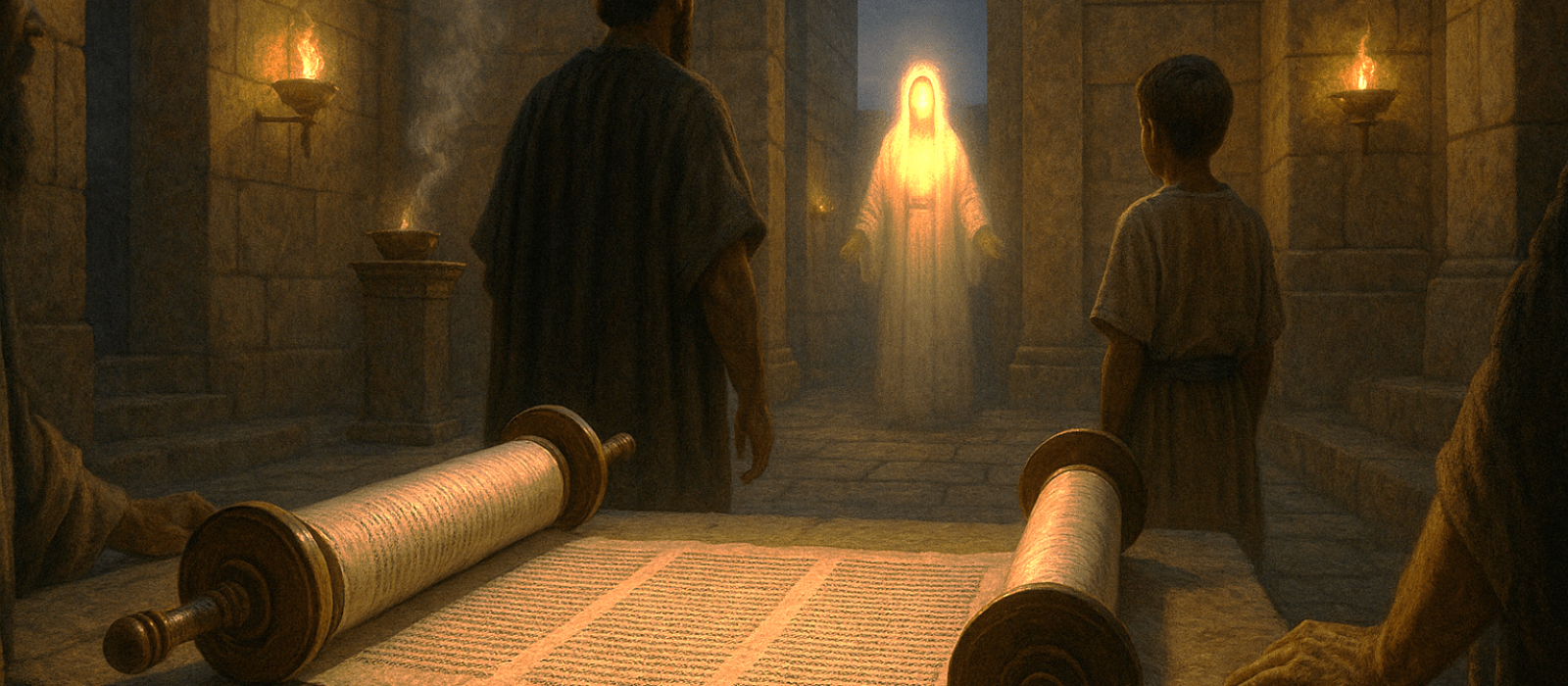
Once they were comfortable, Shaphan broke the silence first: “We found a Torah scroll. We thought they had all been destroyed. Then we read it. Then, we were terrified.”
Huldah watched and listened as they spoke with her, describing all that had happened the previous day. As Huldah listened, she asked an occasional question here or there for clarity.
It was Hilkiah who was now speaking, saying, “So, if you are willing, O prophetess, would you bring our petition to Adonai?”
“Your petition?” Huldah inquired further. “What is your petition?”
Hilkiah continued, “Oh, well, like we were saying, um, it’s complicated. I mean, Judah is not following Adonai, and we have the Torah once again, and it is overwhelming, and we just don’t know what he wants us to do. Would you tell Adonai our petition?”
Huldah thought for a moment. “Well, it is not for me to tell Adonai anything. He already knows your hearts, your fears. But I will listen to him on your behalf.” Huldah stood and closed her eyes, her hands also covering her eyes. “Hear, O Israel, if you can, to Adonai, your Creator, and to him alone.”
Moments passed, and then she looked at everyone. Her fingertips trembled, and she curled them into fists.
“Adonai says… Behold, I am going to bring disaster on Judah. Like Israel, the people of Judah have abandoned me. You burned incense to other gods. My wrath burns against this place, and I will not allow my anger to be quenched.”
“To your King, this is what Adonai says… Since you have a tender and kind heart, and because your mother has taught you humility and you have chosen to be humble before me, because you have torn your clothes in grief and horror when you read my words and realized what Judah has done against me and what I must do against Judah and its inhabitants, because of this, I have heard you, and I will gather you to your fathers before I bring the devastation. You will be gathered to your grave in peace, and you will not have to see the inevitable, utter devastation.”
☼ ☼ ☼
When the King’s envoy relayed all the words of Adonai to Josiah, he began reforms similar to Hezekiah and Asa and the many righteous kings that had come before him. He started with the temple, removing utensils and objects dedicated to foreign gods, removing the additions on the top of the temple, and the abominations surrounding the inner and outer courts, along with all of the occult additions around the Temple Mount, all of which were dedicated to many of the gods of all the surrounding nations put up by the previous wicked kings of Judah.
Then Josiah tore down the male prostitution cults, many other of the high places, horses and chariots dedicated to the sun and the moon, destroyed the hands of Molech, and all the other horrid altars, including the ones in Bethel and Shechem and the high places there. And all through Judah and Israel, Josiah went on a rampage against every idol, high place, and false altar.
Then Josiah removed the priests, the spiritists, and the mediums from Judah and the surrounding areas, from Geba to Beersheba, who were dedicated to the foreign gods and the occult. He destroyed all that could be found in Judah and Israel, and he burned them all, scattering their bones to defile the high places in Shechem and Bethel, just as it was prophesied back in the time of Jeroboam and Rehoboam, when the kingdom given to David was first split in two.
With all the idolatry purged, the cancer was removed, the mass formation of evil in the minds of the people broken, the hearts of many turned back to Adonai, though some were angry that their debauched life was destroyed. But for the faithful, it was a joyous time when Passover was celebrated, for the first time in a long time, in the eighteenth year of Josiah’s reign. It took nearly a decade for Josiah to cleanse the land.
☼ ☼ ☼
Five years after the cleansing was completed, in Josiah’s 23rd year as King, Adonai sent Huldah to visit Josiah. Eagerly, the King welcomed this uninvited guest.
“Greetings!” Josiah began heartily, with just a sprinkle of nervousness. “What brings you to Jerusalem? Good things, I hope? Staving off divine judgment?” he said with a nervous laugh.
“Good things, indeed,” Huldah replied.
They stared at each other for a moment, then Josiah realized his faux pas. “Oh, please, let’s sit. I am sure it was a journey.”
“Thank you, it was.”
The King took Huldah to an anteroom, and servants seated Huldah and the King, while others were preparing refreshments. The King sat quietly, patiently just waiting on Huldah.
She noticed and continued, “Well, Adonai is very happy with what you are doing, your effort, and your zeal. But, uh, this is still kind of hard to say.” She sighed hard before continuing, “There is no staving off.”
Huldah watched Josiah’s face as his positive complexion melted into severe consternation. “What do you mean?”
“You have to understand, King Josiah, your zeal has connected with many in Judah and even some people in Israel. But it’s just not enough.”
Josiah interrupted, “What do you mean, not enough? I can make it enough. Just tell me what I need to do!”
“It can never be enough. You just don’t understand what has to happen or why. The rebellion, the wickedness that Manasseh caused the people to do—no amount of good on your part can undo that much willful defiance. And this Messiah complex you have—it’s not your place. You cannot save everyone. Adonai promised simply that you would not see the fall of Judah to the Babylonians as acknowledgment of your efforts. He never said that he would forestall the judgment indefinitely. Judgment must come. You read the Torah; you read Adonai’s words. Judgment must come, else Adonai would be a liar. And that is something he certainly is not.”
“What … what can I do?” The King asked that half like he was offering assistance, and half like he wanted to find a loophole.
“What you can do,” Huldah spoke with almost maternal affection, “is to let it happen. Adonai is not a reed blowing in the wind. He doesn’t change his mind. He doesn’t wake up and say, ‘Do you know what just occurred to me?’ He is infinite and eternal. You and I—we could never understand that depth of existence. But what we can understand is obedience.”
“But I can’t!” Josiah shouted, causing everyone in the room to stop and turn. But he didn’t care. “I can’t just let it all burn! And it’s not even how much work I have put into Judah and Israel. I love these people with my life! I would give my life to protect these people from Babylon, Assyria, Egypt…”
“Dear King, you are not the only one willing to give his life for this nation. But now is not the time. One day, but not now. But if you want to lay down your life to try and protect your people, as futile as your effort will be, Adonai will not stop you. He certainly does understand what it means to want to lay down your life to save everyone. Take care, dear King. Take care.”
Huldah politely set down her drink, gathered her things, and, with a slight bow, left the King to his ultimate destiny…
Used with permission by the author. Find the author’s complete works online: Complete Works of Mack Samuels