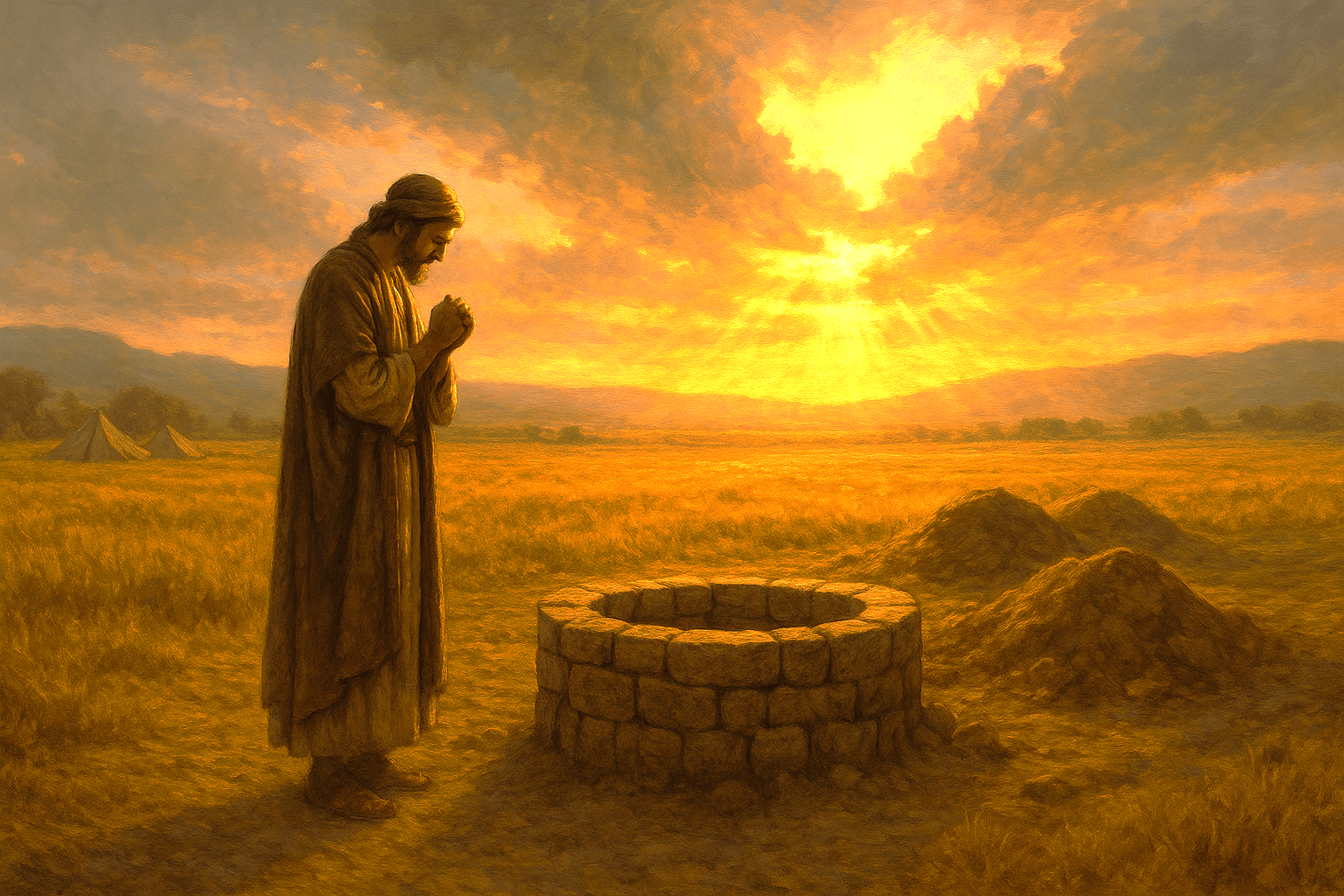


3124 AM (636 BCE) – INSOLENCE AND HUMILITY
King Manasseh was incensed. Angry. Livid, even. He was boiling on the inside, but his exterior betrayed nothing. How could he? He was King. Not that he was afraid of what his subjects would think; they were back in Jerusalem, and he was … where?
Manasseh looked around, but he did not recognize any of the landscape, neither near nor distant. It had been weeks since they had been led out of Jerusalem, headed northeast, surrounded by Assyrian guards. They had left northern Israel and passed through the Transjordan, where Manasseh recognized the Moabites and the Ammonites. But since they crossed the Euphrates: the dress, the culture, the food—well, the food was still terrible. But the culture was radically different.
Finally, as the group arrived at a large city the Assyrians called Mari, several of the prisoners were removed from the various columns, and new ones added. They also changed the guards with presumably fresh ones. When morning came, some of the columns were loaded onto boats, and they headed downstream.
But Manasseh was not among those. He joined the group that continued on foot, heading up the Euphrates River. Little did Manasseh know that even though they would be traveling along relatively level ground, on well-worn paths, in beautiful scenic vistas, they would not stop walking for nearly three weeks. But then they arrived … in Babylon.
“Babylon?” Manasseh pondered to himself, “Why Babylon?”
☼ ☼ ☼
As the column entered the city of Babylon, they would stop every half hour or so, and prisoners would be delivered to this labor area or that prison or this brick facility or that grain mill.
Deeper and deeper into the heart of Babylon they marched, and thinner and thinner the ranks of prisoners and guards became. As they headed to the royal palace in the heart of the city, King Manasseh alone was left with the original Assyrian officer who had accompanied him since they left Judah.
Manasseh was marched into the palace and taken to a fairly comfortable room. There, servants washed him and got him dressed to be presented before their king, Nabopolassar. Manasseh looked at the ornate robe he was given. It was deep red, with gold trim, and was covered in Babylonian iconography.
Manasseh was deeply intrigued and inspected the robe closely. He was familiar with some of the icons from his own worship back in Judah, while others were entirely new.
☼ ☼ ☼
Manasseh was presented to the King, who greeted him with great enthusiasm. There was a banquet and many guests. Manasseh was to be among them.
“You cleaned up well,” King Nabopolassar said with genuine sincerity. “I am pleased you were able to make the journey. I was not sure you would. You seem stout. Please,” the King motioned to everyone to begin, “Please! You must be famished!”
Manasseh half-smiled, trying to be polite, but the situation was so surreal. What was this? What was going on? He had been force-marched to Babylon of all places, by the Assyrians of all people, for over a month.
And they give him a dinner party? OK …
“I am,” Manasseh said, taking only a polite portion. He regally completed that plate, with the manners and grandeur any king should have, and ten more like it—but slowly, over the course of the conversation.
“If I may be permitted,” Manasseh began, looking to King Nabopolassar, who gestured to him to continue, “what is this all about? I mean, the Assyrians attacked us, took a few prisoners, brought me here?”
Manasseh let his observations hang, looking for King Nabopolassar or anyone else to pick up his train of thought and add some clarity.
It was the Assyrian officer who spoke first. “King Manasseh, I am but a humble Assyrian commander. I do not know you, and you do not know me. But your god came to one of our priests, one of the ones we brought to Samaria from the exile of Israel. Anyway, your god spoke to this priest and said the priest was more faithful to your god than you were, even though he was a Samaritan.”
The Assyrian paused to scoop up something that looked like hummus with something that looked like a corner of pita. He savored the flavors, and then looked back at Manasseh.
“You see,” the Assyrian said, “it was not great King Nabopolassar of Babylon who brought you here, or even great King Esarhaddon of Assyria who brought you here. It is your god that has sent you into exile.”
Manasseh was perplexed. “For what?” he blurted like a young child.
“Oh,” King Nabopolassar started to say with a knowing grin, “I think you know why.” King Nabopolassar turned to the Assyrian. “Let me ask you something.”
The Assyrian commander bowed magnanimously to the King in acknowledgement, so the King continued, “How many wives do you have?”
The Assyrian stroked his gray and black beard. “Interesting question. I have four.”
“Four?” the King replied, elated. “And do you sleep with any other women aside from them? Even when you are away on a mission? Or lonely? Or bored?”
“Never,” said the Assyrian. “It would be a betrayal of family.”
“I see,” the King said to the commander. “And how many gods do you worship?”
“That, well,” the Assyrian said, smiling, “I honestly could not tell you. There are so many. Assur, Ishtar, Shamash, Nanna, Hadad, Nabu, others I’m sure.”
“Marduk?” the King interjected politely.
“No offense, great King, no. I do not worship Babylonian gods. If I were to leave Assyria and become a Babylonian, then certainly, but then I would not worship the Assyrian gods. It would just be, I don’t know, somehow wrong.”
The King was very satisfied with the commander’s answer. “Quite right you are, Commander, quite right you are. Dessert?”
“Oh yes, please,” the commander responded.
Manasseh was as apoplectic as he was confused. He wanted to say something, but words would not come. Servants brought desserts to all at the table. The King and the commander immediately began enjoying the delicacy. Manasseh looked down and stared at the dish, but then looked back up at the King.
The King and the commander watched the consternation on Manasseh’s face. They could not take it any longer, and both of them burst into laughter. It was the King who decided to put Manasseh out of his misery.
“OK, fine,” the King said, setting down his fork. “Look, you, oh great King Manasseh, have not been faithful to your god. I must be honest. I have never heard of a god that is as jealous as your Adonai. I have certainly never heard of a god taking the time to personally come down and ask an enemy to do what he has asked us to do.”
Suddenly turning to the commander, King Nabopolassar asked, “Have you?”
“Never, great King, never,” he replied.
Turning back to Manasseh, the King continued, “Yet, yours has. What are we to do? I presume if Marduk asked you to do a similar thing, you would have obliged? In any case, it doesn’t matter. It is what it is. Your Adonai is, how we might say, upset, and, well, here you are.”
The King turned his attention back to his dessert, while Manasseh fought for words. Finally, he was able to choke out, “So, what—what does he want you to do?”
“Ah,” the King once again smiled his regal smile, “straight to it, then. He wants us to teach you fidelity.”
“Fidelity?” Manasseh repeated.
“Fidelity,” the King emphasized. “And he even told us how he wants it done. Every morning, you will be woken up before dawn. You will be dressed for the day. You will be taken to one of a dozen different places where hard labor is required. You will be harshly treated. Then, when the prisoners are released for the night, you will be brought back here. You will be cleaned up and dressed, and then you will enjoy a meal with myself and our wonderful Assyrian commander here.”
“We will talk about … well, whatever comes to mind, I suppose. But fidelity is the lesson you are to learn. If you resist, you will be whipped like any slave. If you comply, you will be treated well. In any case, you will find yourself here every night. If you have a problem with that, I imagine you should take that up with your Adonai.”
Manasseh was dumbfounded.
“Are you going to finish that?” the Assyrian asked, half-joking.
Again, Manasseh looked down at his plate and then at the officer, and then shook his head. “OK, then,” the Assyrian said, “let’s get you to bed. Big day tomorrow.”
☼ ☼ ☼
The next morning came incredibly early. Servants came and dressed the king every morning. Getting up wasn’t an option. He was not given a breakfast or a midday meal. His only meal would be with the King every evening, where the King and the Assyrian would continue their various anecdotes about fidelity to wives and fidelity to gods. It annoyed Manasseh to no end.
He hated it.
During the days, he worked harder than a mule and was treated worse than one. During the day, the great light left its marks on his back. At first the redness, then the blisters, then the brown. He would sometimes stop his work and scream to the heavens. This, the guards permitted, so long as he eventually continued his work. Water was the only sustenance permitted during the day.
Sure, a few times, Manasseh tried to be obstinate. He was King, after all; he did have his pride. But the Babylonian whips quickly kept his defiance to Adonai in the quietness of his own thoughts. While his body was physically punished during the day, and his mind was mentally tortured during the evening meal, Manasseh would struggle with Adonai quietly in his own thoughts.
But Adonai’s rebukes were not easy, either. Every time Manasseh would attack Adonai, Adonai would simply show him an image of the various idols or occult practices or infanticide that Manasseh had inflicted on the people of Judah. Moreover, Adonai would let Manasseh see it from Adonai’s perspective.
Day after day, Manasseh would wrestle with Adonai, and Adonai showed Manasseh the value of life and the difficulty of preserving life. Adonai then showed Manasseh how the Dragon, that great serpent of old, hated life and created these false gods, occult and fertility practices to actually destroy life, not to help with fertility or spiritual knowledge. The practices led to death and sterility of the body as well as the soul.
But Manasseh was stubborn. Weeks turned into months. Despite the rich food the King was serving, Manasseh’s body was becoming lean and strong. Manasseh remained stubborn, but the Assyrian commander and King Nabopolassar remained ever eager to assist Adonai, and continued their many moral lessons that had helped build Assyria and Babylon into the great empires they were.
☼ ☼ ☼
“You see,” King Nabopolassar expounded during one such meal, “we have a set of laws that were handed down to us from, I believe, your very own Noah.”
This got Manasseh’s undivided attention.
“Oh yes,” the King stammered, elatedly, “oh yes! Very simple laws, really. I mean, we have built quite the legal system, you understand. But, nevertheless, the core is there—fidelity to your gods and wives, the sanctity of life, treating animals well, and enforcing the law justly and consistently. This we have done. This the Assyrians have done. Sure, we war over land and customs, but typically because one or the other feels that some form of these laws has been violated.”
“I would say that is accurate,” the mostly silent Assyrian commander added. “For the most part, we get along. Skirmishes happen; so does war. It’s just part of life. We all have to die. Might as well be for principles or our land or our gods.”
“Quite right,” King Nabopolassar gleefully exclaimed. “You have a land, Manasseh, and you have a god who obviously loves you and your people. Why else would he go to these lengths? If I were not a Babylonian, if I did not have a country, I would certainly consider Judah. Never have I seen such a personal, loving god. You know,” King Nabopolassar said, turning to the Assyrian, “of all my wives, only the jealous ones are the ones that I know actually love me. Have you noticed that?”
“Indeed, oh great King, indeed,” the Assyrian said with a gentle laugh.
☼ ☼ ☼
As Manasseh was ushered to bed later that night, the evening’s discussion haunted him—especially that Assyrian’s laugh. It was pregnant with … with … Manasseh wasn’t sure. But it haunted him that night, and throughout the following day. The work was brutal. The food and the rest made it manageable, but the stronger he got, the more was demanded from him.
Finally, like an earthen dam overcome with the force of a spring runoff, the heart of Manasseh burst forth. He was carrying a load of bricks heavier than most men. They dropped to the ground as wails of grief and sorrow flooded from his soul. Guilt from years of rebellion weighed heavier on him than all the bricks he had ever hauled on his back. He cried out to Adonai—broken, in tears.
Adonai listened.
Somehow, the guards knew. A guard escorted Manasseh back to the palace. The Assyrian was waiting for him. He said nothing. Manasseh was cleaned up and dressed in fresh clothes ideal for traveling. Without a word, the Assyrian commander led the king all the way back to Judah.
Once there, the people were amazed. Who was this man? He looked different! He sounded different! He acted radically different! Manasseh, with his physical prowess and refined convictions, quickly ended—with prejudice—the idol worship and the foreign incense. He ended the occult practices and spiritism. He ended the infanticide.
Manasseh tried to get Judah right with Adonai. He had a positive influence on the land, though those who loved evil hid their evil from him. And while Manasseh started out as a horrible king, he at least ended well.
Unfortunately, not as much can be said about his son, Amon. But Amon’s evil was so severe that only two years into his rule, the servants who longed for what Manasseh had started killed Amon in his own house.
Many wanted to return to the evil ways that Manasseh had instilled in the land, despite Manasseh’s change of heart. They were angry with the servants for killing the wicked Amon because he was righteous in their eyes. So, the wicked people of Judah rose up and killed the servants of Manasseh.
Actions have consequences. And although Manasseh had repented, Judah had to endure the debilitating evil and infidelity he had a dominant hand in reestablishing. It was because of Manasseh that Adonai permanently fixed the date for the exile of Judah to Babylon.
Used with permission by the author. Find the author’s complete works online: Complete Works of Mack Samuels