
3015 AM (745 BCE) – ANGEL OF DEATH
The advanced scouts had recently returned. And just as Hezekiah had feared, the Assyrians were starting to head down from Samaria. For generations, the Assyrians strengthened their foothold in Samaria. They controlled vast areas of Israel, and through some population replacement, with immigration and simple population growth through reproduction, the standing Assyrian army in Samaria was vast, consisting of nearly all native Samaritans.
And these Samaritans were certainly not good and moral people. Their armies were legendary in their cruelty and notorious in their terrorism.
Samaria, as King Hezekiah knew it today, started as some Assyrian farmers, some Hebrew priests, and a whole lot of pagan influence. Perhaps not as much idol worship as Israel before Adonai sent Israel into exile in Assyria, but that was then. More recently, after the last four great kings, when a long sequence of evil kings of Judah undid all the progress made against the false idols, the Assyrian army had made incursions. These border clashes were extremely violent, leaving the kind of terror in their wake that caused fear and frailty among the ranks of the army of Judah.
Hezekiah, a rare, good king, wished he could have been alive then, so that he could have prevented the falling away. He would have… he would…
Hezekiah sighed.
He would have done what he is doing now: destroying idols and high places, trying to turn the people’s heart back to Adonai. And yet, it was like trying to turn an ox by its horns without an ox goad. The cumulative momentum of the wickedness in Judah was just extremely overwhelming. And now, despite the warnings of Adonai, the pleading of his prophets, and the strong admonition of the king, the ox stayed fast on its course to destruction.
And now, the Assyrians—strong, numerous, confident—had invaded. Whichever of the outlying cities they happened upon surrendered. But it mattered little. They were to be an example. Everyone was brutally murdered—men, women, children, infants, animals. People were beheaded, dismembered, and left to bleed out… or not. Pregnant women were disemboweled and left to suffer. The animals were just butchered and not even eaten—too unclean for even the Assyrians. And the children…
“Stop!” the king commanded the advanced scout. “Just stop. I get it. They are terrorists. They wanted to send a message to the fortified cities. I get it!”
His Highness, Hezekiah, the king of Judah, was having a royal panic attack. It’s not like he didn’t know what the scout—what other scouts, what all the scouts—had already reported. It all just proved to be insurmountable.
Hezekiah watched and waited. He watched as column after column of Samaritans entered the valley and made camp. He watched as the camps slowly encircled the entire fortified City of David.
Hezekiah was grateful for Isaiah, who told him this day would come. Despite his efforts, and despite his progress, the people had to understand what Adonai meant when he said, “Just as it was in the time of Adam, the wages of rebellion would surely be death.”
Hezekiah understood all too well. Once upon a time, Joshua and all of Israel cleared the land of the Amalekites for exactly the things Judah had recently done, but the Amalekites just seemed far more brutal. He listened to Isaiah and the dark harbingers of Adonai, and he rebuilt the walls of Jerusalem, fortified the parapets, and secured the water sources. And now, the Assyrians were here. Jerusalem was surrounded.
☼ ☼ ☼
In the distance, a cloud of dust approached. Hezekiah spoke to the leaders of the city, “Go and tell the people of Jerusalem to seek Adonai and petition his salvation. Our situation is beyond our abilities. Adonai alone can save us.”
Just then, the dust cloud arrived. It was the general of Sennacherib’s army who approached, along with a full detachment of men as an escort. King Hezekiah watched from the fortifications as the men took up defensive formation. The king shouted down in Akkadian, “Greetings. What brings you here on this hot, dusty day?”
The general was amused. He looked around and, convinced there was nobody lying in wait, turned to address the king. In Akkadian, he replied, “What is the meaning of this? Did your scouts not relay our sentiments to you? Did you not understand what would happen to you if you resisted the will of the undefeated Sennacherib? We will fillet you, not to put too fine a point on the matter. And what is this? I find you locked away, like a child hiding in a cellar? And what should I think? That these people want to be destroyed? Is it that you want to die? Is going into captivity really a worse alternative, than the alternative?”
An arrogant smile was laminated on the face of the general as he continued to speak, but this time he spoke in Hebrew so that all on the walls could hear. His Hebrew was flawless.
“But then,” he started, his index finger lightly tapping his temple, “I begin to say to myself, ‘What if they believe their god will protect them?’ But then I laugh, again saying to myself, ‘They would not be so foolish, would they?’ After all, let’s face it, how many cities and regions have we conquered? How many of them had many gods to whom they prayed, yet not one delivered them.”
King Hezekiah rebuked the general, “Speak Akkadian. This is between you and me. This is a matter of state.”
But the general, still replying in Hebrew, responded, “It may be a matter of state, but this concerns them as well. Why hide what will happen to them? Anyway, as I was saying, you think that your god of wood and stone is any different? Did she come to save Israel when Tiglath-Pileser III came for the Israelites? Did they not worship her, plus many others? And yet, Israel fell into Pul’s hands. You fools! How long will you believe in your superstitions?”
“We believe in the power of our sword, which you should as well, for you will find out that it cuts both ways. I plead with you! As vicious and ruthless and bloodied as my soldiers get, it is still unpleasant business. We would rather increase our numbers and presence in the land through arbitration. You have already lost. Question is, how many of your children and women and men will you force us to kill before you give up your strongholds?”
“How selfish of you! I would rather be someplace else, doing anything else, but this is what I do best, and my duties have brought me here. Again, I beg of you, please, let this go easy for us all. If only you listen to reason, to rationality, to the wisdom of even just what you see with your eyes! Do you really think your god will save you? Not even if she comes down from whatever it is you call heaven will the outcome of your situation change!”
In Hebrew, King Hezekiah responded, “We understand our situation. I hope you understand yours. I hope you understand what you are demanding from Adonai. He is not just some superstitious figment of the cumulative Hebrew collective, but the Creator of heaven and earth and even you, dear general. So, I leave it up to him. You go and rest in your camps. We are not going anywhere. Tomorrow, you may begin the siege with our blessing, if Adonai has chosen not to deliver us. We just ask you give us this night to make peace with Adonai, and we offer the same opportunity to you. Give up your many gods of wood and stone and come and worship Adonai.”
“What?” the general said, truly perplexed, “Make peace with your god? Are you serious? Forsake our gods? Engage in divine worship with just your Adonai?”
The general started to authentically lose himself in a moment of hysteria that, if the situation wasn’t so reverently desperate, might have been contagious to everyone looking down from high on the wall. But, as it were, it was only contagious to the general’s men, and then the moment was gone. The general, now with a granite expression, clicked his tongue twice, and his horse obediently trotted away. His men, mostly still filled with levity, followed closely after.
Once the general had traveled far enough away, King Hezekiah, with a sense of urgency, spoke to his most trusted messenger, “Elioenai!”
“I am here, my king,” Elioenai said immediately.
The king got close to Elioenai and whispered, “Follow them. Do not be discovered. Report back by dawn. You are my eyes and ears. Tell me all you can. Do not be discovered!”
Elioenai immediately gathered some basic supplies and discreetly left on foot. Then the king spoke to Isaiah, “Isaiah, you and I have some petitioning to do. Come, join me in the Temple.”
☼ ☼ ☼
From dusk until dawn, Hezekiah and Isaiah took turns petitioning Adonai. Advisors would come and beg Hezekiah to rest for battle, but the king rebuked his advisors, saying, “Swords and shields are not going to win this battle, only the hand of Adonai.”
Then Hezekiah returned to his petitions, “You are the King of the world, the Creator, the Most High. Many try to take your glory and your kingdom for themselves. Sennacherib truly is evil and believes his evil has made him powerful. In his heart, he has resolved himself to ascend to the highest peaks of power, to dominate over all the rulers of the earth, to have his kingdom surpass even the mightiest of kingdoms, to even take the throne of Adonai, if that were possible.”
“But shall the created rise above the Creator? Should anyone compare Adonai to the gods of men—made of wood and stone with eyes that cannot see and feet that cannot walk and mouths that cannot speak and hands that cannot deliver us? But you, O Adonai, great and mighty, can deliver us. For we are the remnant. We are all that is left. Deliver us, Adonai, if only this once, if only because we have tried to reform—even if in our own strength.”
“We remember Passover once again! Almost forgotten, yet we reestablished this appointed time along with the many others! We remember it again! Let this calamity pass over us! Don’t let this be the only year Judah remembers Passover! And the incense and menorah are once again burning; don’t let the light of Judah be extinguished! And we have just cleared the idols from your Temple and rededicated it! Don’t let it fall into the hands of the idolaters! And we take rest in Adonai every Shabbat, as in the days of your beloved servant David! Allow us to continue to rest in you, O Adonai!”
☼ ☼ ☼
Hezekiah and Isaiah continued petitioning all night. A massive evening storm blew through with tremendous thunder and lightning, though little rain. Amid the peals of thunder, the word of Adonai came to Hezekiah through Isaiah.
Isaiah turned to Hezekiah and, almost involuntarily, began prophesying, “Hear, O Israel, the word of Adonai, and his word alone. Do not be fearful, Hezekiah, for I have heard you. The king has blasphemed me. Not only will they return to their own land, but I will cause Sennacherib to fall by the sword when he arrives home. And this will be a sign for you: you will eat what grows this year of itself, and next year, and in the third year you will sow and reap a bountiful harvest. Judah will once again take root.”
☼ ☼ ☼
The next morning, Hezekiah and Isaiah waited for both Elioenai and the general to return. The word from Adonai quickly spread throughout the whole city, such that the city was in a joyous state. It wasn’t until the greater light was high in the sky and the heat of the day had arrived that Elioenai returned with news. Elioenai was drenched in sweat and shaking.
The king commanded that he be brought in and taken care of. Whatever news he had to bring could be heard once he had recovered from his exertions. While Elioenai was being taken care of, the king waited for the general to arrive. As twilight came upon them, all the king could do was exchange shrugs with Isaiah and head into the palace to avoid the chill of the evening.
☼ ☼ ☼
The king’s servants had cleaned up Elioenai, and he was fast asleep in one of the guest rooms in the palace. A servant woke Elioenai and invited him to join the king for dinner. In addition, Isaiah was invited, along with some scribes. The meal was not extravagant, at least not for what a king was used to. Elioenai was overwhelmed, being used to eating mainly bread, chicken, and lamb, along with the occasional fruits and vegetables.
But it really wasn’t about the food; it was the conversation that everyone was eager to get to. Hezekiah did not want Elioenai to miss even a nuance of what happened, because clearly something had.
Elioenai began with the basics of travel—following the general back, tracking him from the hills to avoid their spies, and the like. He explained how the general went to Sennacherib’s tent and discussed everything. They were very jovial, and Sennacherib, retiring to his tent, ended the whole conversation with a dismissive wave.
By the time dessert was served, Elioenai was discussing the details of where he was hiding, numbers of the Assyrians, locations, allocations, troop deployments, and counts, all of which Elioenai had committed to memory, per his training.
But then Elioenai grew quiet. He pushed his dessert around his plate, contemplating what he saw.
“I, uh, was not sure at first that you would believe me. At first, I thought I was going mad.”
He looked up at the king, and then he looked at Isaiah, and then back at the king. “It was like the Garden of Eden…”
The king and Isaiah exchanged very puzzled expressions. “Go on,” the king said. “There is nothing you could say that would surprise me. In the beginning, Adonai created the heavens and the earth, the stars, and all of life. What is too impossible for Adonai?”
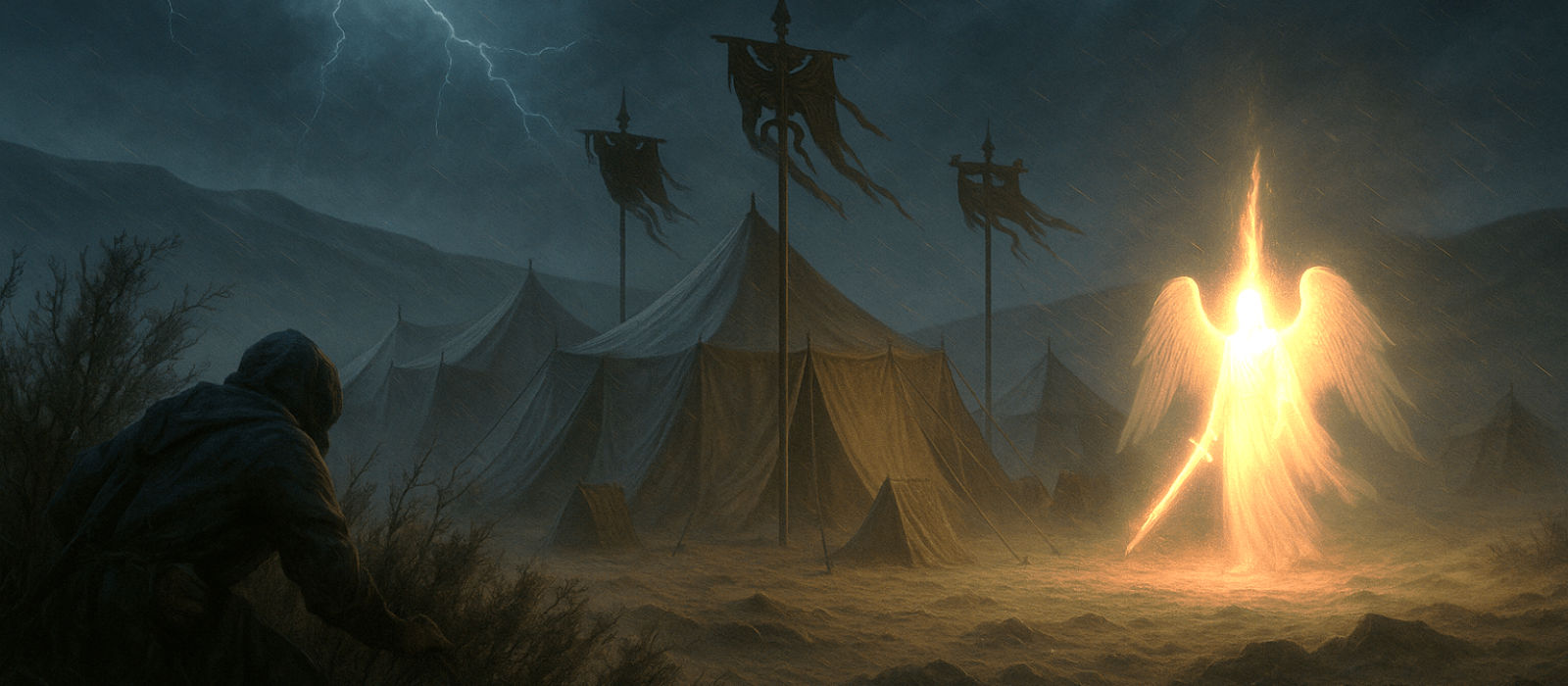
Elioenai gave a nervous half-smile, but then continued, “I was watching the camp late into the night. This terrible, fierce storm came out of almost nowhere. There were no clouds anywhere on the horizon by dusk, but the moon was completely blotted out within a few hours. The camp was mainly asleep, with just one detachment on watch. When the wind started, people started scurrying around, trying to secure their tents, which were hastily put up, and some were completely blown away.”
“But this is just about the time when things got weird. There was this amazingly bright flash of lightning. It was right above us, and the thunder was extremely loud. My ears were ringing. I had never heard anything like it. But then I looked up, and I saw what I could only describe as an angel of Adonai with a flaming sword that turned every which direction.”
“People were running past him, as if they did not see him. Then there was…” Elioenai stopped. He grabbed his goblet and drank heavily of the wine. He was breathing heavily and trying desperately to control his breathing.”
“What did you see?” Isaiah prompted. Isaiah’s voice was soothing, calming. He caused confidence to swell in Elioenai. An expression of gratitude flashed across the face of Elioenai.
With a deep breath and a slow sigh, Elioenai continued, “The bright flash and ear-splitting sound, and the angel of Adonai with the flaming sword appeared. Only mere moments later, there was another flash and another ear-splitting clash of thunder, and… and… nobody was running around anymore. They were dead… and not just dead; they were butchered, hacked to pieces, slaughtered in a similar manner to what they had done to many of the cities in Judah.”
“Then, again, just moments later, there was one last flash and peal of thunder, and the angel of Adonai, along with his flaming sword, and even the storm itself, were just gone. Stars could be seen in all directions to the horizon. It all happened so fast. It could not have been more than a dozen moments, and almost the entire Assyrian army lay before me in pieces.”
Everyone sat completely still. The king just stared at Elioenai. Isaiah was deeply inspecting the ceiling in great contemplation. Even the servants stood with pitchers and trays, frozen in place, just listening in awe. Slowly, life started to return to the various statuettes scattered around the dining hall.
“I was like stone,” Elioenai began again. “I certainly did not sleep. It wasn’t until daybreak that all the men who slept through it all, however they managed that, began to stir. Among them was Sennacherib himself. He was furious. But only a handful of men were left. The general was dead. They could not even break camp. The remaining men grabbed what horses they could, some provisions, and they all returned, presumably, to Israel—possibly even Assyria. I don’t know. They just headed north.”
☼ ☼ ☼
True to the promises of Adonai, the rest of Hezekiah’s reign was indeed prosperous. So much so that the Temple was well taken care of, as were the priests. But Adonai saw pride in the heart of Hezekiah, so he wanted to test him. Thus, Adonai allowed word of the vast prosperity to reach King Nebuchadnezzar II of Babylon, who sent a political envoy down to visit Hezekiah. Hezekiah was flattered, and his pride overflowed.
To be fair, he was boasting about the faithfulness of Adonai, but to be honest, he was also boasting about his role in all of it as well. And to be frank, he was foolish to show the Babylonians all the wealth and splendor of Judah, not withholding a single thing.
Adonai was not impressed.
But for the sake of the reforms Hezekiah had done, Adonai would not take the kingdom from Hezekiah. Still, he had to send Isaiah with the news to Hezekiah that Babylon would one day come and take Judah into exile for a short time.
After the envoys had left, Isaiah found the king in an extremely favorable mood. But as soon as the king saw Isaiah’s face, he just knew what Isaiah was going to say. In a real sense, Hezekiah already knew that what he was doing was not good, but with all the attention and doting and flattery, his head was swimming in elated feelings. How could he possibly have resisted?
“Hezekiah,” Isaiah said, just shaking his head, “this is why we can’t have nice things.”
Used with permission by the author. Find the author’s complete works online: Complete Works of Mack Samuels