
2740 AM (1020 BCE) – HOW TO LEARN PATIENCE
King Saul returned to his house in Gibeah. There were many worthless men who said things like, “What a coward!” and “How can he save us?” Many brought tribute to Saul, but these men did not. King Saul did not even have the courage to rebuke them.
Now Nahash the Ammonite came to the border of King Saul’s homeland. The men of Jabesh-Gilead went out to parley with Nahash and to covenant a peace settlement. However, Nahash’s words were riddled with violence. He responded to their petition with, “We can have peace, if every man gouges out his own right eye and hands it to me.”
The men of Jabesh-Gilead requested a week to confer. They immediately took the issue to their new King Saul. King Saul was working his field when the men arrived, and he came to them behind a pair of yoked oxen. The Spirit of Adonai rushed upon King Saul like a violent squall, and the sobs of the men filled with self-pity were drowned out with what sounded like thousands of birds. As the Spirit of Adonai rushed upon King Saul, he became exceedingly angry with their weakness and self-pity. He immediately drew his sword and hacked his yoked oxen to pieces. He sent a piece with every man to take to the ends of Israel, with the warning, “So will be done to every man’s oxen who does not show up within two days in Bezek ready to fight.”
The word went out. The people of the land were horrified at King Saul’s impulsiveness. Still, more than three hundred and thirty thousand people showed up in arms. King Saul notified the men of Jabesh-Gilead that they would be delivered by the heat of the following day.
The following day, the fighting was fierce, and the victory was definitive. Certain people who knew about the worthless men not bringing tribute to King Saul started to cause a ruckus, saying, “Bring out those worthless men and put them to death!”
But King Saul said, “No one else needs to die today. Adonai has brought us a victory.”
Samuel nodded approvingly and said, “Come, let us go up to Gilgal. We will renew King Saul’s kingdom.”
The people rejoiced greatly, and even the worthless men made tribute to King Saul. Samuel offered peace offerings and sacrifices unto Adonai, and all Israel rejoiced.
☼ ☼ ☼
Jonathan, Saul’s son, was the commander of a detachment of soldiers. Like his father, Jonathan could be impulsive and brash. As a result, he attacked a garrison of Philistines. When King Saul heard that the Philistines were on the move, he called the armies of Israel together to fight them. Even with the armies of Israel amassed, the army of the Philistines looked like the sand along the beaches of the great western sea. The army was so vast that many at arms snuck away, hidden in caves and tombs. Those remaining were visibly trembling.
King Saul spoke to the people, “Hear me! Adonai will deliver the Philistines into our hands! Have you forgotten Gideon? Deborah? Samson?”
At that, one of the military men made the sound of a donkey, presumably Samson—the donkey Saul had lost.
King Saul was furious, but also afraid. Where was that wind of courage? Where was Adonai? King Saul felt naked and abandoned by Samuel, Adonai, and his men. He was in a panic. “My people,” he shouted again, “Has Adonai ever forsaken us?”
Another anonymous heckler shouted out, “When has he not?”
It was moments like these when King Saul knew he was not his father Kish. He was not brave nor stalwart. He was afraid—always was. He was afraid of what people thought of him, afraid of what people would say, even afraid of being a disappointment to his father. His imagination played on his fears.
He saw his father standing over his grave saying, “A father should not outlive his child. And to die as king only after your second battle? How embarrassing.”
King Saul was suffering a flop sweat. His hair was soaked. His clothes were soaked. Sweat dripped from his ears and nose. It flew from his head every time he looked to his right or to his left. Where was Samuel? Where was Adonai?
Saul eyed the pile of wood set upon the makeshift altar. He saw the animals penned in reserve for the sacrifice. Wasn’t he anointed? Wasn’t he king? Wasn’t this like the two loaves given to him—in that all he needed to do was reach out his arm and eat? And then… and then… and then what? The Spirit of Adonai like a rushing wind? What about the courage and power that His Spirit would bring?
King Saul could see it clearly. His army would come back together. They would defeat the Philistines. There would be parades and accolades. And women. The truth was, King Saul had not been with a woman, his wife or otherwise, in years. Fear kept him involuntarily celibate. He felt grateful to have gotten a son, but with all his amazing looks, he was, at the end of the day—or night as it were—scared.
All of that would change… today. King Saul called out to his army, “We go into battle and Adonai will lead the way! Come, now is the time!”
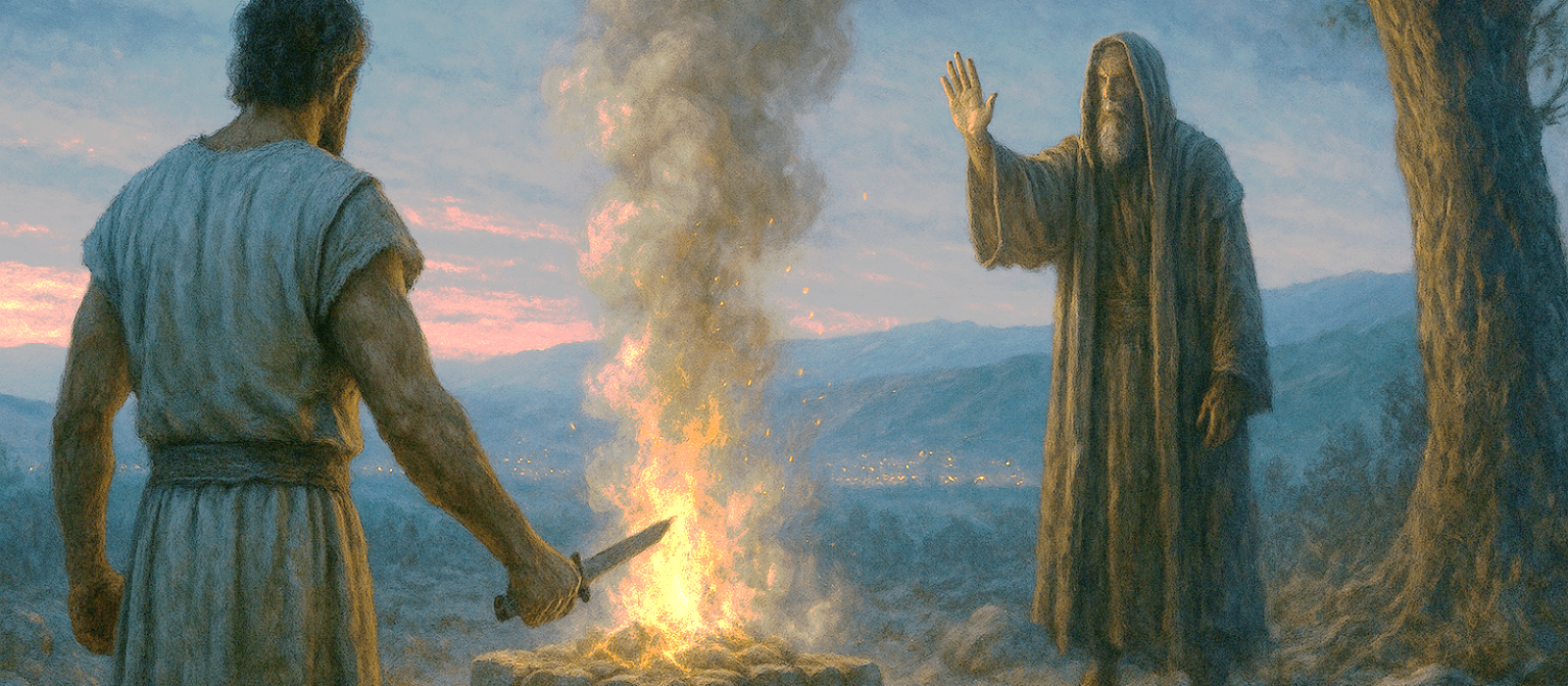
Slowly, the closest of his army began to poke their heads out of the crypts and holes like fearful squirrels. King Saul killed the goat kids and lit the fire. He attempted to say the blessing as Samuel had, but he knew he had massacred it. It mattered little to him. After all, it would be the Philistines that he would massacre next. The smoke of the fire rose high into the air, and even those who had run away some distance started to return.
But there was no rush of wind like a million birds settling upon the shoulders of King Saul. Instead, there were gasps from all those watching the sacrifice, as Samuel stepped out from behind a large tree that he had been standing behind for who knew how long. Immediately Samuel spoke with absolute callous contempt, “Do you want to learn the secret to patience?”
King Saul saw Samuel and had a moment of relief. He moved to go and greet Samuel, but Samuel held up a hand to indicate no. Instead, King Saul tried to open his mouth and respond, but all that came out was a sickly gagging, coughing sound. The best he could do was feign a nod of his head.
“Well, Beloved King,” Samuel scolded, “now I will tell you the secret to patience. You wait. That is the secret to patience. You wait. And when you think you can’t wait any longer, you take a deep breath, and you wait some more. How long? As long as it takes. And after a while, you can handle all this waiting.”
“Well,” Samuel said with contemptuous derision, “apparently not you!” Samuel waved his arm toward the fire and the animals burning. “What is this that you have done?”
The tongue of King Saul became loosened, and he tried to answer in a way to justify himself, “Everyone was leaving, I… I mean, you did not come when you said, and, uh, the Philistines, they, eh… uh. And I wanted the favor of Adonai so that we could defeat… the, uh… um.”
“What you have done is foolish!” Samuel rebuked. “You thought that you could force Adonai to give you power and bravery and strength! Not since the tower of Babel have men had the audacity to try and extort the power of Adonai to His face! You have not kept the commands of Adonai! If you would have but learned a little humility and patience, Adonai would have established your kingdom forever over Israel. Adonai will seek a man after His own heart. You are not him.”
☼ ☼ ☼
Samuel left Gilgal and returned to Gibeah, leaving King Saul humiliated in front of his men. The army consisted of at most six hundred men, most of whom did not even have swords but farm implements. Jonathan and King Saul alone had sharpened swords.
As usual, King Saul was sitting, thinking, looking like a handsome king, but unable to make a decision. He stared at the army of the Philistines, and he saw their advances. As the king stalled, hoping this would all just go away, Jonathan, his son, had a moment of inspiration—an odd thought, maybe even a word from Adonai.
Jonathan spoke to his armor-bearer, “Say, what do you think? What if we go up to the garrison on the other side, and challenge the Philistines?”
The face of the armor-bearer went pale, as if he had died, but he responded, “I… sure, I mean, ok. Why not?”
“That’s a good man!” Jonathan continued. “And if they say, ‘Scram, get lost, or we will come down and show you a thing or two,’ then we will know to scram and get lost. But if they say, ‘Come up here so we can make some sport of you!’ then that will be a sign from Adonai that He will deliver the entire garrison into our hands! What do you think?”
“[Gulp],” was all that the armor-bearer could start with. “I… sure, I mean, ok. Why not?”
“That’s a good man!” Jonathan replied, as he started to get up. “Remember Gideon!”
His armor-bearer also got up to follow and whispered to himself, “Remember Gideon? … oh Adonai!”
With that, Jonathan and his armor-bearer snuck across the gorge to the Philistines’ garrison. As soon as they were halfway up the rock, lookouts saw movement and called down, “Who goes there?”
“It is I, Jonathan!” was the only reply.
The lookouts saw the form of Jonathan—not a large man—and the armor-bearer, basically a boy, and the voice of Jonathan was so youthful that the hearts of the lookouts felt no threat whatsoever.
“Well, come up to us. We shall make some sport of you!” one of the lookouts said.
“As you wish,” Jonathan replied. But they both had not gotten more than a few steps onto the plateau when Jonathan and his armor-bearer struck down thirty Philistines. They cried out in fear, and fear resounded all through the camp. There was a call to arms, but there was also confusion. Lamps were knocked over, and tents went ablaze. In the flickering shadows of the fires, the Philistines took up swords against each other.
Across the gulch, one of Israel’s scouts noticed the commotion and notified the king. They did a count and saw that Jonathan and his armor-bearer were missing.
“What are they doing?” King Saul thought. But it was his son. What would it look like if he didn’t at least rescue his son? “To arms!” King Saul said. “Adonai has given this garrison into our hands!” he hoped.
As King Saul’s small six-hundred-man army routed the Philistines, men of Israel who were hiding in the hills came out en masse and helped route the Philistines even further.
☼ ☼ ☼
As King Saul accomplished defeat after defeat of the Philistines, he began to build his own army with the weapons and resources plundered. He defeated the Moabites, the Ammonites, the Edomites, the kings of Zobah, and many of the Philistines. Of all the lands, the Philistines were the most difficult and a constant thorn to Israel. Whenever King Saul saw a man who was a valiant warrior, he conscripted him into his personal army.
During all of this, Samuel had been conspicuously absent. Yet one day, Samuel appeared before King Saul and spoke, “Adonai wants you to attack the Amalekites. Destroy everything—every man, for they are your enemies; every woman, for they will never think of anything but revenge; and the children and animals, because they have been woefully defiled. Leave nothing alive. This is the word of Adonai.”
So, with his army, the skills they had learned, and the weapons they now possessed, King Saul and his men made quick work of all the Amalekites.
But as King Saul was about to destroy the children and the animals, many of the men of his army grumbled, “But that is our pay! What do you expect to pay us with? No children to sell as slaves? No women? No animals? At least keep the best as a sacrifice to Adonai.”
And on and on the grumbling went. King Saul did not want to disappoint Adonai or Samuel, and he didn’t want to disappoint his men. After all, his men did the heavy lifting of the war… right? Finally, King Saul was worn down, and the army kept the children and livestock, some of the women and even some men alive, along with the king and the queen.
The march back was a cheerful one for King Saul’s army, but deep in the pit of his gut, King Saul knew something was amiss. He had betrayed Adonai… probably. And he would have to face Samuel… most likely. And he was not looking forward to it… quite definitely. The men were singing, and the animals were bleating, and Samuel was standing stoically as they returned to Carmel.
“Greetings, great seer,” King Saul cajoled, “we have completed your task as you have requested.”
King Saul hoped that a proactive affirmation would help his case. He was wrong. As the men saw Samuel—and the look on Samuel’s face—their cheers and singing quickly died into a somber, reverent silence.
After staring down the group, Samuel finally spoke, “‘I regret that I have made Saul king,’ says Adonai, ‘because he has turned his back on Me, has chosen not to follow Me, and has failed in carrying out the simplest of requests.’”
The hot, dry wind blew over the whole area, and the oppressive temperatures seemed as if they came from Samuel’s every word.
“Saul came to Carmel and set up a monument to himself and proceeded down to Gilgal. Now he returns claiming that he has carried out the commands of Adonai? And yet, what do I hear? The bleating of sheep? The weeping of slaves? The quiet indignation of King Agag?”
“B-b-but,” King Saul started, “we have brought the, uh, best… you know… animals and, um, people… erm… slaves, I mean, for a sacrifice to Adonai. I mean the animals, of course… uh, not the, um, people.”
“Is it not true that when I first saw you, you were insignificant in your own eyes? And even though you became king of Israel, that was also insignificant in your own eyes? And Adonai has tested you several times, and you have failed every test. Why, time and again, do you not heed the voice of Adonai? Why!?”
“You and your men did not save the people and animals and wealth for a sacrifice, but to pay your wages. Do you not think that Adonai sees everything? Do you not think that I already know what you are thinking before you even speak? How dare you presume you know better than Adonai. His commandments are life, but you have chosen death. Sacrifice? Adonai welcomes obedience far above and beyond any sacrifice. You have chosen rebellion and insubordination, and you have rejected Adonai—and as a result Adonai has rejected you as king.”
King Saul began to weep. Through his tears, he pleaded with Samuel, “I have sinned and violated the commands of Adonai. I feared what my men would say, and I care more about what they think than what you or Adonai think, and I listen to their voice instead of listening to Adonai. So, please, forgive me this once, pardon me, and return with me so that we can worship Adonai with my men and show them the graciousness and loving-kindness and forgiveness of Adonai.”
Samuel’s complexion was that of intense, abject disbelief at the hubris of King Saul. The audacity was unbearable in its provocation. “No!” Samuel shouted. “I will certainly not go back with you. Who do you think you are even asking such hypocrisy? Adonai has rejected you as king over Israel. Your time will come to an end.”
Samuel turned to walk away, and King Saul grabbed the edge of Samuel’s robe. A length of the robe tore off into the hand of King Saul. Samuel pivoted and looked into King Saul’s eyes. King Saul could not stand Samuel’s penetrating gaze, and he could not look back at Samuel for more than a few seconds at a time.
Samuel grabbed King Saul’s hand—the one holding a piece of Samuel’s robe—and held it high for all to see. “You see this? You see this? Does everyone see this? So too has Adonai torn the kingdom of Israel from the grasp of King Saul, and He has already given it to your neighbor—one whose heart is like Adonai’s. Do you think Adonai is like men, who change their mind like the blowing of the wind? Adonai does not misspeak, He does not lie, He never gets it wrong, and He certainly never, ever changes His mind.”
Once again, King Saul pleaded for sympathy, “Please, I have sinned, please! At least come back one last time and honor me before the elders and all Israel, so that I may worship Adonai one last time.”
Samuel opened his mouth to speak rebuke, but the words were not his own, “Yes, Samuel the seer will accompany you back so that you may have this last request.”
Obediently, Samuel followed King Saul back to Gilgal and allowed him to worship Adonai, giving King Saul this one last honor and dignity befitting any king, even bad ones. Samuel had every last animal butchered and burned up, and every slave set free.
Then Samuel requested that the king be brought to him. King Agag thought that, like the slaves, he too would be set free.
Then Samuel spoke, “As your sword has made women childless today, so also will your mother be childless among women.”
And with great violence, Samuel hacked Agag to pieces before Adonai. Then Samuel went to Ramah and King Saul went to Gibeah, and Samuel never had an audience with King Saul again, for Adonai regretted ever making Saul the king over Israel.
Used with permission by the author. Find the author’s complete works online: Complete Works of Mack Samuels