
2750 AM (1010 BCE) – WE LIVE IN DARKNESS
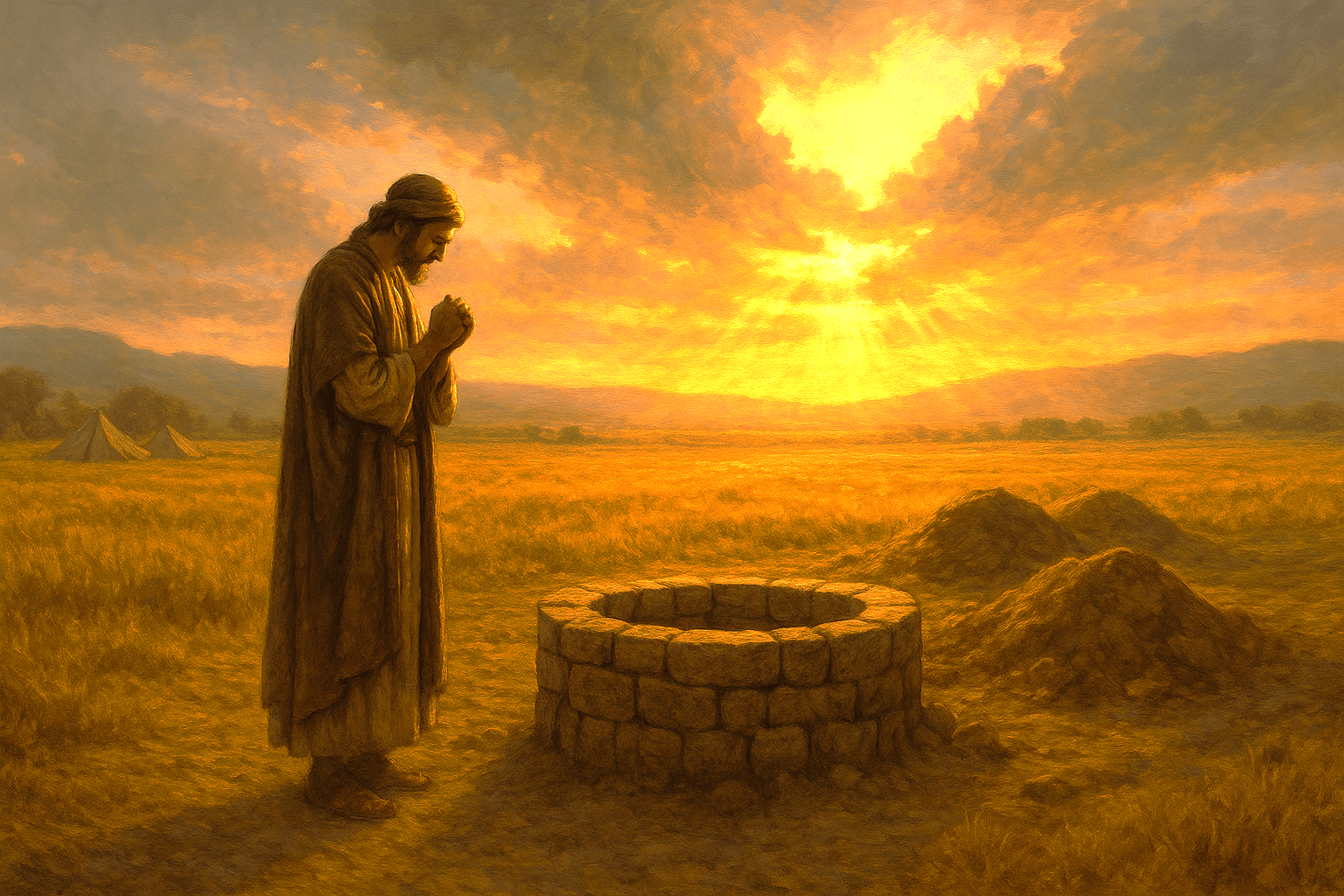
Samuel was intensely meditating on the words of Adonai. It was still dark out, and the small fire sufficiently lit his narrow room. Again and again, Samuel struggled with the issue of King Saul. Again and again, Samuel would ask himself what was wrong with Saul, why he could not simply follow basic instructions, and why he feared men more than the Creator of the universe. Just the simplest obedience, and Samuel knew that Adonai would have given Saul the world.
Around and around, Samuel struggled, and around and around his thoughts flew.
Time progressed, and the great early light pushed hard against the edges of the darkness. Looking up, Samuel saw morning colors dancing around the blackened hillsides, with trees and buildings all conforming to the uniform obsidian silhouette. The light blazed through the branches of the trees waving in the light morning breeze.
Suddenly, words blazed through his own mind, and that gentle Spirit of Adonai cleared away the many ideas cluttering his thoughts.
“Samuel,” the voice said simply in Samuel’s mind.
“Here I am, Adonai,” Samuel answered aloud.
“Samuel, why are you stewing about Saul?” Adonai asked.
Samuel thought about it. Why was he stewing? Was it Samuel who picked Saul to be king? Or was it Adonai? Was it Samuel who refused to obey the Master? Or was it Saul? Was it Samuel who chose to run away and hide? Or was it that donkey?
Samuel laughed. He knew that last bit was from Adonai. Always the comedian. But then his countenance fell a little, “You know, Adonai. You know. I am just heartbroken, I guess. So much potential wasted. Just wasted. I am so incredibly heartbroken.”
“Well,” Adonai said, “I have something that will hopefully cheer you up. And even if it doesn’t, we must move on. Much to do today. I have rejected Saul as king, but I have chosen another whose heart is like my own. I need you to go to him today and anoint him. He is in Bethlehem. He is the son of Jesse. Go now and fill your horn with oil. There is work to be done.”
Samuel was taken aback, “Bethlehem? That is right in the middle of Judah! People know me there! People will talk, and Saul will hear! I mean, Saul will know, and he will kill me! I have not spoken to him since—well, you know. How could I possibly go?”
“Samuel,” Adonai said gently, “what you are saying is only a revelation to you. Here is what you are to do. Get a heifer and explain that you are going down to offer a sacrifice. Now, when you get to Bethlehem, send for Jesse. Then have him bring his sons. When they pass by, I will tell you which one to anoint.”
Samuel was staring blankly at the horizon, just sitting and contemplating. Finally, he stood, saying aloud, “As you wish, Adonai.”
☼ ☼ ☼
The trip to Bethlehem was uneventful, even with his many acquaintances through the land coming up to him with comments like, “Must have a sacrifice today, eh?” and “Who is the lucky guest of honor?” and “Nice day for a barbecue, no?”
Samuel just politely affirmed their comments and continued to walk alongside his cow. He glanced at the animal and then back at the road. This cow was named “Shoshana.” Samuel always made it a point to know the name of the animal. Sometimes animals were offered to him for a sacrifice; other times he would take one from his own herd. But he always made a point to know the animal’s name.
On the way to wherever the animal was to be sacrificed, Samuel would stop frequently so that the animal could be watered or could graze a little. He would observe and pet the animal to try and get a sense of its personality.
Death was always around Samuel. If not war, then sacrifices. Somehow, it was important to know the animal that was giving its life so that the sin of others could be covered. Somehow, all this allowed Samuel to revisit his humanity when an animal had to die by his hand. The last thing he wanted to do was become callous to it all.
Samuel arrived in Bethlehem, and the high place was already set aside for him and made ready. Tables were set, firewood was stacked, and the altar was ready to receive Shoshana the cow.
Samuel sighed.
A servant approached Samuel, “Is everything to your liking?”
“Yes,” Samuel said, “I need you to fetch Jesse and his sons. I will wait here until he arrives.”
The servant hurried off, and Samuel made his customary preparations. It wasn’t long until the servant returned with an entourage of people. Samuel had just lit the fire, and it was beginning its long, slow burn.
“Samuel, this is Jesse and his sons,” the servant said.
“Greetings, Jesse. If you will all take a seat.”
Samuel took Shoshana the cow to the stack of wood. With a sharp blade and a poignant prayer, he opened the life from the cow and allowed the animal to drift peacefully away. Once he was satisfied that the blood was sufficiently removed from the animal, he began the process of ceremonially cleaning the animal in front of everyone. Much of the fat and organs were burned immediately on the altar, while other parts, like the entrails, were deemed unclean, and he had a servant bury them outside of Bethlehem.
Finally, Samuel began to chunk the animal—Shoshana—into various roasts of sizes that would cook well on the fire. This would burn off the major fat, and the aroma was, indeed, pleasing to Adonai and all those seated around. The hide of the animal would be later cured and used to make tents or parchment or whatever else Samuel might need for his work for Adonai.
As the meat cooked, Samuel stood at the head of the table, “Jesse, please introduce me to your sons.”
Jesse stood. One by one, he brought one of his sons to Samuel and introduced their name and occupation. The oldest three sons were warriors for King Saul. The youngest four were training, but mainly did field work. Each one passed by, and each one was introduced. Finally, each one sat down.
Samuel was perplexed. Adonai did not identify any of them as the one to be anointed. And then Samuel knew.
“Jesse,” Samuel said, as he turned back to the patriarch, “are these all of your sons?”
Jesse slowly turned back to Samuel and looked into his eyes, “Uh, well, no, actually. We have our youngest, but he is in the fields with the sheep. We didn’t think… I mean, he’s not the type… uh… I mean…” Jesse just kind of faded off.
With almost a rebuke, Samuel responded, “Why don’t you bring him here. Quickly, if you can. We will wait.”
Samuel sat and faced forward, waiting for Jesse to comply. Immediately, Jesse motioned to one of his sons, who rushed out. Everyone else waited with Samuel. Not much was said. Eager eyes panned from looking at Samuel and contemplating him rather deeply, to looking at the meat that was slowly succumbing to the scorching flames.
Finally, Jesse’s son returned.
Jesse brought his youngest boy to Samuel, as the other retook his seat. They both were panting rather heavily. Jesse began, “And, yes, this is David, our youngest. He tends the sheep and keeps them safe.”
Samuel took a step forward, eyed David, and then he smiled broadly. The smile surprised everyone at the table, especially after the extended period of time of stony expression, verging on a silent, grumpy rage. No, the smile was definitely welcomed by all.
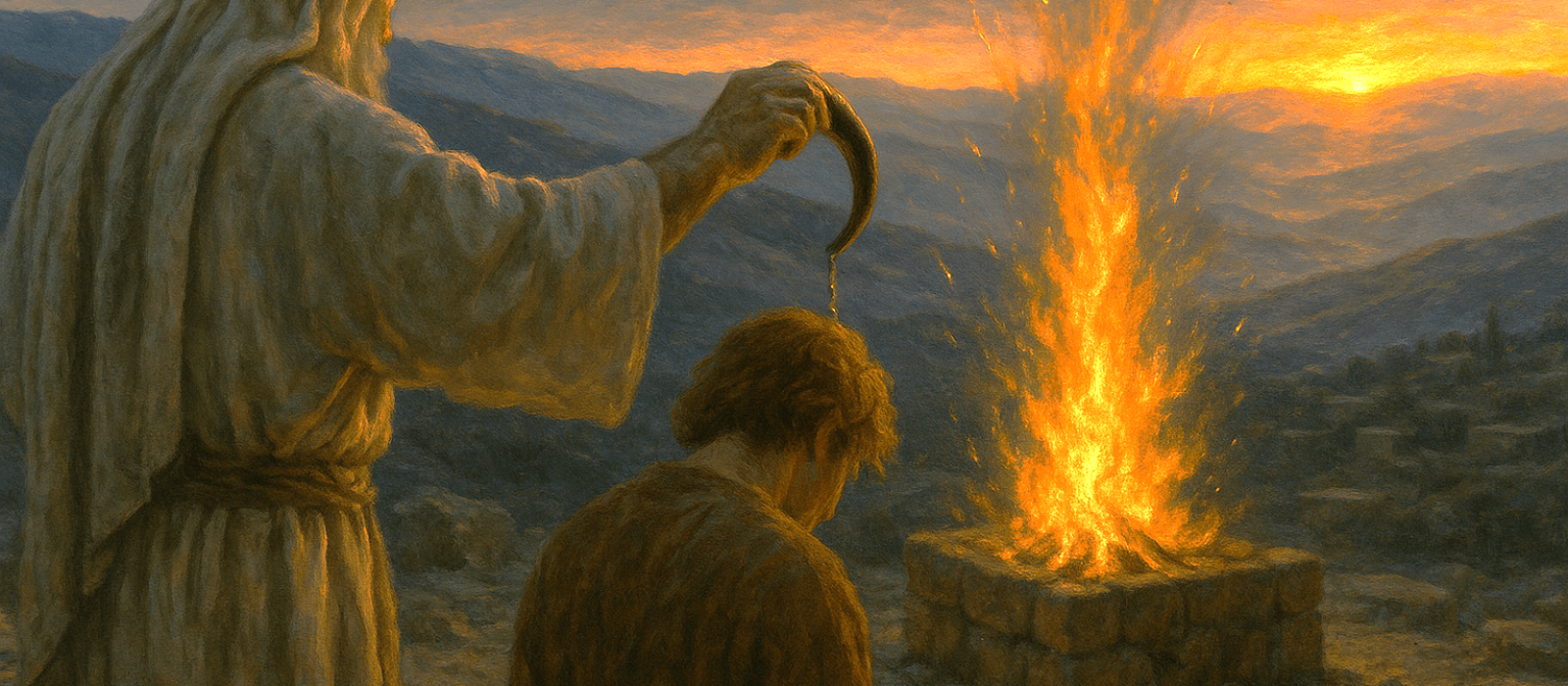
Samuel looked David over. He was handsome and fit. His complexion was that of many freckles, and his hair was a blazing red that would give the great light a run for its money. And David was fit and strong, though still an adolescent. Without a word, Samuel grabbed the horn of oil from his belt and poured it on the head of David. Leaning into David, Samuel whispered into David’s ear, but nobody could understand what was said.
Suddenly, a rush of wind like a thousand doves fell upon David. The flames of the fire leapt wildly, soaring high into the air. Then all was calm. Samuel whispered a few more things, and finally, with a nod, David sat with his brothers. Samuel ordered that the food be brought to all, and then Samuel departed.
☼ ☼ ☼
By the time David was anointed king, the Spirit of Adonai that indwelt David had also long since left Saul. In his place was the spirit of the bearer of darkness. Many of Saul’s servants didn’t notice it at first. Things went on pretty much as they always had.
But as the years went by, they began to notice little things, like bursts of anger or melancholy that had never been exhibited by Saul. Sure, Saul was always a coward, but now he had become rather paranoid as well, always thinking that someone was trying to poison him.
Some of Saul’s servants, who knew Adonai, knew that Saul was not being tormented by Adonai, but by an evil spirit. They knew of the story of Creation, and how Adonai had spoken, and the universe sprang into existence. Perhaps, they wondered, if the music that Adonai also created would hinder the evil that dwelt in Saul. Thus, Saul’s servants suggested to him that they be allowed to find a musician who could play the harp to see if it would soothe the evil spirit.
The king replied enthusiastically, “Yes, please, I have always found the harp soothing. Go, make a search of all the land, and find a musician who can play the harp.”
But one of the servants already had someone in mind, so he spoke to Saul, “Blessed king, I know of such a musician already. He is not only gifted with the harp but is also handsome to look at and a skillful warrior, valiant and mighty. He can hold an intelligent and thoughtful conversation with the king, and he can reason well. What’s more, Adonai is with him.”
Immediately, Saul sent messengers to fetch David, son of Jesse, from Bethlehem. Bethlehem was close, and David was there almost immediately. And he was everything Saul’s servant had promised the king. Saul loved David so much that David became Saul’s armor-bearer, not that Saul ever went into battle anymore. Still, because Bethlehem was so close, David could still mainly tend the flocks, while often spending parts of his days with Saul, comforting him and playing for him.
☼ ☼ ☼
It eventually came to pass, when the Philistines had grown in strength, that they once again began to push up from Gaza toward Judah. It was tiresome to Saul. You could set a sundial with the consistency of their incursions. Because the army of Israel was camped near the Valley of Elah, David had not been summoned to King Saul for quite some time.
One day, almost on a whim, Jesse called David in early from the field and said, “David, my son, you know what? I think you should take some provisions to your brothers. They have been facing off against the Philistines for over a month now, and I have not heard a word. Perhaps you could bring some news? Here is some roasted grain and bread. Oh, and here is my best cheese. Perhaps share some cheese with their commander, and perhaps he will watch over them?”
David smiled, “Of course, Abba, I will go up quickly. First thing in the morning, okay?”
Jesse smiled, “That would be perfect.”
☼ ☼ ☼
By the time the light of the next morning was starting to dawn, David had already left. The trip to the front lines would take no more than half a day’s journey, and for someone like David, strong and conditioned, he arrived before the heat of the day.
As he approached the supply tent, he heard a pompous voice shouting threats in the distance. He could not quite hear the voice, but it was boastful and, in every way, horrid. David handed the attendant of the supply tent his bundle, quickly instructing him what it was to be used for. But David’s attention was on the battlefield, as the armies were lining up in battle lines.
David sprinted to the entrenchment surrounding the valley, and he found his brothers.
“Who is that?” David asked Eliab, his eldest brother.
With a bothersome contempt, Eliab answered David, “That’s Goliath the Gittite.”
“Ahh,” David said with his childlike enthusiasm, “I have heard of them.”
“Them?” Eliab responded. “What do you mean them?”
“Oh, the Gittite clan. Goliath is just one of five brothers. There are Saph, Raphah, Lahmi, Gath, and the six-fingered man. Nobody really knows his name.”
Eliab turned back to David. “Are you for real?”
David glanced back at Eliab, “Yeah, why?” Eliab looked at David, speechless, and then David looked back out into the ranks. “Eliab, are there any other giants here? I can’t tell. Did you see any others, or is it just Goliath?”
“Um,” Eliab started, “how should I know? I mean, I wasn’t looking for other giants. I mean, I’ve only seen the one.”
Just then, Goliath started up his verbal tirade against Israel: “Why do you come out to draw up battle lines? Am I not the epitome of Philistine excellence? Send but one man to challenge me. If you can defeat me, then the Philistines will surrender to you. But if I defeat you, then Israel will be our slaves. I defy your army, and I defy your God. Not even by the hand of your precious Adonai can you defeat me or our army. Your God is lifeless and weak. Israel’s army is lifeless and weak. And I guarantee that whoever you send out will be weak, and I will certainly leave them lifeless!”
After hearing these words, David was more than incensed. He looked up at Eliab, and their eyes locked. Eliab’s eyes were full of shame, but David’s eyes were full of fire. David looked around at all of the Israelite soldiers, just watching each of them. He looked to see if there was anyone with any courage. But they were all like goat cheese left out in the daylight at the hottest part of the afternoon.
“Why don’t any of you do something about this uncircumcised Philistine? He blasphemes Adonai!”
David looked around, but the men either hung their heads or looked away. None made eye contact. It was shameful.
“Tell me,” David inquired aloud, “what will be done for the man who will face Goliath and defeat him?”
All the men surrounding David, along with his brothers, spoke in almost unison, saying things like, “The king will give him great wealth,” and, “I heard that the king would give his daughter in marriage,” and still, “Someone said that the king will exempt his father’s house from paying taxes!”
David was appalled. No mention of the honor of Adonai? No mention of fighting for the one true, righteous name?
Finally, David offered in return, “I will face him.”
Eliab grabbed David’s shoulder. “David, that’s enough! Why did you even come down here? Who is with the sheep? You just want to see the battle! I know you, always talking about warcraft. You are out of your mind! You cannot do this!”
As David and Eliab were arguing, some of the men had left to notify King Saul that David was there. Immediately, the king sent for David, his armor-bearer. He was delighted that David had come. The servants of King Saul went and took David from Eliab and brought him before the king.
☼ ☼ ☼
“My dearest David!” the king started, “What brings you to the battlefront? I do not remember requesting my armor-bearer. What about your flocks?”
David smiled kindly at the king and replied, “My father sent me with provisions for my brothers. We have a hired man watching the flock while I am gone. We use him whenever I am here with you. But the bigger issue, O great king, is the stink of this uncircumcised Philistine in our midst.”
“Ah,” the king replied, “straight to the point, then. David, let me be honest with you. I love you and would be lost without you. You cannot face Goliath; you are but a youth, and Goliath has known nothing but war since his youth. From my perspective—and I mean this with the highest, sincerest—uh—if you go against Goliath, he will kill you.”
“Oh, King Saul, may you live forever, please understand that I have no choice. For one, I cannot stand by while this uncircumcised Philistine blasphemes the name of Adonai. For another, do you remember the story of Samson?”
“Samson?” King Saul flinched, as memories of that donkey flooded his consciousness. He replied somewhat skeptically, “Yes. I mean, I have read the same stories you have. Big muscle-bound Nazirite, whom Adonai gave miraculous strength?”
“Yes and no,” David replied, “he was given great strength, but I have it on authority that he was no bigger than I was. That was the miracle. What great miracle of Adonai would it be if someone the size of Goliath lifted the gates off a city wall? But if someone my size lifted the gates off a city wall, people would take note.”
The king stroked his beard. Clearly, this was something that he had never considered. Nodding slowly, the king prompted David, “Go on, I’m listening.”
“Well, I have watched the flocks for many years. But recently, there have been bear attacks and lion attacks on the flock. I cannot explain it, but when a bear or a lion would attack the flock, even when it scooped up a sheep in its jaws, the Spirit of Adonai would come upon me, and I could pry its jaws apart, rescue the sheep, and either kill the bear or lion or make it flee for its life.”
A servant came up to the king and cleared his throat. The king looked at the servant and then realized his mouth was gaping open as David was telling his amazing story. The king looked back to David and said, “Well, well. I am surprised. It makes sense. At least consider wearing my armor?”
The king motioned to his armor hanging near his throne, and the servants of the king immediately started dressing David. David, having the heart of Adonai, just let them dress him without protest.
Afterward, he walked around a bit and then politely demurred, “Okay, king, I cannot wear this. I have not been conditioned to wear this. It’s all just too heavy. I have to be nimble and quick. Besides, I do not need armor or armies to defend the name of Adonai. He will be my armor and my sword. If Adonai will save me from the fierce animals of His creation, He will save me from this uncircumcised Philistine blasphemer!”
“Very well,” the king said, finally relenting, “go with Adonai. But most importantly, come back to me as well!”
☼ ☼ ☼
David was escorted back out by the king’s servants. He stopped back to where his brothers were. Eliab put a hand on David’s shoulder, “I have faith in you, brother.”
David smiled at his eldest brother, always so serious, “Hey, Eliab, there are some supplies for you that I left with the attendant at the supply tent. Make sure your commander gets some of Abba’s cheese.”
Eliab smiled, “Yeah, ok. You’re talking about cheese?”
David just smiled back. Everyone watched David. He was not looking at Goliath; he was looking down at the ground. One after another, he picked up various stones and then discarded them. Finally, he selected a very smooth stone and held it up with a smile.
“What is that?” Eliab asked David.
“This is for Goliath,” David responded. He put the stone in his pouch and found four more just like it, putting those in his pouch as well.
Nervously, Eliab asked David, “Are those for Goliath as well?”
“Hah, no!” David said glibly, “those are for his brothers, since we do not know if they are here. When I kill Goliath, if they are here, they will certainly try to avenge him right away. I am just being cautious.”
David walked slowly toward Goliath. With the stones and sling in his bag, and his staff in his hand, David appeared completely unarmed.
Goliath was immediately filled with contempt and anger, “Whah? By Beelzebub, what is this? Who the Dagon are you? Are you the challenger for Israel? Are you serious? They send a little boy with a stick? Am I a dog that all is needed is a stick to defend Israel from the Philistines? Young boy, your flesh, what little there is of it, will be filleted for the birds of the air and the wild beasts of the field to share. And then all of Israel will know that it is Dagon and Beelzebub that rules this land.”
The fire never left David’s eyes. He spoke loud enough for many on both sides to hear, “Goliath, you large, uncircumcised Philistine! How dare you! You come with sword and spear, weapons made by the hands of man, thinking that they will deliver you from the Creator of all creation! You blaspheme the one who gives you breath of life and food to eat. He gives your land rain so that your people can have crops, for He has created all of that and much more. And yet, you blaspheme Adonai, and you credit to idols of wood and stone the works the Spirit of Adonai has done. Now, see what the true power of Adonai is, whom you have defied. This day Adonai will hand you over to me. This day the animals and birds will feast not only on your carcass but that of the Philistine army as well. For all will know that there is not only a God in Israel, but that He is Lord of all.”
Goliath did not appreciate the less-than-subtle words of David, and with a loud war cry started running toward David at full speed, spear in hand. The Philistine army erupted in war cheers and mocking chants.
At the same time, David dropped his staff, grabbed his sling and a single stone, and ran full speed toward Goliath. In an instant, David swung the sling a few times and slung the rock at Goliath. The rock hit him just above his brow, above his eyes but just below his helmet, and sank deep into Goliath’s skull. Goliath pitched forward, landing hard on the ground, even sliding a short distance. David never broke his stride; leaping onto the back of Goliath, he drew Goliath’s sword and struck off the head of the Philistine.
The ruckus of the Philistines immediately died as well. It was replaced by shouts from the army of Israel, who immediately attacked the Philistine army. Instead of honoring the pledge of Goliath and surrendering, the Philistine army fled like cowards and was pursued by the army of Israel.
And so it continues to be with cowardly, bully nations of this type that attack Israel and then hide from retribution, even to this very day.
☼ ☼ ☼
With Goliath’s sword in one hand and Goliath’s head in the other, David joined the chaos of the army of Israel pursuing the army of the Philistines. Men flocked to follow David, and he led them into battle. The army pursued the Philistines for several days.
Finally, as they were coming back, they were covered in blood and dirt. David walked ahead of the men he led, as a commander would. Saul looked out and did not recognize David, so he sent his aide, Abner, to find out who that young commander was.
Abner brought David before the king, and King Saul still did not recognize David because of how dirty and covered in blood David was. So, the king asked David, “Who are you?”
“Oh, great king, may you live forever! It is I, David, your armor-bearer.”
David still had the head of Goliath in his right hand, and Goliath’s sword in his left. King Saul was amazed. He just could not process what he was seeing. This is the son of Jesse? The shepherd? The beautiful one that plays the harp?
The king had David sent to be washed. David was assigned a sleeping tent, and he stowed the head of Goliath and Goliath’s weapons in his tent, along with his shepherd’s staff. After being groomed, he returned to the presence of the king. The king’s son, Jonathan, was there, and David walked in as he was being discussed by them.
“Yes, I saw David in battle. Very capable. You wouldn’t know it by his size, but he is valiant and fierce.” Jonathan looked up and saw David enter, “And here he is now.”
Jonathan stepped away from his father, who beckoned David to come forward.
“Well, young warrior, whatever shall I do with you?” said the king, as he looked David over. “I certainly can’t keep you for myself. Jonathan, what do you think? Should we make him a commander?”
Jonathan thought about it, and looked at his father, and then back at David. Without a word, he went to David, took off his royal robe and gave it to David, along with his sword and bow and belt. From that moment on, their souls were knitted together.
With a nod, the king agreed, “Very well, Jonathan, we will make him a commander.”
☼ ☼ ☼
David was sent into battles and skirmishes as King Saul required. Everything he did and everywhere he went, David was successful. And the king was greatly blessed in many ways because of David. David’s name became renowned, but the heart of David never changed—David still had the heart of Adonai—powerful, humble, kind, competent.
The women of Israel fawned over their ruddy commander, David, and they sang songs of praise, “Oh, how Saul has slain his thousands, and David his tens of thousands.”
It was understood as a romantic hyperbole, but as King Saul heard these songs, his demeanor changed. Instead of appreciating David for his many accomplishments, he began to realize that David was going to replace him. How did he know that? It was probably that still, small, dark demonic voice of evil whispering deceit in his ears.
Used with permission by the author. Find the author’s complete works online: Complete Works of Mack Samuels