
2760 AM (1000 BCE) – THE STRUGGLE IS REAL
The women of Israel continued to fawn over their ruddy commander, David, and they sang chants of praise:
“Oh, how Saul has slain his thousands, and David his tens of thousands …”
David had been called in to play the harp for King Saul. Without hesitation, David appeared, knowing what kind of anguish the King was currently enduring. Jonathan said that he could not eat or sleep. He was moody and would often just start spewing strings of profanity. David dutifully sat at the harp, improvising a new, soothing melody as he had done many times.
Unknown to David, King Saul could not hear him playing the harp. All he could hear was the amelodic chanting of “Oh, how Saul has slain his thousands, and David his tens of thousands,” in his head, again and again and again and again. He watched his son Jonathan come to him and say something, but he could not hear it, because of that anti-melody. Or his servant would come and inquire something, but the King could not hear that either, because of that amelodic tune.
The longer David played, the more enraged the King became. Paranoia poisoned his thoughts, and that chant—that tune—that demonic repetition of spite and inadequacy—finally caused the King to snap.
With a long, loud shout, King Saul threw his spear at David. David ducked and rolled, and the harp went flying. The spear impaled the wall right where David was sitting. David’s first thought was what was wrong with the King, as this was becoming a growing pattern. His second thought turned to how long it would take to retune the harp.
David could see the fear in King Saul’s eyes every time the King looked at him. He almost shook in fear. It was almost like the cowardice of decades ago was starting to reassert itself. After all these years …
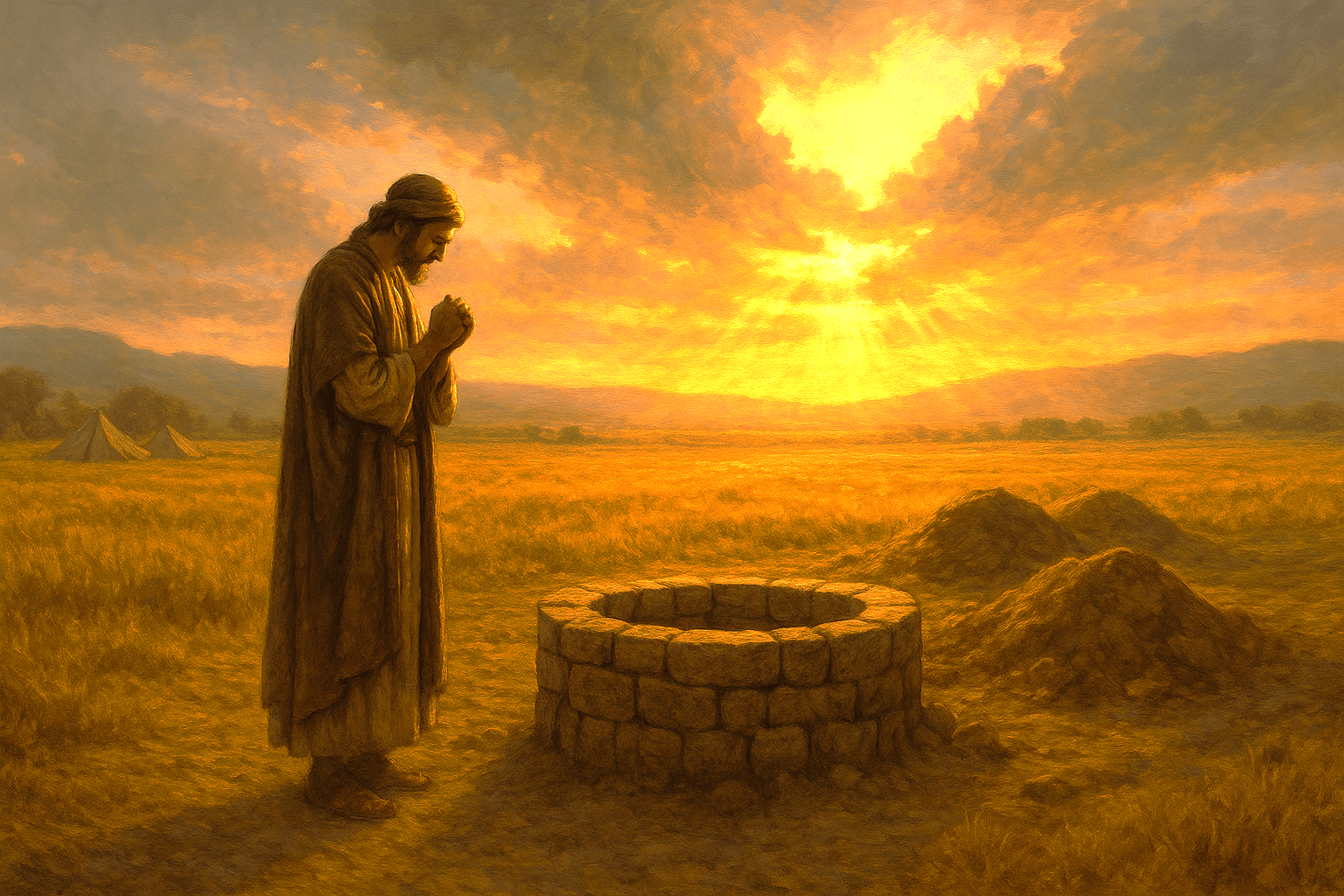
David stopped and said a prayer for King Saul out loud. Those in earshot stopped what they were doing, and reverently closed their eyes in reverence. Tears streamed down David’s cheeks. Like Samuel, David struggled with all the lost potential of King Saul. Every time the King sent David out to battle, instead of going himself, David tried all that much harder to be victorious, so that King Saul would look good and be honored and even admired. But for whatever reason, the King could not see it.
☼ ☼ ☼
As David’s successes mounted, King Saul offered Merav, his daughter, to David as a wife. David humbly responded in sincerity, “Who am I that I should be the King’s son-in-law? And who is my family? They are of the lowest status. And how could we possibly pay the dowry for Merav?”
“Never mind that,” the King replied. “If you continue to excel at war with the Philistines, I shall give you Merav!”
“As you wish,” David responded.
King Saul sent David into more vicious battles, one after the next, in hopes the Philistines would be successful in killing David. But not only was David not harmed, but few of his troops were injured or killed, due to David’s extremely effective military strategies.
As time wore on, King Saul gave Merav to Adriel the Meholathite as a wife. It amused the King to defy David in this way, and the King watched David for a reaction, any reaction, but nothing was ever forthcoming. David continued to serve the King in excellence without any expectation of special compensation or entitlement.
It infuriated the King.
However, it came to the King’s attention that Michal, another of his daughters, had fallen in love with David. He thought about all the angles he could use to hurt David with this information, from marrying her off to outright killing her in front of him. But maybe, rather than all of that, he could use her as a mole, a thorn in David’s side, to get intelligence and find another weakness to exploit—to not only end David, but also to finally end the people’s fascination with him. He had to break whatever spell David had cast on his people, his kingdom.
When David was back from one of his military conquests, the King requested an audience with David. Dutifully, David appeared before the King.
“Ah, Commander,” the King started. “It has come to my attention that my daughter Michal is rather taken with you. Perhaps it is your youthful, ruddy appearance, or your effectiveness in the field. Whatever the case, I, uh, wanted to take the opportunity to, um, apologize for the confusion with Merav, which seemed to be rather providential, wouldn’t you say?”
The King said that last bit with almost a smirk, but David was quick to answer, “Yes, oh great King, most providential. I am quite taken with Michal as well. She would be a great wife. But again, great King, it is not a small thing to be the son-in-law of the King. My family is still of humble origins, and I still have no dowry befitting Michal.”
“I see,” King Saul said in sudden seriousness, as he realized what David was saying, “I see. You make a great point. Without an adequate dowry, we both would be guilty of cheapening her value as a person and a wife. Quite right you are. I know what you earn, and I know what you are worth. Forget about paying money. Say, perhaps we could do a compromise.”
“A compromise?” David reflected.
“Yes, a compromise. Certainly, I value coins and gold, fine fabrics, and those sorts of things. But I also value the death of those uncircumcised Philistines. If you were to bring me, say, 100 foreskins of the Philistines in, say, the next two weeks, we could start planning the wedding right after your mission was complete.”
David looked up at the King, and their eyes locked. The King saw what great appreciation and gratitude were in David’s eyes, and he feared that David would see the treachery behind his own. For, to get a hundred foreskins in two weeks, the King imagined that would just about be the end of David and his fighting men.
The King’s thoughts were interrupted when David bowed low, and all but shouted, “As you wish, Your Majesty, I will bring you two hundred, and I will do it in a week!”
☼ ☼ ☼
It was actually only after five days that David and his men returned from striking down two hundred Philistines and presented the foreskins to the King for his approval. The wedding turned out to be one of the most attended royal galas ever during the reign of King Saul. The festivities lasted a whole week, and David and Michal were blissfully lost to each other. However, Michal was faithful to David and never had anything worth sharing with the King.
The pent-up animosity toward David continued to build. So many thoughts, so much anger, and, again, bouts of that stupid song drowning out the world around him. The more Saul sent David out, the more success he saw and the more the people loved David. When David was away, King Saul could often be heard mumbling threats against David, as he aimlessly shuffled around his throne room in circles.
Now Jonathan, whose soul was knit to David, would often hear the threatening mumbles, but he could not understand the source of them. All David and his fighting men ever did was serve the King better than any three commanders ever could. Finally, it was too much for Jonathan, and he had to say something to David, if only to warn him.
As David’s men were arriving back from a recent campaign, Jonathan took David aside.
“Look, David, the King wants you dead. He just can’t do it because of the people. At least, I thought he couldn’t. I hear him breathing threats against you all the time, every day. He just stumbles around the palace mumbling vitriolic diatribes against you.”
The expression on David’s face was utter disbelief. But it was Jonathan who could not believe the innocent, naïve nature of David.
“Really?” David responded. “I just can’t believe that.”
p>“Your innocence will be your undoing, my friend. Look, if you don’t believe me, I will tell you what. Tomorrow, go into the southern gardens and hide. I will take my father to the veranda overlooking the gardens, and I will confront him about his murderous threats. Just listen to what he says and how he talks. If you do not believe me, at least you could believe your own ears.”David looked at Jonathan with the kind of expression that is both understanding and dismissive. What Jonathan was saying was so beyond what David could conceive. Truly, there were signs that the King was unwell—the multiple attempted spearings, for instance. But that impulsivity brought on by the evil spirits tormenting him is not the same as Saul meditating on murder.
Finally, David relented, “Fine. As you wish. What harm could it do?”
☼ ☼ ☼
The next morning, David waited and finally saw Jonathan and the King approach the veranda overlooking the southern gardens.
“Now what is it you would like to ask, my son?” the King remarked. “Ask it of me, and I will grant it to you up to half my kingdom!”
Jonathan was unsure how to respond, so he just started with, “I wish for the life of David to be spared. Please, oh great King, do not sin against David since he has not sinned against you. In fact, David loves the King and lays his life down for the King every time he goes into battle with the Philistines. Don’t shed innocent blood.”
“Very well, my son,” King Saul said.
“What?” Jonathan replied, astonished.
“I will not touch David, for your sake and mine. You are right; he is a righteous man and a valiant warrior. He keeps the Philistines at bay, and I should be tremendously grateful for that. As Adonai lives, David will not be put to death.”
The King smiled at Jonathan and sweetly touched his cheek ever so lovingly. Then the King left Jonathan on the veranda. David poked his head out from his hiding place, and Jonathan took the stone stairway down to the terrace, where David came to join him.
“Did you hear all that?” Jonathan inquired.
“Most of it,” David replied.
“I guess you were right. He does not want to harm you, but … how?”
“I am telling you, Jonathan, it is those evil spirits. When he is in his right mind, he is righteous and good, maybe even seeking truth. But when the evil spirits pervert his perception, he only thinks of self-self-self. That is toxic and dangerous. But it is not who he is, although it might be who he is becoming if he doesn’t keep it in check. Unless …” David trailed off.
“Unless what?” Jonathan pressed.
“Well, unless he told you what he wanted you to hear. Maybe even wanted us to hear,” David replied with a skeptical sigh.
“Wait, you think he knew you were there?” Jonathan asked incredulously.
“Well, he is the King. He has eyes and ears everywhere. It would not surprise me. Plus, again, he is very intelligent. It’s possible he could spot a ruse. I suppose we will know tomorrow.”
“Tomorrow? Why tomorrow?” Jonathan inquired. “What’s happening tomorrow?”
David smiled. “Oh, I have been summoned to play the harp for the King, to soothe the savage beast.”
Jonathan admired David’s courage in the face of absolute danger. He never wavered, never questioned. He just acted in righteousness and truth. Jonathan was amazed.
☼ ☼ ☼
The next morning, the King was in a very bad state. It was the worst David had ever seen him. David continued to play the harp, eyes closed, concentrating both on the melodies and the sounds of the room.
He could hear when the King tried to quietly stand, and he could hear as the King’s robe almost silently brushed along the floor to where the King’s spear was leaning. He also could hear the ever-so-slightest scraping of metal on the stone wall as the spear was picked up.
When the King let out a scream of victory, David simply stopped playing, opened his eyes, stood, and sidestepped the lance, all in but a fraction of a second.
☼ ☼ ☼
David fled the palace and went to his house to be with Michal. She was horrified as David told her all the events of the previous two days.
“You can’t be serious,” Michal responded. “I mean, my dad loves you?”
“So I thought… Did you hear that?” David asked, looking at Michal.
“Yes,” she said. “Horses. It has to be Saul’s men. You can’t stay here. We are probably already surrounded. By morning, you will be dead.”
David nodded in agreement. “Okay, I will go and head toward—”
“No, don’t tell me,” Michal said, interrupting David, “then I don’t have to lie about it.”
David nodded again. “Okay. Just let me grab—”
But again, Michal interrupted him. “No, you don’t understand my father. Go now. Just go! Here’s some rope; I can lower you out the back. Adonai will have to provide for you; you don’t have the time. You put both our lives at risk with every minute longer you stay.”
David took a deep breath and assessed that Michal was right. She wrapped the rope around herself, letting the rest drop to the ground below.
“I love you,” David said, with a kiss, as he grabbed the rope, worked his way quickly down, and dropped to the ground.
“I know,” Michal whispered softly after him as she stood in the window and watched David quickly disappear into the hillside.
☼ ☼ ☼
David made a beeline to Samuel in Ramah. He was pretty sure he was not followed, but it was always hard to tell. Keeping to the shadows and avoiding all people, he made good time and was at Samuel’s by morning.
Samuel welcomed him in, but Adonai had already informed Samuel of the details.
Before David had a chance to speak, Samuel started with, “Okay, David, look, do not worry. Adonai has everything under control. Tomorrow, you will return to the palace, and you will be safe.”
David opened his mouth to protest with a “How?” but then he closed it. After a minute of exchanging glances with Samuel, David finally said, “So be it.”
☼ ☼ ☼
By noon, many prophets had joined them. The Spirit of Adonai was thick in their midst. They moved out into the neighboring field, and they prophesied and worshiped Adonai.
David heard it first—the sound of hooves in the distance—and looked up, but the Spirit of Adonai swept him back into song and dance. They then stripped bare in humility before Adonai and lay in the dust of the ground, still prophesying.
Saul dismounted and drew his sword. Suddenly the Spirit of Adonai rushed upon the King like a mighty flock of birds, and his sword dropped to the ground. Saul began prophesying with everyone else. His most regal highness, too, got naked and lay face down in the dirt in abject humility. But the Spirit of Adonai subdued the evil spirits of the King. He wept with gratitude and longing. He prophesied:
“Give your justice, O God, to the King’s son; Grant righteousness to the ruler’s offspring. May he judge your people with righteousness, and your afflicted ones with justice. Let the mountains bring prosperity to the people, and the hills, in righteousness.”
“May he defend the afflicted among the people and save the children of the needy; May he crush the oppressor. And may he endure as long as the great light, like a moon that shines throughout all generations. May he be like rain falling on a mown field, like showers watering the earth.”
“In his days may the righteous flourish and prosperity abound till the moon is no more. May your righteous one and your righteous people rule from the river to the sea, for all who live under Adonai will be free, and wickedness and sin will no longer be found in the hearts of those who dwell there.”
☼ ☼ ☼
The next day, David returned to the palace and met with Jonathan. “Dear brother, beloved friend, have I done something evil against your father that I don’t know about? What have I done that he is seeking my life?”
Jonathan put a hand on David’s shoulder and said, “Now you see what I saw.”
“Indeed. Adonai intervened in Ramah and pacified the evil spirits in the King. But I don’t know how long that will last.”
David pursed his lips and contemplated his options.
“Hey,” Jonathan said as David, who was looking at nothing, came back to the present, “whatever you need to do, count me in. No matter how dangerous, we have to do something.”
“Okay,” David agreed, “let’s do this. We have a new moon feast tomorrow. I am obligated as a commander to be in the presence of the King. But if I were to get, say, the King’s son’s permission, I might have the new moon feast with my father, who really has missed me.”
“Okay,” Jonathan started, “let’s assume the King’s son has granted such a request. Then what?”
“Well, I won’t actually go to my family; I will hide myself out in a nearby field. Then, if he misses me, explain to him that I am with my family. If he is okay with it, then possibly Adonai has removed the evil oppression from his heart permanently. But if he gets angry, well, then we have to accept that this is the new King Saul.”
David said that last part with a heavy heart.
Jonathan fought back his own tears.
“Come,” Jonathan said, “let’s go figure out where you will hide.”
☼ ☼ ☼
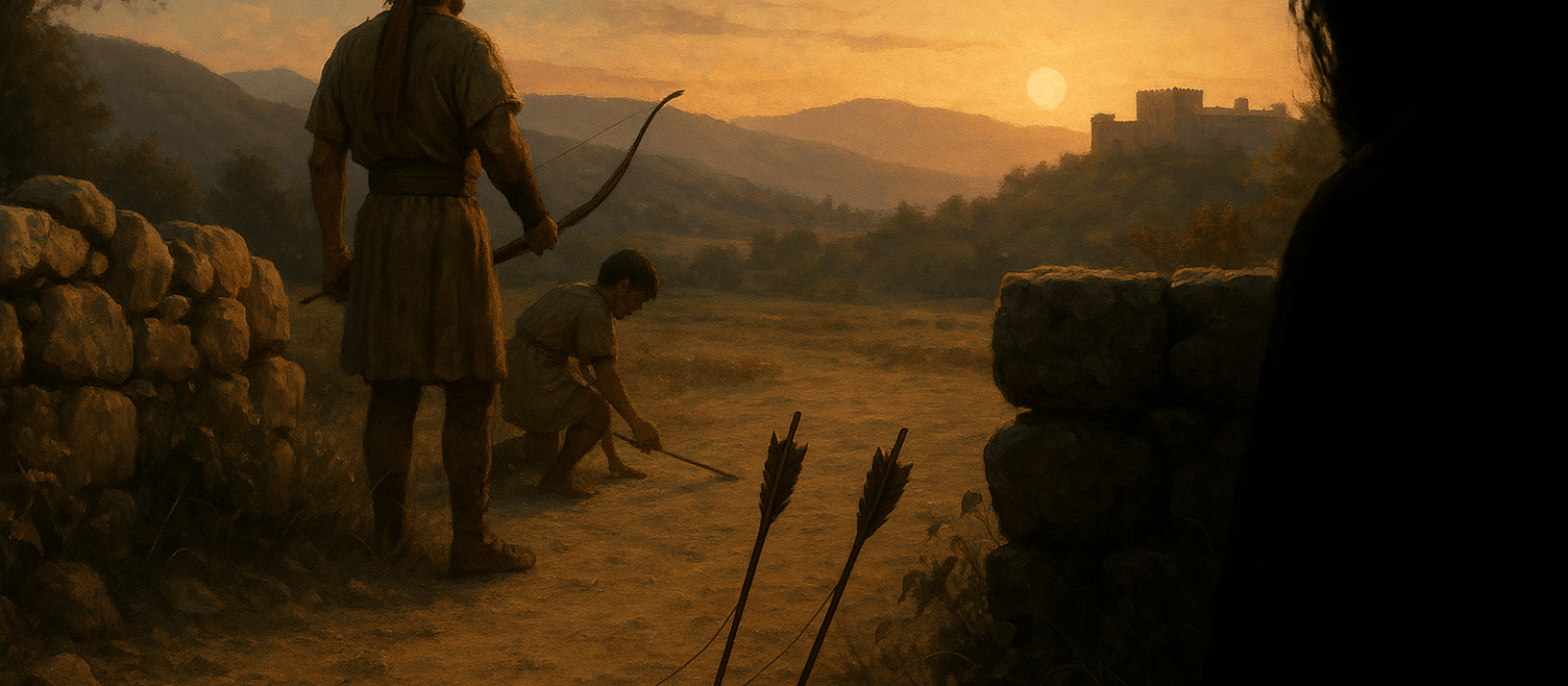
They wandered around the grounds of the palace, scoping out multiple possible locations. They agreed the best place would be the most distant field, still part of the palace, where they practiced archery. They stumbled upon an overgrown stone wall that would provide a very comfortable hiding spot for several days. They both looked up with a smile, and they just knew. It was Jonathan who came up with an idea.
“Okay, how about this: I will shoot some arrows. If you are safe, I will shoot my arrows short and tell my arrow retriever that they are on this side of the wall. If you are in danger, I will shoot them long and tell him that they are beyond you. Then you should just get up and go. Just go. Don’t even say goodbye, for I won’t be able to guarantee your safety.”
David looked at his hidey-hole and then back at the palace. With a sigh and a quick shake of his head, David agreed, “Fine. Tomorrow, then.”
Jonathan watched David disappear into the hills, and, for the most part, Jonathan just kept a low profile around the palace. His father never asked for either of them.
☼ ☼ ☼
As a commander, Jonathan would also be expected to join the King for the new moon feast, just as David was expected to. Jonathan dressed in his best military attire. He sat near the King in his usual spot. The meal went on. A couple of times the King looked at the empty chair where David should be sitting, but he said nothing. The following night went the same way, though the King did appear more visibly agitated.
Toward the end of the night, King Saul finally addressed his son, “Jonathan, where is David? He has been absent for the entire feast.”
Jonathan looked up, trying not to betray the ruse. “Of course. I should have told you. I am sorry, Father. David wanted to spend the new moon with his family. They are offering a sacrifice, and David asked me if I would permit him to go. I thought it would be okay.”
But the King did not believe his son, and his anger burned like daylight. “You son of a perverse and rebellious woman! Do you think I don’t see through you? You are choosing David to be King, even over yourself! Your mother was naked in childbearing to give you life for what? For nothing! As long as David is alive, you have no kingdom and no inheritance. Is that what you want?”
Jonathan looked up at his father. “But,” he started, “David is innocent. Besides, Samuel said—”
But Jonathan never got to finish his sentence. King Saul screamed with a lion-like roar before grabbing his spear and throwing it at his own son. Jonathan froze in disbelief; he did not move, and thankfully the spear missed. But Jonathan finally knew the truth.
☼ ☼ ☼
The next morning, Jonathan went shooting. He shot a few arrows well beyond where David should be, and he shouted to his arrow retriever, “No, you have to go farther, for the arrows are beyond that wall.”
Jonathan could not see David, and he didn’t know if David heard him. His heart sank. The boy came back, and Jonathan looked at his youth and innocence. “I am done. Take these back. I am just going to enjoy some solitude for a while.”
“As you wish, sir,” the lad said. He enthusiastically scooped up the equipment and headed back into the palace to return everything to the armory.
Jonathan did, in fact, linger and enjoy the warmth of the daylight. Birds were singing praises to Adonai, and the wind gently rustled the trees. Jonathan thought he saw some movement where David was to be. Inspecting his surroundings, he quietly walked gingerly out, as if just enjoying his surroundings. As he got close, David stood, and Jonathan stopped.
David looked at Jonathan. “I heard,” was all he could say.
Tears welled up deeply in Jonathan’s eyes, and both men wept bitterly. David was a pariah, not because of anything bad he had done, but for all the good he had done.
“I sense,” Jonathan said, having to catch his breath and suppress his sobs, “I sense that my time is also short. Please, remember me and my family. Show them kindness, even though Saul has not shown you kindness.”
“There will always be a place at my table for your family,” David said, barely able to finish his sentiments.
“You must go,” Jonathan insisted. “But don’t go to Michal. Her life is just as much in danger as yours. I will tell Michal what has happened.”
“It might be years before I can come back,” David said as much to himself as to Jonathan.
“I know. And I will let Michal know. That’s all I can do for now. You must go!”
Used with permission by the author. Find the author’s complete works online: Complete Works of Mack Samuels