
3446 AM (314 BCE) – THE TIRED PERSIAN
King Darius looked out across his war-torn land. He hated war. He hated conquest. He was the latest in a long line of Persian kings. He was the third with the great name Darius, and he was pretty sure he would be the last.
He looked toward where Greece would be if he could see it. This was a foreign land he never bothered to visit. They celebrated fighting and conquest and were not content to just live. And that new king of theirs? The young one? His name ran ahead of him like wild boars consuming the land. People laid down their weapons before him. How many cities named Alexandria did they really need?
But he could not lay down his weapons. He was a Darius, known for his role as the Persian defender and protector. But he was failing at his job. Though, not just him, much of the Persian Empire was already splintered away by many of the previous kings. Neo-Babylonia? Egypt? Judah? Lydia? And they were making many other inroads into Persia.
Darius sighed. It was what was coming next that gave him pause. Alexander was headed his way, to the heart of Persia. The beloved city of Tyre was no more. Every war tactic he tried, that capricious Greek sidestepped. Every historically successful strategy at best slowed his progress at great cost to the Persians.
Darius sighed. It would be morning soon. His generals would need marching orders. They would expect direction and leadership.
“Hmm … leadership,” Darius spoke softly, as a new idea entered his mind for the first time.
☼ ☼ ☼
The generals were gathered in the war room. It was actually the elite ballroom of Persia, known historically for hosting lavish events of the highest decorum. Today, it was full of generals and a mockup model of what was left of Persia in great detail. The topography was accurate and to scale. And while this marvel of artistry warmed Darius’ heart for its attention to detail, it also betrayed the dire position of Persia as the young Greek’s forces encroached.
As Darius entered, the generals stood at attention. The first general began explaining their current plan to the king, “Yes, sir, so we think, at best, we can marshal forces around this river near Gaugamela. Based on his past engagements, if we begin to set our army here,” he explained, pointing to a valley between two steep bluffs, all cut through with a swift river, “then their forward scouts will direct his army right to us. At least, that’s what he’s done every time.”
“And he’s outflanked us as well,” Darius rebuked.
“True, sir, but we believe that these bluffs run at least a parasang in length, are very steep and full of trees. Armor, chariots, and so on—just logistics in general—would make flanking virtually impossible. We fortify the crossing and keep to the frontal attack. That has fared best.”
Darius looked it over, “I agree. That’s what makes me question it. But I could not tell you a better strategy.”
“Well,” another general offered, “we could keep a contingent up in the trees, archers maybe, hidden, and bring them out after the initial attack.”
The other generals nodded, and the king thought about it, “And if they get cut off?”
“Well, when the fighting starts, they will be cut off, for sure. It will be up to them to fight at the appointed time and to rejoin when possible. It’s the fog of war, sir. Fog of war.”
“Fog indeed,” the king began, “How long to begin establishing a line and gathering our army?”
The second general looked up with a troubling expression, “That, um, will take some doing. We are scattered. The remaining armies between us and Alexander—I mean, the young Greek—are already falling back toward us in rapid retreat. I can send out scouts to have them begin the fortifications along the beach. Our other army…”
“Army?” the king implored, already knowing the answers.
“…uh, they are being assembled from all our reservists. It is formidable. These men are older, but they are in shape and strong. And they have decades of war behind them. They want to fight. They want to fight as free Persians, and that gives them a special strength. Numbers-wise, it will be the biggest army we have assembled, and it will even surpass the size of the young Greek’s army. We just have to put our skill and their experience to use.”
Darius wasn’t fully convinced, but the general was not being coy or dishonest. The facts were as he said.
“OK,” the king agreed, “make it so.” But then Darius looked up to all his generals and met their eyes, “But I must go. I must lead. They will fight harder if their king is with them.”
“But sir,” the first general said, advancing toward the king with urgency, “if we lose you, the whole empire will be lost!”
Darius held up a hand with his steady, regal repose, “If we do not defeat that young Greek now, there will be nothing left.”
☼ ☼ ☼
Eudoxos sat on his horse next to Polemon. They sat staring at the river. It was obvious to them that the Persians were preparing for their arrival. Already a sizable group of men made some kind of defensive preparations.
Having followed the retreating Persian army, far in advance of Alexander, they were there to gather intelligence and return. Hermokrates and Nikos separated, heading up the ridges to scout the local terrain. It had been nearly a day when the sound of hooves compelled Polemon to glance at their approach.
“And?” was all Eudoxos offered.
It was Nikos who answered, “It’s as you suspected. The terrain is impassable. A contingent would have to be detached a day’s journey back, where you suggested.”
Eudoxos looked at the men, nodded simply, and turned his horse around. The others followed.
☼ ☼ ☼
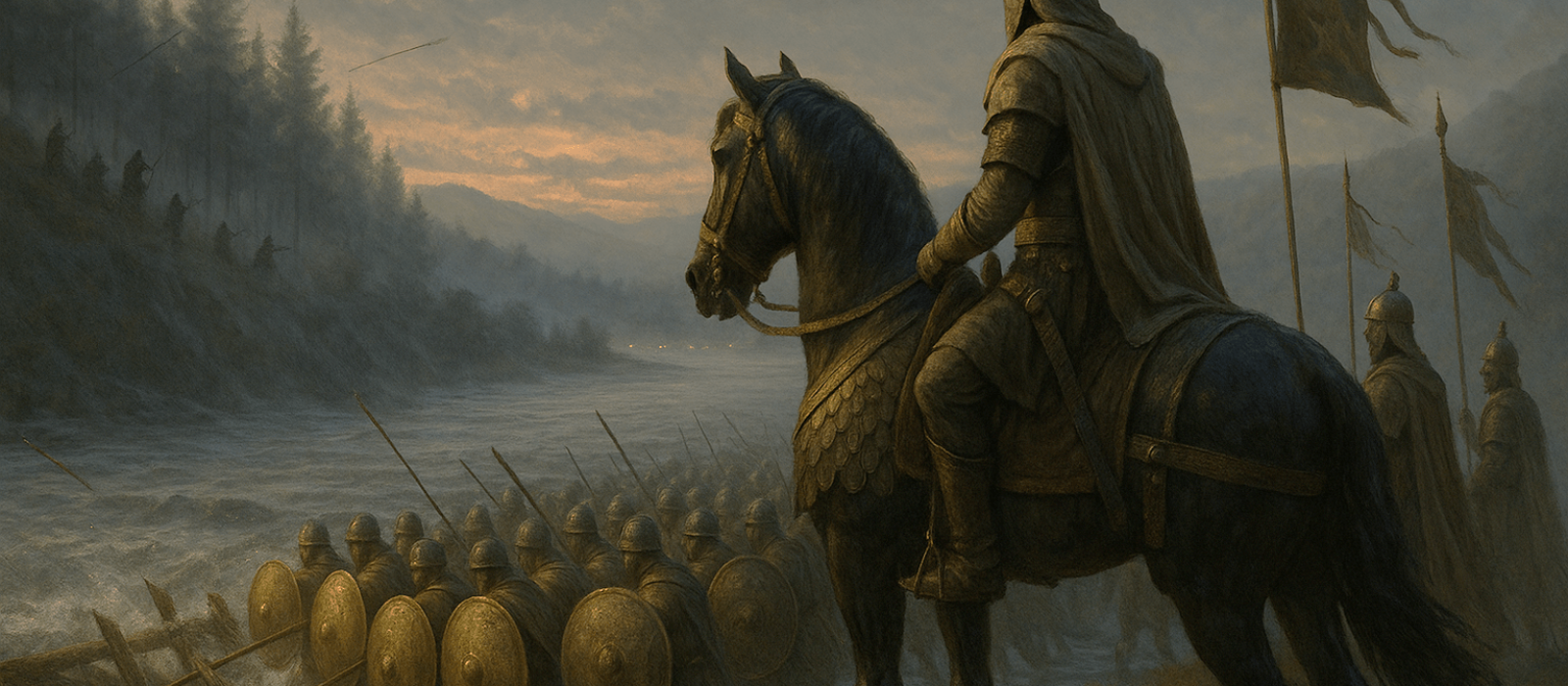
Darius stood upon his steed. Easily the largest horse, decked out in battle armor, it was a symbol of pride to the army. Just as the army of Darius filled the riverbanks in a formidable defensive posture, the army of the young Greek also filled in along the opposite bank. It was a formidable army as well. Darius did not recognize anyone who could be the king. Clearly, this was just their forward thrust, with their logistics obviously held back—likely where he was.
Darius and his generals had mapped out a plan of attack. They would hold the line no matter what, mind the gaps, and stay clear of archers. The Greeks on the other side seemed very relaxed, just milling about, some even appearing to make jokes and laugh. The king was not impressed. In this business of war, one should have reverence, even for those you might care little about. Their life is worth something. Some mother gave birth to that infant, nursed him through childhood, and raised him into a man over a score of years. And how many childless mothers suffered in Persia?
A loud horn sounded from the Greeks’ side. The Greeks milling about immediately got into formation. Their lines were tight and even. They came marching in line, with shields close together. They waded through the water, but instead of being swept away by the current, they held firm. Taking turns, they methodically chopped the wooden barricades to pieces, and Darius waited helplessly as their initial defense floated downstream.
Archers attempted to find their marks, but the Greeks were very disciplined in the matters of war. Soon, the line—and the lines behind them—were beginning to make their way onto the bank. Darius’s own army sounded their attack, and walls of Persians merged with lines of Greeks. The battle was fierce, as all battles tend to be. As the fighting dragged on, Persian casualties were minimal, and the Greek army suddenly began to withdraw. The king had seen this before. He tried to shout, “Stand your ground. Don’t follow! Hold the bank!”
And while Darius’s archers in the trees tried to rain arrows down on the retreating Greek army, with minimal success, the noise of battle drowned out the desperate orders of the king. Half the army was drawn into the river after the retreating force. The king watched helplessly as his army followed. Another set of Greek horns sounded. The Greeks were coming up from both sides of the river.
“How?!” Darius said in utter exasperation. “That’s… impossible…”
Used with permission by the author. Find the author’s complete works online: Complete Works of Mack Samuels