
2407 AM (1353 BCE) – FORTY
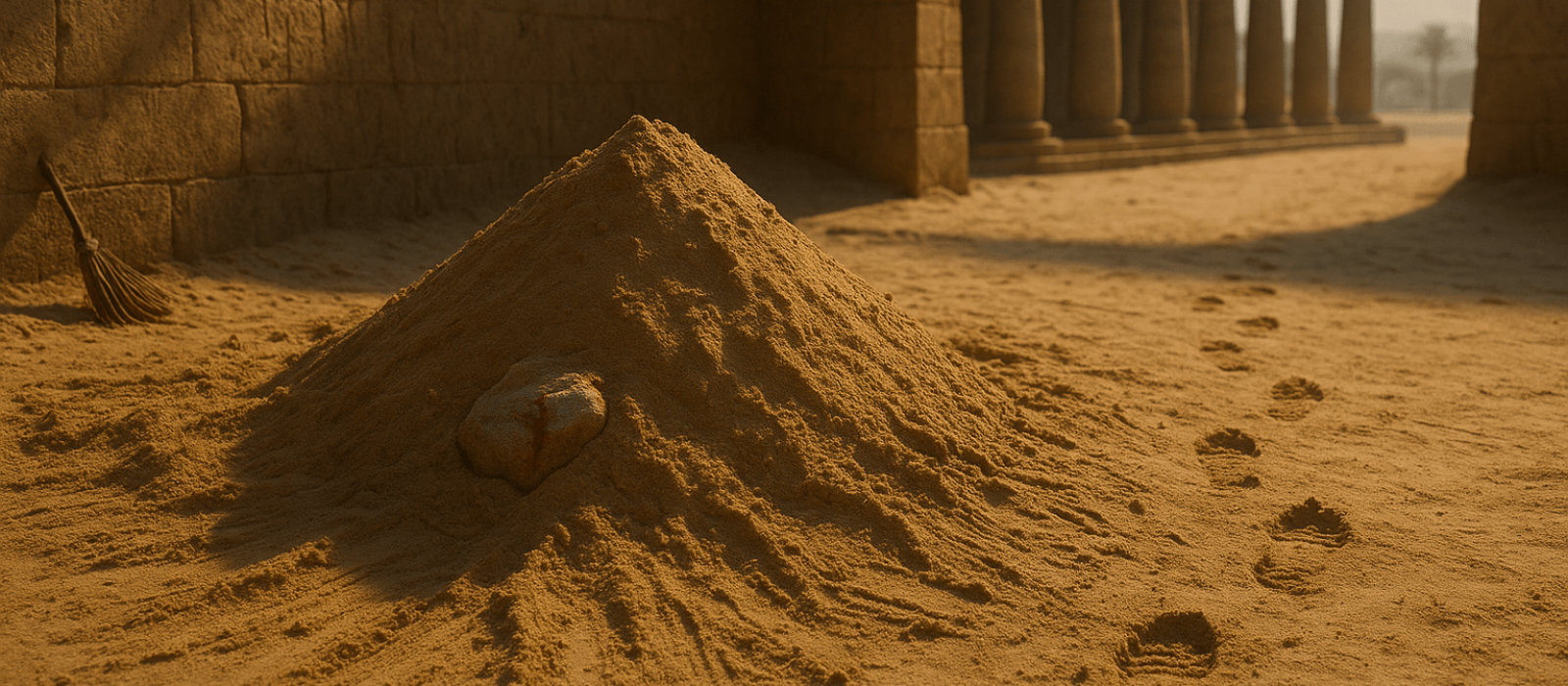
Moshe looked at the rock. It lay lifeless on the ground, in the sand, covered in blood. Moshe’s chest heaved in panic and anger. What had he done? His gaze moved from the bloody rock lying in the bloody sand to the bloody fingers attached to the bloody hand belonging to the bloody Egyptian guard also lying in the sand. In irrational impulsiveness, Moshe heaped sand on the body. Then he heaped even more sand on the body. And then more and more and more sand. Slowly, the rock and the Egyptian and the blood all disappeared under this sandy mound of desperation.
Moshe sat kneeling in the sand. His body was covered in it. It stuck to his sweaty face and arms. It stuck to his very own bloody hands. But he wasn’t thinking about the sand, but how he got there and his anger and her choice. Why did she ever draw me from the water? It would have been better if I had never been born.
“Wuh-wuh-wuh-why?” Moshe stuttered in anguish.
Kneeling there in the sand, his streams of thinking were interrupted by the sounds of whips cracking constantly, incessantly echoing off the walls and stone walkways. The sound never stopped. It echoed through the halls of the palace, when he awoke in his bed of privilege, when he kissed his mother, the Princess, who rescued him from the Nile, when he sat down to his studies, and when he took his meals.
The sound echoed in his mind, haunting his very existence. He was tired of hearing it, because after the crack of every whip was a bitter wail of agony and desperation. The ends of the whips did not land on the backs of any of the Egyptians; rather, they landed on the long scarred and bloodied backs of the Hebrew people—his people.
He wished his mom had kept that from him, that he was a Hebrew. He could have passed as an Egyptian. He was clean and shaven, knew nothing about herding dumb animals, educated in the gods and government, and spoke the many languages of Egypt. He would never be Pharaoh, of course. He was at best a prince who served at the behest and pleasure of Pharaoh’s courtiers. But the Princess would not hear of it. “Truth above all else,” she would often say, if not daily. And so, he knew his parents… his real parents, along with his brother Aaron and his sister Miriam.
His sister Miriam was the one who had brought Moshe‘s real mother to nurse him all those many years ago. Of course, the Princess knew the nursemaid was Moshe’s real mother. And it was a gamble, a risk, to let the mother and Miriam walk away with Moshe and the coins. They could have disappeared, but they didn’t. She would bring Moshe almost weekly for the Princess to hold and kiss, until Moshe was, indeed, weaned. And ever after that, the Princess would call for Miriam through the years and give her gifts of coins so they could afford a slightly better status.
Moshe was grateful for that, he decided, but in doing so, the Princess taught him that his sister and mother had value. And if his sister and mother had value, so did his family. And if his family had value, so did his people. Again, with the, “His people.” But they were his people. And regardless of what he learned or did or who he served, he would always be nothing more than a Hebrew.
The sand ground painfully into Moshe’s knees. He looked down at his hands. The blood had already dried on his hands from the hot Egyptian sun. He rubbed his bloodied fingers, and bits of sand flaked off.
An arm touched Moshe’s shoulder, and he looked up. It was the Princess. She didn’t ask what he was doing, why he was sitting there, or what was on his hands. She just took him lovingly by the arm and said, “Come, Moshe, let’s get you cleaned up.”
☼ ☼ ☼
His mother walked with him into the bathing pool. She had sent the servants away. The Princess, now forty years older, washed her son for the last time. He usually would make a fuss, but today he was lost in thought, so he acquiesced to her washing him.
Then Moshe spoke suddenly, “He was just stuh-stuh-stuh-standing there,” Moshe started, “Yesterday, I saw him whipping a Huh-Huh-Hebrew. I didn’t e-e-even know who the Egyptian was. Tuh-Tuh-Today. I saw him, and then I suh-suh-saw a rock… I was juh-juh-just suh-suh-suh-so angry…”
His voice trailed off. The Princess dried him off. “Say no more,” she said, “You did what you had to for your people. I understand. I really do. They are your people, Moshe. They are your people.”
☼ ☼ ☼
The next day, Moshe was making his rounds, and he found two Hebrew slaves arguing with each other. It wasn’t clear to Moshe what the argument was over. The larger grabbed the smaller and pinned him forcefully by his neck against the wall.
Moshe ran up, “woah, woah, woah, Buh-buh-brothers? What is thuh-thuh-this? Isn’t there enough puh-puh-pain and suffering, alr—alr—already?”
With the little Hebrew slave still pinned to the wall, the big Hebrew slave turned to acknowledge Moshe and rebuked, “Who are you calling brother, Moshe. Yeah, we know who you are. Who made you king over us? What? You fancy yourself one of us, you clean-shaven Egyptian? What, you going to murder us like you did the guard?”
The big Hebrew slave loosened his grip on the little Hebrew slave as he looked at Moshe’s expression. A wry smile crept across the lips of the big Hebrew slave. He glanced at the smaller slave and said mockingly, “He doesn’t know!”
Turning back to Moshe, he said, almost laughing, “You don’t know? How do you not know? Everybody knows. Pharaoh has a bounty out for your heart!”
Moshe’s face blanched, and he took a step back.
The big slave continued his berate, “Yeah, brother,” he said with sarcastic contempt, “you had better run. If you don’t, Pharaoh will have your heart in a canopic jar,” he mocked.
Moshe just stood there, frozen in fear.
The big slave enjoyed his moment, although he knew his moment was almost over. So, the big Hebrew slave decided to end his moment by suddenly screaming at Moshe, “What are you waiting for? Run!”
Moshe snapped to and started running east. The jeers and laughter of the two Hebrews faded slowly into the background sounds of whips, work, slaves, and brutality.
Yet, Moshe was still able to hear the big slave shout out one last long, “Run!”
Used with permission by the author. Find the author’s complete works online: Complete Works of Mack Samuels