
2367 AD (1393 BCE) – ZERO
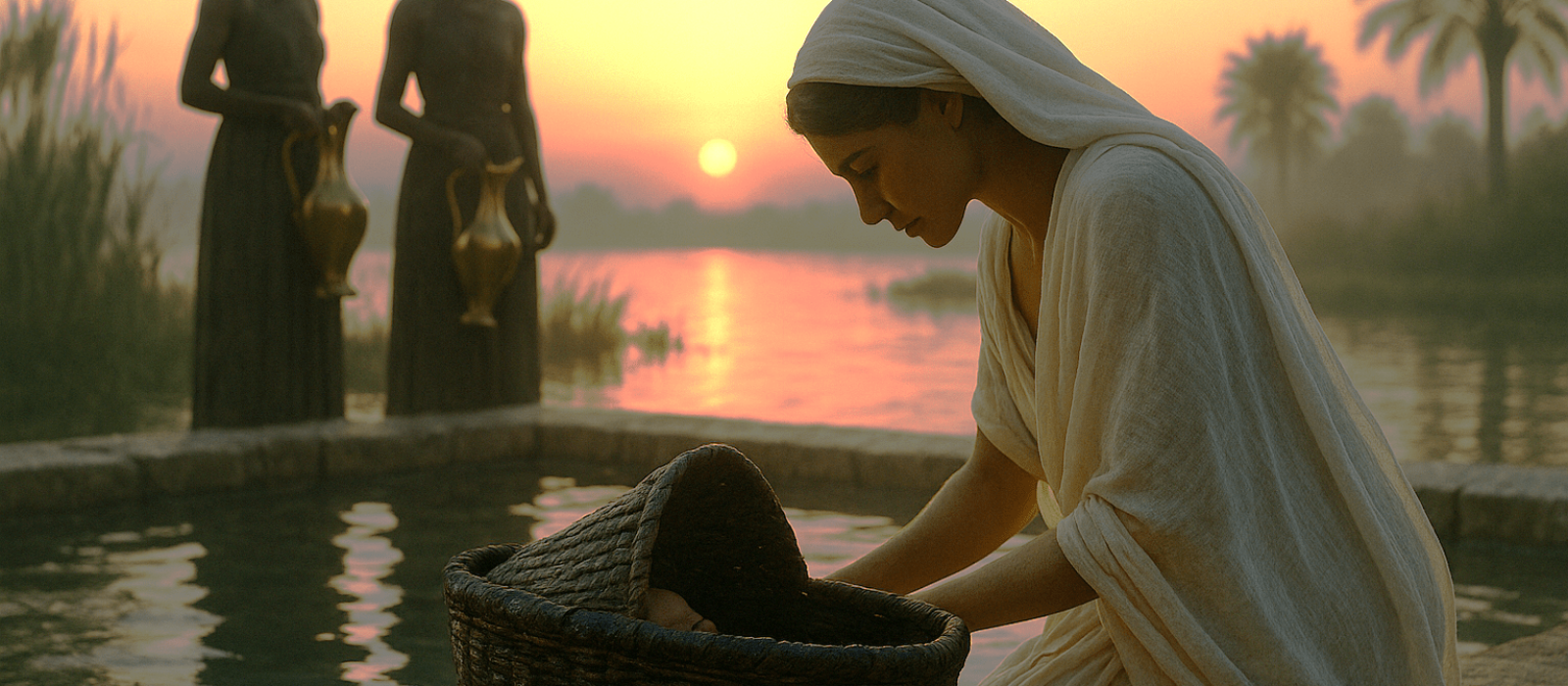
She dropped her thin robe and regally descended into the private outdoor bathing pool in the way only the daughter of the Pharaoh could. Many servants immediately followed her, wading waist-deep into the water. Her gaze was fixed into the distance, as she held her arms out as an invitation. The servants proceeded to wash and scrub. Ornate vessels of gold were poured with reverent care to rinse away the soapy residue of sand and soil and soot.
Most suddenly, her gaze dropped, and all those helping her froze, not daring to look up. What happened? Did someone make a mistake? In fear and trembling, they just waited—waited for the Princess to speak. With a deep sigh, she pointed and asked what that thing was floating near the edge of the pool.
“Moshe!” she demanded in Egyptian.
Immediately the closest servant nodded, handed her golden vessel to the next servant, and quickly waded toward the object. As requested, she drew the floating thing out of the water and brought it to the Princess. It was a basket made of thick straw and reeds, glued together with a thick, black tar, with a covering made from similar materials.
“Lif‘toe ahk!” she commanded again.
With a nod, the servant quickly opened the basket as requested and presented the contents. The Princess peered inside. Her servants, ever ready with obedient anticipation, watched as her head tilted ever so slightly from one side to the other, as this royal daughter of their god, Pharaoh, tried to comprehend what she was seeing.
It was a baby boy, and he needed attention.
She could tell he needed attention because he was crying. She could tell he was crying because tears streamed from the little baby’s dark brown eyes, his thin face was bright red with grief, and his mouth was wide open, his fat tongue protruding ever so slightly. However, to her astonishment, there was no sound. Why was there no sound? The Princess was momentarily puzzled, but only for a moment. There could be only one explanation for a baby crying silently in a basket floating in the Nile.
He had to be one of those Hebrew babies.
The Princess immediately knew what must happen to this child. She kept trying to look away. But every time she started to look away, some little nuance or motion from this little spark of fiery life—just trying to survive—kept her from being able to look away.
The longer she stared, the more her own tears began to stream down her face, as the obviousness of her father’s decree began to weigh heavy on her soul.
The Pharaoh had commanded that all the Hebrew boys were to be drowned in the Nile.
Anger flared in the Princess’s countenance. All these children were to be discarded, wasted, thrown out. But she bit her lip. She was being far too kind. These children were being murdered. And where were her children? Where was her joy?
She was as barren as the desert surrounding them in its hateful desolation.
How long had she petitioned the gods for a child? And now, the mighty Nile had finally answered her petition. In that moment—an instant—her decision was made, her mind made up. This would be her child, her joy.
Children were playing in the water some distance away, and one of the children, a young girl, approached the Princess as she was lost in thought, staring into the basket. The servants looked up in horror and panic as this stranger approached. But the Princess, ever calm and in control, looked up at the girl. The girl was obviously another Hebrew.
“Little girl,” the Princess asked in Egyptian.
The little girl, waist-deep in the pool, answered with a simple bow, such that her nose touched the surface of the water.
The Princess continued, “This child is hungry. Go find me a wet nurse from your Hebrew village.”
After the Princess spoke, the little girl nodded and quickly started wading back the way she had come, past the other children playing in the water.
The Princess went back to the baby and picked him up. Her tears dripped down on him, mixing with his. She began to ascend from the pool, and her servants rushed to dry her and cover her up.
She turned to her servants. “We will call him Moshe,” she proclaimed, “for he is a gift that was drawn up from the waters of the Nile.”
☼ ☼ ☼
Later in the day, as the Princess was sitting with Moshe near the edge of her bathing pool, the little Hebrew girl once again approached, but this time with a woman—clearly, obviously a wet nurse.
“Take this child. His name is Moshe. Nurse him until he is weaned, and then return him to me.”
The woman bowed in acknowledgement, and the Princess beckoned the nursemaid forward. Laying Moshe in her arms, the baby began nursing immediately.
As the mother began to carry the beloved baby back to her home, the Princess spoke. “You,” she said to the little girl, “hold out your hand.”
The little girl slowly stepped forward and held out her hand. The Princess set in her hand a small bag containing coins. The Princess looked to her left, and then to her right, and then allowed herself to smile quickly at the little girl. The little girl returned the Princess’s smile with a bright smile of her own. Then the little girl closed her hand tightly and ran after her mother.
Used with permission by the author. Find the author’s complete works online: Complete Works of Mack Samuels