
Parashah Vayak’hel Comments 2022
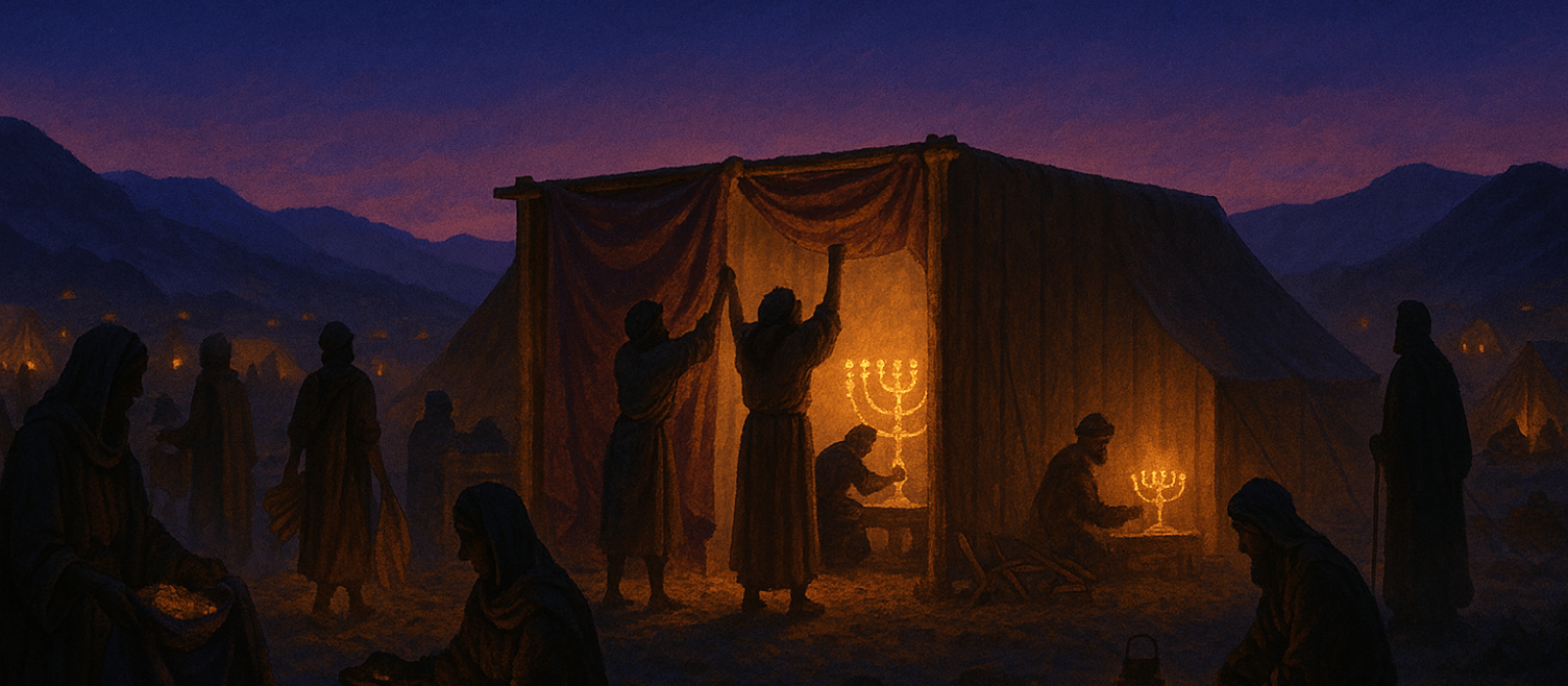
The parashah (Torah portion) for this week is “Vayak’el” (“He assembled” in English). The word from which Vayak’hel is derived is kahal, the Hebrew word for congregation or assembly. The portion starts with Moses assembling the people to teach them the Torah he received from HaShem on Mt. Sinai, and ends with the assembling of the Mishkan (the Tabernacle).
Some people find the portions of the Bible dealing with the Tabernacle, the First and Second Temples, and the prophesied Fourth Temple difficult—hard to visualize, hard to understand why so much detail is given, and, consequently, hard to stay engaged. Let me share a few things about the Tabernacle that may make these passages easier to appreciate.
First, the overriding message God is communicating here is that worship is very, very important. Does God need our worship? Of course not. He is self-sufficient. He needs nothing from us—including our worship. It is we who need to worship. “Worship God” is commandment number one. We should do it because He says so, and that would be enough; however, here are a few more reasons.
Worshipping God declares that He is at the center of our lives. It is a powerful weapon against the lies of this world and inoculates us with the truth of God. It teaches us to surrender our will and all our cares—priorities, plans, hopes, dreams, and even sorrows—to Him.
Another point to understand about this parashah is what it communicated to the Israelites and the world: (1) God has forgiven Israel for the incident concerning the Golden Calf, of which we read in the last parashah, and (2) God’s great love for Israel and His great desire for a relationship with Israel.
Let me go a bit further and share what I learned about the interior of the Mishkan. I hope that by the time we are done, you will look at the Tabernacle with new eyes. The Tabernacle of Moses is comprised of three parts: the Courtyard, the Holy Place, and the Holy of Holies.
The Israelites would enter the Mishkan through the Courtyard. First, remember that to enter, you had to be ritually clean. No death was to be connected to you prior to entering. This meant, among other things, no recent contact with a dead person and, for a woman, not coming during the time of her niddah (period).
The Tabernacle is divided into three sections—Courtyard, Holy Place, and Holy of Holies. The diagram of the furnishings shows this clearly.
In the Courtyard, we first encounter the Altar of Burnt Offering. All sacrifices by fire were performed here. Between the Altar and the Holy Place stood the Bronze Basin (the “Laver”), where the priests washed hands and feet in preparation to serve.
Proceeding into the Holy Place, we encounter the Table of the Presence on the right, with the Lechem HaPanim (“Bread of the Face”), and the Menorah (“Lampstand”) on the left. The light, the Ner Tamid (eternal light), was to be lit every evening. Further in stands the Altar of Incense, placed opposite the Ark of the Covenant, which rests in the Holy of Holies on the other side of the Veil. The Veil (the parokhet, Hebrew for “separation”) divides the Holy Place from the Holy of Holies.
The High Priest alone was permitted into the Holy of Holies. There we find the Ark of the Covenant containing Aaron’s rod, the memorial jar of manna, and the two tablets inscribed with the Ten Words written by the Finger of God. The Torah of Moses sat by the side of the Ark.
On top of the Ark rested the Mercy Seat, where God met the Cohen HaGadol (High Priest). The Seat was made of pure gold, and rising on both sides were two golden cherubim facing one another with wings extended.
It is estimated that as many as 200,000 Jewish people were followers of Yeshua by the end of His earthly ministry, with many more coming to faith following His sacrificial death and resurrection. Their confidence was strengthened by the Holy Scriptures (the Tenach), the Apocrypha, other sacred texts, the Oral Law, and the customs of the time. Arguably the most profound encouragement for early believers was found in the furnishings and elements inside the Tabernacle of Moses. Let us look at these with our minds inclined toward their purpose.
Every day, two lambs (one morning, one afternoon) were sacrificed and completely consumed on the Altar of Burnt Offering. It symbolized the Passover Lamb, and for believers in Yeshua it represents Messiah’s sacrifice.
The Bronze Basin represents our cleansing from sin and separation from the world. Yeshua was in the world, yet His home was with the Father. The washing calls to mind the forgiveness Yeshua offers and the repentance that welcomes it.
The Table of the Presence was acacia wood overlaid with gold. The wood symbolizes humanity in the natural world; the gold symbolizes holiness and spiritual maturity. Seen this way, the Table is a picture of Messiah. (Shittim, “acacia,” comes from a root meaning “to pierce.”) Three furnishings share this acacia-and-gold design: the Table, the Altar of Incense, and the Ark of the Covenant.
The Bread of the Presence recalls Yeshua’s miracles of the loaves. The Lechem HaPanim was replaced weekly and given to the priests—tradition says it remained as fresh as the day it was baked. It was eaten as Yeshua said He Himself must be “eaten.”
The Menorah provided illumination in the Holy Place at night. When Yeshua ascended, He asked the Father to send the Comforter—the Ruach HaKodesh (Holy Spirit). The light represents this Spirit. Yeshua declared, “I am the light of the world.” His light illuminates the Word, modeling God’s attributes and how we are to live.
The Menorah was pure gold—light from God. It depicts God’s communication through the Holy Spirit, who convicts us of the truth of Yeshua our Master.
The Altar of Incense stood on the Holy-Place side of the parokhet, opposite the Mercy Seat above the Ark. The incense symbolizes the prayers Yeshua continually offers to the Father in the heavenly Mishkan. Like the Table and the Ark, the Altar of Incense was acacia overlaid with gold—Messiah’s humanity and perfect holiness.
Within the Ark, Aaron’s budded rod represents resurrection—a dead staff sprouting life. The tablets portray the reality of God’s voice etched in stone. The jar of manna signifies the bread of life and reflects Yeshua’s declarations.
John 6:51 — “…I am the living bread that has come down from heaven…”
The Writings of Moses beside the Ark are God’s instruction—coming to life in Yeshua, the Obedient One, who embodies perfect obedience to the will of God.
The rituals and furnishings of the Courtyard point to death, judgment, washing, and cleansing—pictures of redemption through Yeshua’s atoning death. He is the way to repentance and salvation through forgiveness and baptism.
In the Holy Place, everything points to life: light (Menorah), food (Lechem HaPanim), sweet incense, and the fruits and gifts of the Spirit. The Courtyard symbolizes initial salvation for the newly repentant follower of Yeshua. The Holy Place speaks of growth and maturity—moving from spiritual infancy to spiritual adulthood.
The Courtyard corresponds more to the physical; the Holy Place to the inner life—our emotional and mental condition, our soul. The Holy of Holies speaks to the human spirit. As we progress from the Courtyard to the Holy of Holies, God draws us to ever-higher spiritual levels, with the ultimate goal of spirit-to-Spirit intimacy with Him.
Torah also gives us many three-part transitions. The three pilgrimage feasts (Shelosh Regalim) seem to move from the physical (unleavened bread) to initiation into the spiritual (the Holy Spirit) to communion with God in personal tabernacles.
The traditional Hebrew wedding likewise unfolds in three parts: betrothal, consummation, and celebration. In Scripture the number three often signifies completeness: past–present–future; beginning–middle–end; civil–ceremonial–moral; and it also points to the relationship of Father, Son, and Holy Spirit. When Scripture couples “three” with movement from death to life, rising and descending, or life from barrenness, it is often highlighting Messiah’s life and ministry.
Moving from the Courtyard to the Holy Place symbolizes our spiritual journey—from thinking God is here for our benefit to realizing we are here for His. We are called to His purposes, not our own.
When Yeshua died and the veil was torn, it showed that in Him we pass from Adamic life to eternal life in God’s presence. Yeshua described the “third death”: death to self.
We are exhorted to pour out our lives in obedience and consecration to the will of God. This is Yeshua’s greatest lesson—accepting a death meant for us all.
When the High Priest entered the Holy of Holies, he sprinkled the Ark with the blood of a sacrificed lamb—another picture of what we must learn: to internalize the suffering, death, and resurrection of Yeshua. Only then do we grasp the love that sent the Beloved Son and the endless life of communion with God that this brings.
Where do you see yourself spiritually within the Mishkan? Are you in the Courtyard—becoming aware of sin and the need for forgiveness? Newly saved and thankful, learning that God grants our heartfelt desires when they align with His will? In the Holy Place—recognizing that God is awesome and worthy of our praise and thanks? Or approaching the Holy of Holies—giving yourself completely to God and preparing for a spiritual life with the Eternal One?
Are you moving in the direction that will mean the most at the end of your life? If not, it is time to repent. Ask God to open your heart and direct your path.
The world is changing—rapidly and often painfully. But we know: (1) God is in control; (2) today’s burdens can become tomorrow’s blessings.
Love God. Love His children. Seek to emulate His ways. Communicate the same to any who will listen—“when necessary, use words.” May the Ruach HaKodesh use these words to encourage those who need them. And may this Messianic explanation of the Mishkan enhance and magnify your understanding of HaShem, bringing you nearer to the Source of all reality. BaShem Yeshua HaMashiach. Ormein.