
Parashah Pekudei Comments 2022 (Revised 2024)
To understand this teaching, you will need a few basics about written Hebrew and “gematria.”
What Is Gematria? Why Do Vowels Look Different?
Gematria is a method of interpreting Hebrew words and phrases by the numerical values of their letters. Biblical Hebrew is written with consonants; in the Tanakh and other sacred texts the vowels are not written. The reader supplies the vowels from context.
The word Masora means “traditional.” The Masoretes (c. 800–900 CE) accurately preserved Hebrew Scripture for future generations. After the Septuagint (Greek translation of the Hebrew Bible), the Masoretes added niqqud—vowel pointings—to guide pronunciation. (See the Hebrew alphabet chart noted at the end; numbers in parentheses under each letter reflect gematria values.)
Medieval Kabbalists systematized gematria as a tool to draw out meaning—especially in passages that seemed obscure. Some dismissed it as number play; others found devotional and interpretive value.
Example: In Genesis 28:12, Jacob dreams of a ladder (sullam) reaching heaven with angels ascending and descending. Sullam (סֻלָּם) totals 130 (samekh 60 + lamed 30 + mem 40). Sinai (סיני) also totals 130 (samekh 60 + yud 10 + nun 50 + yud 10). Many interpreters infer: the Torah, revealed at Sinai, is the “ladder” by which humanity ascends toward God.
Pekudei and Creation: “So Moses Finished the Work”
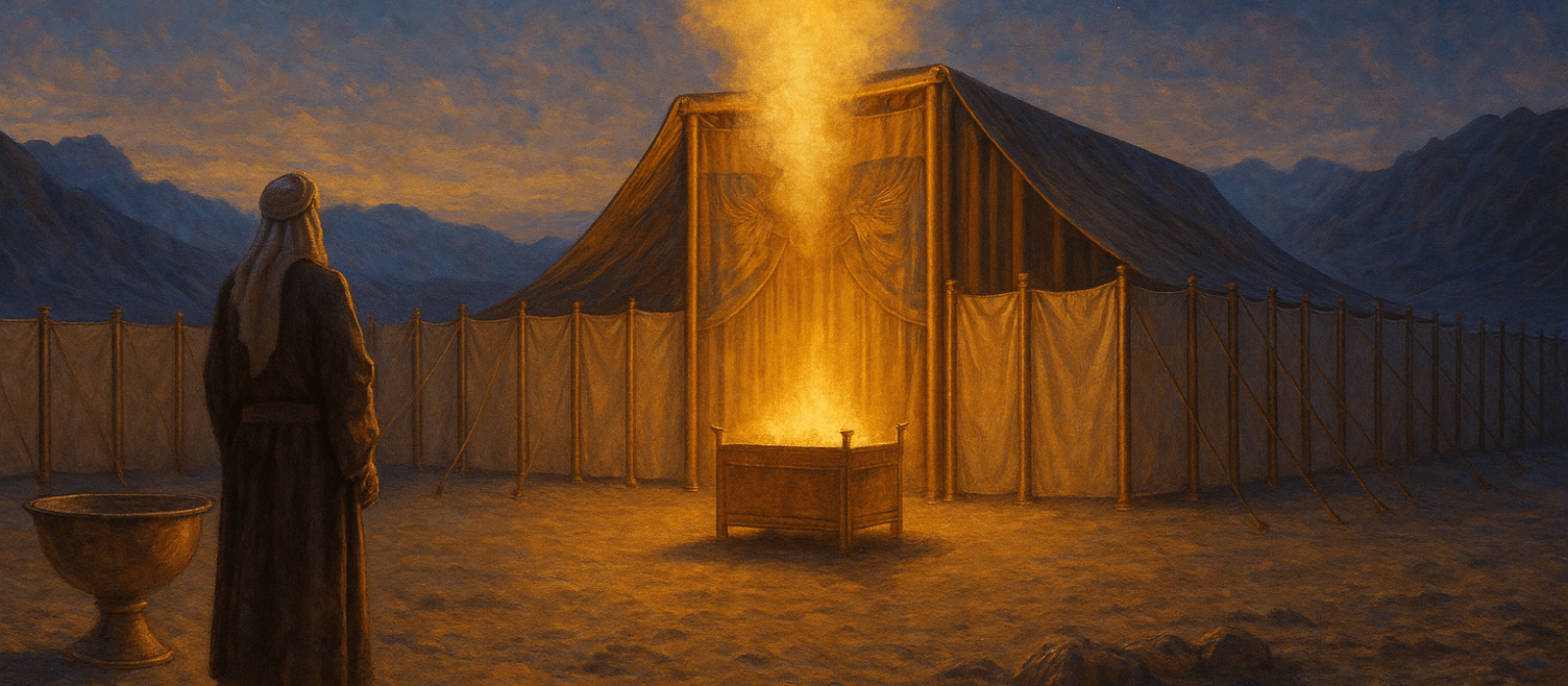
The final portion of Shemot (Exodus) details the building of the Mishkan (Tabernacle), its furnishings, and priestly garments. It culminates:
Exodus 40:33
“So Moses finished the work.”
By gematria, the value of this phrase equals the value of the opening words of the Torah—
Genesis 1:1
“In the beginning…”
The implication: creation itself reaches toward the Mishkan—God dwelling among His people—and, by extension, toward the revelation of His sacrificial love to all creation.
John 3:16
“For God so loved the world that He gave His one and only Son….”
This aligns with the Talmudic assertion that the Tabernacle foreshadows Messiah:
Sanhedrin 98b
“All the world was created for the Messiah.”
Messiah From the Beginning
Revelation 13:8
“The Lamb slain from the foundation of the world.”
1 Peter 1:20
“He was foreknown before the foundation of the world….”
Ephesians 1:4
“In the Messiah He chose us… before the creation of the universe….”
2 Timothy 1:9
“…grace which He gave us in Messiah Yeshua before the beginning of time.”
Yeshua stands at the center of creation—Aleph and Tav, beginning and end.
Isaiah 44:6
“I am the first and I am the last; besides Me there is no God.”
Revelation 1:17
“Fear not, I am the first and the last.”
“Truth” Sealed Into Creation
Jewish sages say God’s seal is emet (“truth”). The final letters of the last three words in the creation account—bara (א), Elohim (ם), la’asot (ת)—spell א־מ־ת (emet). The phrase “God created to do” (Genesis 2:3) suggests that God’s creative (and redemptive) work was already complete from the foundation.
Hebrews 4:3
“…His works were finished from the foundation of the world.”
Again we see: the Lamb was “slain” from the beginning; salvation was not a contingency plan but the plan.
Jewish Context: How Did Many Recognize Yeshua?
The Tanakh is a Jewish document—and so is the Brit Chadashah (New Testament). First-century Jewish believers came to faith through the Scriptures and the living Jewish theological conversation of their time.
Proverbs 31:30
“Grace is deceitful, and beauty is vain….”
In gematria, chen (“grace/beauty”) shares the value of yemach (“to blot out”). Some traditions call Messiah “Chen.” Outward appearances can mislead; the Beautiful One could be miscast as deceitful—especially amid politicized religion.
Another Orthodox idea: the people must be prepared to receive Messiah; if not, He departs and returns when hearts are ready. The modern resurgence of Messianic Jewish communities may signal such preparation.
Paul’s Damascus-road encounter was shaped by profound context—he was trained by Rabban Gamaliel. His revelation landed in fertile, Messianic soil.
Proverbs 30:1–4
“Who has gone up to heaven and come down… What is His name, and what is His Son’s name? Surely you know!”
Kabbalistic sources (e.g., the Zohar) speak of ten divine emanations; binah (understanding) is read as ben (“son of”) + Yah. Some note that this verse contains, in sequence, the Hebrew letters that can spell “Yeshua.” While not biblical exegesis, such ideas were part of the Second-Temple Jewish conversation.
Four Periods of the Messiah
A pre-New Testament concept: (1) before His birth, (2) birth to death, (3) death to resurrection, (4) resurrection to return.
John 2:19
“Destroy this temple, and in three days I will raise it up.”
Yeshua identifies Himself as the true Temple—the meeting place with the Father—just as the Mishkan and later the Jerusalem Temple served as tangible loci of divine presence.
The Mishkan Mirrors Creation
Creation fills two chapters; the Mishkan’s construction fills fifty. Yeshua is present through all, whether we perceive Him or not. Recognizing this deepens faith in the God of Israel and His Beloved Son, Yeshua the Messiah.
The Tabernacle gave Israel a communal house of worship. Sinai’s fiery Presence became a mobile, defined Presence as Israel journeyed to the Land of Promise. The Mishkan flowed from God to creation, to Israel, from the courtyard to the Holy Place, and into the Holy of Holies—where God was enthroned above the Mercy Seat on the Ark. The Mishkan is thus a living portrait of creation itself.
Genesis says God “made” (la’asot) and “finished.” Exodus says Moses “finished the work.” God saw and completed His work; Moses saw and completed the Mishkan—both culminating in Messiah’s redemption (God by omniscience; Moses by standing with Yeshua and Elijah at the Transfiguration, speaking of Messiah’s future work).
With the Mishkan completed, Exodus closes: the once “absent” God during slavery now leads His people toward promise.
Chazak, chazak, v’nitchazek! Be strong, be strong, and let us be strengthened—in conviction and in delighting in God’s Word.
Father, may we know You better, represent You well, and be instruments preparing this world for the return of Your Messiah. Amen.