
3680 AM (80 BCE) – A HASMONEAN LEGACY
Young Micah ben Avram, scholar and scribe, apprentice to the great Elder Pharisee Shimon ben Shetach, head of the Sanhedrin, looked up in astonishment at the stern voice of Ezra ben Tzadok the Sadducee. Ezra’s rant against the entire sect of the Pharisees reached a fiery apex. Everything was in disarray within the Jewish community. Many were slaughtered or missing. The Sanhedrin was in shambles, and the Temple struggled to function as it once had.
Micah’s thoughts had been elsewhere. His eyes had wandered between his mentor Shimon and Shimon’s rival, Ezra. He couldn’t help it. He was still quite young with much to learn. It was their attire. It matched the rhetoric of their latest round of fiery darts, salvoed at each other for the better part of the morning.
The contrast of their arguments paralleled the contrast of their attire: Ezra, with his finely woven turban, dyed purple from the most expensive imperial dyes from Phoenicia and trimmed with gold leaf, spoke many colorful words worth many shekels, which danced and ebbed around the discussion at hand—speaking much, but saying little. Shimon, on the other hand, with his dingy white turban and his plain tallit, adorned simply with plain tzitzit, used simple words, truthful and forceful, that struck at the heart of the issue.
Micah was not a dummy. In fact, he was the brightest for his age in his community, which is why he was allowed to be there. And Micah certainly meant no disrespect by his meandering mind. It wasn’t that the topic at hand didn’t interest him, but that he had heard it all before, so many, many times, and the discussion seemed to never change.
Shimon would always start with a rendition of “farewell, Judah,” and how idolatry caused the fall of Solomon’s Temple, and how the Torah is crystal clear that Jewish identity must remain pure and untainted by foreign influences. The Jews must remain separate in order to preserve the identity and traditions that will ensure the existence of Israel for generations to come.
But then Ezra would respond that the world is Hellenistic. It is a fact, and Judea needs to adapt—needs to stay relevant for a generation that is losing interest in the old ways. Why not make the Jewish rituals more beautiful and accessible and appealing to the broader population? Maybe we could even attract those in the diaspora back into the community of Israel.
But then Shimon would respond that even the smallest compromises become a slippery slope and greater assimilation until we are no different than the Jews of Alexandria! Should we exchange our faith for syncretism?
But then Ezra would counter that the Sadducees have a responsibility both to the Temple and to ensure Israel stays sovereign, since, as it is written, the scepter shall never depart from the throne of Judah. Maybe the Pharisees don’t take that seriously, but the Sadducees certainly do!
And on and on and on and on…
So, you see, it was completely understandable that Micah’s mind, along with his eyes, would wander now and again. But what Micah could not understand was why his eyes always seemed to wander over to Eliora. His heart would always quicken when he caught a glimpse of her profile, but he never could be found staring at her—not her, not surrounded by this turmoil. Too much hostility. But she was breathtaking, young, and, like Micah, extremely intelligent.
Eliora was Ezra’s youngest sister, yet to be married off. Much gossip floated on the winds as to why. Had she not been his sister, she certainly would not have been allowed in the assembly where women were not allowed. Gossip implied some inappropriateness, though Micah absolutely knew there was none. Micah knew why she was really there and unmarried. He knew why Ezra kept Eliora close.
Eliora was Micah’s equal in every way. She was a scholar—brilliant, captivating, and bold. Argumentative in the classical Greek sense, but not combative. And she was not dressed like her brother at all. A delicate veil covered her head, with modest, muted colors that subtly suggested possibilities of expression that would never be, just like they could never be. At least, they could never be anything more than colleagues and friends. And even that latter thing was something they had to be very, extremely careful about.
Once again, Micah’s wandering attention was pulled back to the debate, where the argument had actually turned combative. Shimon had leaped across the table, spilling scrolls and scattering other miscellaneous things about. Ezra had grabbed Shimon’s arms, and the two were engaged in a kind of standing wrestling with each other, as older men might. Other Sadducees and Pharisees worked to keep the two community leaders from doing something that could not be undone.
Shimon finally left in a huff out the main exit with his entourage of Pharisees, as Ezra took the side entrance that he was more accustomed to, leaving Micah and Eliora mostly alone to clean up. This was not an uncommon occurrence, especially as of late.
☼ ☼ ☼
“You missed one,” she said to him.
His heart beat tremendously in his chest as he looked up into her sparkling eyes. She pointed. He moved a chair over a bit and finally saw what she saw.
“Ah, thanks,” Micah said to Eliora as he picked up the stray scroll and tossed it into the worn leather satchel slung across his shoulders.
“You are welcome,” she said with a sly smirk. She let a moment pass, and then continued, “But you know,” she started, waiting for the mind and eyes of Micah to finally catch up and acknowledge her.
“Yeah?” Micah said, looking back.
“Those two,” she said flatly.
“Yeah,” Micah said, understanding well what she meant. “Those two.”
Like Ezra and Shimon, Eliora and Micah had also spent many hours debating each other as they cleaned. And like Ezra and Shimon, they could become heated. But Micah and Eliora knew that they were, first and foremost, both Jews, and they had a civilization to preserve. The rhetoric was so inflammatory these days that it almost always devolved into blows.
“But what to do?” Micah wondered aloud.
“I wish I had words of wisdom, Micah, but I think only Adonai can fix this. The Pharisees will never change,” she said, looking up at Micah, “but then neither will the Sadducees. In many ways, I agree with the Pharisees about keeping Hellenism at arm’s length.”
This quick admission and moment of honesty certainly surprised Micah, who repaid her comment with a quizzical expression of dismay… and a smile.
“Don’t get ahead of yourself; I will always be a Sadducee. I could not live like you people. I mean, look at how you dress.”
Her tone was mocking, and Micah could not tell if she was serious or not. He looked down at his clothes, as if for the first time. “You do have a point, Eliora. Why should we allow a people who look like us to exist? We are a blight on Grecian fashion.”
Eliora’s face turned crimson at the implication. She was not angry—well, maybe—but also a little embarrassed. Genocide was certainly always a constant threat. Israel, save a few moments during the reign of King Solomon, has always and only known conflict with those who constantly try to wipe them out.
Micah saw the consequence of his own hapless statement and quickly retreated. “I’m sorry. That was over the line.”
“It’s okay, ‘Shimon,’” she said, taking a deep breath and letting the tension of the moment just melt away, “I mean, Micah.”
Her eyes met his, and he just studied her.
☼ ☼ ☼
In public, Micah and Eliora never had cause to interact. And even if they did, it would not be safe. For the most part, the Pharisees kept to themselves, and the Sadducees likewise. They would see each other in passing, but they would never dare acknowledge the other publicly. Micah did not know how Eliora felt about it, but it was torture to him. He could not greet her, nor could he smile at her. Not that, of course, he wanted or needed anything from her, but now was supposed to be a festive time, yet he felt as if he was constantly bound tightly from head to toe in leather straps.
Micah sighed. He had to get back to their sukkah. Shimon had sent him for yet more supplies. The armful was starting to feel heavy. No sooner had he arrived than Shimon sent him out for another task.
So was the festival of Sukkot every year Micah had apprenticed under Shimon. And for the most part, it was a festive time. Hospitality was the name of the game. Just as Hashem had provided for all of Israel in the wilderness desert for forty years, Jews were to show hospitality to everyone. It was one of the few times you would see Jews be hospitable to gentiles. Of course, it was one of those few times you would see Sadducees and Pharisees being hospitable to each other as well.
But Micah could only hope that Ezra would stop by for a cordial visit, likely with Eliora in tow. They could step outside and chat about the current geopolitical quandary and—
“Hey, watch it!” someone said, nearly knocking Micah flat to the ground. Micah looked up in time to avoid the collision. Where was his mind? He knew where it was. It was distracted with hopeful ideals bordering on denial of reality. He wanted an Israel that wasn’t in conflict. He wanted a Judea not riddled with baseless hatred. He wanted a Jerusalem where he could fall in love with and marry a Sadducee without it being some kind of political scandal. And how he wanted it. But did she?
“Hey, careful!” another someone spoke to Micah. This time Micah began to return to the real world and noticed many people scurrying about. Seeing a Pharisee rushing by, he held up a hand. “What is going on?”
“There is trouble at Jannaeus’ sukkah!” the man said, waiting only long enough to get the words out before rushing away. Micah followed him, forgetting whatever sojourn for Shimon he might have been on.
☼ ☼ ☼
As Micah approached, the line of men thickened. It was impassable. He could see the wall of humanity, and then on the other side, all he could see was smoke and the occasional flames licking high into the air. Finally, from behind him he saw his mentor Shimon walking up. The crowd began to part. Instantly, Micah could see the pile of lulavs burning in front of the sukkah that belonged to Jannaeus.
Micah fell in behind his mentor. They approached the fiery mass of sacred fronds, myrtles, and willows, and all grew silent and still. Certainly, it was not unheard of to burn a lulav, but that was done just before Pesach. What Micah saw, on the very eve of Sukkot, made no sense, since the lulavs were a critical part of the celebration.
Micah looked at the face of Jannaeus, who did not appear to be angry. Rather, he was impassive and cold—almost dismissive of the whole scene. Then Micah looked at Shimon, whose expression was also more like stone than flesh. Finally, his eyes settled on the flames and peered ever closer at the lulavs themselves. Micah wondered whose lulavs they once were, but based on their configuration, they were clearly Sadducean and not something the Pharisees would have accepted.
Taking a step forward, Shimon looked around at everyone, but especially his Pharisees. When he finally spoke, his tone was unquestionably stern. “Let this be the last of it,” he said before turning and walking away. The crowd quickly began to disperse.
Micah was about to follow, but he noticed Jannaeus still standing stoic, along with all the Sadducees. Apparently, they were all their lulavs in the pyre. Once again, Micah turned to leave, not wanting to stand out or be noticed. Yet, still being among the last to leave, he heard Jannaeus say under his breath, “We will not desecrate Sukkot with vengeance, but neither will we forget.” Micah followed him, forgetting whatever sojourn for Shimon he might have been on.
☼ ☼ ☼
Jannaeus’s threatening words would hang over Micah’s countenance the whole week of Sukkot. But he thought it would be best to keep it to himself. This was a time of joy and celebration, even amidst the looming darkness. Maybe, even despite it.
Suddenly, Micah heard it and looked up. Music! The songs had started! He quickened his pace to get to the market square. As he approached, people lined all along the closed shops. Groups were already dancing, as familiar lyrics and melodies filled the air.
“Ushavtem mayim b’sason Mimainei hayeshua!”
The meaning flooded Micah’s thoughts: “You shall draw water with joy from the wells of salvation.” He longed for the living waters of salvation to cleanse Israel of all this bitterness. He longed for hope and the promises of Hashem. But most of all, he longed for…
And there she was, Eliora, dancing with other young ladies, circling and spinning. What was he thinking about again? Never mind. It didn’t matter. Quickly, he moved to join in the dancing and the singing. Quickly, he moved to join in to any sense of normalcy he could. This was a time of celebration, and they could dance and celebrate—they should dance and celebrate—late into the night.
☼ ☼ ☼
The next morning found Shimon and Micah, along with as many Jews as could fit in and around the large sukkah that was built for Shimon, studying Torah. Shimon had finished shaking the lulav in all directions, and they were reading today from Ecclesiastes.
“Vanity of vanities, all is vanity,” Shimon started. “What profits a Jew to gain the whole world and lose his soul?”
Voices of affirmation could be heard. Micah knew the implication was against the wealth and influence the Sadducees held with the Hasmoneans.
“Go and eat the bread of the earth and fruit of the vine. Hashem has already approved you to do so. It is a sin for you not to enjoy the provisions that Hashem has made for you. Are you unmarried? You must get married! Have you no children? You must make children! Many children!”
Much laughter erupted from those standing around.
“But they must be good children, moral children. They must be the kind that will build up our civilization, not tear it down.”
Accolades and affirmations filled the air.
“Take my Micah, for example. He does well in all I ask of him. He puts learning Torah and living Torah above all else, and yet he treats people with dignity and respect, kindness and compassion.”
Micah was beet red in embarrassment, but he appreciated the acknowledgment.
“Yet,” Shimon said, holding up a finger, “there is one thing even Micah lacks.”
Silence filled the air as everyone, including Micah, pondered what Shimon could possibly mean. Suddenly, Shimon shouted out, “A wife! When are we going to find Micah a decent wife?”
More voices erupted in cheers and laughter. Micah looked up in embarrassment, as joyful jeers celebrated the words of Shimon, even if a little at Micah’s expense.
In all seriousness, Shimon looked to Micah. “Micah, Micah, you must understand. A woman will make you or break you. This is why we don’t leave it to children to find a wife; we find a woman who will challenge you, love you, support you, but most of all, give you a family. You don’t get married because you want a wife; you get married because you want a family.”
Micah nodded, small tears streaming from his eyes. How true were Shimon’s words.
Then suddenly, in a boisterous voice, Shimon continued his teaching: “Rejoice, O young man, in your youth, and let your heart cheer you in the days of your youth. Walk in the ways of your heart and the sight of your eyes. But know that for all these things God will bring you into judgment.”
This, too, received great affirmation from the crowds.
☼ ☼ ☼
Late in the evening, after the teachings and the meals, Micah had some free time and joined a group of friends, about his age, in what was known as Sukkah hopping. Mainly, they were looking for sweets. They tried not to stay more than a few minutes admiring decorations or receiving blessings like, “May Hashem make you like Ephraim and Manasseh” and “May Hashem make you like Sarah, Rebekah, Rachel, and Leah.” But the more sweets, or the more familiar they were with the people who owned the sukkah, the longer they would stay.
Before long, yet another day had been spent, and then it was evening. And then morning, and then evening again. Sukkot was one of those joyous festival times when anything was possible, and time was fleeting. If it wasn’t for the morning, afternoon, and evening prayers marking time, the whole appointed time risked being a blur.
The crescendo of excitement peaked the morning of Hoshana Rabbah, the last day of Sukkot, with the morning prayers and the Hoshanot prayers said for the last time. Everyone gathered at the Temple and performed the Hoshanot procession, circling the bimah, and, ultimately, everyone ending up in the Temple courtyard.
It was the first time during Sukkot that the Pharisees and the Sadducees would perform the Hoshanot prayers together. Micah could sense the tensions were high. The Pharisees were grouped together, praying loudly and shaking their lulavs wildly in the air, while the Sadducees stood stoic and motionless, noticeably missing their lulavs.
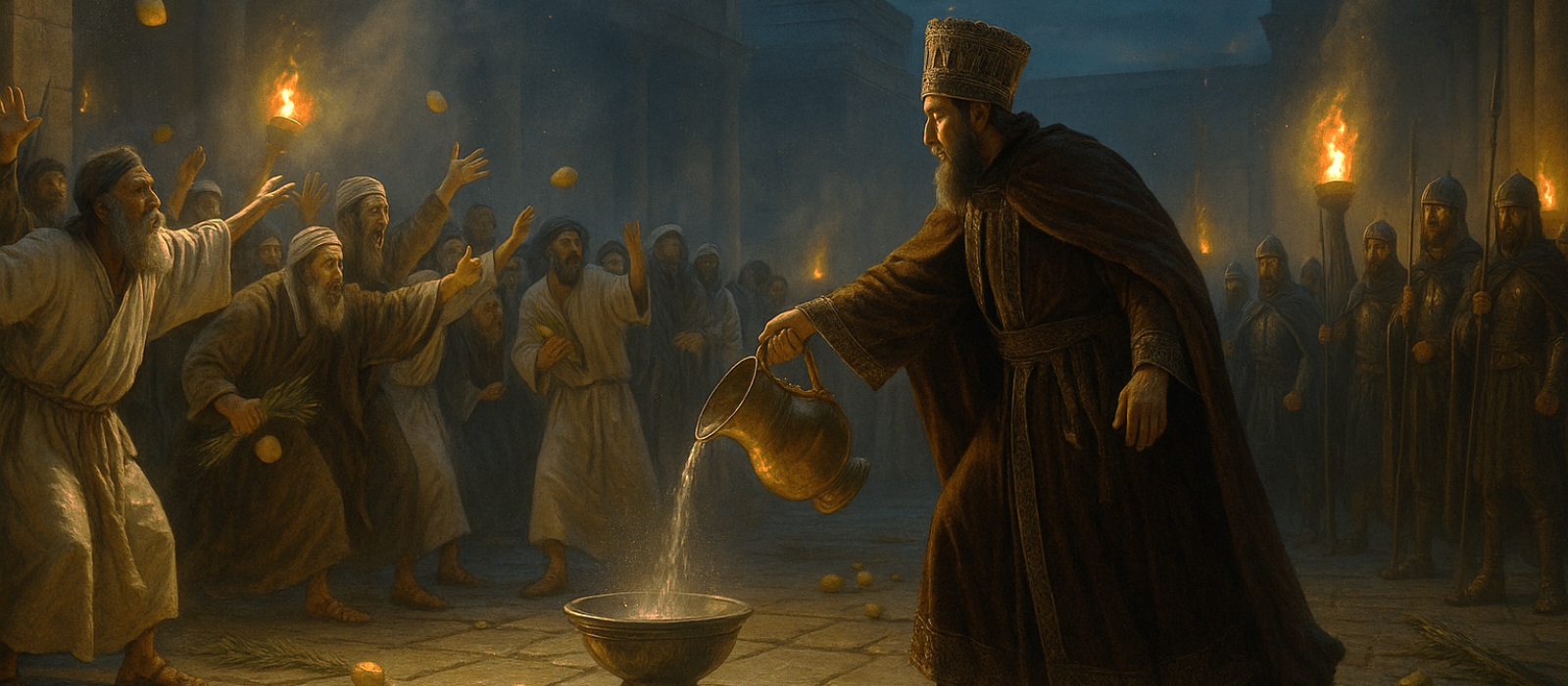
It was Jannaeus, acting as High Priest, who broke the impasse. He walked to the golden vessels containing the water freshly drawn from the Pool of Siloam that very morning. Picking up the vessel, he just held it without saying a word, without starting a prayer. His eyes moved between the Sadducees and the Pharisees. Slowly, the commotion of the Pharisees began to die down. The prayers stopped, and the lulav stilled.
Standing in front of the silver basin, a smile crept across the face of Jannaeus. It was a wicked smile. Slowly, methodically, and with the utmost care, he began to pour. But the water, blessed early in the morning, set apart unto Hashem for blessing of rain and prosperity, did not make it to the silver basin. Instead, it splattered on the stones. After nearly a full minute, the golden vessel was empty.
“What is this?” some Pharisee asked, with others joining in, demanding an answer.
“You dare desecrate Sukkot! You are no High Priest! You are a devil!” another Pharisee said aloud, and others, too, joined him as the cacophony grew more intense.
Finally, another Pharisee said, “You Cretan! You heathen! You dare desecrate Sukkot, you godless, wicked Sadducee!” and he threw his citron at Jannaeus.
It was a good throw.
The citrusy fruit, still hard and barely just ripe, landed hard above Jannaeus’ eye, sending his head back. In moments, every Pharisee standing there had liberated themselves of their own citrons, at the expense of Jannaeus, who had little time to protect himself from the pelting. Many hit their mark; many hit his face.
When the pelting ceased, Jannaeus tried wiping his eyes, no doubt stinging from the citric juices running into them, and called to the Sadducean Temple guard, “Clear the court. I don’t want a single Pharisee left here. Move them all out. With prejudice.”
Aides came to Jannaeus and escorted him out, and the Sadducees followed him. The Pharisees, on the other hand, were brutally forced to leave by the guards. The Pharisees refused, and more guards were deployed. Eventually, the guards began striking down any Pharisee they could get their hands on. Soon, the carnage spilled outside the Temple. By the end of the day, over 6,000 Pharisees had been slaughtered by Jannaeus.
☼ ☼ ☼
Micah never saw Ezra or Eliora again. And if that was not enough anguish for one miserable day, Micah was told by the followers of Shimon that Shimon, his mentor, was also murdered. Micah was now, in a very real sense, an orphan, and he pondered what he should do next. But that decision was made for him a few days after the libation massacre. Some of the followers of Shimon found a place for Micah to stay, along with a wife. They said it was his duty to fulfill the dying wish of Shimon and be his legacy. He must continue learning, and he must begin to teach what Shimon had taught him. The torch must be passed.
Micah was speechless. Part of him grieved Eliora, but his thoughts were not so bound up by her as they once were. Bloodshed and devastation had a way of sobering one’s countenance and focusing one’s mind on what was really important in life. And so many murdered for … for … for what? Baseless hatred? 8,000 souls for some lemons and lulavs?
No, Micah decided, no matter what, no matter who, and no matter how, he would honor Shimon’s wishes.
☼ ☼ ☼
Eliora lay crumpled by the body of her brother, Ezra, weeping. Ezra, while a zealous Sadducee, tried to defend some Pharisees from the Temple guards, and he, too, was struck down. Eliora’s family finally found her and collected her brother’s body.
She was inconsolable.
Eliora was first angry at the Pharisees and then at Micah and Shimon, but then she was furious at Ezra for trying to help those Pharisees, and then she was just as angry at the Sadducees and Jannaeus for allowing such devastation.
She wailed. She wept. She screamed. She slept.
Eliora lived in utter depression. She was sent to live with family on the outer edge of Jerusalem. Without Ezra as a guardian, she was quickly married off to a man. She didn’t know him and couldn’t care less. Micah never entered her thoughts, and soon even the pain of Ezra dulled into a daily malaise.
Until one day, she just ran away.
☼ ☼ ☼
As the years progressed, the cruelty of Jannaeus was every bit as vicious as anything done by Antiochus and the Greeks, and so was his desire for power. Never in the history of Judaism had Jews forced anyone to convert to Judaism—except for Jannaeus, who forced the Idumeans to convert. These were ancient Edomites, brothers of Jacob.
Jannaeus did not care. He ruled by strength and fear, and all who opposed him should be wary. Still, his menacing attempts to quell even any potential uprising, while obviously self-serving to himself and to his station, were not well-liked by the other Sadducees.
And lately there always seemed to be an uprising in the making.
“Wasn’t this why Judas Maccabee led the rebellion all those many years ago? Won’t it lead to another one?” Priest Zadok, now the head of the Sanhedrin, asked cautiously.
These were the types of questions that Jannaeus was asked frequently by the Sadducees, who apparently did not really consider the moral implications of murdering their brothers in Abraham, but rather only the political implications of future internal conflict and what could be gained or lost.
Jannaeus would treat their questions rhetorically and was very sparing in his answers, if he bothered to answer them at all. But today, he had an answer.
“Zadok, do you know what it feels like to be betrayed and humiliated—thrown under the chariot, as some would say?”
“Thrown under the chariot?” Zadok repeated. “I don’t think I have heard that particular idiom. People say that?”
“Yes!” Jannaeus thundered. “People say that. And not only can I not tolerate being thrown under the chariot, but I cannot tolerate the insolence of the Pharisees not recognizing me as High Priest.”
“This too shall pass,” Zadok said with a wave.
“So what,” Jannaeus continued in a vitriolic rant, “just because I am not a Levite? So what, just because I don’t always get everything just so in the Temple? What does any of that really matter, anyway?”
“Well, I mean, your Hebrew could use some work, and—”
p>But Jannaeus cut Zadok off. “I am not talking about my Hebrew; I am talking about the fact that I am king, and I am the High Priest.”Spit flew from his mouth as he barked at the new head of the Sanhedrin; his breathing quickened, and his eyes bored holes through Zadok. “Those Pharisees will either recognize me in my rightful positions, or they, and everyone they could possibly care about, will die.”
Used with permission by the author. Find the author’s complete works online: Complete Works of Mack Samuels