
3678 AM (82 BCE) – THE MACCABEAN REVOLTS
“Enough!” Mattathias yelled as loud as he could stand. His voice reverberated from the walls of the synagogue. “I will not hear another word of it! It’s one thing if a Jew decides—as moronic as it is—to follow the ways of the Greeks. We will not be forced into it! One little compromise here and a little one over there, and now they want us to pinch incense to a man?”
“Speaking of incensed,” another leader of the synagogue spoke.
“This is not a joke!” Mattathias roared. “Your minds are like sieves. You learn and you forget. How many lost to Assyria? To Babylon? And even so far to the Greeks? I don’t mean killed. It is an honor to die as a Jew: Shema Yisrael, Adonai Eloheinu, Adonai Echad! But how many have we lost who have become pagans, adopting the practices of the Assyrians, the Babylonians, and the Greeks? That is unacceptable! Better to die as a Jew than live as a Greek. When you stand before Hashem and look Him in the eye, you tell me—what will you say then? What can you say? Remember, as we say, Mi Chamocha Ba’elim, Adonai! Who is like Adonai? There is none!”
“Shhh!” another voice whispered. “You should not talk so! The walls and birds and mice have ears!”
“Cower in fear? Of them? What can they do to me—kill me? I would like to see them try. They will rue the day.”
“But how many of us must die?” yet another said.
“Die on your feet or die on your knees, but you will surely die. Hashem said that at the very beginning. Should we deny Him?”
A few of the young men answered with a smattering of “noes,” but that was an insufficient response for Mattathias.
“Excuse me? Are we men, or are we children? Are we men or are we cattle? Are we a sad group deserving extinction, or are we appointed for such a time as this to lift the name of Hashem to the highest? Who is with me?”
“We are,” a few more said, this time with more confidence.
“I said, who is with me!” Mattathias yelled again.
“We are!” voices rang out again—this time with resolve, strength, and determination that satisfied Mattathias’ ears.
One person shouted, “Mi Chamocha Ba’elim, Adonai!”
Others shouted, “Who is like Adonai?! Who is like Adonai?!”
Then some in the group started repeating, “Ma–Cha–Be! Ma–Cha–Be!”—the shortened form of “Mi Chamocha Ba’elim, Adonai!” Others joined in until the chorus felt as if it would cause the walls to crumble.
Mattathias held up a hand to silence the room. He scanned every eye and spoke with firmness, “Okay, then. It’s time to prepare. Pray. Study. Mikvah. Confess unto Adonai your wickedness. Turn back to virtue. Bring the appropriate offering. This war—and believe me when I say war—is as much spiritual as it is physical. Did Hashem not defeat the entire army of the Assyrians with just a single one of His messengers? Well, I have a message for old Antiochus Epimanes, the madman: We will not give up Shabbat! We will eat kosher! We will remember our covenant with Hashem through circumcision. We will teach Torah—the very words of Hashem! Hashem will not suffer this blasphemy any longer! The Jews will be free! We long to be free! We will be righteous, and we will be free—free to follow the commands of Adonai!”
☼ ☼ ☼
“Lochagos Kallimachos!” the commander Nikandros bellowed from his station.
The ever-faithful captain Kallimachos quickly answered the general’s beckoning. With a salute to the chest, Kallimachos stood at attention, eyes forward, waiting for instruction.
Nikandros was finishing a parchment before glancing up. “Do you know what I hate, Kallimachos?” he asked rhetorically. “I hate those who are treasonous to the Emperor. Even the slightest smell of treason I disdain.”
He resumed reading. “What I have here is quite a dilemma for me. Who protects us from our enemies? Who makes sure that Greece is a nation like no other? Who has preordained our success before we even go into battle?”
“The gods, sir!” Kallimachos responded.
“Quite right,” Nikandros said. “And it is treason to tempt fate—to give the gods any excuse to withhold their favor. Anyone who does not pay them homage asks for them to smite Greece. It’s unthinkable! It’s unnecessary! It’s… treason.”
He tossed the remaining pages on his desk and stood, staring out a window over Jerusalem, the corner of the Jewish Temple just in view. “On my desk is a decree—an old one. Yet I look out and see a city of rebellious, treasonous rabble that thinks what they do does not matter. It does.”
“Simply, they are traitors, and they deserve far worse than what we have been able to do thus far. But that will change. By the gods, that will change. Still, we need to send them a message. I am dispatching all my captains to all the synagogues in Jerusalem and the surrounding cities. I expect compliance. They will pinch incense at least to the gods, if not to Antiochus, or I will burn their synagogues along with their pathetic villages.”
He continued, “There is a special someone who needs an extra-special something. He’s not like the other Jews. Loud and very defiant. Mattathias, they call him. The Hammer—Maccabee. Hasmonean stock. I’m sending you to Modi’in to adjust his attitude.”
“That is all,” he said softly.
Kallimachos saluted and left.
☼ ☼ ☼
The Helios was descending in the distance, taking with him all the light allowed to Greece for the day—or so the Greeks would have Mattathias believe. It wasn’t some glowing chariot-driving god, and Mattathias knew it. It was the greater light created by Hashem when He created everything else. Its departure meant Shabbat was about to begin.
The synagogue was full. Some were praying; others were chatting. Mattathias laid out what was tradition for the evening’s service as he stood on the bema before the congregation.
Judas, Mattathias’s son, ran in. “Abba! It’s the Greeks. They are outside. You have to come quick, or they will defile our synagogue.”
Silence fell. Mattathias sheathed the long blade at his waist—the knife he used for slaughtering and preparing animals when serving in the Temple. Stepping away from the bema, he went to meet the intruders threatening to defile Shabbat by their very presence.
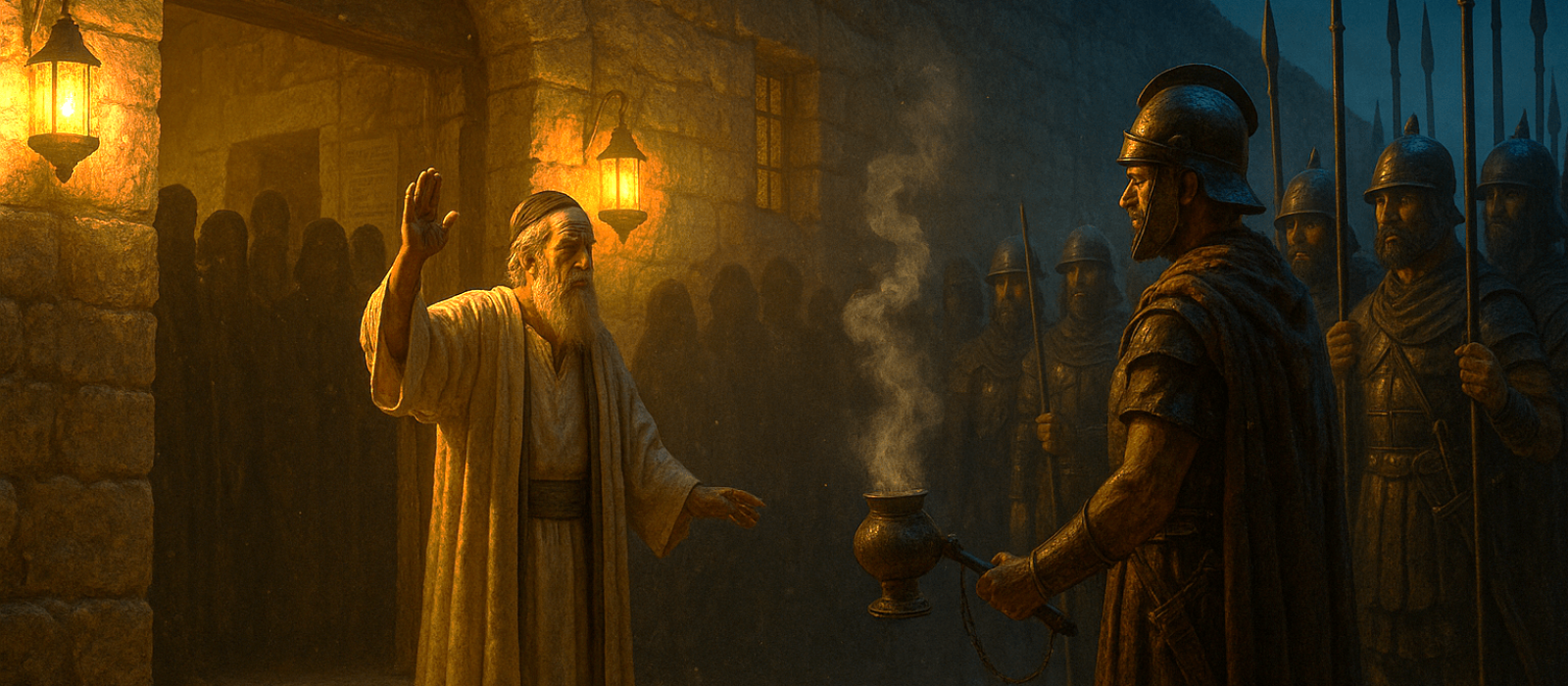
The people followed Judas and Mattathias out, clogging the entranceway to make entry impossible. The lead soldier waited for Mattathias. Tall, broad, and classically Hellenistic—stoic. The men behind him formed a wall of formidable flesh, meant to intimidate.
As the comparatively frail Mattathias approached, he opened brusquely, “What is your business here?”
“I am Captain Kallimachos. Commander Nikandros sent me to enforce the decree of the Emperor, Antiochus Epiphanes—gods made flesh.”
Snickering rose from the crowd—“Epimanes.” The captain’s cheeks flushed ruby, and his tone sharpened. “Compliance with the decree is long overdue. Your attire alone appears contrary and defiant.”
Mattathias glanced at his priestly vestment, lifting his arms with a faint grin. It was a joy to do what Hashem commands when the enemies of Hashem forbid it, as much as it was a joy to refuse what Hashem forbids when the enemies of Hashem command it.
“You will get no argument from us,” he said.
For a moment, Kallimachos was confused. Bursting in frustration, he blurted, “What exactly do you mean by that?”
Slowly, Mattathias repeated, “You will get no argument from us—that we are rather contrary and defiant to this decree.”
Kallimachos’s heart raced. No one had ever dared speak to him like that—much less a Jew, and a scrawny one at that.
“Your choice is simple,” Kallimachos said darkly. “Fulfill the decree, or we will burn your synagogue and your village.”
“Oh?” Mattathias wondered aloud. “You and what army?”
Kallimachos frowned, fighting his temper. “Fine. I understand. You are a superstitious people worshipping a fake god, using it to defy real divine power. So I’ll give you a break today. If just one of you pinches this incense into the flames…”
The flames in a soldier’s censer leapt and crackled, the aroma filling the street. The odor of blasphemy incensed Mattathias. “If just one of you does this in honor of the gods and of Antiochus Epiphanes, we will call it a day.”
Mattathias took a step forward. The soldiers moved the censer closer, but Mattathias raised his hand. “No.”
The soldier stepped back, nearly stumbling. Embers spilled. Another set the canister down to avoid being burned.
Mattathias’s eyes burned. “There is no way we will submit to this blasphemy. Worship your gods and then worship ours? You defile yourselves with temple prostitutes and then return to your wives—and you expect us to do likewise? Hashem forbid.”
“Anyone? Anyone at all, and we can be on our way?” Kallimachos pressed.
“You do not understand. I will not permit this,” Mattathias barked, as if the voice of Hashem spoke through him.
Kallimachos stepped back, chilled, yet pleaded on. Then from the back, a man pushed forward as whispers rose: “Esau, no!”
Esau looked at Kallimachos, then at Mattathias. “And you promise to leave us?” he asked the captain.
“Yes,” Kallimachos answered. “At least for today.”
Esau looked back at Mattathias, who rebuked him. “Esau, no! I will not allow it!”
“But it’s our home! Our families! Someone has to,” Esau replied, reaching out.
“I said no!” Mattathias shouted. In a single, swift motion he drew his razor-sharp knife and cut Esau’s throat from artery to artery, as he had done a thousand times in the Temple. In the same motion he spun to the soldier with the incense and repeated the maneuver. With his momentum, he ended the life of the great Captain Kallimachos.
Three men lay bleeding at his feet. The remaining Greeks stood in shock. Mattathias pointed and rasped a single word: “Leave.” They did, in haste.
☼ ☼ ☼
The next day, the community gathered again for afternoon Shabbat service. The men in the streets had been buried the previous night, as was the custom of the Jews—though their blood, modestly covered with sand, remained a dark, foreboding harbinger.
As the service concluded, Mattathias addressed the congregation. “You know what happened last night will not be ignored long. My men and I will have to leave.”
“But you can’t leave us!” a frightened voice cried. “We will be defenseless!”
“No, you won’t,” Mattathias said. “For one, Hashem will honor your righteousness. For another, we will keep tabs on the roads into Modi’in. Our plan is to be like a wild ibex—hiding in the wilderness, striking the Seleucids, and disappearing. We will keep them so busy that they will never come back here. Besides, there are many more angry Jews than just us. We must go village to village to find them. We will have an army as great as King David’s. And what could he accomplish with just five hundred fighting men? I assure you—for our community, and for the sake of Hashem’s Name—we will do the same.”
Used with permission by the author. Find the author’s complete works online: Complete Works of Mack Samuels