
Scripture References: Acts 2; Romans 11; Ephesians 2
4073 AM (313 CE) – SOL EVICTUS
The Bishop was hunched over in his studies contemplating one of the many old letters from the Apostle Paul. He found them most intriguing, these letters to the churches dealing with many of the challenges he, himself, faced nearly every day. He wondered how Paul could have possibly known, outside of the obvious divine inspiration, of course, and–
The Bishop’s attention was drawn to the approaching footsteps in the hallway. The door to his study slowly opened, and the head of his custodian appeared. “Bishop Eusebius, uh, there’s a message for you from Constantine.”
“For me?” the Bishop Eusebius responded, “Personally?” he inquired further.
“Oh, no, sir, sorry,” the custodian humbly apologized, “to all the Bishops in general.”
“Well, Timony, don’t keep me waiting,” Eusebius responded cordially.
“Of course, sir,” Timony quickly responded, opening the door wider to reveal a very stoic Roman, stern and impressive. The Roman walked in and saluted the Bishop. Taking a parchment from his satchel, he opened it and began to read aloud:
“By the authority of Emperor Constantine and Licinius Augustus, let it be known throughout the provinces of the Roman Empire that the sacred faith of the Christians is henceforth granted lawful and equal standing above all other religions, and Jehovah is to be held above all other gods, ensuring the peace and unity of the empire through his blessing. Thus, let no confusion be sown among the faithful: those who persist in blending the customs of the Jews with the teachings of the Church, clinging to obsolete rites, doctrines or appointed times, will be deemed heretical agitators, unfit for the harmony of the Church or the established order of Rome. Such individuals, in their obstinacy and wickedness, shall remove themselves from Roman territories, lest their divisive practices undermine the sanctity of this imperial decree. This law is to be enforced with diligence, beginning the summer solstice, that the peace of the divine order and the favor of the Most High may remain with the empire forevermore. All Bishops will acknowledge their compliance with their embossing.”
The Bishop sat back in his chair and peered at the Roman as he read almost mechanically, and then the Bishop briefly looked at the custodian, whose gaze was pointed to the floor.
“Well, well,” the Bishop finally responded to the reading, “that is something. Timony,” Eusebius said, turning to the custodian.
Timony replied, “Yes, Bishop.”
“I suppose I will need my seal. Fetch it for me, would you?”
Timony responded quickly, “Of course, Bishop, right away,” before scurrying from the room.
The resulting silence was uncomfortable, to say the least, but the Roman seemed not to notice, or was, at the very least, disinterested in mitigating it. However, salvation was upon them. Timony reentered the room with Bishop Eusebius’ seal. Grabbing a lit candle, the Bishop smiled as he pooled hot wax in the lower portion of the parchment, where space had been left for that purpose, and then he quickly embossed his personal seal deep into the wax.
The Roman held the edict high in the air for several moments, allowing the wax to harden, before carefully returning it to his satchel. With another violent salute, the Roman departed.
The smile immediately left his face as his eyes met Timony’s. “Get Samuel,” the Bishop pleaded.
Timony’s face shared the same anxiety present in the Bishop’s face. “Yes, Eusebius, right away.”
☼ ☼ ☼
Timony hustled through the streets of Rome. Much had changed since the time when Christians and Jews alike hung from pikes, covered in pitch, and lit for the Emperor’s amusement. It had also not been that long since Christians and Jews had been used as fun and fodder in the Colosseum. Yet now, Timony walked the streets of Rome with no fear whatsoever. Christians, especially those in service of the Church, had almost a protected, elite status within Rome.
People would show deference and step aside to let Timony pass. He didn’t like it. It seemed so hypocritical. It went against everything Jehovah taught in the sacred texts. It was almost like they feared him because of Jehovah, instead of seeking the blessing that came with the truth of Jehovah. But as much as Timony hated the deference given to him, he disdained even more the indifference given to the Jews, who were still targets of Roman hatred.
For thousands of years, the Romans believed that to have a sustainable society, one must placate the gods. And now, not much had changed. They just replaced their many meaningless idols with a caricature of Jehovah, and Timony hated it. How can one profess to love the Christ and hate the people from whom the Christ came?
Timony’s troubling thoughts were finally eased as he arrived at the Synagogue of Rome. This was not the Synagogue attended by the Jews who still followed the Sanhedrin in Israel, but this was the Messianic Synagogue that was founded shortly after the first Pentecost, when Peter and the other disciples were visited by the Holy Spirit with tongues of fire in the upper room. They had come down to speak to everyone in Jerusalem, and Jews from Rome were there. And one said he heard Peter speak in perfect Greek, while another said he was speaking in perfect Latin, and yet another said he heard him in perfect Aramaic.
Needless to say, they believed the Good News that Yeshua was the Messiah. They were not welcomed back into the Synagogue, but founded a new one. It was to this Synagogue that the letter of Paul to the Romans was directed, which mainly focused on the great discussion of whether the Gentiles needed to become Jews to accept the Messiah Yeshua. Ultimately, Paul said no, though that was not entirely accepted by the Synagogue. Thus, the first Gentile churches of Rome sprang up, grew in size, and eventually changed the face of the world.
But now this foundation of Christianity was in great peril, and Timony was desperate to talk with their Rabbi, Samuel.
☼ ☼ ☼
“Samuel!” Timony shouted, his voice echoing throughout the synagogue. “Samuel!”
The rabbi was discussing an upcoming circumcision with a congregant, and waved Timony in his direction. Shaking hands, he concluded his discussion just moments before Timony arrived.
Out of breath and frantic, Timony tried to convey the urgency. “Rabbi Samuel, the most terrible thing has occurred! You have to come to the Basilica! Eusebius must speak with you! It’s urgent!”
“Timony, really. What is so urgent? I have midday prayers. Can it not wait an hour? Maybe two? It’s not like it’s the end of the world as we know it,” Samuel said, trying to elevate Timony’s disposition.
It didn’t work. Tears began to stream from Timony’s eyes. “You don’t understand, Rabbi, it is the end of the world, at least as you will know it.”
☼ ☼ ☼
The walk back to the Basilica was not filled with amiable conversation or joy, as would normally be the case with brothers in the Messiah. Something dark was approaching, and Samuel just somehow already knew what Eusebius was going to say, and yet he had no idea what he was going to say.
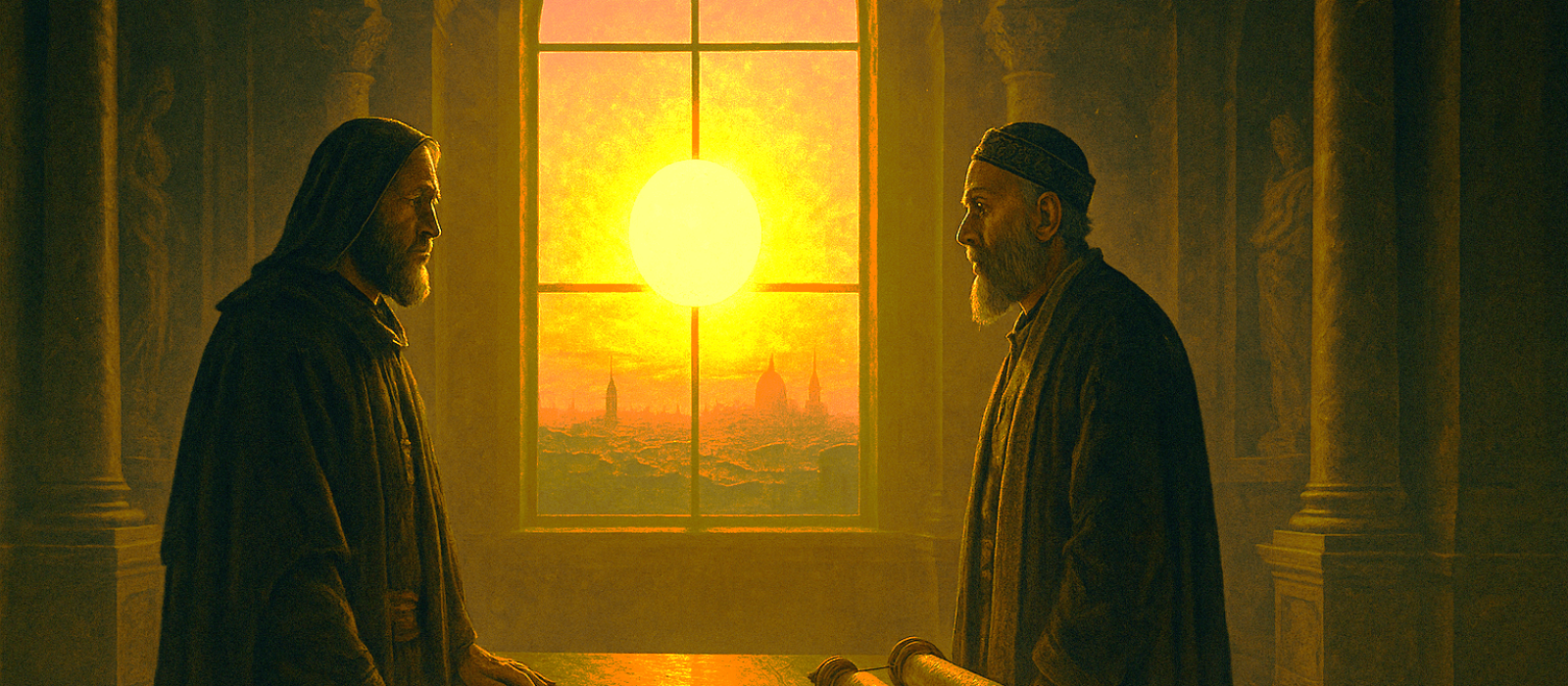
Timony knocked gently on the door of the study as he eased it open. The bishop was standing at a window peering out into the land that was supposedly the new Kingdom of the Messiah, but it was hard for him to see it. It was not in focus.
Samuel walked up to Eusebius and stood beside him, peering out the window. “Bishop,” Samuel acknowledged.
“Rabbi,” Eusebius acknowledged in return. After a few more moments, Eusebius finally turned to Samuel, who was eager to discover what tragedy had occurred. With their eyes locked and a long sigh, the bishop finally said, “The Church has formally been recognized by Rome as the authoritative religion of the land.”
Samuel thought. “Really,” he finally replied, “that’s… good, right?”
The bishop broke his gaze and turned back to the window.
“The Church. Not the synagogue.”
The weight of years of second-class status in Rome came flooding back onto the shoulders of Samuel, who exhaled sharply and joined his friend, peering once again out the window.
“What does that mean?” Samuel finally asked.
“Oh,” the bishop retorted with great angst, “it means the Jews are no longer welcome, Messianic or otherwise. It means they have been invited to leave the land. All of the Jews.”
“All of the Jews?” Samuel wondered aloud, astounded. “But we are brothers in the Messiah. We are the bedrock of the Church. How can the church of Rome possibly function without knowing its Jewish heritage rooted deeply in Judaism? What will keep the church grounded in Torah if we leave?”
“It is out of my hands,” Eusebius replied. “I don’t know. Jehovah will just have to intercede in other ways, I suppose.”
“But why?” Samuel pleaded.
“Power?” the bishop answered. “Politics? Does it matter? It is out of my hands!” The bishop waved his palms flat up in front of himself, emphasizing his impotence.
“How long?” the rabbi finally inquired.
“By the summer solstice, or then things will turn violent.”
“But,” Samuel started, but what else could he say? It was not enough time to pack up an entire community. They could spend years trying to move the wealth of the community and the literature… Finally, he settled on, “Where?”
Again, the bishop was no help. “I don’t know. Jerusalem? Babylon, maybe? Persia? Past the furthest reaches of Rome?”
“Ah, Babylon. I knew you would say that. I just knew it!” There was a sharp edge to Samuel’s voice. “You know the Talmudic Jews hate us worse than Rome. We are a stench to their nostrils, worse than pagans.”
The bishop turned sharply. “We are not pagans—not anymore!”
“You say that…” Samuel responded, not wanting to finish his thought. “But Constantine is.”
Eusebius grabbed Samuel’s sleeve and spoke angrily. “Lower your voice!”
In a much quieter tone, Samuel continued, “But you know it is true. He claims to believe, but he doesn’t. He claims to not worship the pagan gods, but he does. Do you really think he believes in Yeshua, the S-O-N, Son of Elohim? Or does he believe in the S-U-N, Sun of the gods?”
“It doesn’t matter what I believe. It doesn’t matter what Constantine believes. It does matter, especially to me, that you get your congregation out of here safely.”
“But where can we go?” Samuel once again pleaded.
Another long sigh emanated from Eusebius. “I don’t know. If there is not a civilization civilized enough to take you in, my friend, perhaps you need to restart your own civilization. Maybe, just maybe, you have to go where no Jew has gone before and be a light where even the Christians have not traveled. The Spirit of Hashem will lead you, my friend. But for now, you must go. Take with you what you can, sell what you must. Time is not on your side.”
Used with permission by the author. Find the author’s complete works online: Complete Works of Mack Samuels