
Our weekly readings circled around holiness, Sabbath, and rest. We read of the priests who were called to live set-apart lives because the people were watching, and of the Shmita, the seventh year when the land itself was commanded to rest. We remembered the seven feasts of the Lord and, at the center of it all, the weekly Shabbat – the Sabbath day when we cease from our own works, gather, and rest before Him. :contentReference[oaicite:0]{index=0}
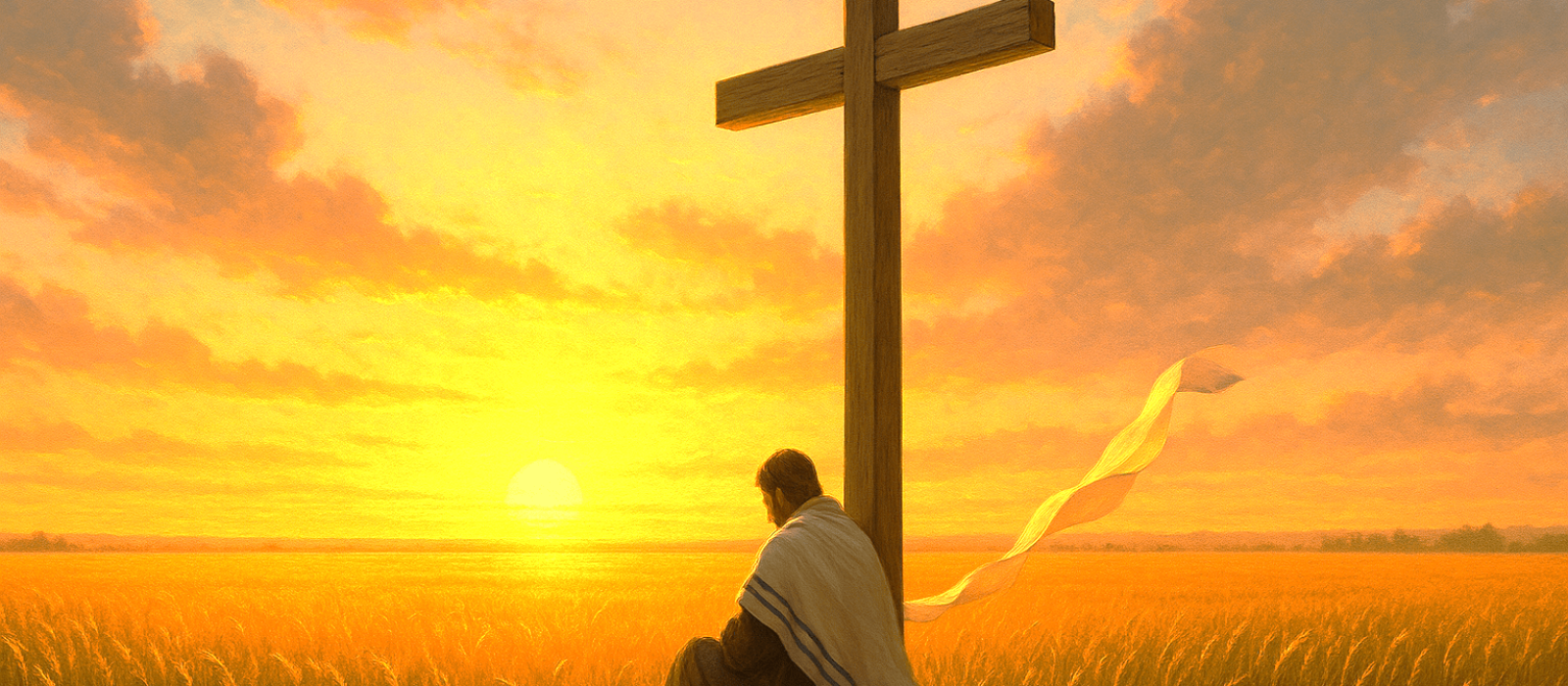
In Hebrew, Shabbat is tied to rest. Another word that kept echoing in my heart was shuv – to return, to repent. In the ancient picture language, it has the sense of sitting, returning to the sign of the cross, resting at its feet. Shabbat and shuv together invite us not only to stop working, but to sit at the foot of the cross and let our hearts return to God.
Our Gospel reading spoke of that same cross. Yeshua began to show His disciples that He must suffer, be killed, and be raised on the third day. Peter could not bear it. He rebuked the Lord – and the Lord rebuked him back: “You are not setting your mind on the things of God, but on the things of men.” Our flesh does not like the cross either. We do not like the painful dealings that afflict our flesh. We do not like surrender. We want resurrection without crucifixion, glory without laying anything down.
Yet the call is clear: “If anyone would come after Me, let him deny himself, take up his cross, and follow Me.” What does that look like in real life? What does it mean, practically, to lay down your life and to rest at the foot of the cross?
Recently, the Lord answered that question for me in a very personal way — through my father’s final days.
My dad was a fighter in every sense of the word. He had been a boxer, a four-time Midwest champion. Years ago, when he had open-heart surgery, the doctors gathered us and said, “Call the family. His kidneys are shutting down. He’s not going to make it.” But he fought. They drained fluid from his lungs again and again, and he pulled through. The Lord gave him seven more years of life, and we were so grateful for that miracle. :contentReference[oaicite:1]{index=1}
So when he suddenly grew very sick this time, everything in me wanted to fight again. I walked into the room ready to storm heaven. “Okay, Dad, it’s time to pray for a miracle.” But he looked at me and said words I didn’t expect: “You pray for Gerri Lou.” At first I thought he was being sarcastic – he had that kind of humor – but he meant it. He wasn’t asking for one more rescue. He was asking God to work in me.
What I learned later was that before I arrived, my dad had already had a blunt, honest conversation with the doctor. “Be real with me, Doc. Give it to me straight.” And the doctor had: “This is your demise. There are no options.” My dad listened, accepted it, and said, “Thank you.” While I was gearing up for another round, he had already laid down his gloves.
Over the next four days I watched what it looks like when a man stops fighting, when he truly lays his life down. The doctors said we could feed him and give him water, but that it would only prolong his suffering. He was bleeding internally and in pain. Everything in our human nature wants to cling to life, cling to comfort, cling to what we know. Yet my dad chose to release his grip.
It is hard to see a loved one die. It must have been just as hard for the disciples to hear Yeshua speaking about His cross, to watch Him suffer. They could not grasp the beauty or necessity of the cross. Without the cross and the resurrection, there would be no salvation at all.
On Mother’s Day, at seven o’clock in the evening, my dad took his last breath. He never opened his eyes, but he smiled, and his eyebrows lifted as if he were seeing something wonderful. I believe his mama and others were there to greet him. After days of struggle, the end was utterly peaceful. He died slowly, suffocating, much like our Lord on the cross, pushing Himself up to breathe and then sinking back down for hours. It was agonizing to watch the suffering, but the moment of stepping into eternity was pure rest.
In those days I saw holiness – qadosh – being worked in him. Not perfection in the sense of never having sinned; my dad had a wild past, and the priests came to give last rites multiple times. But I saw something being refined and set apart in him, something finished by God Himself.
The Hebrew word qadosh (holy) carries a picture like a threshing floor. David built an altar on the threshing floor of Arunah. Wheat is brought there and beaten. Then it’s tossed into the air and the wind separates the wheat from the chaff. The chaff is blown away; the grain remains. Holiness is like that. The Lord allows beatings, losses, afflictions — not because He delights in our pain, but because He is threshing away the chaff so that only what is of Him remains. :contentReference[oaicite:2]{index=2}
Lamentations says, “Though He causes grief, yet He will have compassion according to His abundant lovingkindness. For He does not afflict willingly, nor grieve the children of men.” He is not cruel. He is purposeful. The God who sanctifies us – YHWH M’kaddesh, the Lord who makes us holy – is the One who begins the good work and is faithful to complete it.
Many of us fall into striving. We hear, “Work out your salvation with fear and trembling,” and we stop there. We think we must fast more, witness more, try harder, be holier, fix ourselves. But the rest of the verse says, “For it is God who works in you both to will and to do His good pleasure.” It is His work. Our call is to yield to it, to stay on the threshing floor and trust His hands.
Paul begged the Lord three times to remove his thorn in the flesh. The answer he received was not “Yes,” but “My grace is sufficient for you, for My power is made perfect in weakness.” When we are weak, then His strength is perfected in us. Holiness is not us flexing our spiritual muscles; it is us surrendering to the One who is strong.
I also wrestled with concern for my dad’s soul. He was a committed Catholic, clutching his rosary, praying it over and over as his point of contact with God. I never rebuked him for that. It was his way of reaching out in faith. My brother prayed with him, and we discussed salvation, but I still found myself asking, “Lord, did he really know You? Did he truly put his trust in Yeshua?”
In the end, the Lord gave me peace. That last smile, those lifted eyebrows, the gentleness I saw in him in those days – little glimpses of Christlikeness I had never seen before – were God’s kindness to my heart. Something happened in those four days. The sanctifying work was being completed. The threshing floor did its work, and the wheat remained.
As I walked through this, my mind also went to the wider world. We heard news of two young Israeli men who were senselessly murdered, victims of baseless hatred. One was about to be engaged. My heart broke for them, for their families, and for Israel — a nation reborn in a day, sustained through wars and persecution, yet still surrounded by growing antisemitism. In all of it, I heard again the words from Jeremiah: “Behold, I am the Lord, the God of all flesh. Is anything too hard for Me?”
God has promised a greater exodus than the first, a future redemption that will make the original Exodus look small by comparison. On a personal level, we all have our own exodus stories – being brought out of bondage, out of addiction, out of self-centeredness and self-promotion. On a national level, God is still writing Israel’s story. On an individual level, He is still writing the stories of our fathers, mothers, children, brothers, and friends.
This brought me to another theme of the evening: our loved ones who seem far from God. Every one of us in that room carried names on our hearts – sons and daughters, siblings, spouses, friends. Some have grown stagnant in their faith and said, “That’s enough. I’m comfortable where I am.” Others don’t know the Lord at all. Some are suffering in their bodies; others are bound in unbelief or anger. We feel helpless watching them, longing for their salvation and wholeness.
We shared and wept and prayed together. One person prayed for her sons, asking the Lord to remind her that she does not see the end from the beginning, that she cannot impose her timing on their journey. Another lifted up a girlfriend who had just lost her mother, asking that God would wrap her in a tangible sense of His love. Someone else prayed for a sister driven to her knees by years of hardship, asking Hashem to “flip the switch” in His time and bring her into the light. Others prayed for prodigals to come home, for stagnant hearts to be stirred, for a new hunger for God to awaken in their families.
As each name was spoken, I kept sensing the heart of our Father in the parable of the prodigal son. He is the One standing at the end of the road, watching and waiting. When He sees the prodigal “while he is still a long way off,” He runs to meet him, throws His arms around him, and calls for a robe, a ring, and a feast. That is the heart of the One who sanctifies us. He longs to save, to cleanse, to restore, to keep.
Jude reminds us that it is God who is able to keep us from stumbling and to present us before His presence with great joy. His ability is greater than our wandering. His faithfulness is stronger than our inconsistency. His mercy is stronger than death itself.
So what does Shabbat look like in light of all this? It is more than not going to the movies on Saturday, more than turning off our phones or avoiding certain activities. True Sabbath is choosing to sit at the feet of Yeshua, at the foot of the cross, and laying down our frantic efforts to control ourselves and everyone around us. It is trusting the One who is threshing, sanctifying, and completing the work – in us and in those we love.
It is Shabbat and shuv together: rest and return. Rest from striving. Return to the cross. Rest from trying to sanctify ourselves. Return to the Lord who says, “I am YHWH M’kaddesh – the Lord who sanctifies you.”
Tonight, my heart is simply to encourage you: wherever there is pain, confusion, or grief; wherever you are hurting for loved ones; wherever you are tempted to despair that nothing will ever change — remember the threshing floor. Remember my father’s last smile. Remember Israel’s unlikely survival. Remember the prodigal’s Father. Remember the cross.
There is nothing too hard for the Lord. He is faithful to finish what He started. Our part is to live at His feet, in prayer, in surrendered trust. Yeshua said, “My house shall be called a house of prayer.” That is where we are called to live — in His house, at His feet, resting in His love, while He does the holy work only He can do.