
Parashah Pekudei Comments (2014)
Much of this teaching draws on John J. Parsons’ article “Beginning and End” at Hebrews4Christians.com.
Creation, Completion, and the Mishkan
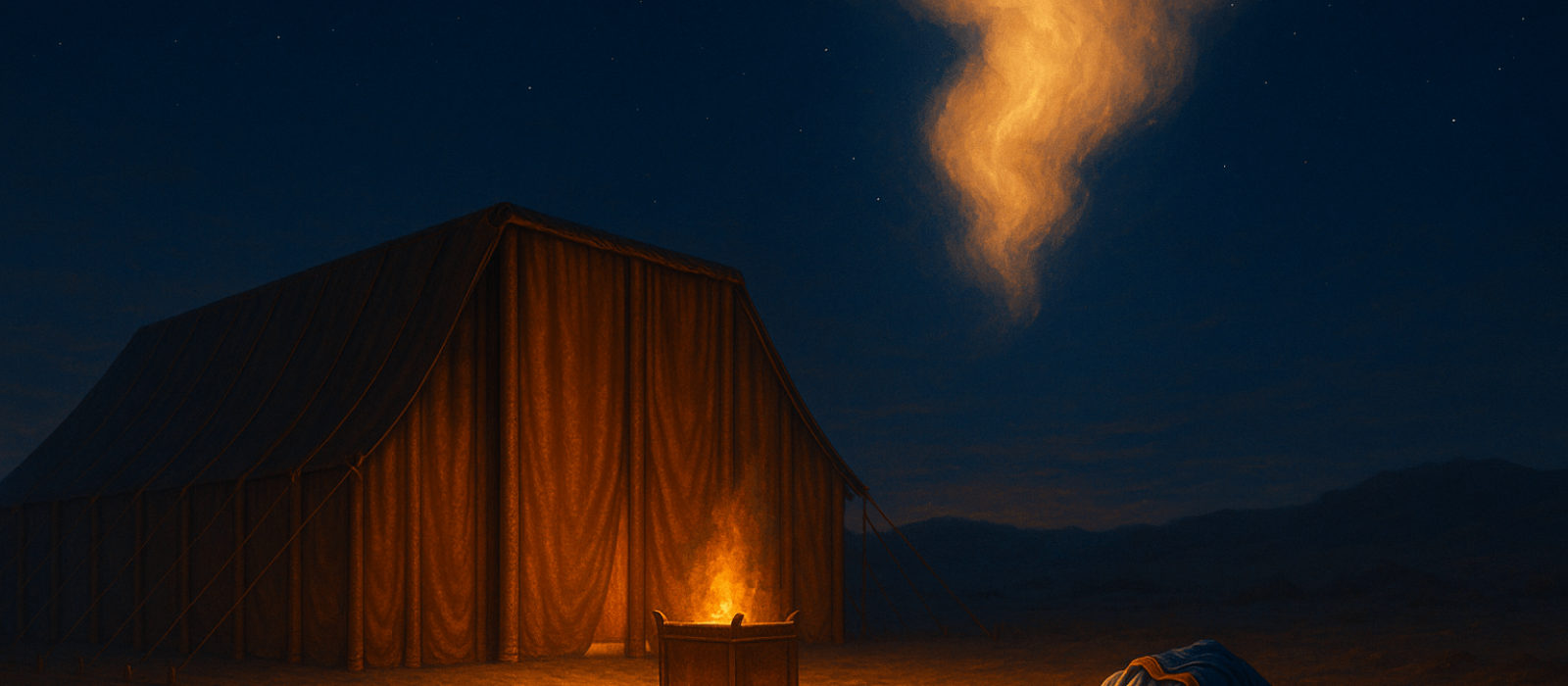
The final portion of Exodus (Pekudei) details the building of the Mishkan (Tabernacle), its furnishings, and the special clothing of the priests. Toward the end we read:
In gematria (assigning numeric values to Hebrew letters), the value of this phrase is the same as the opening words of Scripture—“In the beginning…” (Genesis 1:1). This suggests that creation itself aimed toward the Tabernacle and, by extension, to the revelation of God’s sacrificial love.
The Mishkan is a living picture of the Messiah. The Talmud (Sanhedrin 98b) says, “All the world was created for the Messiah.” The Brit Chadashah confirms this by revealing Yeshua as the Lamb “slain from the foundation of the world.”
Messiah from the Beginning
Revelation 13:8 — “Everyone living on earth will worship it except those whose names are written in the Book of Life belonging to the Lamb slaughtered before the world was founded.”
1 Peter 1:20 — “He was foreknown before the foundation of the world but was made manifest in the last times for the sake of you…”
Ephesians 1:4 — “In the Messiah he chose us in love before the creation of the universe to be holy and without defect in his presence.”
2 Timothy 1:9 — “…not because of our deeds, but because of his own purpose and grace in the Messiah Yeshua. He did this before the beginning of time…”
Colossians 1:16–17 — “For by him all things were created… all things were created through him and for him… and in him all things hold together.”
Creation therefore culminates in the redemptive love of God manifested in Yeshua HaMashiach, the great Lamb of God. He is the Aleph and the Tav, the beginning and the end.
Isaiah 44:6 — “Thus says the Lord, the King of Israel and his Redeemer, the Lord of hosts: ‘I am the first and I am the last; besides me there is no god.’”
Revelation 1:17 — “When I saw him, I fell at his feet as though dead. But he laid his right hand on me and said, ‘Fear not, I am the first and the last…’”
“The Seal of God is Truth” — Emet
Some sages say God’s seal is emet (truth). The final letters of the last three words in the creation account—bará Elohim la’asot (“God created to do”)—are aleph, mem, tav, which spell “emet.” The phrase “to do” implies that God’s creative and redemptive work was finished from the foundation of the world.
Hebrews 4:3 — “For we who have believed enter that rest… although his works were finished from the foundation of the world.”
Salvation was never “Plan B.” Yeshua is, and remains, the Way, the Truth, and the Life.
John 14:6 — “I am the way, and the truth, and the life. No one comes to the Father except through me.”
Jewish Texts, First-Century Context
The Tanakh is a Jewish document—and so is the Brit Chadashah. The apostles and multitudes of first-century Jewish believers came to faith through the Scriptures available to them then. Rabbi Itzhak Shapira’s The Return of the Kosher Pig discusses ideas present in Jewish discourse 2,000 years ago that help explain this.
Two Illustrations from Proverbs and the Zohar
1) Proverbs 31:30 and “Chen.” The Hebrew word chen (grace/beauty) shares a numeric value in gematria with yemach (“to blot out”). A traditional title for the Messiah is “Chen.” Outward appearances can be deceiving; the beautiful may be despised. Many in Yeshua’s day, especially under powerful religious-political pressures, failed to recognize his true beauty. As awareness and context align, the Messiah (the emet) is revealed.
2) Proverbs 30:1–4, “What is His son’s name?” The Zohar describes divine emanations; binah (understanding) is sometimes read as a blend of ben (son) and Yah. Some note that the Hebrew of Proverbs 30:4 (“and what is his son’s name—surely you know!”) intriguingly contains, in sequence, letters that can spell “Yeshua.” While not a biblical proof, it reflects a stream of Jewish thought once common but later muted in post-Temple polemics. Today, such discussions are re-emerging.
Yeshua as the Living Temple
John 8:58 — “Truly, truly, I say to you, before Abraham was, I am.”
John 2:19 — “Destroy this temple, and in three days I will raise it up.”
The creation narrative spans two chapters; the building of the Mishkan spans about fifty. Yeshua is present in every chapter—if we have eyes to see.
Chazak! Chazak! Venitchazek!
This parashah completes the book of Exodus. At each completion we say: Chazak, chazak! Venitchazek!—“Be strong! Be strong! And be strengthened!”
Amen
Father God, strengthen us to reflect your character, represent you well on earth, and be your instruments in preparing this world for your Son’s return. Amen.
Notes on Gematria
Gematria is a traditional interpretive method that can “yield thoughts.” For introductions, see Dictionary.com and a brief overview at MyJewishLearning. Classic examples include the shared value (130) of sullam (“ladder,” Genesis 28:12) and Sinai, suggesting Torah as the ladder between heaven and earth.