

Parashah Lech Lecha Comments 2024
HaShem gave me two articles that speak to the Oneness of G-d, and bear on this week’s parashah: Lech Lecha (in English, “Get Yourself Out”). The first came through the current issue of Petah Tikvah Magazine and was originally published by TheIsraelBible.com on February 15, 2024, written by Shira Schechter, content editor for TheIsraelBible.com and Israel365. It is entitled, “A Prayer Across Time.” Here is an excerpt and summary:
“A Prayer Across Time” — the Shema that finds children
In 1946, shortly after the end of World War II, Rabbi Isaac Halevi Herzog, the Ashkenazi Chief Rabbi of Mandatory Palestine, traveled to Europe in hopes of finding Jewish children who had survived the war. He visited a large monastery known to have sheltered Jewish children from death at the hands of the Nazis. Rabbi Herzog sought to reunite these children with their people.
While the Reverend Mother was willing to give the children back, she was not sure how to identify which children among the hundreds in the monastery were, in fact, Jewish. Rabbi Herzog asked her to gather all of the children in a large room. When they were all assembled, he cried out, “Shema Yisrael, Adonai Eloheinu, Adonai Echad.”
Known as the Shema, this fundamental Jewish prayer prompted an emotional reunion as dozens of children recognized the words and ran toward him. Though few remembered much of their early lives, the sound of the Shema—recited with their parents before bedtime—awakened identity and belonging.
What the Shema proclaims
The Shema acknowledges that G-d exists and asserts that He is the sole divine authority. Reciting it daily embraces His sovereign role and accepts Him as King. “G-d is One” reaches beyond bare singularity; it affirms G-d’s active presence sustaining creation at every moment. Nothing stands apart from Him. The universe continually relies upon His life-giving word; should that flow cease, creation would not endure. Because of its centrality, the Shema is recited morning and night, before bed, and is emphatically proclaimed three times at the close of Yom Kippur.
Identity, unity, and survival in modern times
Since the Shema is taught from earliest childhood, it has functioned as a “code word” in moments of danger. Zvi Zamir, a former head of the Mossad, recounted reassuring an elderly woman during an evacuation by proclaiming the Shema—she recognized she was among her people. During and after the attacks of October 7, reservists and civilians alike used the Shema to identify themselves, open safe rooms, and prevent friendly fire. The Shema stands as a symbol of identity, unity, survival, and trust in G-d’s rule.
Creation and Covenant: a second reflection
The second article I received, anonymously, is a lovely, poetic meditation on creation and the Patriarchs. It notes that while Genesis is called the “Book of Creation,” the six days of making heaven and earth occupy only a small portion; the bulk of the book shows how the Patriarchs and Matriarchs “created” a people who would give meaning and purpose to the world—Abraham’s family refined into a nation.
Ramban (Nachmanides) observes that events in the lives of the Patriarchs are omens (ma’aseh avot siman lebanim) for their descendants. Choice, winnowing, and tests are the themes of Genesis: Noah stands when the world is corrupt; Abraham stands when others fail; Isaac and Jacob prevail; and the family of Jacob emerges to carry Messiah’s hope. Greatness must surmount adversity—hence Abraham’s tests were opportunities to turn potential into reality and forge Israel’s tenacity in G-d’s service.
Lech Lecha: the call and the promises
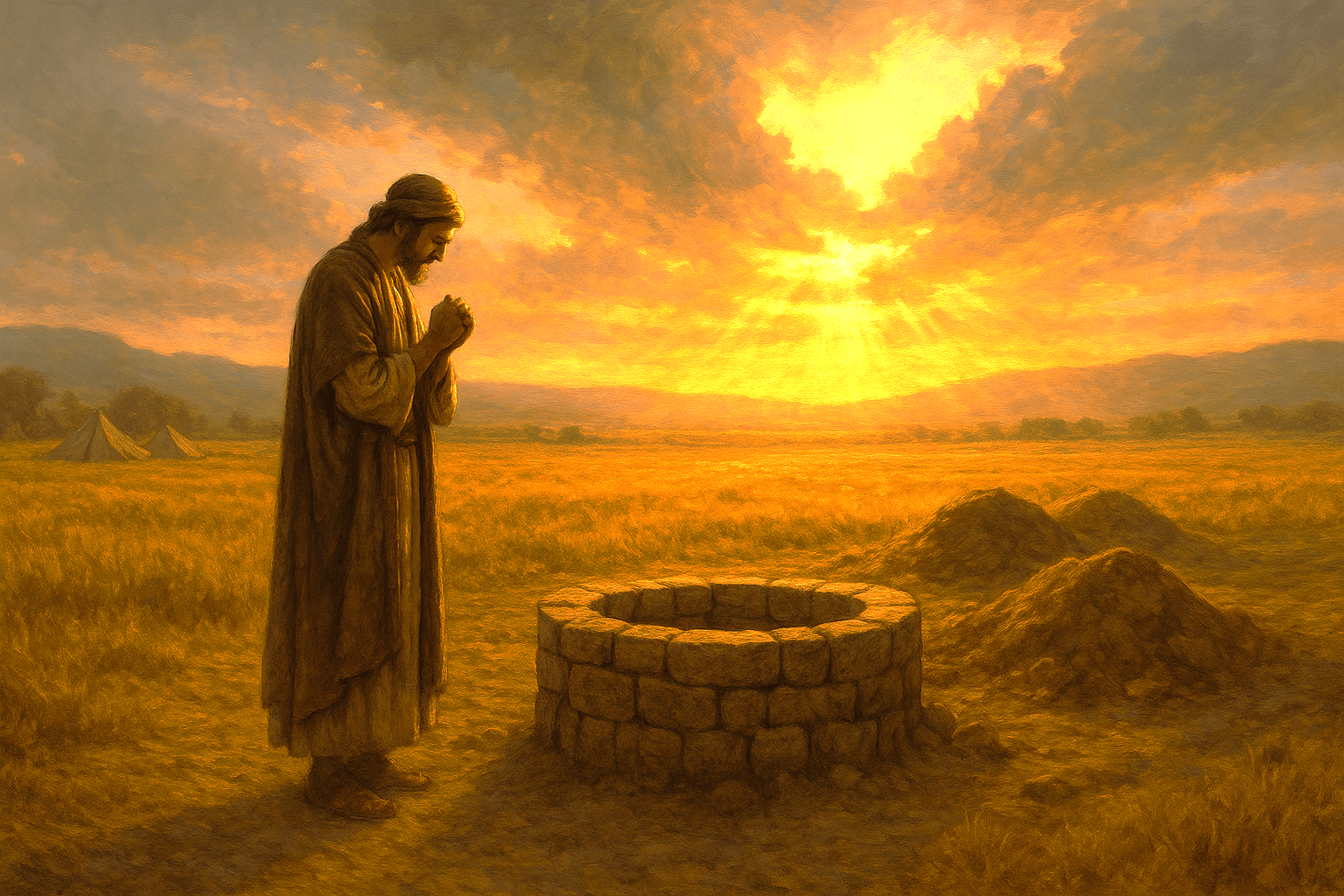
The book of Genesis divides naturally into two parts: G-d and His relationship to the world (Genesis 1–11), and G-d’s relationship with Abraham and his family (Genesis 12–50). The second part begins with our parashah, Lech Lecha (“Get yourself going”).
This is the first of ten tests G-d gives Abraham; he passes them all. A midrash likens Abraham to a vial of myrrh closed in a corner—when G-d “uncorked” him, the fragrance spread. Abraham’s life became a public witness of G-d’s ways.
These promises unfold through Israel’s story and, ultimately, through Messiah. Many see in Israel’s modern rebirth a sign of G-d’s faithfulness, alongside the enduring moral call of Genesis 12:3. The Shema’s last word, echad (“one”), can denote both absolute unity and a composite oneness (e.g., “a cluster of grapes”), a point often noted in Messianic discussion as resonant with G-d’s mysterious triunity—without denying His indivisible Oneness.
Contesting evil, choosing courage
Scripture warns that those who bless Israel are blessed and those who curse Israel are cursed (see also Genesis 27:29; Numbers 24:9). In our day, antisemitism has resurfaced with tragic clarity. The call of Messiah is to be salt and light—publicly faithful, morally bright, responsibly engaged.
We must repent of complacency, resist moral confusion, and stand with G-d’s purposes. As Proverbs commands, we cannot plead ignorance when life and truth are on the line.
Hope that anchors action
Even as darkness presses, G-d’s mercies are new every morning; He is faithful. Choose this day whom you will serve.
“For such a time as this”
Mordechai’s charge to Esther echoes across generations: silence helps no one. Faithful speech and courageous action align us with G-d’s saving purposes.
Prayer
Father in Heaven, grant us clarity to repent of blindness and to do Your will wherever You assign us. Prepare us to be a blessing to Your people and a rebuke to Your enemies. Call each of us to our portion in Your promises—and give us ears to hear, eyes to see, a heart to feel, and a will to answer. B’shem Yeshua, amein.
Attachment: The Ten Utterances (Pirkei Avot 5:1)
Pirkei Avot 5:1 teaches that the world was created with ten “utterances.” In Genesis 1, the phrase “And G-d said” (vayomer) appears nine times (vv. 3, 6, 9, 11, 14, 20, 24, 26, 28, 29), and the word “Bereshit” is counted as the tenth. The teaching underscores human responsibility: a world fashioned with ten utterances must not be destroyed by wickedness but sustained by righteousness.