
Parashah Ki Tetze Comments 2024
The Torah has 613 mitzvot: to the devout they are all commandments—because whether they are directives, instructions, or even things we only partly grasp, knowing it is God, would you ignore what He is saying to you? In this Torah portion (parashah) there are seventy-four of the 613.
The mitzvot (commonly translated both as “commandment” and “blessing”) are usually classified into mishpatim (judgments) and chukim (ordinances, decrees, boundaries, or limits). Chukim are divine directives from God. We may not fully understand them, but we are to follow them as acts of faith.
A Parent’s Chok
Parents of small children often carry out their responsibilities of protection, provision, and instruction using chukim. Crossing a busy street is no time for a lecture on traffic-light algorithms. The parent takes the child’s hand and says, “Let’s go”—and the child goes. It is not abuse to expect immediate obedience when life and safety are at stake.
The Railing on the Roof
A central chukat (singular of chukim) in this parashah is Deuteronomy 22:8:
Deuteronomy 22:8 (CJB)
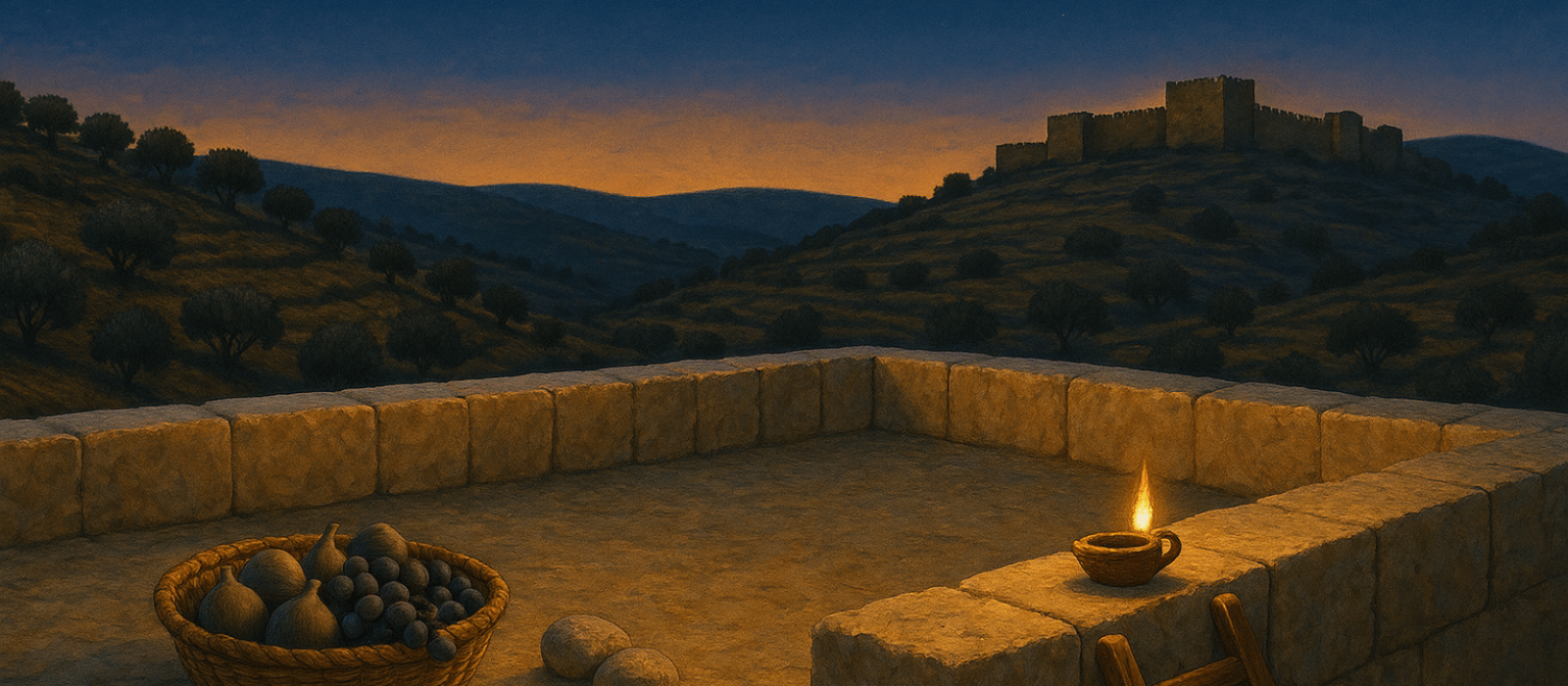
“When you build a new house, you must build a low wall around your roof; otherwise someone may fall from it, and you will be responsible for his death.”
To compare translations:
Deuteronomy 22:8 (AMP)
“When you build a new house, you shall make a railing (parapet) around your [flat] roof, so that you do not bring the guilt of [innocent] blood on your house if someone falls from it.”
This brings to mind what I’ll call “Slobin’s chukat #1”: Don’t stick a safety pin in an electrical outlet! Yeshua’s prohibition of sexual immorality is another. In the Bible’s accounts of David and Goliath, Noah and the Ark, Abraham’s near-sacrifice of Isaac, Joshua at Jericho, and in the lives of Jacob, Joseph, and Samuel—these giants of the Tenach (Older Testament)—we witness obedience to God’s decrees even when the path is costly.
Ananias, Obedience, and the Way
In the Brit Chadashah, Ananias receives a command from the Messiah:
Acts 9 (summary)
“Now there was a disciple named Ananias in Damascus. The Lord said to him, ‘Ananias.’ He said, ‘Here I am, Lord.’” Yeshua sends him to Saul of Tarsus to be a vessel for the Ruach HaKodesh to restore Saul’s sight. Though afraid because of Saul’s reputation as a persecutor, Ananias goes.
And speaking of the Messiah, the best-known verse of all bears witness to obedient love:
John 3:16
“For God so loved the world that He gave His one and only Son…” The Father gave, and the Son allowed Himself to be given—Yeshua went to fulfill the Father’s will. Hallelu-Yah!
“Common Sense” or God’s Law?
To most people, the railing rule seems obvious: if you have an open roof, put a fence, railing, or low wall around the perimeter to keep people from falling off. Whether we label it common sense or God’s law, He makes it clear: this is not optional. We may think we decide, but God has decided. It is not a human, non-binding moral suggestion; it is an absolute directive from Heaven.
In this parashah, sins such as dishonoring parents, sexual infidelity, and enslaving a fellow Israelite are treated with utmost seriousness by God—beyond our modern quibbles. We dismiss God’s laws at our own risk. Unless we have an absolute standard, we have no standard. God’s ways are higher than ours. Which brings us back to the railing.
Sefer HaChinuch: Nature, Providence, and Responsibility
A profound extension of the railing rule is found in the Sefer HaChinuch (“Book of Education”), likely authored by Aharon HaLevi, a 14th-century Spanish rabbi who wrote it to teach his son the commandments. On the parapet, he writes that God exercises providence over all people, yet He ordered creation with dependable natural laws—fire burns, water extinguishes, stones crush, and gravity pulls. Within that order, we must guard life.
Leviticus 19:18
“You shall love your neighbor as yourself.”
God has mercifully given the body a living, intelligent soul capable of guarding that body. Since He confined us to the order of nature, He commanded us to guard ourselves from danger; otherwise, that very nature will act upon us detrimentally. In short: trust God’s providence—and respect His physics.
A Parable We All Know
You’ve heard the joke: a man refuses three successive rescue offers during a flood, insisting, “God will save me.” After he drowns, he asks God why He didn’t. God answers, “I tried three times—you wouldn’t listen.” Miracles do occur, but the Sefer HaChinuch insists this does not absolve us from acting wisely. Even when Israel went to war at God’s command, they still prepared weapons and strategies. We live by faith and by prudence.
Work and Pray
This exposes a shared miscalculation of the atheist and the overly religious: “There is nothing I can do to alter my fate.” The fatalist says, “When it’s my time, it’s my time,” and speeds down the highway—or smokes another cigarette. The hyper-spiritual says, “God will protect me regardless.” But most of us must assume we are not exceptions. The wise path is to “work like it’s up to us and pray like it’s up to God.” God is in control, and part of His control is the reliability of the natural order He declared as binding.
Why the Railing Is Love
We must rest in God and bring sanctified rationality to our faith. Our purpose is to love God and to love His people. That requires being His hands and feet in the world. The morality of the roof-railing rule is set in the context of another rule: the inevitability of natural law. The homeowner must provide an enclosure because gravity is real.
As Israel stood to enter the Land, they had to remember: though God is the source, provider, and protector of all, they were not to abdicate their responsibility to be a light to the nations. The same is true for us.
Fulfilled in Yeshua
For a Messianic Jew like myself, the fullness of Leviticus 19:18—“love your neighbor as yourself”—is embodied in Yeshua. God formed an independent people from Egyptian slavery, giving structure, direction, and boundaries to move toward true liberty under His protection and provision. Yeshua came to express those guidelines in human terms. His fulfillment of God’s laws shows us God’s love. Where stiff-necked hearts needed firm boundaries, Messiah’s example becomes the tool that turns stone to flesh.
God began with Abraham, Isaac, Jacob, Sarah, Leah, Rebecca, and Rachel—He spoke, and they followed unwritten guidance. Centuries later, through Moses, He formalized these directions. Finally, He sent Yeshua to embody the words and bring them home to His children. Becoming one with God unfolds in stages—little by little.
The railing rule makes the most sense when we receive it as an act of love, not merely an act of faith. It is an expression of a more complete Judaism through Yeshua the Messiah, whose witness of love and obedience infuses both Testaments. Yet this is not the end.
Olam Haba and Our Calling
The end is eternal communion with the One who made us and desires relationship with us—beyond Judaism and beyond Christianity—in the olam haba, the world to come. The roof-railing rule is part of that continuum of love and life-guarding obedience.
May the Ruach HaKodesh use these words to draw you closer to our G-d and bring His presence into this world through your faithful imitation of Him. In Yeshua’s name—amen.