
3438 AM (322 BCE) – A GHOST IN THE DARKNESS
The High Priest woke with a start, his pounding heart matching the rapid pounding just outside his door.
“Jaddua!” a voice yelled loudly, “Jaddua!”
Jaddua, the High Priest of the new Temple unto HaShem, quickly robed himself and ran to his door.
“Shhhh!” he whispered firmly, “you will wake everyone, Shimon!”
Jaddua opened the door and quickly ushered Shimon HaTzadik in, before gently shutting his front door.
Shimon did not wait, but he did speak more quietly, “It’s Alexander—the Alexander. He just left Heliopolis.”
“Just?” Jaddua interrupted.
“Okay, yeah, not just. One of our riders just arrived. He apologized for how long it took him. Alexander left almost a week ago, and—”
“A week!” Jaddua said—this time it was his voice echoing through the streets of Jerusalem.
“A week,” Shimon reflected, “Alexander will be here in three days, five at the most.”
Jaddua let out a long breath. He stared, thinking. His eyes gazed into a well of nothingness. The heavy weight of despair threatened to crush their very breaths, but then Jaddua looked up at Shimon with the most comical expression. Shimon’s own expression betrayed his discomfort with Jaddua.
“What?” Shimon pleaded.
“Well,” Jaddua articulated as he sat down as if to start teaching Torah, “three days, a week, tomorrow… is there really a difference? Are we to defend ourselves from Alexander? It is as if HaShem has sent him to judge the Persians. Who could stand against him? Who could—”
Jaddua stopped. His eyes once again wandered, but then they met Shimon’s again. Suddenly, Jaddua stood and spoke urgently, “We need to go to the Gazit!”
☼ ☼ ☼
The temple guards opened the Chamber of Hewn Stone for Jaddua and Shimon, and they stepped inside.
“What are you looking for?” Shimon finally asked.
“I don’t know. Something I read when I was a child. Was it Ezekiel?”
Jaddua grabbed the scroll for Ezekiel.
“Careful!” Shimon shouted.
Jaddua checked himself. “Quite right, Shimon. We do have three days… maybe five.”
Gently, Jaddua opened Ezekiel. It was scrolled to the story of the two sisters Oholah and Oholibah. Jaddua read quietly to himself and then sighed.
“What?” Shimon prodded.
“It’s the Jeroboam/Rehoboam sisters… I…”
Jaddua stopped and looked up. Shimon was snickering. “What?”
“Really? Jeroboam/Rehoboam sisters? I mean, really!”
Shimon was teasing, but this was sacred text. Sure, it was the allegory of the wayward Samaria and Judah, and the adultery, and certainly Oholah and Oholibah had to be Jeroboam and Rehoboam… or was it the other way around?
“No, no, no!” Jaddua lamented, breaking Shimon’s contemplation. “This is not right at all!” Jaddua was just scrolling and scanning. “No, this is not right. It’s not Ezekiel.”
“Well, Jeremiah, then? Daniel?” Shimon offered.
“Yeah, okay, fine. Let’s do Jeremiah,” Jaddua finally yielded. “Wait, no! Let’s do Daniel. I think it was Daniel. Something about a sheep? Or a chicken?”
Shimon had grabbed the scroll of Daniel, but held it in his hands just inches from Jaddua, with utter disbelief painted wildly on his face. “A chicken? I don’t think a chicken is even mentioned in the list of clean and unclean birds…”
“Okay, whatever, just give me that.”
Jaddua grabbed the scroll of the prophet Daniel as Shimon picked up Ezekiel and set it back in the Ark. The scroll of Daniel was rolled to the very beginning. Jaddua began scanning again. Shimon just stood and waited. The minutes ticked by, then a dozen, and then another dozen.
Finally, Jaddua abruptly shouted, “It’s here!”
This startled Shimon, who just about fell over in fright. Steadying himself with the table before them, he inquired, “Found what, exactly? Your chicken, then?”
“Hah, no!” Jaddua said, pointing to the parchment. “Not a chicken—a goat! A ram, actually. A powerful ram. A ram like no other. It’s the story of the ram that destroys north and south and east and west. You know it, yes?”
“Yes. I know it well, actually,” Shimon affirmed. “But, uh, to be honest, animals and horns and… it’s kinda confusing to follow, and I have never understood what it means… other than kings and battles. Why do you think it is Alexander?”
“Well, Shimon, the ram is the key, along with the other dream of Daniel—the statue. You know that as well?”
“Yes, I know that well… um… as well. A head of gold, which is Nebuchadnezzar—”
“And how do you know that?” Jaddua interrupted, ever the teacher.
“Uh, yeah. Well, because the text tells us. Daniel tells us.”
Shimon looked to Jaddua for confirmation.
“Correct. And who are the arms of silver?”
“Well,” Shimon thought about it. He grabbed the scroll and started to roll back a bit to the previous prophecy. He read it, and then scrolled more. It wasn’t until the scroll was nearly at the beginning that Shimon found his answer. “It doesn’t say. But it was a kingdom that comes after the Babylonians. They are of a lesser value, silver being less than gold. I don’t know; the Medes and Persians come to my mind.”
“Indeed,” Jaddua shot back, “the Medes and the Persians come to my mind as well. So, what comes next? Or, perhaps I should ask, who comes next?”
Shimon read more. “Well, an empire of bronze. So, lesser still. But you know, the head is tiny but valuable, the arms are larger but less valuable, and the abdominal area is larger still and yet still worth even less. Each subsequent empire takes over the previous and then some.”
“And then some,” Jaddua agreed. “Babylon ruled with gold and wealth. They were known for their opulence. The Medes and the Persians had more common sense. They were more frugal, though they could throw a lavish gala if they wanted to. But their grasp of war is what ended Babylon. So, how does that pattern continue?”
Shimon looked up at Jaddua. “Ah…” Shimon looked pale. The blood drained from his face, and Jaddua was fearful that he might faint. Instead, he spoke. “It means that this next empire will replace the Medes and the Persians… well, the Persians—the Medes are already kind of not a thing at the moment. And they will take all the land the Persians have and then some. Yeah, looks like the Greeks. But, I mean, still, are we sure?”
“And the bronze?” Jaddua prompted.
“The bronze? What about the bronze? They will be even more conservative?” Shimon answered. “I don’t know. It’s late; I’m tired.”
“Now don’t get lazy, Shimon. The bronze is the most important part. It’s how they took power. Babylon with their gold, the Persians with their silver. The Greeks with their bronze.”
Jaddua just let his last comment linger.
“But you can’t buy anything with bronze. I mean, it’s a strong metal, but hardly valuable…”
“Correct. Not valuable, but strong. Might be useful if used in a sword or a shield? Lighter than steel and almost as strong. Easier to make and keep an army equipped,” Jaddua finished with an air of satisfaction.
“That’s right. I had forgotten. Alexander does use a lot of bronze.” Shimon was rubbing his beard, his fatigue apparently no longer an issue, “and he is powerful, aggressive… like a ram, just punching through enemy lines like a ram through a tree, or so I am told.”
Jaddua smiled. “Oh, I am sure you are right. I have seen a ram knock down a whole tree!”
Shimon gave Jaddua a look.
“Okay, it was a smaller tree. Still, Alexander is our guy, and when we go to him and show him this…”
“Whoa, whoa, whoa, whoa, whoa… whoa!” Shimon interrupted. “What are you even suggesting?”
“Don’t you see, Shimon? We have to go and meet him. If he gets to Jerusalem, I don’t know what the city leaders will do. They may get pig-headed.”
“Hey, don’t say that!” Shimon chastised his teacher.
“Fine. I’m just saying, we can’t count on them not to overreact. Look, cities that invite Alexander in have a much better chance. That’s all I am saying. Any resistance, and he will level our city along with our new Temple. I cannot let that happen. I will not let that happen, Shimon. What did Hadassah say?”
“For such a time as this?” Shimon responded.
“No, my friend, that was Mordechai,” Jaddua said with a chuckle. “Hadassah said, ‘If I perish, I perish.’ Now come, we have work to do.”
☼ ☼ ☼
The greater light was once again high above in the sky and was well on its downward trajectory, indicating the day was nearly done. Time was wisely spent preparing for an unconventional political maneuver, and they were now simply out of time.
And where was Jaddua?
Shimon looked around and was growing impatient. He had spent the day—his last day—quietly gathering some of the most trusted of the elders and Levites, along with other prominent citizens, who had been entrusted with the plan. These were men that Jaddua had known for years and trusted with his life…
Again, where was Jaddua?
Shimon paced. It was getting to the point of embarrassment now. Their horsemen in the region had been sending intelligence reports about Alexander’s last known location and where his army was heading. They were getting close.
Shimon waited with the entourage in the outer Temple courts. They had already been there half an hour. It was not as if they would be too conspicuous with the many people of Jerusalem going here and there.
The great light was dipping behind the city walls, and they were all cast into cold, gloomy shadows, reflecting the eerie insecurities nibbling away at Shimon’s courage and resolve. But then, at last, FINALLY, relief.
Sort of.
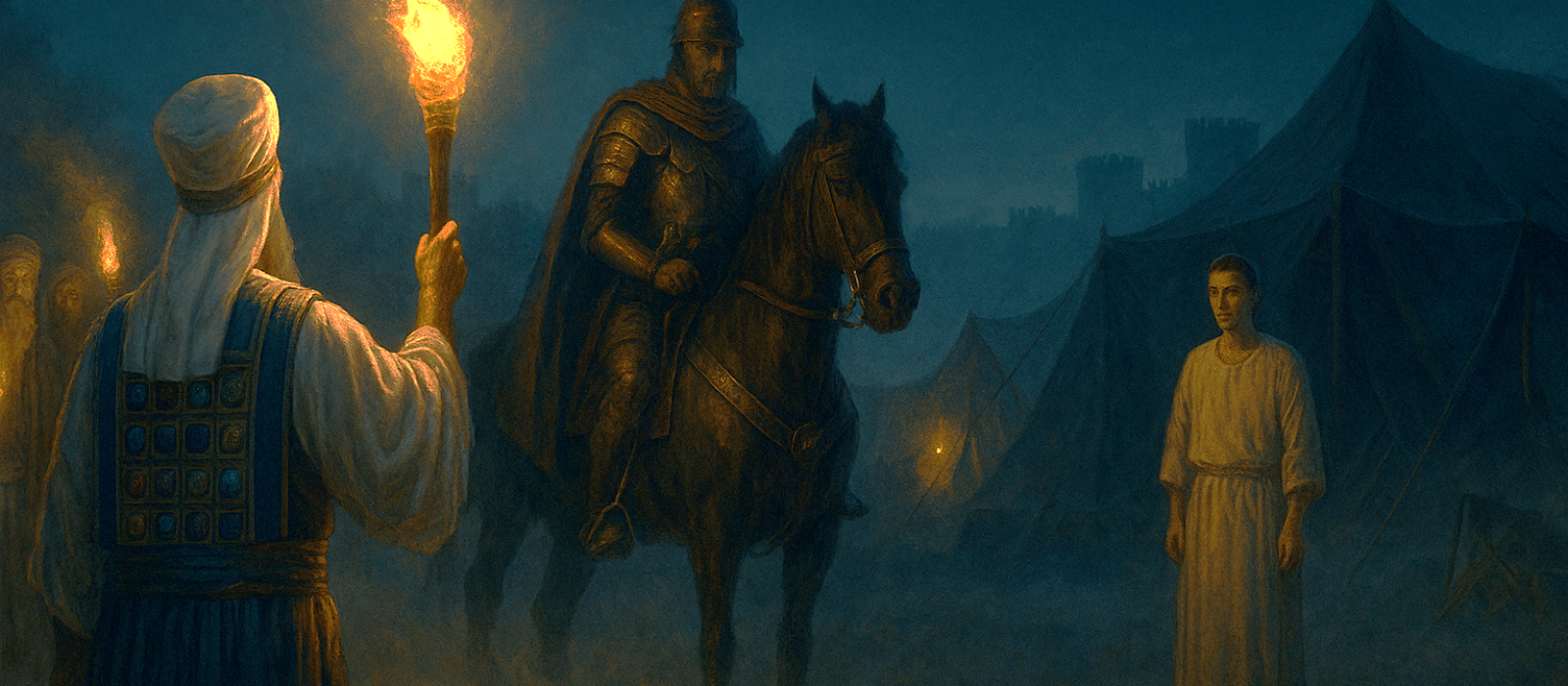
Jaddua appeared… wearing his priestly ephod. Shimon exhaled sharply. What was this? Shimon had to look again to be sure, but Jaddua was wearing the two-piece apron-like garment made from fine linen, intricately woven with blue and scarlet threads. The stones representing the tribes of Israel hung heavy on his chest—and the craftsmanship.
“What are you doing?” Shimon finally blurted out to Jaddua, “You are not really going to wear that, are you? I mean, you can’t wear that outside the Temple… can you?”
Jaddua looked at Shimon as a father might his son, “Shimon, look, Alexander is a great man. You know as well as I that this Macedonian is acting as the hand of HaShem. But he is also a soldier, a king, and formalities are still important—especially at war. If we are to be granted any kind of parley, should we not be dressed as diplomatically as possible?”
“Diplomatic?” Shimon demurred, “Diplomats of Jerusalem?”
“No, Shimon, diplomats of HaShem. Now, I know where Alexander is going to be camping tonight. It will be dark when we arrive, so grab those torches so we can announce our presence, or at the very least not appear to hide it. Yes, one for each of you.”
Shimon grabbed unlit torches from the storage area and handed them out to everyone.
“Okay,” Jaddua said, surveying the group, “that should do it. Let’s get moving.”
☼ ☼ ☼
Shimon and Jaddua led the way, with the rest of the group right behind them.
“Where’s the moon?” Shimon wondered aloud as he looked around in frustration.
It was so very dark. Clouds covered the stars, even as a light fog covered the ground. It was… unusual, to say the least. Maybe a little spooky. The light of their eight small torches illuminated the light fog, amplifying their brilliance in a way that made it hard for Shimon to see much beyond where they were walking.
“It’s okay, Shimon, I know these grounds. I know where we are. More importantly, I know where Alexander is.”
Suddenly, an unfamiliar voice rang out in Greek, “Who goes there? Identify yourself!”
To Shimon’s surprise, Jaddua spoke out in nearly perfect Greek, “I am Jaddua, High Priest of the Temple of HaShem, caretaker of the people of Jerusalem. We have come to seek an audience with the great Alexander of Macedonia, if he would be so humble as to receive us.”
A man approached on a massive black steed in bronze armor. Perched high above them, the man held a massive torch—possibly as bright as all of theirs combined.
“I am Cleitus the Black, trusted friend and protector of Alexander the Great.”
Looking down, Cleitus looked at each person in the group. He waited until they looked up at him, and he gazed into their eyes. One by one, he peered through them as if their soul was laid bare.
“Very well,” Cleitus finally said. “Follow me.”
☼ ☼ ☼
As the group approached the encampment, someone came up to Cleitus. They quietly exchanged a few words, and the someone scampered away. The camp was dark, and all appeared to be asleep. The torches held by Cleitus and Jaddua’s group were the only sources of light to be seen.
Finally, the someone returned with another someone. Cleitus sat erect in his saddle and sidestepped his horse, “May I present to you Alexander from Macedonia.”
As Jaddua stepped forward, he was surprised that it was only Alexander and Cleitus. Even the someone had already left them alone. Jaddua just stood there as Alexander took in the group. Alexander was in his sleeping robe, and he had no weapons. He seemed very confident and fearless.
“We are sorry to come to you like this, great Alexander,” Jaddua started, “but your name precedes you wherever you go. Your acts, both terrible and noble, do as well. It is because of that we come before you now, as a plea for kindness and peace. We have no love of the Persians, and certainly no loyalty. Our true loyalty is to our God, HaShem. He is the one who has sent us here to you today. He is also the one who has sent you here to us today. We have a message… and a warning. We are no threat to you, nor your rule, your mission, nor your campaign. And if you are willing, HaShem can show you what was, what is, and what will be.”
Another long silence ensued, as Alexander considered Jaddua’s words. Alexander looked down at the priestly garments of Jaddua and then, again, at the whole group. Alexander turned to Shimon, “What say you?” he asked in Greek.
Shimon turned red in embarrassment. Not knowing what Alexander said, he turned to Jaddua, panicked. Jaddua translated to him in Hebrew.
“Oh,” Shimon said in Hebrew, “I agree.”
Jaddua translated. Alexander looked to Cleitus, who nodded in agreement with Jaddua’s translation.
Alexander smirked, “You agree,” he said again in Greek. Then he turned to Jaddua and said, “We are what we repeatedly do.”
Jaddua jumped in, “Excellence, then, is not an act, but a habit.”
“So, you know Aristotle? I suppose that makes sense, if you know Greek. Tell me, Mr…?” Alexander looked to Cleitus.
“High Priest Jaddua,” Cleitus whispered.
“High Priest Jaddua, what is this message and this warning you have come to tell me about?”
“Of course,” Jaddua began, “It all started with a dream that the Babylonian king had.”
Jaddua pointed to his scribe. The scribe came forward with a sack. From the sack he pulled out a scroll. It was the scroll of Daniel. He opened the scroll and held it in the air. The torch lit the text, and Jaddua translated the text to Alexander.
He explained the statue to Alexander, and Alexander agreed with the text. But then Alexander interjected, “So, who are the legs of iron? And what is with the feet of iron and clay?”
“That is who will come after you, great Alexander,” Jaddua answered.
“What?” Alexander said with a grin, “You don’t think I will live forever?”
“Do any of us?” Jaddua, returning a warm smile, “Anyway, I fear that whoever comes after Greece will be coarser culturally, violent, and similar to how you wage war with bronze, they will wage war with iron.”
“Iron? I mean, the cost of that,” Alexander said, bewildered at the small glimpse of the future, “How is that even possible?”
“It’s not. Not on a large scale. Not like bronze. But it’s in the future. Decades? Centuries? Who knows, except HaShem,” Jaddua added.
“Well, you know,” Alexander began, thinking aloud. Turning to his protector, “Cleitus, remember what you were saying about that thing you saw in our most northern provinces? What did they call that?”
“They called it a foundry,” Cleitus dutifully replied.
“That’s right. A foundry,” Alexander echoed, turning back to Jaddua, “Not to be rude, High Priest, but is that all?”
“Not quite,” Jaddua said. The scribe returned the scroll to the sack and pulled out another scroll of Daniel and opened it. This one was positioned at the story of the ram. As the scribe held it up, Jaddua turned and read the story aloud, translating the Hebrew into Greek:
“There was a ram standing by a great channel. It had two long horns, though the one horn grew faster than the other, and the second was the longer of the two. The ram charged north and south and west, and nothing could stand against it. It did as it wanted. Then a great goat with a single prominent horn came and charged the previous ram with great rage, and it struck so hard the horns shattered. The goat knocked the ram to the ground and trampled on it. And the goat became very great.”
Jaddua stopped and looked up, but it was Alexander who spoke, “I see. I am the great goat, and the Medes and the Persians are the horns. When was this written?”
“Two hundred years ago,” Jaddua answered.
“And you have been waiting all this time to show me this?” Alexander wondered aloud as he examined the parchment, which was, indeed, very old, with ink that was faded in places—all the telltale signs of an old parchment.
“No,” Jaddua replied.
Alexander looked up, “No?” It was not the answer he expected.
“No,” Jaddua continued, “we did not even think to look for this until you were headed this way. And then… I don’t know. We were just led to the text. You must understand, we have dozens of unique scrolls, and hundreds of copies of them. We study Torah, and we try to understand. Sometimes, we just don’t know what the prophets are talking about. Daniel, for example—this is his scroll. He is the one who wrote this two hundred years ago. There are things that have happened, like you, Persia, Babylon. And there are things that haven’t—the legs of iron, feet of iron and clay, and that great Gazit that crushes the whole statue to dust.”
“Gazit?” Alexander asked.
“Oh, sorry, Hewn Stone. Sometimes I slip into a little Greek-brew.”
“Funny,” Alexander replied as he laughed out loud, “But what does the Gazit—if I could borrow that term—what does the Gazit mean?”
“It is the Messiah, the anointed one. He will wipe away the turmoil and war. But apparently, not for a very long time yet.”
“So, I must say, I am deeply moved by all this. Uh, you mentioned a warning?”
Jaddua’s expression became very stoic, “Yes, I did mention a warning.” He motioned for the scribe to hold the scroll up, and he continued to read, “The goat became great, and at the height of his power, the large horn was broken off, and in its place four prominent horns grew up toward the four winds of heaven.”
“I see,” Alexander replied with his own stoicism, “Indeed. Nobody lives forever. I can only surmise the four horns are my four generals. I can only imagine what they will do when I am gone. Do you know if I am assassinated or if it is natural?”
“Hmm,” Jaddua scowled, rereading the text, “It says broken off, but not by someone. Self-inflicted? Almost like… I don’t know, like you were so aggressive and zealous that you broke your own horn?”
“That does sound like me. It warms my heart that there is not treachery in my ranks.” Alexander quickly clapped his hands loudly, startling everyone. Even Cleitus had to settle his horse, who whinnied in disdain at the sudden noise, “So, dear Jaddua, you have convinced me that we were sent to each other by your HaShem. So, now, what is it that you want?”
“Tomorrow, when you arrive to Jerusalem, call for me. Say that you would like a tour of the Temple. I will have them throw open the gates and welcome you in as a friend. And I will, indeed, show you the Temple, at least the parts I am allowed to. The men with me today are in key positions in the city. They will make sure all is calm. And then…”
Jaddua looked up to meet Alexander’s eyes, prompting him to inquire further, “And then what?”
“And then, my friend, do with us as you wish,” Jaddua finished.
Used with permission by the author. Find the author’s complete works online: Complete Works of Mack Samuels