
3320 AM (440 BCE) – EXACTLY THE SAME BUT DIFFERENT
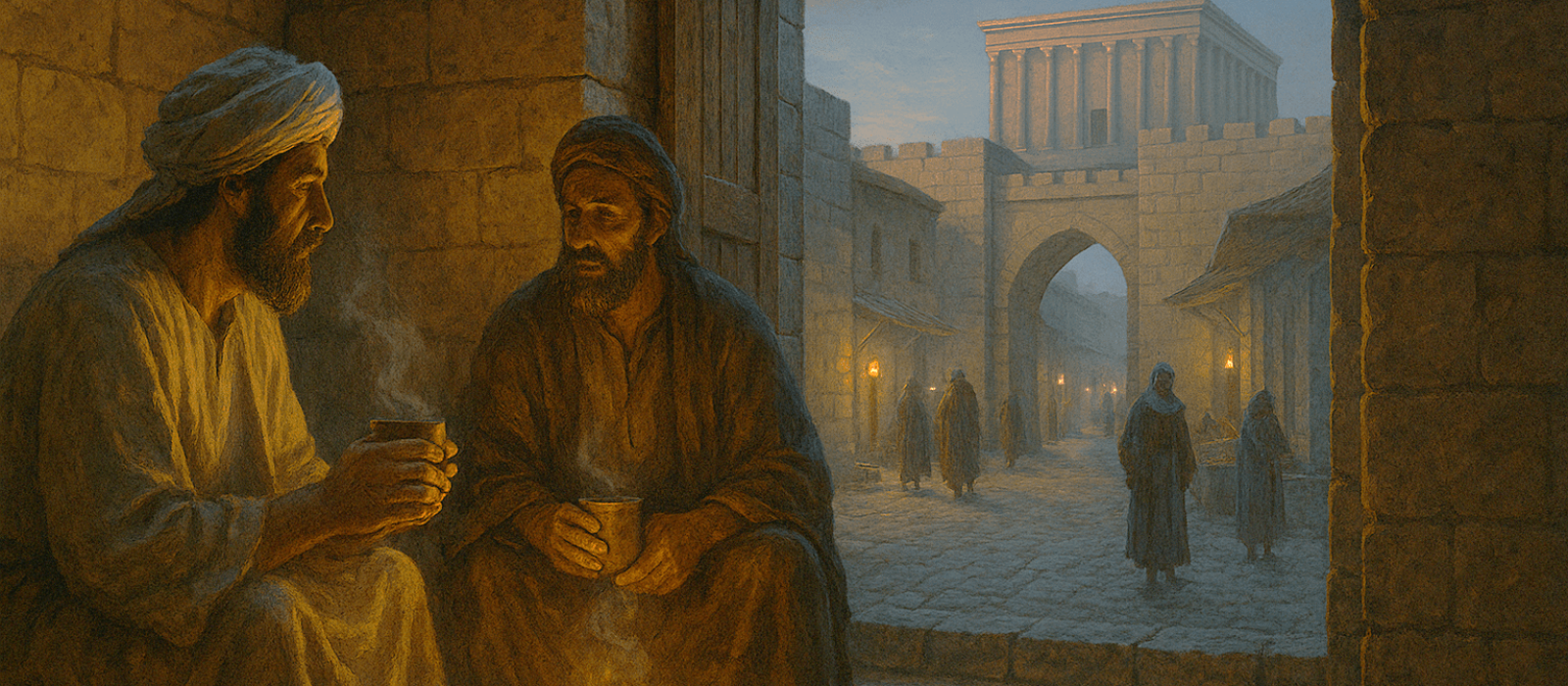
Ezra opened his newly reconstructed door in his newly reconstructed dwelling in the newly reconstructed city wall of Jerusalem. It was Nehemiah who was standing on the other side.
“Nehemiah! Dear friend! Come in!”
Ezra shut the door as Nehemiah passed, “Have a seat, my friend. Take a load off! How long has it been?”
“Oh, it’s been a bit of time,” Nehemiah replied. “I guess since we finished the wall.”
Nehemiah took Ezra’s offer and, with a mighty sigh, sat down. Ezra was uneasy. Something was not right with his friend.
“What is it, Nehemiah?” Ezra prodded.
Nehemiah looked at Ezra. His gaze was full of exasperation. He tried to speak—but he wanted to speak—but words seemed elusive.
“Did I do something, Nehemiah? Did I do something to you?”
“Not to me, exactly,” he finally blurted.
“Then what? Something is bothering you, that is clear enough.”
Ezra sat across from Nehemiah and just watched him. Nehemiah looked up and saw the friendly expectation in Ezra’s eyes and relaxed a little.
“Tell me, Nehemiah, why did you come here?”
Nehemiah was amazed by the question—what a question! Did Ezra not know why he had been sent? To preserve those very things that preserved the Jews in Babylon and Persia for so long, that being Shabbat, the appointed times, and, of course, obedience to Adonai’s commands.
“Well,” Nehemiah began, “I mean, the Temple. Setting it up, I mean. Or, at least, I needed to help organize the people to get things set up and going. I mean, we built it in a year, but we had to dedicate it, dedicate the new priests … there was a lot that needed to be done. We did everything according to Torah. I mean, I thought we did.”
“Yet?” Ezra answered.
“Yet?” Nehemiah replied to the enigma. “Yet what? Aren’t you bothered that it didn’t happen the same way as the first time?”
Ezra stroked his beard, his mouth an obvious frown of consternation. “You mean,” Ezra mumbled, a bit perplex, “no cloud.”
“No cloud,” Nehemiah repeated. “I don’t know, maybe we did not sacrifice enough. I know we did not sacrifice as many animals as Solomon had. Or maybe we made an error with anointing the priests. Or maybe we got something else wrong. But yeah, no cloud.”
“Well, honestly, Nehemiah, you can’t be bent out of shape over just that, after all this time?”
“No, it’s not just that,” Nehemiah started, but Ezra interrupted, “Do you think we are not keeping the appointed times in the right way or at the right times? Passover? Yom Kippur? Purim?”
“Ah, Purim,” Nehemiah replied. “That’s not even one of Adonai’s appointed times!”
“You are bothered by Purim?” Ezra pushed further.
“No, I’m not. I don’t know what it is. There is something just off.”
“Okay, I mean, Nehemiah, you certainly don’t wish to be back in Babylon, do you?”
“Certainly not!” Nehemiah said violently, standing as he spoke.
Ezra looked up astonished, and finally Nehemiah sat back down.
“I think I will make us some tea,” Ezra said, standing.
He grabbed his metal pot for boiling water, filled it from his supply, and hung it over the fire. While the water heated, he grabbed a couple of clay cups and added a mixture of herbs. Carefully taking the water off the fire, he poured a little into each and handed one to Nehemiah.
“Here, take this,” Ezra offered.
Nehemiah complied and held the clay cup, the heat already passing through the material. Nehemiah blew, then sipped.
Once again, Nehemiah looked up at Ezra. “It’s not just that; I am also struggling with the mixed marriages.”
“Mixed marriages? But we annulled those marriages and sent them back to Babylon and Persia, respectively. We have to honor the commandments of Adonai. It’s why we were sent to Babylon in the first place. We are not going to make that mistake again. How could we? So, what’s the issue?”
“What about Malachi?” Nehemiah followed up.
“Malachi?” Ezra said, dumbfounded. “The prophet, you mean? What about him?”
“Do you recall what he wrote about midway in his scroll about marriage?”
Ezra’s expression changed for the worse. “About marriage?”
Without waiting, Nehemiah continued, “It says Adonai hates divorce as much as he hates those clothed in violence. He warns us to take heed and not to break faith with the wife of your youth.”
“Yeah, sure. I remember. But that’s not Torah, I mean—”
“Really?” Nehemiah scolded. “You really think what Adonai said through the prophets doesn’t carry as much weight as the Torah?”
“What do you want me to say, Nehemiah? They’re gone. They’ve left. It’s done!”
“It’s not done. It’s just the beginning. Don’t you see? Can’t you see? How have you become so blind to it? Can’t you feel it in the streets? When you shop in the markets? Judgment. But not from Adonai. Judgment from the people, making sure you fulfill this law of Adonai or that. And if you don’t, or even if you do and they think you don’t, I don’t know, it’s like some baseless hatred.”
Ezra thought about Nehemiah’s words. They bothered him greatly, but only because they had merit. People were rather cold and indifferent. It was strange. There seemed to be no joy or celebration for their recent liberation, or for the Temple, or even for the rebuilding of Jerusalem. Even at the appointed times, everything seemed subdued and muted. It wasn’t as much suppressed enthusiasm as maybe, I don’t know, jaded skepticism?
“Well, Nehemiah, perhaps it’s just this generation. Maybe we just have to wait. Too many memories, you know? Perhaps in a few generations, people will take joy in where they are at and what Adonai has given them?”
Nehemiah wasn’t sure. “Perhaps. But if we don’t teach our children joy and dignity and compassion and love of our neighbors, how will they know to teach that to their children? And then what are you left with? Generations of people trapped in the cycle of just not getting along, petty disputes and complaints. It would almost be like when we were in the desert with Moses, and the mixed multitudes were complaining.”
Nehemiah stopped and looked at Ezra. “The mixed multitudes? What about the ones that joined our people from the first exodus? The ones that were accepted by Adonai without question? My God, Ezra, what have we done? What have we done?”
“Nehemiah, calm down. You don’t think Adonai will tear this temple down because of the annulments? Baseless hatred? You can’t be serious. After all we have gone through? You do not really think Adonai will destroy his temple and Jerusalem again, do you?”
Nehemiah shook his head, but only slightly. “And look how selfish everyone is, Ezra! I don’t know. Maybe not now or even in ten generations. But the possibility seems very real to me.”
Nehemiah sighed heavily and looked down at his empty cup, and then back up at Ezra. “We’re obviously going to need more tea.”
Used with permission by the author. Find the author’s complete works online: Complete Works of Mack Samuels