
3091 AM (669 BCE) – THE BEST LAID PLANS OF MICE
From his throne room, Hoshea looked out across the desert and saw the army of Shalmaneser of Assyria. They looked like locusts covering the sands. Thus, Hoshea called his advisors to ask what they thought.
“Well, they look like locusts,” his advisor, Matanah, said.
Hoshea looked at him sternly. “You think?”
“Uh, yeah,” he replied pensively. “Do you not think so?”
Annoyed, Hoshea turned to his other advisor, Zimrah. “Well, what do you think?”
With similar useless bluster, Zimrah agreed. “Yes, absolutely. Locusts for sure.”
Elior, the third advisor standing there, took the opportunity to chime in. “I’m of the same mind, your majesty. Without a doubt, locusts.”
“Gentlemen, gentlemen,” Hoshea responded, returning to his throne and taking a seat. “The reason I called you in here was not to remind me how bad the situation is—which you have done such a stellar job at—”
“Thank you!” they all said in unison, interrupting the king.
With a long sigh, Hoshea continued, “I called you in because I want ideas on how to deal with this bad situation, and for better or worse, you three happen to be the best minds Israel has to offer, gods help us.”
“Indeed, sir,” Matanah said. “Thank you, sir!”
Hoshea looked at the three, spreading his palms to indicate it was their turn to contribute something more useful than sycophantic babble.
“Oh,” Matanah said again. “Well, based on our current military strength, we cannot defeat the locusts. Uh… the Assyrians, I mean.”
“And?” Hoshea prompted.
Elior spoke up. “I would say diplomacy is in order. I mean, how much could the tribute really be?”
“That seems rather cowardly, don’t you think?” Hoshea menacingly inquired.
“Oh, well,” Zimrah started, uneasy. “Well, I suppose, So. How about So?” he emphasized strongly.
Hoshea was losing patience. “So? So?!”
Zimrah breathed easier as his expression relaxed. “Yes, So!”
Hoshea stood, visibly angry, his face as red as the sandstone. “What do you mean, So? Do you think it is okay to be cowardly?!”
“Oh, no—So!” Zimrah said, the color draining from his face. He struggled to breathe. “I… I mean So, the Pharaoh of Egypt.”
Hoshea paused, thinking. Slowly he eased himself back down into his throne. “Ah, So…” he noodled to himself.
Matanah quickly added, “The Pharaoh’s army would even the odds—more or less. But the problem is time: we must delay until the Egyptians can get here… assuming they would come, and assuming Judah would allow them to pass.”
“Wow!” Hoshea said suddenly. “You three are capable of thinking. I almost lost hope.”
Matanah smiled broadly. “Not at all, sir. We all do what we can! Always happy to help!”
Even still, Hoshea began to pace. How to pull it off? Looking up at Matanah, he asked, “How long to get a messenger to So?”
Matanah thought. “Assuming access to fresh horses, a little over a week. Without them, a little over two to go down and back.”
Elior suggested, “If we move forward with tribute—servitude—we could buy ourselves at least a few weeks.”
Hoshea read Elior’s hesitation. “Fine, do it. But keep it close to the chest, gentlemen. Assume that Shalmaneser has scouts, lookouts, spies. Do not breathe a word of this to anyone. Don’t even talk about it amongst yourselves. Understand?”
Hoshea raised his voice to a threatening volume, his tone menacing. He made eye contact with each advisor until they nodded yes.
“Fine. Get it done.”
After several awkward moments, the brain trust finally left the king alone with his thoughts.
☼ ☼ ☼
It ended up being closer to three weeks before the rider returned. Hoshea had agreed to be a servant and pay tribute, the first payment coming due soon. The rider brought news from the king of Egypt, who demanded more details. Hoshea’s heart sank. This would not be a quick solution, but one of endurance. After several years, So of Egypt finally agreed to marshal his troops against Assyria and liberate Israel.
Not once did King Hoshea turn to Adonai or to one of His prophets for advice. So, king of Egypt, told Hoshea to stop paying the tribute and save their money, for they would have to pay for Egypt’s assistance. Thus, Hoshea stopped payments and started organizing his army. Like a father humorously indulging his toddler, King Shalmaneser of Assyria allowed Israel to prepare its defenses and fortify its cities. Then Shalmaneser sent a messenger to Hoshea.
☼ ☼ ☼
Hoshea was on his throne when the viceroy of Shalmaneser arrived. Hoshea was offended. He immediately stood and demanded, “What do you mean by this? Will Shalmaneser not address me directly?”
Slowly, the viceroy walked up to the king and looked him in the eye. “I assure you, King Hoshea, that I speak for Shalmaneser as if he were standing here in front of you. Besides, oh great king of Israel,” the viceroy said sarcastically, “you will have many opportunities to visit with the great Shalmaneser. For now, there are things you need to account for. For starters, you have been conspiring with King So of Egypt.”
The viceroy let that sink in as he slowly passed the king and sat on his throne. His hands explored the regal materials composing what was, at the end of the day, just a chair.
Looking up at Hoshea, the viceroy continued, “Did you think we didn’t notice your many riders? Not that it was necessary, because King So himself told us about the conspiracy. He was never going to rescue you. He led you on so that we would be paid by you. In return, we agreed to leave them alone.”
“Moreover, we told them they could have Judah, because, honestly, it is still too strong for us. It is like a valiant steed, difficult to tame. Israel, on the other hand—you are like an old mare that, if not already beaten to death, is at serious risk of bursting its mortal coil.”
The viceroy laughed haughtily at his own remark for a minute. When the laughter passed, he was all business again.
“So,” he began deliberately, “we were happy to take your money and look the other way—perhaps even give you a sense of false hope. That is, until you stopped paying the tribute. Thus, here we are, and King So is not.”
King Hoshea was pale. He tried to still his shaking hands, but he was terrified. Egypt had betrayed them, and he had no recourse.
“Now,” the viceroy continued, “you have a choice to make. How does your God say it? Life or death? Blessing or cursing?”
Hoshea looked blankly at the viceroy, having no idea what he meant. “Which of the gods says that?”
The viceroy studied him for a moment, trying to discern whether Hoshea was serious, then concluded that the king was truly ignorant.
With a sigh, he addressed the gap. “Apparently, I know your God Adonai better than you do. You can trust me—He says that a lot.”
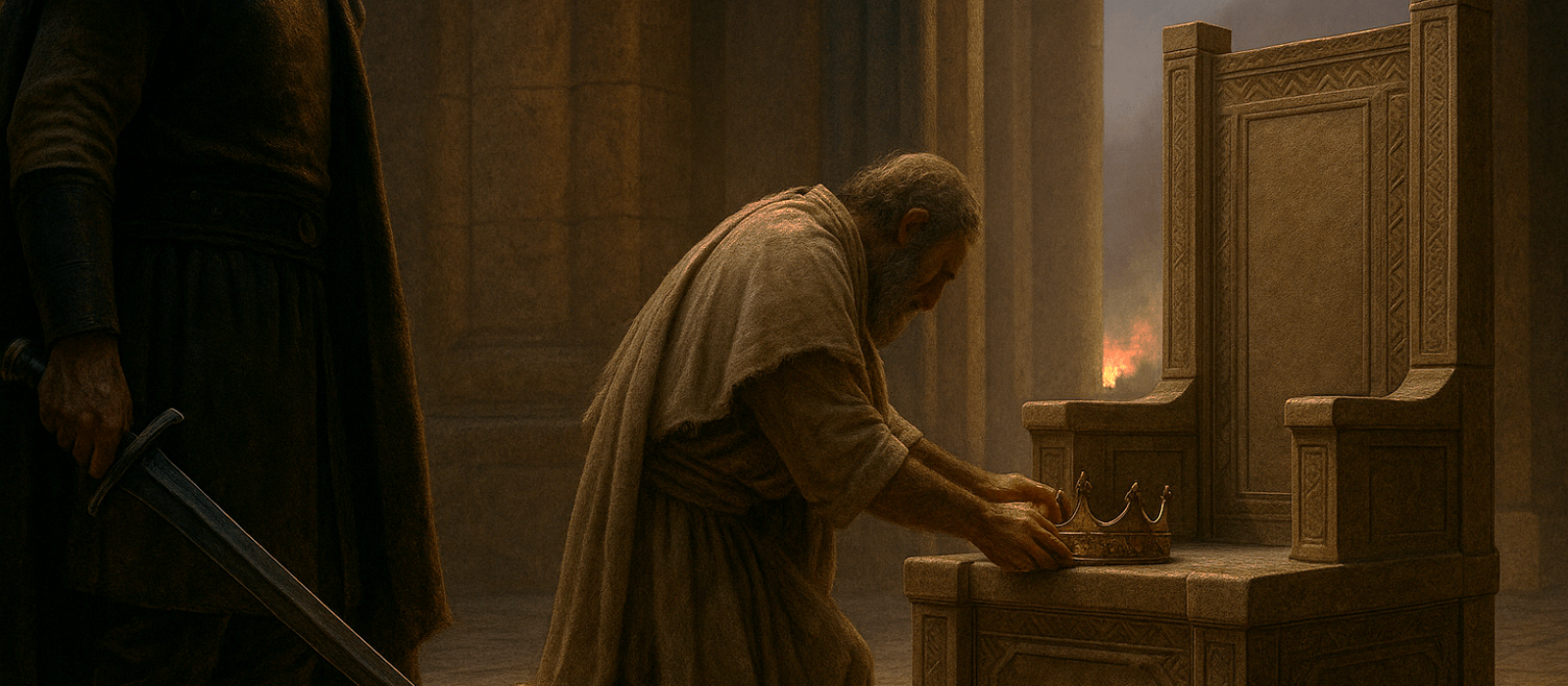
He continued, “Here is what will happen. I will rise from this throne and draw my blade. When I do, you will take off your crown and set it on the throne. Then, with my sword in hand, I will walk you out to my men waiting for us, and you will quietly accompany me. You will be put in prison, but you will live—fairly comfortably, I might add. Or you can deviate from my instructions in any way, and I will hack you to pieces where you stand. That is your choice: life or death, blessing or cursing. Take a minute to think it over.”
The viceroy took a deep breath and let it out slowly.
“King Hoshea, my advice to you would be the same as your God, Adonai, would say to you right now—if you could hear Him. Choose life, Mr. Hoshea.”
He waited several long minutes as a courtesy. He wanted Hoshea to weigh every course of action. The shaking in Hoshea’s hand stopped—either newfound courage or simple acceptance. The viceroy hoped it was the latter.
Slowly, calmly, with the intent of a dangerous man in total control, the viceroy stood and stepped aside. With only the slightest hesitation, followed by a quick nod, Hoshea took off his crown and set it on the throne with utmost care. With tears streaming down his face, Hoshea was led to prison.
☼ ☼ ☼
After Assyria invaded Israel, they besieged Samaria for three years. They led the survivors of the siege into exile in Assyria. They brought their own people down and resettled the land of Samaria. Wild beasts attacked many Assyrians in Samaria. The Assyrians thought that if they brought a few priests back to teach them about Adonai, the God of Israel, the beasts would stop attacking them—which they apparently did.
And while the form of Judaism that resulted from this bastardization was not pure—with the Samaritans still following many gods—it would seem that the Samaritans followed Adonai far more closely than Israel ever did under Jeroboam and all their subsequent kings.
Think about that before you claim to want to follow Adonai as your God. He has expectations. He has standards. He is a jealous God. He demands to be worshiped in Spirit and in Truth.
Used with permission by the author. Find the author’s complete works online: Complete Works of Mack Samuels