
In Seventh Heaven
By Philologos — July 10, 2007
Forward reader Nochum Elek inquires:
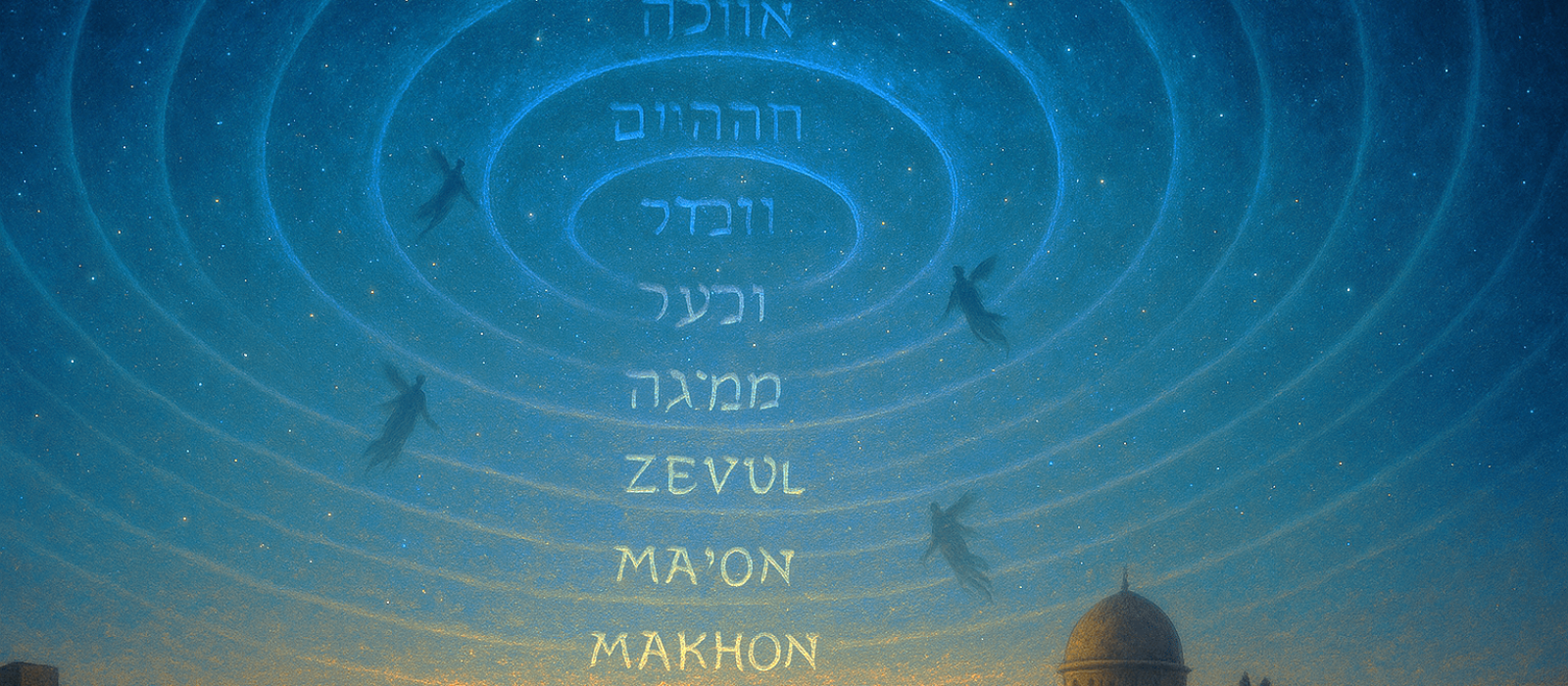
“I would like to know whether the Yiddish expression in zibnten himl [in seventh heaven] is a translation from the English, or whether it is the other way around and the English ‘seventh heaven’ comes from the one mentioned in the tractate of Hagigah in the Talmud, where it says: ‘There are seven heavens: Vilon, Rakia, Shehakim, Zevul, Ma’on, Makhon, [and] Aravot.’ And if so, what is so special about the seventh heaven?”
Ancient Roots of Multiple Heavens
The idea that the heavens are multiple and stacked one above another was widespread among the ancient cultures of the world. Perhaps this came from a natural tendency to ask what lay above the dome of the sky and to imagine a hierarchy of additional skies in which the gods dwelled. But the number of heavens in ancient mythologies was not necessarily seven; lesser and greater numbers were imagined, too. The number seven (and sometimes eight) first took hold in the Near East and eastern Mediterranean as a blend of Babylonian astronomy and early Greek science.
Babylonian Astronomy and Greek Science
The Babylonians first charted the precise trajectories of the seven visible celestial bodies—the sun, the moon, Mercury, Venus, Mars, Saturn, and Jupiter—that did not move in tandem with the fixed stars. The Greeks then reasoned that each of these bodies must be situated on a circular plane of its own, revolving independently of the others.
In the “myth of Er” in The Republic, Plato (4th century BCE) imagined the universe as a spinning top, with the earth at its bottom and eight inner wheels (the eighth carrying the fixed stars) rotating above the earth at different speeds. Each wheel effectively constituted a separate heaven, with the sides of the top forming the outer limits of the universe. This conception later received a sophisticated mathematical form in the second century C.E. under astronomer Ptolemy. Variants of the Ptolemaic system posited seven to eleven celestial spheres and prevailed in Europe until Copernicus.
Why Seven in Jewish Thought?
Because the idea of seven heavens is not found in the Bible and first appears in early centuries C.E. in the rabbinic literature of the Land of Israel—then steeped in Greek culture—it stands to reason that the rabbis borrowed the basic schema from Greek science. They likely settled on “seven” because of the number’s special importance in Jewish tradition—think of Shabbat—and populated the heavens with angels, from lower ranks in the first heaven to the highest in the seventh.
Biblical Terms, Rabbinic Structure
Of the seven names in Hagigah—Vilon, Raki’a, Shehakim, Zevul, Ma’on, Makhon, and Aravot—all but Vilon (“curtain” in rabbinic Hebrew) appear in the Bible as terms for God’s dwelling place. Yet in Tanakh these words are essentially synonyms; only rabbinic literature structures them as distinct strata.
Genesis 1: Raki’a (“firmament”) appears in the Creation account.
Psalms: “Who in the heaven (ba’shehakim) can be compared unto the Lord?” (KJV).
Isaiah: “Look down from heaven and behold from the habitation of Your holiness (zevul kodshekha).”
Hechalot Mysticism and Ascent
In early Jewish mystical tradition—often called Hechalot (“Palaces”)—the initiate ascends, by meditative means, through the seven heavens in order, meeting angelic challenges in each, and then passes through the seven palaces of the seventh heaven to reach the base of God’s throne.
Across the Mediterranean World
Similar layered-heaven beliefs, complete with complex angelology, appeared in various Gnostic sects of the Roman world and had some currency in early Christianity.
2 Corinthians 12: Paul alludes to someone “caught up to the third heaven.”
From Judaism and/or Christianity, the model spread to Islam as well.
Qur’an, Sura 71: “See you not how Allah has created the seven heavens one above another, and made the moon a light in their midst and made the sun a lamp?”
Why “Seventh Heaven” Means Bliss
To be in “seventh heaven” is to reach the pinnacle of bliss—the highest stratum of divine proximity. The English phrase has been around a long time; whether it entered English via Christian, Jewish, or Muslim channels is uncertain. It almost certainly did not come from the Yiddish in zibnten himl, which is later in American usage, yet the Yiddish expression likewise springs from internal Jewish traditions. Both ultimately trace back to ancient cosmologies thousands of years old.
Source
Original article: “In Seventh Heaven” by Philologos, published July 10, 2007 in The Forward. Read at Forward.