
Scripture References: Ezekiel 37 (Valley of Dry Bones); Psalm 83; Zechariah 12.
5783 AM (2023 CE) – GAZA CONFLICT
The desert air was still crisp in the early dawn, a soft golden hue stretching across the Negev horizon. The Supernova Sukkot Gathering was a music festival alive with energy, a celebration of life, thumping music that would not quit, and the joy of youth. Thousands of festival-goers, young and carefree, danced beneath a sky that had not yet fully surrendered to daylight.
The electronic beats pulsed, blending with laughter and the rhythmic stomping of feet on the dry earth. Some had been awake all night, lost in the music, swaying in the open space under the infinite sky. Others lounged in tents, recovering from hours of dancing, the hum of conversation mingling with the sound of the breeze.
Then, the first rockets streaked across the sky.
For a fleeting moment, the crowd mistook them for fireworks, a strange and unexpected addition to the festival. But confusion quickly turned to dread as the shrill wail of air raid sirens cut through the music.
Phones buzzed in pockets and hands, screens lighting up with Tzeva Adom alerts – incoming rocket fire.
Then, the explosions.
A loud boom sent a shockwave through the festival, drowning out the music. A fireball erupted in the distance, sending up a plume of smoke. Screams rippled through the crowd, people looking around in disbelief. Some instinctively dropped to the ground, others stood frozen in place.
Then came the gunfire.
It started at the edges – the sound of automatic rifles punctuating the morning air, tearing through tents and bodies alike. Black-clad gunmen, armed with Kalashnikovs and RPGs, stormed in on pickup trucks, their arrival blending almost seamlessly with the chaos of the rockets overhead. Paragliders, silhouetted against the rising sun, drifted eerily toward the ground, Hamas militants descending like a dark omen onto the festival grounds.
Hundreds scrambled in every direction, running blindly, hands clutching at friends, lovers, strangers – anyone they could pull along. The lucky ones made it to their cars. Others dove into the fields, hoping the tall grass would be enough to keep them hidden.
But the gunmen were everywhere.
A group of young Israelis huddled inside a portable toilet, the smell of chemicals thick in their nostrils, their backs pressed against the flimsy plastic walls. One girl whispered through panicked breaths, fingers tapping a frantic message to her parents: “I love you. Please, don’t forget me.” Footsteps pounded outside, a gunshot ripped through the stall, and silence fell.
Two best friends ran hand in hand, their feet kicking up dust as they darted toward a fence at the edge of the festival. Just as they reached it, a burst of gunfire sent one of them sprawling to the ground. The survivor hesitated only a second before collapsing beside their fallen friend, cradling them, refusing to leave. The gunmen approached. They didn’t hesitate.
An off-duty IDF soldier, unarmed, tried to rally a small group, shouting instructions, urging them to move toward the tree line. “Don’t stop! Keep running!” he yelled. But before they could take more than a few steps, he staggered forward, blood blossoming from his chest as a bullet tore through him. His body crumpled to the ground, lifeless. The group scattered in terror.
A young woman was dragged by her hair toward a truck, her screams swallowed by the chaos. She thrashed, kicked, but the grip on her arms was unrelenting. A terrorist laughed, filming her with his phone, live-streaming her abduction to the world.
Frantic calls to 1-0-0 – Israel’s emergency line – flooded the airwaves.
“Please, they’re shooting everyone!”
“There’s no way out!”
“They took my friend, they took her!”
“I can hear them coming – oh God –”
But the IDF was overwhelmed. The border had been breached. The army bases had been hit. There were no soldiers coming.
The festival-goers were on their own.
Gunmen moved methodically, firing at anyone they saw, tossing grenades into tents, setting cars ablaze with people still inside. The smell of burning fuel and flesh thickened the air.
The massacre stretched for hours.
By the time the attack was over, at least 364 young people were dead. Dozens were kidnapped, thrown into trucks and taken back across the border.
Blood soaked the sand, the once-thriving festival now a field of death.
The sun rose higher over the Negev, shining mercilessly on a scene of unspeakable horror. The music had long since stopped, but the echo of screams remained.
☼ ☼ ☼
The air raid sirens never stopped.
What began as a morning of horror at the Supernova festival had now spilled over into the entire country.
The sky over southern Israel was streaked with fire, the relentless launch of rockets from Gaza lighting up the atmosphere. Thousands of them, fired in coordinated waves, raining down on cities from Ashkelon to Tel Aviv. The Iron Dome intercepted as many as it could, bright explosions dotting the sky as defense batteries worked frantically – but some rockets got through.
The explosions rocked apartment buildings, sending fire and shrapnel into the streets below. A daycare center in Ashdod collapsed, its roof caving in from a direct hit. People ran through the streets in panic, hands over their heads, dodging falling debris as the sirens screamed warnings too late.
In Sderot, the roads burned. A car erupted into flames as a rocket crashed into a main intersection. Smoke billowed over the city skyline. In the chaos, parents tried shielding their children, covering them with their bodies as another barrage of rockets shrieked overhead.
The home front was burning. And yet, the worst was still to come.
☼ ☼ ☼
The border had been breached – not just in one location, but in dozens.
The security fence meant to protect Israel from Hamas militants was useless. The terrorists had blown through it, cutting holes through barbed wire, smashing their way through gates, and flooding into Israel en masse.
Pickup trucks rumbled down rural roads, packed with heavily armed men screaming “Allahu Akbar!” They moved with terrifying coordination, fanning out toward kibbutzim, small villages, and townships.
Some gunmen arrived at dawn in Kibbutz Be’eri, catching the small farming community as it still lay in morning silence.
They went house to house, breaking down doors, throwing grenades inside before entering with rifles drawn.
Families who had once left their doors unlocked for their neighbors now found themselves prisoners in their own homes, hunted by the enemy.
A Holocaust survivor, 90 years old, was dragged from his bed and shot on his front porch. His grandson, hiding in a closet, whispered through his sobs into his phone, begging for the army to come. No one was coming.
In another house, a young mother clutched her infant to her chest, whispering soft prayers in Hebrew as gunmen kicked down her door. They ripped the child from her arms, shoved the crying baby into a terrorist’s backpack, and dragged her away screaming.
In a kibbutz dining hall, terrified residents had barricaded themselves inside, pushing tables against doors, hoping to hold out until the IDF arrived. The terrorists set the building on fire instead.
The bloodbath continued for hours.
Kibbutzim like Kfar Aza, Nahal Oz, and Re’im faced the same horrors – entire families executed, bodies left in the streets, homes burned to the ground, and dozens of hostages forced into trucks bound for Gaza.
A police station in Sderot was stormed – the officers inside slaughtered, their weapons taken.
Highways turned into war zones, with Hamas gunmen blocking roads, ambushing innocent drivers, pulling people from their vehicles.
A father and his two sons were kidnapped, their hands zip-tied, blindfolds forced over their eyes, and thrown into the back of a van.
The horror was unthinkable – it was an invasion, not an attack.
Men, women, children, even the elderly, were hauled into cars, motorcycles, anything that moved. A young girl, no older than ten, sobbed as she was dragged across the border, her hands tied, her face buried in fear.
A disabled woman in a wheelchair was lifted and carried, thrown into a truck like luggage.
A Thai worker from an Israeli farm, confused, terrified, begged for his life – they shot him anyway.
This wasn’t war. This was terror in its purest form. The IDF was caught off-guard – completely overwhelmed. Commanders, blindsided, rushed to mobilize troops, but so many bases had been hit by rockets that units struggled to regroup.
Special forces were called up immediately, but reaching the besieged towns was nearly impossible – every road leading south was a battlefield.
Reservists – men and women who had fought in Lebanon, Gaza, Syria – began grabbing their rifles, putting on their old uniforms, rushing to their bases.
The air force was scrambling jets, but Hamas had set up anti-air defenses, turning what should have been easy strikes into deadly risks.
The military wasn’t just fighting Hamas – it was trying to catch up to a disaster already in motion.
Israel had never been caught so off guard.
☼ ☼ ☼
Far from the terror, in Peki’in, the Halevi home was eerily silent.
David sat motionless on the couch, his knuckles white, the remote gripped tightly in his hand as he flipped between news stations. Every channel was the same – fire, death, screaming.
Nadir stood behind him, arms crossed, his face unreadable, but his dark eyes burned with fury.
They had seen so many wars, but this felt different. This wasn’t a battle between armies. This was something else.
“This is a pogrom,” David finally said, his voice hoarse, “It’s a damn pogrom in the 21st century.”
Nadir didn’t respond at first. He just exhaled slowly, his breath shaking slightly.
“It’s worse,” he muttered, “At least the Jews of Europe didn’t have an army back then.”
The screen flickered – live footage from Gaza. The hostages, now in captivity, being paraded through the streets as human trophies. Children crying, women with torn clothing, men beaten and bloody.
David gritted his teeth.
Nadir, still watching, let out a bitter chuckle – a sound full of rage, not amusement.
“Tell me something, David,” he said, voice heavy, “How do we forgive this?”
David didn’t answer.
He had no answer to give.
☼ ☼ ☼
The drive to Jerusalem was a blur of sirens, emergency vehicles, and the distant booms of Iron Dome interceptions. The highway was clogged with IDF convoys, tanks and armored vehicles racing south to Gaza, their crews standing in open hatches, grim-faced, battle-ready.
David gripped the steering wheel so tightly his knuckles turned white. The radio in the truck spat out garbled news updates, the reporters struggling to keep up with the catastrophe unfolding in real-time.
“Casualties rising into the hundreds – Hamas militants still active inside multiple kibbutzim – IDF forces engaging in heavy firefights – hostages confirmed taken into Gaza –”
The words hit like blows.
David flicked the radio off. He couldn’t listen anymore.
Beside him, Nadir stared ahead in silence, his jaw set, his fingers tapping a steady rhythm against the door. Every now and then, he reached into his jacket, as if checking for a weapon that wasn’t there anymore.
Finally, David spoke, “We have to do something.”
Nadir let out a slow breath, “They won’t even take our calls, David. We’re relics.”
David’s fingers tightened around the wheel, “Then we show up.”
☼ ☼ ☼
The air outside the intelligence compound was electric. A storm of personnel rushed through the entrance, soldiers, analysts, field operatives, all moving with urgent purpose. A line of IDF command vehicles sat idling near the curb, their occupants deep in high-level discussions.
David and Nadir stepped out of the truck, barely shutting the doors before striding toward the entrance.
Security personnel at the checkpoint tensed when they approached. One of them recognized David immediately.
“Lt Col Halevi?” The young soldier’s eyes widened in recognition. He glanced at Nadir, “Commander Haddad?”
David nodded, “We need to speak to intelligence. Now.”
The soldier hesitated, as if unsure what to do. He spoke quickly into his radio, then gestured for them to follow, “This way.”
Inside, the Shin Bet offices buzzed with controlled chaos. Walls of monitors displayed live drone feeds, tracking both IDF movements and terrorist activity inside Israel. Officers rushed between workstations, voices sharp with orders and data reports.
David and Nadir hadn’t been inside these halls for years, but nothing had changed. The smell of stale coffee, the hum of servers, the feeling that the weight of the nation rested in these rooms.
A young intelligence officer – mid-30s, sharp suit, tense posture – approached them. He knew who they were, but his expression was guarded.
“Lt Col Halevi, Commander Haddad,” he greeted them with forced politeness, “I’m sorry, but now isn’t the best time.”
David ignored the dismissal, “We’re not here to waste time. We need to be briefed – tell us what’s happening in the south.”
The officer sighed, “Sirs, with all due respect… this isn’t your fight anymore.”
Nadir snorted, shaking his head, “Tell that to the children they just took.”
The officer’s jaw tightened, but he stood firm, “We have our best teams on this. Every available unit is being mobilized. I’m sure you understand – our priority is deploying active personnel.”
David leaned in, voice low, firm, “You need intelligence officers who know the enemy. Who know how they think. Who’ve fought them before. Who aren’t just reading reports from a damn tablet.”
The younger man hesitated, clearly conflicted, but shook his head, “I have my orders.”
David could see it now – they were relics. Late in their 80s. Sidelined by time. By bureaucracy. Once, they had been the ones making these decisions. Now, they were being dismissed like the old men watching a war they could no longer fight.
Nadir exhaled through his nose, his hands on his hips. He glanced around the war room, taking in the fresh-faced intelligence officers, the analysts hunched over desks. They were kids, in his eyes. Kids running a war.
David ran a hand through his thin, gray hair. His chest burned with frustration – not at the officer, not at Shin Bet, but at the reality of it all.
Finally, he nodded once. It was over.
“Alright,” David muttered, stepping back, “We won’t waste any more of your time.”
The officer offered a stiff nod, clearly relieved.
David and Nadir turned and walked away.
The war was happening without them.
☼ ☼ ☼
The cool evening air did little to calm their nerves as David and Nadir stepped out of the Shin Bet headquarters. The sky over Jerusalem was unusually dark, the usual glow of city lights dimmed by power fluctuations and emergency protocols. The war had changed everything in an instant.
David walked with purpose, his mind still reeling from their dismissal inside. Retired. Useless. He had never felt more helpless.
Nadir, however, walked with a different energy. He had accepted it years ago – the war was no longer theirs to fight directly. But that didn’t mean they couldn’t do something.
As they stepped onto the main road, a news van was parked nearby, its bright floodlights cutting through the evening gloom. A small crew was setting up, their faces tense, their movements hurried.
A woman in a dark blazer, her hair pulled back in a loose ponytail, glanced up from her phone, recognition flickering across her face.
It was Yael Cohen, a well-known Israeli war correspondent. She was in her mid-30s, her expression weary but sharp, the kind of journalist who had seen too much, too soon.
She hesitated for a moment, then quickly strode toward them, her cameraman trailing behind.
“Sir – Lt Col Halevi? Commander Haddad?” she called, microphone in hand, “Um, uh, hello! Can we ask you a few questions?”
David immediately scowled, the last thing he wanted was to be used for a news cycle soundbite, “Not interested,” he muttered, turning to walk away.
But Nadir grinned, grabbing David’s arm, stopping him in his tracks. He loved moments like this, “What’s the matter, David? You don’t want to be famous?”
David shot him a glare, but Nadir turned back to Yael, his smirk widening, “Alright, Cohen, you caught us. What do you want to know?”
Yael gestured for the camera to roll, stepping forward cautiously, sensing there was something important here – something more than a typical military soundbite.
Yael spoke into the microphone in her hands, “You’ve both fought for Israel in almost every major war since its founding. What do you make of… all of this?”
David exhaled sharply, running a hand over his face. He wanted to walk away. He wanted to not care. But he couldn’t.
Yael pointed the microphone at David, “There’s nothing new under the sun. The same hatred, the same war. Only the weapons and tactics change.”
Nadir’s smirk faded as he glanced toward the camera, “And the targets,” he added, “Now they take babies.”
Yael flinched slightly, as if the reality had just sunk even deeper.
Not missing a beat, Yael followed up, “You’ve both fought so many wars for Israel. How do you reconcile everything you’ve seen?”
David hesitated. Reconcile? What a question.
David huffed, “The line is never clear. It never has been. We do what we must.”
Yael’s grip on the mic tightened, “But where is the line?”
David opened his mouth to answer but paused, his jaw tightening.
Nadir stepped in, “I have a question for you, Yael.”
She blinked, “Me?”
Nadir nodded, his expression serious now.
She pointed the mic at Nadir, “What would you do if it was your family? Your home?”
Yael’s lips parted slightly, her face flickering with doubt, struggling for an answer.
Nadir leaned in, voice quiet but firm, “That’s the choice we face every day.”
The words hung heavy in the air. For once, Yael had no counter. The cameraman zoomed in, catching every detail – David’s haunted expression, Nadir’s intensity, the deep, unshakable weight of history in their eyes.
The interview would go viral within hours, flooding Israeli social media. For the first time, the world was watching not just the war, but the men who had lived through all of them.
☼ ☼ ☼
The café in Jerusalem’s Rehavia district was quiet that morning. A stark contrast to the chaos of the past 24 hours. There were few customers – just a handful of locals sipping coffee, heads bent over newspapers with grim, unchanging headlines.
David and Nadir sat at a small corner table, a steaming kettle of mint tea between them. They weren’t ones for interviews. They had spent most of their lives in the shadows of history, not in front of cameras. But something about Yael Cohen’s persistence had convinced them to make an exception.
Yael arrived with her notepad and a recorder, sliding into the chair across from them. She looked tired but determined, the weight of yesterday’s massacre still clinging to her posture.
She placed her recorder on the table, looking between them, “Thank you for meeting with me.”
David stirred his tea, his fingers wrapped around the glass, “You caught us in a weak moment.”
Nadir smirked, “Or a dramatic one.”
Yael gave a small chuckle, but it quickly faded, “People want to know more about you two. Your story. Two men, a Druze and a Jew, who fought through almost every war Israel has known. So, who are you?”
David exhaled, his gaze drifting as he thought back – way back, “We were just kids once,” he said.
Nadir nodded, leaning back in his chair, “Two boys in Peki’in. Our fathers were stubborn old men, arguing politics, drinking arak. We were running around the hills, stealing figs from the trees.”
Yael smiled slightly, picturing it, “What was it like? A Druze and a Jew growing up together in that time?”
David shrugged, “It was… simpler. We didn’t think of ourselves as different. I had my faith and understanding, and I was confident in it. He had his, and he made no apologies.”
Nadir scoffed, “Oh, speak for yourself. My mother never let me forget it.” He grinned, “But David? He was the only Jew I knew who could fight like a Druze.”
David smirked, “And Nadir was the only Druze I knew who could talk his way out of every beating he deserved.”
They both chuckled, a rare moment of lightness amid the storm.
Yael glanced at her notes, “And then… war.”
David’s smile faded, “Yeah. And then war.”
Yael leaned forward, “Tell me about the War of Independence?”
David nodded slowly, his voice heavier now, “We were still boys. Barely eighteen.”
Nadir tapped the rim of his glass, “Barely fifteen, actually. We lied about our ages. Said we were older. They needed men, and we wanted to fight.”
David’s fingers curled slightly, “We had no idea what we were walking into.”
Yael’s voice softened, “And what was that?”
David’s eyes darkened, the memories sharp, “Death. Chaos. Cities burning, villages erased. Friends gone in an instant.”
Nadir nodded grimly, “We fought side by side. Every war after that, too. Sinai, ‘67, Yom Kippur, Lebanon.”
Yael pressed, “And each time, you chose to fight?”
David exhaled through his nose, “It never felt like a choice.”
Nadir’s voice was quieter now, “You don’t fight because you want to. You fight because if you don’t, there won’t be a home left to return to.”
Yael let the words settle, scribbling notes before asking, “And was it worth it?”
David sat back, the question lingering in the air. He took a slow sip of his tea before answering, “We’re still here. I suppose that means yes.”
Nadir let out a dry chuckle, “Depends on how you define ‘worth it.’”
Yael glanced up, “How do you define it, Commander Nadir?”
Nadir sighed, rubbing his temples, “We won wars, Yael. But we never won peace. It’s like we are barely holding back the tide.”
David tilted his head, his voice thoughtful but firm, “Maybe that’s not the point. Maybe the point is that we were always meant to stand, even when the tide keeps coming.”
Yael looked between them, “So why keep fighting?”
David set his glass down gently, the weight of history behind his voice, “Because of prophecy, maybe.”
Yael frowned slightly, “Prophecy?”
David nodded, “Ezekiel. The Valley of Dry Bones. I’m sure you are familiar with it. It’s our destiny, I suppose.”
Nadir smirked, “David and his prophecies.”
David ignored him, “The prophet stood over a valley of the dead – nothing but bones, scattered and dry. And Hashem said, ‘Son of man, can these bones live?’ And the bones rose. Flesh covered them. The spirit of life returned.”
Yael was listening intently now.
David continued, “We were dust. We were scattered to the winds. Now we stand as a nation.”
Nadir’s smirk faded. He sighed, tapping his fingers on the table, “Without sounding like a broken record…” Nadir stopped and looked at the young Yael, “You do know what a record is, right?”
“Yes,” Yael said with a laugh, “I know what a record is.”
“Well,” Nadir continued, “without sounding like a broken record, we stand as a nation now, but at what cost?”
Yael looked at them, the years of war etched into both their faces, “Well, that is the question, isn’t it?”
The café was silent, save for the faint hum of conversations around them. The war had taken so much. And yet, they were still here.
Yael stared at them, absorbing it all, “And what now?”
David and Nadir exchanged a glance.
Nadir shrugged, “Now? We wait for the next war.”
David’s voice was quieter this time, “And we wonder if the bones have risen for good, or if they will once again get scattered. You see, there’s the rub. There will always be the next tyrant, the next terrorist, the next person who hates Jews for no other reason than they were taught to hate Jews by their friends and parents and teachers and imams.”
The weight of it hung in the air, thick with history, pain, and the unshakable reality of their lives.
Several long hours passed as David and Nadir recounted a lifetime of war. And when the interview finally ended, Yael knew – this was just the beginning of a story that the world needed to hear.
☼ ☼ ☼
They all met again the next day. The café was quieter. Fewer customers, hushed voices, the tension in the city thicker than the scent of coffee and mint tea. The war had truly begun now. Gaza was burning, the IDF had mobilized, and all across Israel, the news screamed one word in bold, blaring fonts: WAR.
Yael adjusted her recorder, shifting in her seat.
The first interview had captivated the country – two unknown soldiers with a lifetime of wars behind them, speaking of the past with a weight few could carry. But now? Now she had to ask the hard questions.
She glanced between them. David and Nadir, sitting across from her like two pillars of stone, men who had seen it all. Their eyes were heavy, their faces worn, and yet – they were still here.
Yael took a breath, “Israel has declared war.”
David stirred his tea, saying nothing.
Yael continued, her voice steady but not without weight, “Gaza is burning. The world is watching. Some are calling it a ‘scorched earth’ response.”
Nadir let out a short, humorless chuckle, “Of course they are.”
Yael met his gaze, “And they’re not wrong, are they?”
David set his glass down, “Yael,” he said evenly, “where were these same voices when our babies were being dragged from their beds?”
Silence.
Yael didn’t break eye contact, “I’m not excusing Hamas. What they did was beyond comprehension. But does that justify what’s happening now?”
David exhaled, rubbing his temples, “You’re asking the wrong question.”
Yael frowned, “Then what’s the right one?”
Nadir leaned forward, hands clasped on the table, “The right question is: where is the line between justice and vengeance?”
Yael nodded slowly, “Hmm. Okay. Then tell me – where is it?”
David’s voice was quiet, deliberate, “There is a difference between war and murder. But war is never clean.”
Yael let the words settle, “So you think what’s happening is justified?”
David sighed, “I think war is always a failure. But if we do nothing, we invite another massacre.”
Nadir’s voice was sharper, “People think this is about land. It’s not. It’s about existence. They didn’t come for settlements. They came for our homes, our people, our lives. The world wants to pretend that this is some political dispute that can be negotiated through land treaties and diplomacy. But how do you reason with unreasonable people? You can’t. By definition you can’t. Tell me, Yael – do you negotiate with men who murder infants in their cribs?”
Yael’s lips parted, but she had no answer.
David watched her carefully, “You think we have a choice. We don’t.”
Yael’s expression was conflicted, “Then where does it end?”
David looked away, his fingers tightening around his glass, “It ends when there is nothing left to kill.”
Nadir’s voice was quieter, “Or when there is nothing left to hate.”
Yael let the words sink in.
A heavy silence fell over the table.
For many, the war was only beginning. But for men like David and Nadir? It had never ended, nor would the war likely ever end for Israel.
It certainly would not end for the hostages still trapped in darkened rooms beneath Gaza, their fate unknown. Nor for the families of soldiers buried in fresh graves, their families still grieving.
The conflict had dragged on, with Hamas striking deeper into Israeli cities, Hezbollah probing the north, and Iran’s proxies stirring the embers of an even greater fire. Israel, in turn, retaliated with force the world hadn’t seen in decades. Entire districts leveled. Leaders hunted down and eliminated. Gaza was a ruin, but Hamas still held strong.
For David and Nadir, it felt like watching history repeat itself again and again and again, but this time, they were forced to watch from the sidelines. Their hands were no longer on the trigger. Now, they were just two witnesses. For every truth had to be testified about by two witnesses.
And, somehow, they had become something else too.
☼ ☼ ☼
Yael Cohen had kept digging. She had spent months combing through declassified documents, old military reports, and forgotten footnotes buried in history. And the more she found, the more she realized –
David Halevi and Nadir Haddad were ghosts.
Decorated, unspoken legends of Israel’s modern wars. Soldiers who had fought, bled, and nearly died for every inch of the country’s existence – but who had never sought recognition, titles, or parades. Their service records barely scratched the surface of the things they had done, the wars they had fought.
Yet here they were.
Two old men. A Jew and a Druze. Forgotten by time. Unacknowledged. But undeniably part of the backbone of Israel’s survival.
She requested a follow-up interview, this time a full two-hour prime-time sit-down on one of Israel’s largest news networks. They refused at first.
“We’re not politicians. We’re not interested.”
But Yael had pressed. And, in the end, they had agreed.
Millions of Israelis, and even people abroad, tuned in to watch.
The camera framed them as they sat in a quiet, dimly lit studio, facing Yael. David, as always, was measured and thoughtful. Nadir, sharper, firmer, more biting.
They spoke about their childhood in Peki’in, their first war, the generations of death they had witnessed.
They spoke about morality vs. survival – where the line was, and if it even existed anymore.
Yael’s voice was steady as she pushed them, her face tense with emotion, “So many in the world look at Israel right now and see a country that is ruthless. A country that has lost its soul. What do you say to them?”
David leaned forward, exhaling through his nose. His voice was low but unwavering. “I say they don’t know what true evil is.”
Yael opened her mouth to respond, but Nadir spoke first. His voice was harder, edged with something deep and unshaken, “But we do. We’ve seen it. We’ve fought it. We’ve bled for it.”
Yael’s fingers curled into a fist against the table. Her eyes glistened, her jaw set tight. She wasn’t just a reporter anymore – she was a witness to history, and she knew it.
She turned to Nadir, “You say that, but there are probably thousands of men alive who share your same path as you, yes?”
David nodded slightly, “Most definitely.”
Yael leaned in, voice quieter now, but sharper than ever, “And hundreds of thousands whose paths were cut short?”
The room was silent.
David’s jaw clenched. He closed his eyes for a brief second, rubbing his fingers together. When he spoke, his voice was heavy, his words a lifetime of grief, “Yes.”
“David, Nadir, what do you have to say to those watching? For the soldiers fighting who do not have a voice, what are we missing? Please, if you could, fill us in.”
Nadir and David looked at each other with a deep, mutual understanding. It was going to be a long night.
☼ ☼ ☼
The interview went viral.
Clips flooded social media. Their words echoed across the country, across the diaspora. Some called them voices of wisdom. Others called them dangerous relics of an era that should have passed.
But everyone listened, and everyone knew. The war had changed nothing. It was only waiting to begin again.
☼ ☼ ☼
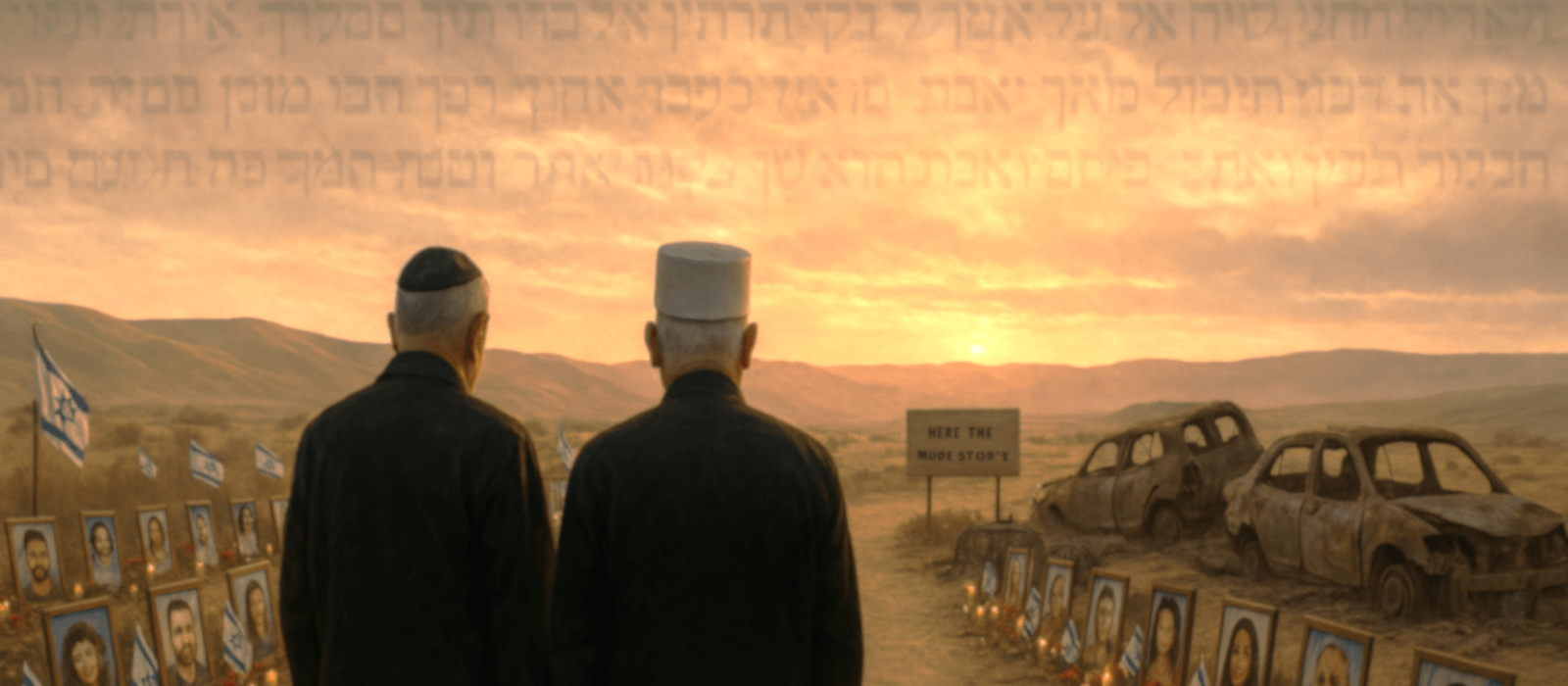
October 20, 2025 – The Nova Festival Memorial – A National Day of Mourning
The wind was low but steady, rustling the rows of photographs that lined the memorial site. Some were pinned to the wooden posts that once held festival banners, now draped in black and blue ribbons. Others were printed on placards, their laminated surfaces reflecting the midmorning light. Along the edge of the open field, young trees stood in neat rows, each planted by a family, each with a small plaque at its base bearing a name, a date, a fragment of a life. Near the entrance, metal sculptures in the shape of red anemones rose from the ground, a permanent reminder of the flowers that once covered these fields every spring.
David and Nadir walked slowly, their boots pressing into the dry, uneven earth where two years ago, thousands had danced to music that was meant to bring joy, not tragedy. A narrow path of crushed stone now wound through the site, guiding visitors past burned-out car frames preserved behind railings, past the outline of the old stage marked by a simple wooden sign: HERE THE MUSIC STOPPED.
Now, there was no music. Just the whisper of wind and the occasional soft sob from visitors who knelt beside the makeshift shrines.
Candles – some new, some melted to the base – lined the site. Flowers, long wilted, had been replaced by fresh bouquets, left by those who still came, those who still remembered. Stuffed animals, letters, trinkets, all stood as silent sentinels to the lives that had been taken. A long stretch of fencing had been turned into a “wall of memory,” layered with flags, bracelets, and handwritten notes in Hebrew, English, Russian, Amharic – a collage of grief in a dozen tongues.
David stopped in front of a wall where a collage of photographs had been placed – each face frozen in time, each name followed by a story.
He scanned them, his eyes lingering on the brief biographies scribbled beneath.
Lior and Yael, engaged the week before, murdered as they held hands.
Avi Ben-David, a musician who never got to play his final set.
Sergeant Maya Tal, 23 years old, died shielding three festival-goers from gunfire.
Eden Rahmani, 19, a medic who refused to leave the wounded, executed by terrorists.
So many. Too many.
David exhaled, the weight of the stories pressing down on him. His hands trembled as he reached out, running his fingers over the edges of one of the photos, as if somehow, by touching it, he could restore what was lost.
“This was supposed to be joy,” he muttered. His voice was low, barely more than a whisper, “Music. Life.”
Nadir nodded beside him, his usual smirk absent, “And instead, it was slaughter.”
They stood there for a long time, reading story after story, absorbing the enormity of the loss. The silence was deafening.
Then, a balloon broke free from one of the makeshift memorials, lifting slowly into the sky. Its silver surface reflected the sunlight, twisting and turning as it ascended.
Nadir watched it go, his eyes tracking it as it floated higher and higher, until it was just a speck in the vast blue expanse above them.
His voice was low, reflective, “Hashem gave us a rainbow once, David. But I don’t know how much longer He’ll tolerate this.”
David didn’t look away from the photos. His jaw tightened.
“The rainbow meant no flood,” he said quietly, “He never said anything about fire.”
The balloon disappeared into the sky.
David and Nadir stood in silence, surrounded by names, faces, and memories. The war was over. The hostages had come home. And yet, there was no peace.
Not for Israel.
Not for them.
And certainly not for the dead.
☼ ☼ ☼
Used with permission by the author. Find the author’s complete works online: Complete Works of Mack Samuels