
Scripture References: Psalm 122; Ecclesiastes 3; Zechariah 12; Matthew 24
5748 AM (1988 CE)– INTIFADAS
Due to the lateness of the hour, the Halevi home was quieter than usual, but the tension in the air was thick. The television screen flickered with grainy footage from Gaza – streets choked with smoke, masked teenagers hurling rocks and Molotov cocktails at IDF soldiers. The banner at the bottom of the screen continuously scrolled, “1988 Uprising in Gaza: The First Intifada?”
David sat forward on the couch, his hands clasped tightly. His children were asleep, Rivkah had long since gone to bed, but he couldn’t stop watching.
At the dining table, Nadir poured himself another cup of tea, his expression unreadable. The only sound was the news anchor’s grim voice narrating the footage.
“This is not a conventional war. Palestinian youths, armed with nothing but stones, face down Israeli soldiers in what is being called an organic, leaderless rebellion. The Israeli government calls it an act of terror, but among the Palestinians, it is being hailed as the first step toward liberation.”
David muted the television.
“They’re calling this a war?” He scoffed, shaking his head, “This isn’t war. This is madness.”
Nadir took a slow sip of his tea, “It’s war, David. Just not the kind we’re used to.”
David turned toward him, his voice sharp, “Since when is throwing rocks a war?”
Nadir exhaled through his nose, leaning back in his chair, “Since the day a child throws a rock, and a soldier shoots back.”
David felt his gut tighten, “We don’t shoot children.”
Nadir’s eyes flickered toward him, “Don’t we?”
David’s jaw clenched, “You think the Arabs are innocent?”
Nadir shook his head, swirling his tea absentmindedly, “No one’s innocent. That’s the problem.”
David turned back to the television. The footage had shifted to an interview with an Israeli commander stationed in Gaza. His face was weathered, his uniform dusty.
“We’re doing what we can to restore order, but this isn’t like fighting an army. It’s chaos. The enemy isn’t wearing uniforms. It’s children, teenagers, shopkeepers – throwing rocks by day, planting bombs by night.”
The camera cut to footage of an Israeli jeep engulfed in flames, smoke rising into the sky.
David sighed, rubbing his temples, “We’re going to lose either way. If we hold back, we lose control. If we respond with force, the world calls us monsters.”
Nadir smirked, “Sounds like Israel’s usual position.”
David shot him a look, “And what’s your position, then? You’re in intelligence now. What does the Shin Bet think?”
Nadir didn’t answer immediately. He leaned forward, setting his tea down. His voice was quieter when he spoke.
“Officially, the Shin Bet thinks the Arabs are done waiting. The PLO failed them. The Arab League failed them. And now, they think they can force the world to care about them.” He glanced at the muted television screen, “Unofficially, these very groups are likely behind it all – the unrest, the violence. But what can be done? What can we do? From the looks of it, it seems that there are Palestinians more than happy to play their part in the theatrics.”
David let out a long breath, “Then what’s the solution?”
Nadir chuckled, “David, my friend, if I knew the solution, I wouldn’t be sitting here drinking tea with you.”
David didn’t laugh. He just stared at the screen, at the masked teenagers throwing stones at a tank.
“Where does this end?” he asked.
Nadir’s smirk faded, “Where it always does. But it’s late. I’m gonna take off. We both have work tomorrow, and traffic to Jerusalem is always a nightmare.”
David sat another moment in his despondency, “Alright, Nadir. Believe it or not, you were helpful. I appreciate you, brother.”
“And I you,” Nadir replied, as he got up off the couch.
☼ ☼ ☼
The next day, Nadir found himself sitting across from a man whose hands were cuffed to the chair.
The air in the Shin Bet interrogation room was thick with cigarette smoke and the smell of stale sweat. The single fluorescent bulb cast a sickly yellow light over the metal table.
The man in the handcuffs sat on a solid metal chair bolted to the ground, handcuffs interlaced at the back of the chair, where one of his arms was in front and the other in back. Neither could he get up nor sit normally. So he shifted constantly on his stationary perch, trying to relieve the discomfort.
His name was Mahmoud al-Husseini – a street leader in Hebron, caught organizing a riot that left two Israeli soldiers dead. His face was bloodied, his left eye swollen shut.
Nadir flicked the ash from his cigarette onto the floor, “I don’t have all night, Mahmoud.”
The man glared at him, spitting onto the floor between them, “You disgust me, you kha’in! You traitor.”
Nadir exhaled slowly, his patience thinning, “I’m not a traitor. I love my country, and my country loves me.”
“You work for them,” Mahmoud snarled, “You sell out your own people. You’re a lapdog of the Jews. Just a dhanab.”
Nadir’s expression didn’t change, “I have a secret to tell you, Mahmoud, I am Druze. You have killed as many of my people as you have the Jews over as many centuries. Pretend all you like, but you have never considered us one of you, nor will you ever.”
Mahmoud spat again, “But you are still of this land! You should be with us!”
Nadir leaned forward, “You don’t say? My family has been in this land long before you or the Turks or the Ottomans. I know thuggery and bullying tactics. It’s a sign of cowardice. Every one of you who blows himself up to kill others is a coward. Can’t look your victims in the eyes. Can’t live with the guilt.”
Nadir stared directly into Mahmoud’s eyes, at least the good one. He probed and studied his every feature with great intensity. Mahmoud, on the other hand, struggled to keep eye contact, looking around, anxious.
“So,” Nadir continued after several awkward minutes had passed, “not an Arab like you. But let’s say I was with you. What would you do if I was? If I dressed like you, wore your colors? You wouldn’t trust me. You wouldn’t let me lead you to a better life. The fact is you are afraid to live because you are cowards. I am not sure you would even know how to live, if it wasn’t for your self-inflicted prison camp – my bad, refugee camp – that takes care of your every need. Anyway, you’d still call me a dog behind my back.” Nadir flicked his cigarette onto the floor, letting it smolder, “So don’t talk to me about brotherhood.”
Mahmoud’s jaw tightened, “You are nothing, Nadir Haddad. You are a tool. When they are done with you, they will throw you away.”
Nadir let out a dry chuckle, reflecting on his years of service and sacrifice that not only contributed to the greatness of Israel, but had been publicly acknowledged many times with more medals than he could ever wear on his dress unis. “Funny,” Nadir continued, “I was going to say the same about you.”
Mahmoud’s breathing was ragged, his body stiff with defiance. But behind his anger, there was, indeed, something else, and Nadir saw it as plain as his swollen eye – fear.
Nadir stood up, smoothing out his uniform, “Okay, then. I am going to let you stew for a bit. You’re going to tell me what I need to know. Maybe not tonight. Maybe not tomorrow. But you will. You will talk. Everybody talks. It’s just a matter of time. It’s just a matter of how long you want to be imprisoned in this hellhole of a facility. Hope you like Leonard Cohen.”
Nadir opened the door to leave. Stepping out, he turned back to Mahmoud, pausing just before stepping out, “But here’s the thing, Mahmoud, when you do talk, I won’t be judging you. You’ll still be a proud Palestinian, and I will be a proud Israeli.” Nadir paused thoughtfully, “But me? In your eyes? I’ll still be the traitor … Hmm.”
Waiting just a moment longer, eyes locked with Mahmoud, Nadir smiled and then slammed the door shut behind him.
☼ ☼ ☼
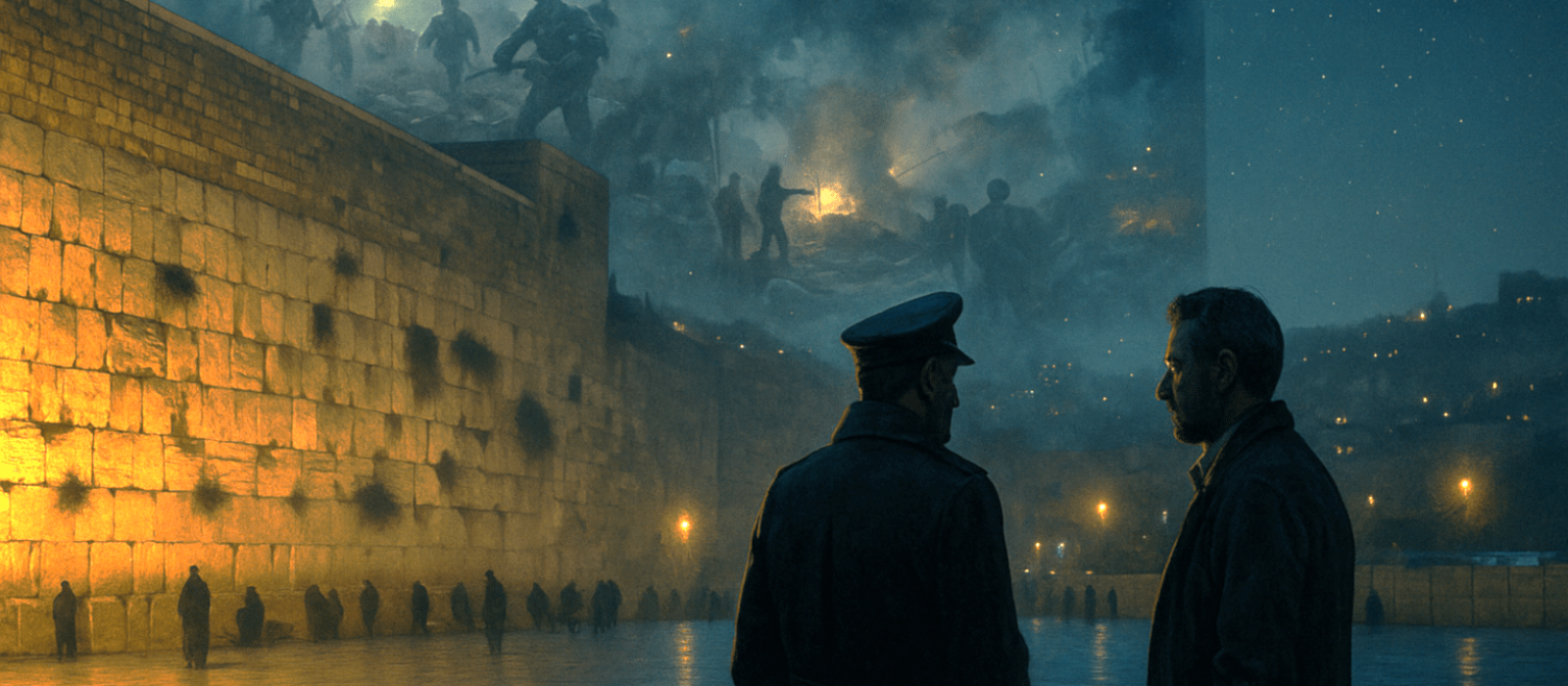
It was late at night. The Kotel HaMa’aravi, the Western Wall, was nearly empty, save for a few men whispering prayers. David stood with his hands in his pockets, staring up at the ancient stones, “How do we stop this, Nadir?”
Nadir stood beside him, arms crossed, “We don’t. We can’t. How could we?”
David turned his head, “Then what’s the point?”
Nadir smirked, “What’s the point? Survival. The survival of the Third Temple. Israel’s survival. Our survival.”
David scoffed, “You sound like my father.”
Nadir chuckled, “And you sound like a man who still believes this all somehow can end in peace.”
David looked away, “You don’t?”
Nadir exhaled. He looked up at the stars, blotted mostly out by the many city lights, “I believe in reality, David. And reality is ugly.”
They continued standing in a long silence, the weight of the city pressing down on them. After a while, David finally asked, “When does survival become something worse? When, Nadir, when does it come to a point when we lose our souls to survive?”
Nadir didn’t answer. And that, David realized, was the real problem.
☼ ☼ ☼
The streets of Jerusalem weren’t what they used to be.
David drove slowly through the city, past shuttered shops and streets still scarred from riots. Scorched black marks on the walls, shattered glass glinting in the gutter. The aftermath of another long night. Another round of Molotov cocktails. More death.
The radio hummed with a news update, the anchor’s voice carrying that same rehearsed, detached professionalism, “Prime Minister Yitzhak Shamir has reiterated Israel’s position, calling the Palestinian uprising an orchestrated campaign of terror. Meanwhile, international pressure continues to mount, with the UN condemning Israel’s use of force in the territories—”
David switched it off. He’d heard enough. He’d certainly heard it all before.
Nadir, sitting in the passenger seat, glanced at him, smirking, “Gonna throw the radio out the window next?”
David sighed, gripping the wheel tighter, “What’s the point of listening? It’s the same thing every day, and I just get so irate about it.”
Nadir snorted, “Fair enough. Pace yourself. Remember that, unlike war, peace is not just gonna break out overnight.”
David didn’t answer. He kept driving.
They pulled up to a security checkpoint near the Old City. It wasn’t their usual post, but things were different now. The Shin Bet had warned of increased threats – suicide bombers, cells moving explosives across the Green Line.
David stepped out of the truck, adjusting his rifle strap. He wasn’t in uniform, but the soldiers manning the checkpoint recognized him.
“Lt. Col. Halevi, sir.” One of the younger men gave a quick salute. His eyes flicked to Nadir, “And – uh, sir?”
“Nadir Haddad,” David answered for him, “Shin Bet.”
The soldier hesitated. Nadir smirked. He could always tell when someone was uncomfortable around him. To them, he was an enigma. A Druze officer working intelligence, sitting somewhere between Israeli and Arab, trusted but never fully embraced. How could such a thing ever have happened?
David interrupted the obvious ponderings of the soldier, “What do we have?”
The soldier’s face darkened, “Intel says a man from Nablus is coming through today. Possible explosives. We’ve been stopping every car and screening pedestrians.”
David scanned the checkpoint. The usual. An IDF armored jeep. A small crowd of Palestinians waiting to cross, along with a long line of cars. Plus, Israeli soldiers looking exhausted. Cars were being emptied and checked. Mirrors on poles were used to look under the vehicles. Everyone’s belongings were being rummaged through.
Then, he noticed a man at the back of the line. Something was off. He was sweating, even though it was a cool morning.
David’s stomach tightened.
“Nadir,” he muttered.
Nadir had already seen him. His sharp eyes followed the man as he shuffled forward, looking around nervously. A heavy jacket. Too heavy for the weather.
“Possible bomber,” Nadir whispered.
David stepped forward, hand raised, “Stop!”
The man froze.
“Lift your shirt,” David commanded, as he pointed his rifle at the man who stopped, the other soldiers followed suit, aiming their own rifles at the potential bomber.
The man didn’t move.
David took another step forward, his heart pounding, “Lift up your shirt! Do it now!”
The man’s eyes darted left, then right. His breathing picked up.
And David knew.
He knew.
“Everyone DOWN!” David shouted, pulling the soldier and Nadir down behind a vehicle.
The explosion tore through the checkpoint.
☼ ☼ ☼
When David came to, the sky was spinning. His ears were ringing. Something heavy was on his chest – Nadir’s arm.
Nadir groaned, rolling off him, clutching his shoulder, “Shekhet…” he muttered, cursing under his breath.
David forced himself up. Smoke. Blood. Distant screams. Almost everyone in line was dead. Several soldiers were down. The checkpoint was in ruins. Vehicles near the bomber were ablaze. Bodies lay scattered everywhere. Few were moving; most were not. The armored jeep was a twisted wreck.
David staggered forward, grabbing the first injured soldier he saw. “Medic!” he bellowed.
Nadir was already moving, his face grim. He knelt beside a man missing half a leg. He whipped off his own belt and applied pressure to stop the bleeding.
The sirens came quickly. The medics even faster. But there was no way in this hot holy hell that the medics could ever arrive quickly enough.
☼ ☼ ☼
Hours later, David sat on the steps outside a Jerusalem hospital, his hands and clothes stained with soot and blood. Nadir lit two cigarettes and handed David one, his own hands shaking slightly.
“Over a dozen Palestinian civilians dead,” he said flatly, “and three of our soldiers. More wounded than I can even count. They don’t even hesitate to kill their own.”
Silence stretched between them.
Finally, Nadir took a slow drag of his cigarette and exhaled, “So, what do you think now, David? You still wanna talk about choices? You think that man woke up this morning and had a choice?”
David didn’t answer. He just didn’t know anymore.
☼ ☼ ☼
A few days later, David sat at his father’s bedside. They had taken him to the hospital, then to hospice. Now, Yitzhak lay in the same bed he had shared with his wife for nearly a lifetime, the same bed where she went to sleep years ago and woke up in the arms of Hashem.
Yitzhak’s breath was labored, his skin pale. The old man had fought four wars, outlived countless friends, buried his wife – and yet, somehow, this felt like the end of an era. Yet, David did not want to let go. He could not let go.
Tears burned long, slow streaks of sorrow as they overwhelmed his stoic attempts. David hadn’t talked to his father about the bombing. What was the point? He already knew. The whole country did.
Yitzhak turned his head slightly, “Did you stop it?”
David swallowed the lump in his throat, “Stop it? What do you mean?”
His father sighed, “The intifada.”
“Ah, no, Abba,” David replied, his voice broken and strained, “I … I think Hashem will have to step in. I just … I just don’t know.”
Yitzhak closed his eyes, “Then what’s left, David? What’s left for us? What legacy will we leave our children, if not a place of refuge and hope?”
David could not answer, his tears like the mighty Jordan in spring.
And then Abba was gone.
☼ ☼ ☼
The funeral was simple. Family. Friends. A handful of old war veterans, standing stiffly in their worn uniforms.
Nadir stood beside him as the last shovel of dirt was placed over the grave. He didn’t say anything, didn’t offer condolences. He just stood there.
Later, as they sat in David’s kitchen, the smell of Rivkah’s cooking filling the house, Nadir finally spoke.
“He never knew peace,” he said, “not once in his whole life.”
David nodded, “Neither have we.”
Nadir let out a bitter chuckle, “You sound like me now.”
David exhaled, “Maybe I’m starting to understand you.”
Nadir took a sip of his tea, then asked, “Hopefully not at the cost of your soul.”
David stared into his cup, his reflection wavering in the dark liquid, “I dunno.”
☼ ☼ ☼
December 31, 1999 – New Year’s Eve.
The intifada had faded into the recesses of suppressed memory for many. Recent years had been pleasant, dare one say even mostly peaceful. Mostly.
The Halevi home was unusually lively for a winter night. Not for any particular reason – at least, not one that Rivkah would acknowledge – but because Nadir had shown up unannounced, grinning like a fool, carrying a bottle of Arak and a small radio blasting dance music from some Tel Aviv station.
“David, we are saying goodbye to the 20th century, my friend!” Nadir announced, kicking off his boots at the door.
David, who had been reading by the fireplace, barely looked up from his book, “Good riddance.”
Rivkah, passing through the living room, gave Nadir the look, “We don’t celebrate New Year’s, Nadir. We celebrate Rosh Hashanah.”
Nadir put a hand to his chest, mock-offended, “And yet, here we are, at the dawn of the Year 2000, about to enter a new millennium! The world is moving forward, Rivkah! You can’t just ignore it!”
Rivkah sighed, shaking her head, “I assure you, I can.”
Nadir turned back to David, grinning, “Come on, tell me you haven’t at least heard about the Y2K bug. The entire world is convinced that at midnight, every computer will crash, planes will fall from the sky, and we’ll be sent back to the Stone Age.”
David finally looked up, his expression dry, “And this concerns me why?”
Nadir threw his hands up, “Because if it happens, you’ll regret not having had one last drink before civilization collapses!”
David smirked, “If the world collapses, I’ll need a drink after, not before.”
Miriam, now in her twenties and rolling her eyes at the entire exchange, walked into the room, “You know, Ima, most normal people are actually celebrating tonight.”
Rivkah placed a hand on her hip, “Then I suppose you’ll be leaving to go join these ‘normal people’ of whom you speak?”
Miriam hesitated, “Well, uh…”
Leah, sitting at the kitchen table with her own smirk, “Busted!”
Miriam shot her a look, then turned back to her mother, “I mean, some friends from the university are throwing a small thing at the pub. Just a quiet gathering… more or less.”
“Mm-hmm,” Rivkah murmured.
David glanced at Rivkah, “You’re going to say no, aren’t you?”
She sighed, “What do I look like, some kind of secularist?”
Nadir gasped dramatically, “David, she just insulted my entire existence!”
David chuckled, finally closing his book, “Miriam, go. But be smart, take Leah with you, and don’t come home at some ungodly hour.”
Miriam beamed, kissed her father’s cheek, and disappeared down the hall to grab her coat.
Leah stared with faux contempt, grabbing her own jacket, “Fine. I can babysit.”
Rivkah crossed her arms, “I’m officially outnumbered in my own home.”
“Welcome to democracy,” Nadir quipped, pouring himself another drink.
Rivkah muttered something under her breath in Hebrew, snatched the Arak bottle, and stashed it on the highest kitchen shelf, where Nadir couldn’t reach.
Finishing his drink, Nadir set the glass down. “Oh, I see how it is,” he quipped.
Rivkah left for her bedroom, but not before going over to David and kissing him goodnight on the forehead. “I’m going to bed. Please, don’t get into trouble with this one tonight.”
After she left, Nadir turned to David and implored, “So, are your sore bones up for a walk?”
☼ ☼ ☼
Outside, Peki’in hummed with quiet excitement. It had grown from a small village into a proper town – bigger, busier, and David had noticed every change. The energy in Peki’in tonight was nothing like it would be in Tel Aviv, though considerably more than in Jerusalem, where Nadir and David spent most of their time these days.
In Tel Aviv, the streets would be alive with music and fireworks. In Jerusalem, the hotels in the western parts of the city held elegant parties for diplomats and secular Israelis. Russian immigrants gathered in private homes, celebrating Novy God with decorated trees, food, and champagne.
Though in Mea She’arim and the religious neighborhoods, the streets would be quiet. The Ultra-Orthodox paid no mind to the Gregorian calendar, and most synagogues would have their regular Torah study sessions – as if it were any other night.
Yet here, in Peki’in, there was something in the air. The promise of a new millennium.
They walked through the winding streets of their childhood, passing old houses now surrounded by new ones. Security had been tightened, just like in every Israeli town and city. The intifada had ended, but peace was always fleeting.
“You know,” Nadir mused, kicking at a loose stone, “if we were in Tel Aviv right now, we’d be drunk and dancing in the streets.”
David smirked, “Which is why we’re not in Tel Aviv.”
Nadir exhaled, “Come on, David, doesn’t it feel strange? The entire world is celebrating, and here we are, just… pretending it doesn’t exist?”
David shrugged, “The entire world also ate pork for dinner. Should I be mourning that too?”
Nadir laughed, “Alright, fine, I get it. But it’s still a new century. Doesn’t that mean anything to you?”
David glanced up at the stone houses lining the streets, “Not really. This land has seen empires rise and fall for thousands of years. What’s one more millennium?”
Nadir studied him for a moment, then smirked, “And yet, you’re here with me. Instead of in bed with Rivkah, like a good Jewish husband.”
David sighed, rubbing his temple, “You’re exhausting, you know that?”
Nadir grinned, “I do, yes.”
The distant sound of fireworks echoed from the center of town. A new year. A new century. A new millennium.
But for David, Nadir, and the rest of Israel, the struggle remained the same.
Nadir checked his watch, “Well, happy New Year, my friend.”
David smirked, “Mazel tov.”
And just like that, the 21st century began.
☼ ☼ ☼
The new year didn’t change much.
David split his time between his work at military command and advising the Shin Bet – if only to spend more time with Nadir and keep him out of trouble. Together, they watched terror networks evolve.
The intifada had faded, but something else was coming.
One evening, as the sun dipped over the Western Wall, David and Nadir sat on a bench, watching tourists press their hands against the ancient stones, whispering prayers.
David exhaled, watching the last golden light fade, “You feel it too, don’t you?”
Nadir, ever restless, tapped his foot, “Yeah. You could cut it with a butter knife.”
Silence.
“Any chance we’re wrong?”
Nadir chuckled dryly, “David, when have we ever been wrong?”
David sighed, staring up at the sky, “There always could be a first time.”
☼ ☼ ☼
Used with permission by the author. Find the author’s complete works online: Complete Works of Mack Samuels