
Deut 32:35 (“Vengeance is Mine”); Lev 24:19–20 (eye for eye); Exod 12:15 (remove chametz); Prov 10:12; Mic 6:8; Ps 122:6–9
3682 AM (78 BCE) – THE UNCIVIL WAR
Her name was Leah, one of the many granddaughters of Shimon.
Their well-attended wedding was as memorable as it was overwhelming to Micah. It was an obligation of everyone there to forget about the libation massacre from the weeks before and enjoy themselves … even if only for the evening.
It was difficult for Micah at first, but Leah was a scholar of sorts, as much as was permitted by the Pharisees. The followers of Shimon knew that Micah would need his wife to be able to engage with him intellectually. Leah was that and much more.
Leah worked hard to build the family, both in number and in integrity. Within what would seem like only a few short years, they celebrated two kids, with a third on the way. Leah turned out to be as much a comfort as she was a joy. And, in many ways, she reminded Micah of Shimon. There were differences, of course.
Leah was quiet, but would always share her opinion when asked. She was amiable, but still had expectations for Micah of study and teaching. On the occasions when Micah did not feel like studying, for whatever reason—grief, sadness, whatever—Leah was always quick to remind him that she could study in his place, and he could keep the household running.
Thus, Leah helped Micah push through his obstacles, often of his own making, to become the leader she knew her grandfather to be, for Micah was pushed to take a more and more prominent leadership role in the Pharisaic community. And that was incredibly important, as the condition of liberty and respect for the Pharisees in Jerusalem was at an all-time low.
How could it be that the City of David would treat the Pharisees thus? Almost like second-class citizens, but not quite. Micah saw to it that they were represented in the Sanhedrin, and that things would go on as cordially as possible. And, unlike Shimon, Micah did not have quite the intolerable temper, mainly because of Eliora.
Whenever he would be discussing issues with the Sadducees, and they were being obviously obstinate, he would remember his discussions with Eliora, and how he would be patient and listen to her, even when he didn’t agree with her, for her sake alone and for no other reason. Certainly, he could give the Sadducees a similar courtesy.
After all, bloodshed appeared to be the only alternative. Micah pleaded with the Pharisees to be patient and wait, not to engage in violence or retribution, since vengeance belongs to Hashem alone. Yet, it seemed that petty street violence from both sides was on a steady increase.
What Micah could not grasp is why.
☼ ☼ ☼
In the shadows of Jerusalem, near the site of the Temple Mount, there are whispers that echo softly through the night. These whispers come from voices deep below the light of the moon, mingling its light with the many flickering torches along the streets. Long after the moon has moved on, and the torches have gone out, the voices remain.
If you were skilled enough to gain access to Hezekiah’s Tunnel, which was an attempt to withstand the ancient Assyrians’ siege centuries before, and you knew what you were looking for (and you were, perhaps, small enough), you could also gain access to a secondary tunnel beneath even that. This tunnel would connect you to a series of tunnels that ran the width and the breadth of Jerusalem.
Through the years these tunnels were created and collapsed, dug out again and filled in. Sometimes the intent was escape routes or emergency storage, or in some cases, preservation of significant artifacts of Judaism. These tunnels integrated with limestone caves even deeper still beneath the Temple, where many have explored and were never seen again.
It is here we find the source of the whispers, that drew us to these depths, speaking to a crowd of people, “Because, if we let up, and we let things get back to the way they were, nothing will get resolved. We have to keep up the pressure, especially on Jannaeus. We have to keep him off-balance and always playing catch-up.”
Baruch ben Uri was speaking. He spoke the wishes of Eli. Eli was responsible for organizing this group, except nobody knew who Eli was, except for Baruch ben Uri. And nobody really knew who Baruch ben Uri was, except that he was a Pharisee. But it did not matter. This group was not going to let Jannaeus kill six thousand of their brothers and allow it to go unaddressed.
What was for sure was that Eli and Baruch were well funded and well-armed. Everyone spent their time training for military conquest in these underground tunnels. Most had walked away from their lives, which had been destroyed. Everyone there had lost someone dear. But Eli and Baruch made it clear that they were not out for revenge, but true social justice.
And that would start with the head of Jannaeus.
☼ ☼ ☼
Jannaeus stormed into the Sanhedrin, “They are at it again!”
“Who?” Zadok asked.
“The Pharisees!” Jannaeus answered in a torrent of exasperation.
Zadok looked to young Micah, who stood and replied, “King Jannaeus, I am not sure what you have heard, but those Pharisees in this city are not concocting some grand plan or scheme against you. Why would we? I assure you, six thousand lives were certainly enough.”
Micah’s expression was flat, and his tone was flat. But then he let out a sigh, “But, ok, for argument’s sake, what have you heard?”
The anxiety on the face of Jannaeus eased a little, and he almost seemed grateful to Micah.
“Yeah, ok,” Jannaeus began, “Well, one of my aides reported that a strange man dressed like a Pharisee, covered with his prayer shawl so that his face wasn’t visible, stood just behind him at morning prayers, and whispered something ominous.”
“Ominous?” Micah repeated, “What exactly?”
“The man said, ‘Spring is near, and it is time to remove the chametz from the Temple.’ My aide turned around, but the man had walked away and disappeared with everyone else.”
“So, you think he is calling you chametz, yeast, and it was definitely someone dressed like a Pharisee.”
“It was a Pharisee!” Jannaeus blurted.
“It was someone with a prayer shawl. It could be a political enemy trying to sow strife. It could be anyone,” Micah corrected.
“Including a Pharisee,” Jannaeus added.
“Including a Pharisee,” Micah finally agreed. Micah whispered to one of his own aides, who went scurrying away. Looking back up, Micah sighed, “I will get to the bottom of this. If it is a Pharisee, or Pharisees, I will end it.”
“No,” Jannaeus responded, “you will hand them over to me.”
Micah shook his head, “I cannot do that.”
“Why?” Jannaeus barked.
“What do you plan to do with them?” Micah inquired.
“Put them down like the dogs that they are!” he spat.
“Which is why I cannot do that. Unless you want a civil war. I don’t know what else to tell you. We need to reduce the tension, get things back to normal. Pharisees may not like you, but they need to trust you as their king. Or, well, there will be nothing I or anyone else can do. Handing you people over to kill is just not on the table.”
“Are you trying to negotiate with me?” Jannaeus sounded most offended.
“Respectfully, yes, my king,” Micah said, with a slight bow, “if only to save life—mine and yours.”
“That is unreasonable! I am the king!” Jannaeus once again retorted.
“Yes, you are—the King of the Jews. All the Jews, which includes the Pharisees.”
☼ ☼ ☼
Micah was sleeping with Leah next to him, and his children piled high and deep on top of them, when he was startled awake by screams from outside. He quietly got up and put on some basic attire to see what the ruckus was about. As he left his home, other Pharisees joined Micah, if only as a measure of protection for their teacher.
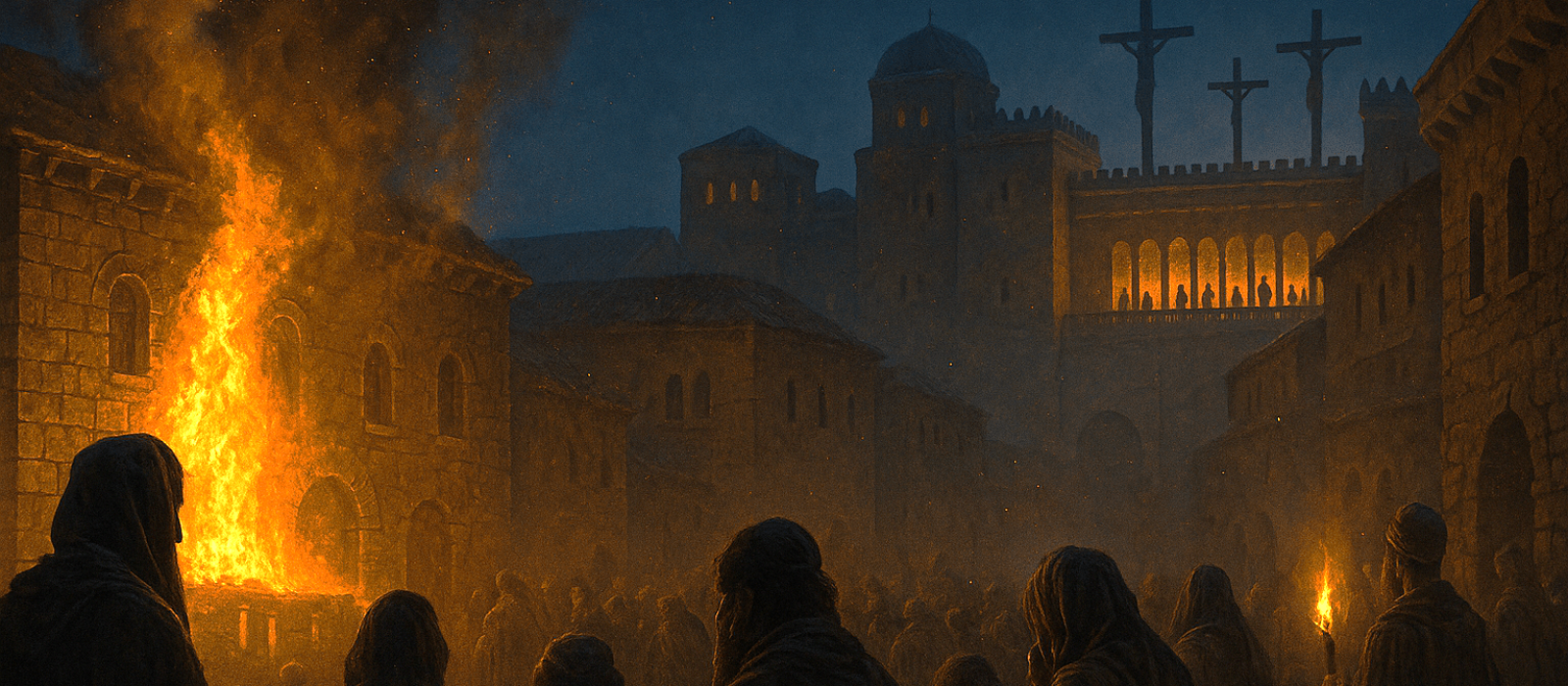
The sounds were distant, but the light from flames could be seen. It was coming from the Sadducean district, near the royal palace. Micah rushed to see what the matter was. Soon, the flames came into view. It was the Sadducean archive. Mostly made of hewn stone, it was ablaze. Not only did it keep the many minutes of their meetings, but also the genealogical archives for the Sadducees.
Micah was aghast. As he got closer, the smell of burning parchment tainted the air. Micah could see efforts well underway to get the fire under control. But as he looked at the side of the building, he was even more aghast at what was written on it, “She’ol ha’esh leTzadokim.”
Which means, “The fires of Sheol await the Sadducees.”
Micah stood so dumbfounded that he did not notice someone standing next to him.
“Do you believe me now?” a voice offered.
Micah looked. It was Jannaeus.
☼ ☼ ☼
The light of the next morning showed the resulting devastation. The building was salvageable, but nothing in it was. Micah spent the morning with his community pleading with them for any information and imploring them not to be a part of such acts.
“This will lead to certain death for many! Please!” Micah would plead.
As the day wore on, Micah’s responsibilities required him back at the Sanhedrin. As Micah walked in, the session was already underway. The speaker abruptly stopped as Micah came in.
“Curious,” Micah thought to himself. But then he heard Jannaeus’ voice again.
Jannaeus’ voice was slow and malevolent, “Eye for eye … tooth for tooth … hand for hand … foot for foot …” As he spoke, he left a long pause between each, “Burn for burn … wound for wound … stripe for stripe … and a life for a life … and maybe more.”
The hair on Micah’s neck stood on end. He did not like where this was going.
“Let your people know: this will not be tolerated.”
Micah was stunned, having no reply.
“Do you need an invitation? Go! Tell them now,” Jannaeus rebuked.
Without a word, Micah turned and left.
☼ ☼ ☼
“Really?” Leah said, as Micah was explaining things to her. “But surely, he has taken it out of context. Surely he knows that?”
“I am sure he does,” Micah said.
Micah did not know what to do when leaving the Sanhedrin, so he went home. Leah was more than excited to see him and find out what was going on.
“But we have to find out who is doing this, or things will escalate.” Micah ran his hands through his hair. “But nobody knows, or nobody is saying anything. I thought people respected me.”
“They do respect you,” Leah affirmed. “They do.”
“But?” Micah probed.
“But? But nothing. They respect you. No buts. You have more than met the community’s expectations. Shimon was right in choosing you as an apprentice all those years ago. He chose well. He saw something in you that was unique and special and, well, like Hashem. Have you considered asking Hashem?”
“Yeah, but He’s not really speaking to me at the moment,” Micah said with a little levity.
“Perhaps,” Leah suggested, “you are not asking the right questions?”
“The right questions?” Micah wondered. “Like, dearest Hashem, please tell me who is bombing the Sadducees?”
“Could it hurt?” Leah answered.
Micah was about to reply, but then just shrugged an OK.
☼ ☼ ☼
The numbers in Eli’s group were growing daily and numbered in the tens of thousands. Many stayed topside, so as to be able to feed information and so that not too many would be missed. Eli’s group now consisted of over ten thousand, with a few thousand dwelling beneath the city.
“Eli was pleased with the result of last week’s raid. Tonight, we have something even bigger planned. I need fifty volunteers. We are going to hit the armory.”
☼ ☼ ☼
“Well? Did you ask?” Leah said to Micah as they were just waking up and still in bed.
“You mean Hashem?” Micah responded. “Honestly, yes, but it felt kind of weird. I asked that He stop this and reveal who was doing it.”
“Oh, wow, OK,” Leah murmured.
“What?” Micah was bewildered by his wife’s response.
“You realize Hashem is all-powerful,” she started.
“Yeah, and?” Micah raised an eyebrow.
“I don’t know, just—be careful what you ask for.”
☼ ☼ ☼
It was morning prayers at the Temple wall, and Micah was leading the services. They prayed and petitioned. Micah felt close to Hashem. As they wrapped up and the crowd began to disperse, an aide from Jannaeus appeared before Micah and summoned him to the palace.
Obediently, Micah followed. The aide walked Micah directly to Jannaeus, who was discussing with senior military officials as Micah walked in. With a nod, Jannaeus dismissed them and waved for Micah to approach.
“Well?” Jannaeus started.
“Well?” Micah responded.
“Do you have anything to say?” Jannaeus continued.
“Oh, about the mysterious fire?” Micah offered. “I know it has been a few weeks, but, honestly, I am getting nowhere on that. Either people don’t know or won’t say.”
Micah’s tone was helpful and constructive, offering an honest report of his current status.
“I am not talking about the fire,” Jannaeus said. “I am talking about last night.”
“Last night?” Micah asked. “Something happened last night?”
He said that more as a statement than a question.
“Yes, something happened last night, but it has been dealt with.”
Jannaeus let his words hang in the air. Faint wails of anguish could be heard from outside. Micah half-turned to listen. It was women wailing in mourning.
“Severely,” Jannaeus added, capturing Micah’s attention.
“What? What is it? What happened? What have you done?” Micah grilled the king. He could not understand.
“Don’t you know? Well, let me enlighten you.”
Jannaeus turned and began to walk out. Micah followed. They went to a balcony where the king could address the plaza below. To Micah’s horror, there were dozens of crucifixes, each with a Pharisee dead on it. People filled the streets, wailed, and tore their clothes.
“What is this?” Micah demanded, holding to the railing of the balcony, if only to steady himself. “What have you done?”
Jannaeus just rolled his eyes and addressed the plaza, “Life for life, wound for wound. These men tried to break into the armory last night. We stopped them. This is what happens when you defy your king and high priest.”
Jannaeus turned to Micah, who was weeping.
“Please,” Jannaeus said with contempt, “you are still going to claim ignorance?”
Jannaeus observed Micah to see if, indeed, this was a ruse. He could not tell for sure, but he was satisfied enough.
“Ok, look,” Jannaeus offered, “help me find them. Let’s end this without any further bloodshed. We tortured them all, and nobody gave us anything, except one name—Eli. But there are ten thousand Elis in Jerusalem. So that’s not helpful. I don’t care if you turn them in or not, just get them to go away. We can call it even.”
Tears made it hard for Micah to see, grief made it hard for him to focus. “You don’t know what you have done. You have no idea.”
☼ ☼ ☼
It was late by the time Micah had coordinated the burial of everyone. They did not have time to give them proper burials. Most could not be identified, and others could, but had no surviving family. Theirs had died during the libation massacre.
But everyone was in the ground by day’s end, and Micah was exhausted. He was among the last to leave and declined his usual escort.
“I just want to be alone to think,” he said.
But Micah couldn’t go home. How could he face Leah? This was horrific. Micah had sent someone to tell her he would be late, so he took the long way home. The very long way.
As he walked, Micah contemplated all that had happened, and how old he had become because of it all. He wondered what was wrong with people. He wondered what could motivate such hatred on both sides.
“Excuse me, teach,” a man said politely.
Micah looked up. In an instant, a thick, black sack went over Micah’s head, and what felt like a knife was pressed into his side. Someone quickly bound his hands behind his back and said, “Don’t make a sound. You are coming with us.”
☼ ☼ ☼
As the men led Micah along, they said nothing. Micah could not feel the impression of the knife blade, and, for the most part, they were gentle. Micah had two thoughts come to him. The first was that he would probably be very late. The second was that he regretted not having his escort.
Then they were underground, and one of his captors had a hand on his head to protect him from hitting it on the low ceiling. They led him for what seemed like hours, until, finally, they appeared in an open cavern. His captors took off the sack but left on the restraints. In front of Micah stood Baruch ben Uri.
“You?!” Micah stammered, “I thought you were dead! They told me you were dead! What is this?”
Baruch came to Micah. “You have done well, really. Some say you teach better than I ever did. I knew I saw something in you.”
“But how could you? Vengeance belongs to Hashem!” Micah cried.
“Oh, we are not out for vengeance, but we are out to depose Jannaeus. He cannot be allowed to remain king. After killing six thousand of us with the sword? And crucifying fifty this very day? Have you seen yourself? You are not exactly ceremonially clean at the moment. You are covered in their blood.”
Baruch walked behind Micah, took out a knife, and liberated his hands from the restraints.
“You were my mentor, Shimon!” Micah said, as he rubbed his wrists.
“I was,” he replied. “Shimon died that day. I am Baruch ben Uri.”
“So what do you plan to do for your next trick? Tear down the Temple? Burn all the red heifers?” Micah said, absolutely exasperated. Then he looked up to his mentor. “And who is Eli?”
Baruch flinched a bit, surprised Micah was even asking. He hesitated.
Finally, another voice answered instead, “I am Eli.”
Baruch looked back at the figure, and, again, Micah was stunned at the revelation.
The voice continued, “Shimon was not the only person to die that day or to lose family or to be tormented.”
Tears streamed from Micah’s eyes as deep sobs made their way from somewhere possibly as deep as Sheol. The two gave Micah a moment to compose himself. Micah breathed deeply and tried to slow his heart, which was racing like a galloping camel. Finally, he felt as though he could say something—anything; all he could get out was, “Eliora!”
☼ ☼ ☼
Leah woke, but Micah was not in bed. Without waking the children, she got up and looked around their modest home. He was nowhere to be found. She stepped over to her neighbor, a Pharisee who often accompanied Micah, but he told her Micah was in such a state last night, and, well, with everything that happened, he wanted to walk home alone.
“And you let him?” Leah asked.
“Well, I mean, you know Micah. Besides, not only could he take care of himself, I could not imagine he would be in any danger. Certainly not from the Pharisees, and obviously he is in good graces with the King. So, I can’t imagine what happened to him. Relax. He will show up.”
☼ ☼ ☼
Micah went over to Eliora. “You are alive! I don’t understand. What is all this?”
They talked like old friends, picking up as if they had just witnessed the latest of spats at the Sanhedrin, and they were picking up scrolls from the floor.
“Therapy,” she said with a chuckle. Then in a most serious tone, she added, “Ezra did not make it. He was trying to protect some Pharisees, and, well, it cost him his life. I was destroyed. They sent me to the edge of the city and married me off. I thought about ending my life, but I decided to start a revolution instead.”
Micah was trying to track her words. Everything she said alternated between a punch in the face and a punch in the gut. He could hardly breathe, and he was in so much pain.
“I don’t want civil war, you know?” she said with a smile. “But I want civil war,” she said sternly.
“Eli?” Micah asked.
“Who would follow some foolish young rich girl?” Eliora said with a smile.
“Debora?” Micah answered.
Eliora touched his face and smiled. Then she stepped away.
“So, what now?” Micah asked.
“The same. Civil war. It has to be,” Eliora said, with a heavy heart.
“Which is why you tried for the armory,” Micah added, as the pieces were falling into place in his mind.
“It would have helped,” she answered candidly, “but it was not necessary.”
Micah listened to her tone. “You knew they would be caught.”
“I did. They knew as well. I knew they would be punished, but I did not know they would be executed, or I would not have sent them.”
“But why?” Micah asked in desperation.
“To foment the rebellion topside. It begins tonight.”
Panic filled Micah’s mind. He could not think.
“Why did you bring me here?” he demanded.
“To reveal ourselves, and to put an end to this. Hashem whispered to me, in His still, small voice, that it was time and to go get you. So I did.”
Micah made the connection. He struggled to believe it.
“Now you have a choice,” she continued, “you can join us, join against us, or take your family, protect them, and flee. Just know that I am doing what Hashem has sent me to do. This baseless hatred has to end.”
“Baseless hatred?” Micah repeated softly, and then looked up, realizing what she was saying. “We have to end the baseless hatred,” he agreed.
☼ ☼ ☼
After almost a decade of fighting and death, the war was over. Jannaeus stood on the balcony over the same plaza. This time, instead of just fifty crucifixes, there were eight hundred. As those eight hundred rebellious Pharisees were hanged painfully on the crosses, dying a slow, excruciating death, their families were slaughtered before them.
After almost a decade of civil unrest, Jannaeus wanted to make it crystal clear that this was his kingdom, and things would be done his way. And if he had to crucify ten thousand more Pharisees, he would. And while his brutality all but guaranteed that nothing like this would happen again, the rest of his reign would be marred by the tension present between the two sects.
Everything was in disarray. Many were slaughtered or missing. The Sanhedrin was in shambles, and the Temple struggled to function as it once did. And just where were Micah, Eliora, Shimon, and the many others who were missing? Well, many fled to Babylon. Others tried to just stay out of the way of history. Some just did not survive the carnage.
☼ ☼ ☼
A little over a decade later, we find Jannaeus lying in his royal bed, dying. He had grasped for power for so long, and yet Israel was still just as splintered as it had ever been. His brutality and vengeance accomplished nothing but shortening his own life.
As he lay dying on his royal bed, his wife, Salome, tried to comfort him, but his heart was full of pain and regret. As he looked at his wife, whom he named Queen in his place, he pleaded for her to rein in the kind of nobility that he lacked and to finally bring peace to the City of Peace.
Used with permission by the author. Find the author’s complete works online: Complete Works of Mack Samuels