
Y’shua in the Tabernacles
(Extensively drawn from David Brickner, Executive Director of Jews for Jesus)
God gave us the biblical festivals to teach all His people about His character and to help us understand His plan of salvation—whether we are Jewish or “grafted in” to the olive tree of Israel (Romans 11:17).
The Feast of Tabernacles (Sukkot) is an eight-day festival. The Gospels record that our Master Y’shua not only celebrated it, but He also took traditional elements of the celebration and applied them to His own life and mission. In John 7–8, Y’shua uses two symbols of Sukkot—water and light—to reveal who He is and what He offers.
Background from Leviticus 23
Moses instructs that the first and eighth days are special sabbaths. Over time, the seventh day became known as Hoshana Rabbah, “the Great Day,” marked by a joyous water-drawing ceremony.
The Water-Drawing Ceremony
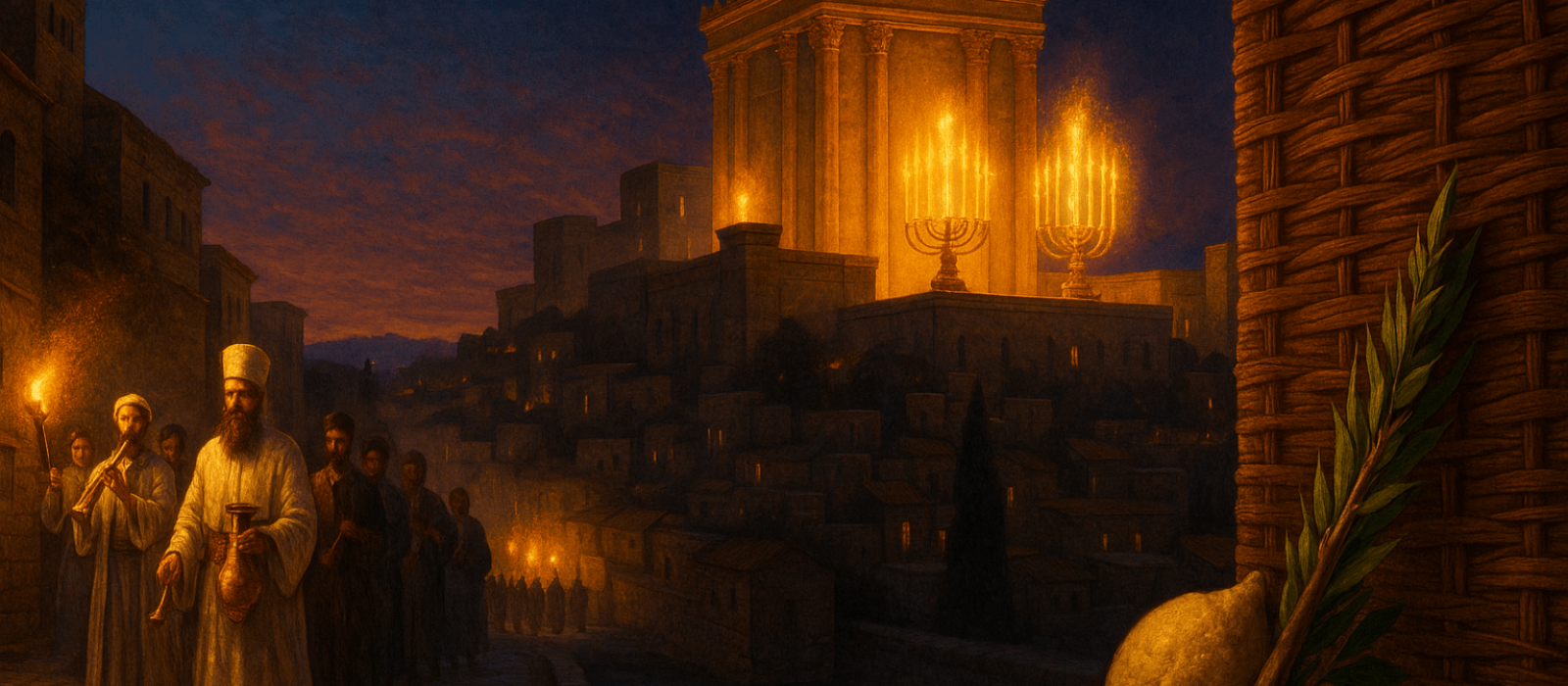
Imagine a parade of worshipers and flutists led by the priest to the Pool of Shiloach (Siloam). The priest carries two golden pitchers—one for wine and one for water drawn from the pool. With Psalm 118 chanted and shofar blasts sounding, the procession returns through the Water Gate to the Temple. Wine is poured into one silver basin as a drink offering to Adonai, and the water into the other as an appeal for life-giving rain.
“I will sprinkle clean water on you, and you will be clean…” — Ezekiel 36:25
In the first-century Land of Israel, water was often scarce. Rain meant life. The prophets used rain as a picture of salvation and the work of the Ruach ha-Kodesh (Holy Spirit). Against this backdrop, Y’shua stood in the Temple on the great day of the feast and cried out:
John explains that Y’shua spoke of the Spirit, who would be given after He was glorified. As rain nourishes the fields, so the Spirit refreshes those who trust in Messiah, causing us to grow in grace and faith and to experience Immanuel—God with us.
Light in the Court of the Women
Another Sukkot symbol was light. At the end of the first day of the feast, the Temple courts were illuminated by towering golden candelabras—each reportedly about 50 cubits high—with great bowls of oil set ablaze. The Temple stands on a hill; the glow was seen across the city. Musicians—Levites with harps, lyres, cymbals, and trumpets—filled the night with joy. The light recalled the Shekhinah that once filled the Temple.
While teaching in the Court of the Women—perhaps beside those very candelabras—Y’shua declared:
Some resisted that light; others were drawn to it. The light of Y’shua still shines today. As our people celebrate Sukkot, we pray they come to know the One to whom all the mo’adim point. May His mayim chayim (living water) quench their thirst and fill them with the very Spirit of the God of Israel.
Walking in the Unity Y’shua Reveals
Y’shua was sent by the Father to lead us to holiness. His light reveals truth and frees us to become our best selves. His living water satisfies our deepest thirst. He is the One sent for all of us—Jews and our grafted-in brothers and sisters.
You who hear or read these words are invited to witness and embody the unity and reconciliation found in Y’shua and to participate in the reality of God’s Kingdom on earth. We don’t need to grab people by the shoulders and shout. Rather, be a blessing. Demonstrate this unity by your conduct. See the holiness of God in everything and act accordingly. We cannot single-handedly avert wars, eliminate disease, or eradicate poverty. But each moment, we can create a piece of God’s Kingdom by how we respond to the world around us.
Y’shua showed us how. Let us follow His example.
A Sukkot Prayer
Avinu Shebashamayim (Father in Heaven), You gave the Feasts to reveal Your character. In Your continuing revelation, You sent us Y’shua to dwell with us—to tabernacle among us—and to heighten our awareness of Your reality. May our celebration of Sukkot draw us nearer to the fullness of Who You are and to the promised unity with You and all Your children. Amen.
Source Acknowledgment
This teaching draws extensively from the insights of David Brickner, Executive Director of Jews for Jesus, with gratitude.