
Parashah Vayak’hel Comments 2022
The parashah (Torah portion) for this week is “Vayak’hel” (“He assembled”). The word from which Vayak’hel is derived is kahal, the Hebrew for congregation or assembly. In the Jewish Publication Society’s translation, the opening can be rendered “convoked,” implying a summoning of a significant group—in this case, everyone in the tribes of Israel.
Exodus 35:1a (JPS): “Moses, then, convoked the whole Israelite community.” The Complete Jewish Bible similarly uses “assembled.”
Every word in the Bible matters. When Scripture repeats an idea, it signals special importance. Consider how often Yeshua introduces sayings with “verily, verily.”
“Verily, verily, I say unto you, The hour is coming, and now is, when the dead shall hear the voice of the Son of God: and they that hear shall live.” — John 5:25 (KJV). See BibleGateway.
Likewise, God instructs Moses in Exodus 31:13:
“Surely you must keep My Shabbatot.”
And again in Exodus 35:2:
“Work is to be done for six days, but the seventh day is a holy day for you, a Shabbat of complete rest to Adonai.”
“Convoking” the whole community alongside the Shabbat command underscores how critical Shabbat is—important to God and life-giving for Israel. With that in mind, Vayak’hel announces the actual work of building the Tabernacle. Why is that so important? Because what God promised in Exodus 31 begins to unfold in Exodus 35: the community is gathered, forgiven, and invited into holy work.
Forgiveness Confirmed Through Generous Hearts
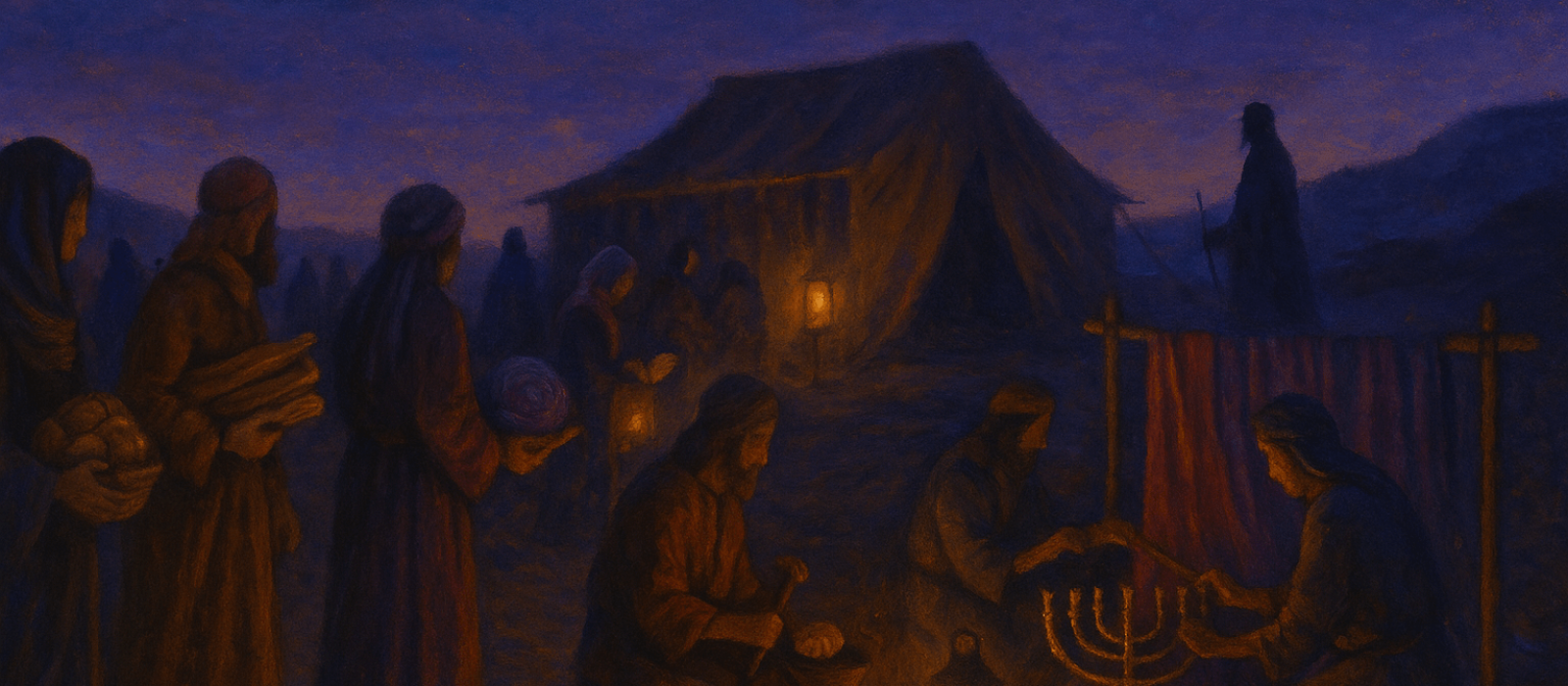
God had not forsaken Israel. After the sin of the Golden Calf, He sent Moses down with the second set of tablets and reaffirmed the Ten Words. In chapter 35, God confirms His forgiveness by calling for voluntary offerings to build the Mishkan. Israel responds with more than enough, demonstrating warmhearted generosity as the fruit of repentance and gratitude.
Why So Much Detail About the Mishkan?
Some readers struggle with the extensive Tabernacle and Temple sections. Yet the Mishkan teaches that worship is central. God does not need our worship; we need to worship. Worship places God at the center, fortifies us against deception, and trains our wills to surrender plans, hopes, and sorrows to Him.
Vayak’hel communicates two realities: (1) God has forgiven Israel after the Golden Calf, and (2) God loves Israel and desires relationship. The Mishkan’s design proclaims both truths.
Inside the Mishkan: Three Spaces, One Journey
The Tabernacle of Moses comprises three parts: the Courtyard, the Holy Place, and the Holy of Holies. Entry required ritual cleanness—no contact with death and (for women) not during niddah.
The Courtyard held the Altar of Burnt Offering (for sacrifices by fire) and the Bronze Basin (Laver) where priests washed hands and feet before service.
The Holy Place contained the Table of the Presence (Lechem HaPanim) on the right and the Menorah on the left; further in stood the Altar of Incense. The Veil (parokhet, “separation”) divided the Holy Place from the Holy of Holies.
The Holy of Holies held the Ark of the Covenant with Aaron’s rod, the jar of manna, and the tablets of the Ten Words; the Torah scroll of Moses rested beside it (Deuteronomy 31:26). Above the Ark was the gold Mercy Seat with cherubim.
“Take this scroll of the Torah and put it next to the ark with the covenant of Adonai your God…” — Deuteronomy 31:26a
Mishkan Symbols Through a Messianic Lens
Many thousands of Jewish believers in Yeshua drew strength from the Scriptures (Torah, Prophets, Writings), other sacred texts, and living traditions. The Mishkan’s furnishings especially encouraged them, foreshadowing Messiah’s work.
Altar of Burnt Offering: Two daily lambs (morning and afternoon) were offered (Tamid), recalling Passover and prefiguring Messiah’s atoning sacrifice.
“Look! God’s lamb! The one who is taking away the sin of the world!” — John 1:29
Bronze Basin: Sign of cleansing and separation from the world—repentance, forgiveness, and a life set apart, as modeled by Yeshua.
Table of the Presence: Acacia (shittim) wood overlaid with gold—humanity joined to holiness—a picture of Messiah. The Bread of the Face remained fresh, recalling Yeshua’s living bread.
“I am the living bread that has come down from heaven… the bread that I will give is my own flesh.” — John 6:51
Menorah: Pure gold—divine light. Yeshua is the light of the world; the Ruach HaKodesh illuminates God’s word and convicts hearts.
Altar of Incense: Placed before the Veil, opposite the Mercy Seat—rising incense as a sign of intercession and prayer, the ministry of Messiah.
Inside the Ark: Aaron’s budding rod (resurrection life), the tablets (God’s reality and covenant), and manna (bread from heaven; John 6:33, 51). The Torah beside the Ark witnesses to instruction fulfilled in the Obedient One.
From Death to Life: Courtyard, Holy Place, Holy of Holies
The Courtyard speaks of sacrifice, judgment, and washing—redemption through Yeshua’s atonement. The Holy Place speaks of life—light, bread, fragrant prayer—growth and maturity. Paul describes us as spirit, soul, and body, kept blameless in Messiah.
“May the God of shalom make you completely holy—may your entire spirit, soul and body be kept blameless…” — 1 Thessalonians 5:23
Progressing inward symbolizes our journey: from “God is here for me” to “I am here for God.” When Yeshua died, the Veil was torn, opening the way into God’s presence. Discipleship means death to self that brings abundant life.
“Unless a grain of wheat… dies, it remains alone; but if it dies, it bears much fruit.” — John 12:24–25
Hebrews connects Yeshua’s flesh with the parokhet, inviting confident access to the Holiest Place.
“We have confidence to use the way into the Holiest Place opened by the blood of Yeshua… a new and living way through the parokhet, by means of his flesh.” — Hebrews 10:19–22
Threefold Patterns and Pilgrimage
Torah highlights threefold transitions: the pilgrimage feasts—Matzah, Shavuot, and Sukkot—move from physical deliverance to Spirit empowerment to dwelling with God.
Exodus 23:14–17; Deuteronomy 16:16–17
Even Hebrew wedding tradition mirrors this: betrothal, consummation, and celebration. Scripture’s “threes” often signal completeness and point to Messiah’s work.
Where Are You in the Mishkan?
Are you in the Courtyard—awakening to sin and seeking forgiveness? In the Holy Place—growing in light, bread, and prayer? Or approaching the Holy of Holies—deep surrender in spirit-to-Spirit communion?
The world is changing rapidly. Still, we trust: God reigns; He weaves even burdens into blessing.
“We know that God causes everything to work together for the good of those who love God and are called according to His purpose.” — Romans 8:28
Love God. Love His children. Walk in His ways. Share the hope you’ve received—“When necessary, use words.” May the Ruach use these words to encourage the weary, and may this Messianic reading of the Mishkan deepen your awe of HaShem and draw you nearer to the Source of all reality. BaShem Yeshua HaMashiach. Amen.