
Parashah Nitzavim/Vayelech Comments 2024
If you haven’t ever flown on a commercial airplane or, at least, haven’t done so since the early 1950s, the correct answer to this question may surprise you: in an emergency, when oxygen masks drop from the aircraft ceiling, who gets the mask first? Is it you, or your child? If no one has told you by now, I would like to inform you that it is not the child!
When I think of most of my flying experiences, the various stewardesses and stewards on these flights have all made it clear as to why not, and who gets the first mask (you do!). You might not be able to help put on your child’s if a delay in putting yours on first causes you to suffer from oxygen deprivation (hypoxia). You might black out, leaving your child unmasked! Still, it seems very counterintuitive to me.
You might think jumping off a concrete ledge is crazy (maybe even suicidal!), but it has now become an Olympic sport! As of the Paris 2024 games, “Skateboarding” is now an officially added event at the Olympic games. Just a bit surreal to my way of thinking.
A number of years ago, an article appeared in the Wall Street Journal about a man who donated a kidney to someone who sorely needed a new one and hoped for a match. The interviewer asked the donor, “Who in your family received the donation”? The man said, the recipient was not a member of his family. In fact, he had no connection with that person at all! The interviewer commented that this was an amazing demonstration of self-sacrifice on the part of the donor. The donor explained to the interviewer, “You don’t understand. What I did was purely selfish!” The man who donated his kidney explained that HE was the beneficiary of the donation because of the deep satisfaction it gave HIM!
He went on to explain that giving a kidney (he happened to have two, so one was a spare!) gave him so much satisfaction that there was no altruism in the act whatsoever! It was purely self-serving. This is certainly a good example of the counterintuitive nature of the truism: “It is more blessed to give than to receive.”
At one time, we were all materialists. We believed that reality was defined by what we could experience with our five senses: taste, sight, smell, touch, and hearing. To come to know God, you must overcome the seemingly counterintuitive perception of reality; however, in Psalm 46:10 God speaks. He says,
“Be still, and know that I am God; I will be exalted among the nations, I will be exalted in the earth.”
I know this is preaching to the choir, but, even if you dismiss the Bible, it seems to me to be much easier to accept God and His Reality than it is to deny it.
Seeing Design Where We Walk
Another element in what some may think is implausible, illogical or intellectually absurd struck me as I waited for my appointment with the podiatrist.
On the wall of his office was a chart of the human foot (actually two feet, but who’s counting?). Each foot was an artist’s rendering of what you will find when you see beyond the skin of the foot into its anatomy. My doctor’s diagram showed the bones, joints, muscles, tendons and ligaments. To me, it seemed to be an elegant integration of its various parts that came together in a wonderful tool of the human body (the foot) that is most helpful in living our best lives: walking!
The diagram was beautifully drawn and colored, but the chart was nothing compared to the reality of how all of those sinews, muscles and bones unite, working together to enable us to do things and go places. I don’t know how a thinking person can avoid the conclusion that the foot was created by intelligent design. However, to come to this conclusion, we all have to see it as counterintuitive before we override that impression and come to believe that it wasn’t just an accident of nature!
The “Return of the God Hypothesis”
Return of the God Hypothesis was published in March of 2021. Below is Amazon’s summary of the book:
The New York Times bestselling author of Darwin’s Doubt, Stephen Meyer, presents groundbreaking scientific evidence of the existence of God, based on breakthroughs in physics, cosmology, and biology.
Beginning in the late 19th century, many intellectuals began to insist that scientific knowledge conflicts with traditional theistic belief—that science and belief in God are “at war.” Philosopher of science Stephen Meyer challenges this view by examining three scientific discoveries with decidedly theistic implications. Building on the case for the intelligent design of life that he developed in Signature in the Cell and Darwin’s Doubt, Meyer demonstrates how discoveries in cosmology and physics coupled with those in biology help to establish the identity of the designing intelligence behind life and the universe.
Meyer argues that theism—with its affirmation of a transcendent, intelligent and active creator—best explains the evidence we have concerning biological and cosmological origins. Previously Meyer refrained from attempting to answer questions about “who” might have designed life. Now he provides an evidence-based answer to perhaps the ultimate mystery of the universe. In so doing, he reveals a stunning conclusion: the data support not just the existence of an intelligent designer of some kind—but the existence of a personal God.
Counterintuitive Faith
As we go further into the spiritual realm, we see many other situations described in the Bible that are counterintuitive. “Keep Believing Ministries,” in the internet article, “Counterintuitive Faith,” said this about such faith: “The world says, ‘Seeing is believing.’ God says, ‘Believing is seeing.’ We believe; therefore, we see.” Read it here: https://www.keepbelieving.com/counterintuitive-faith/.
The article listed six examples: Noah’s building of the ark. Abraham’s leaving Ur of the Chaldees for a place he did not know. The Israelites crossing the Red Sea on dry land because God had parted the waters. David’s standing to face Goliath with no armor. Joshua leading the people around Jericho seven times, after which “the walls came tumbling down.” Peter’s walking on water.
“He persevered because he saw Him who is invisible.”
Nitzavim/Vayelech: The Choice Before Us
Deuteronomy 29:9(10)–31:30, this week’s Torah portion (“parashah” in Hebrew), also gives us insight into the intuitive nature of faith in God from the Exodus and provides lessons and warnings for us today. Let’s look at Deuteronomy 30:1–3.
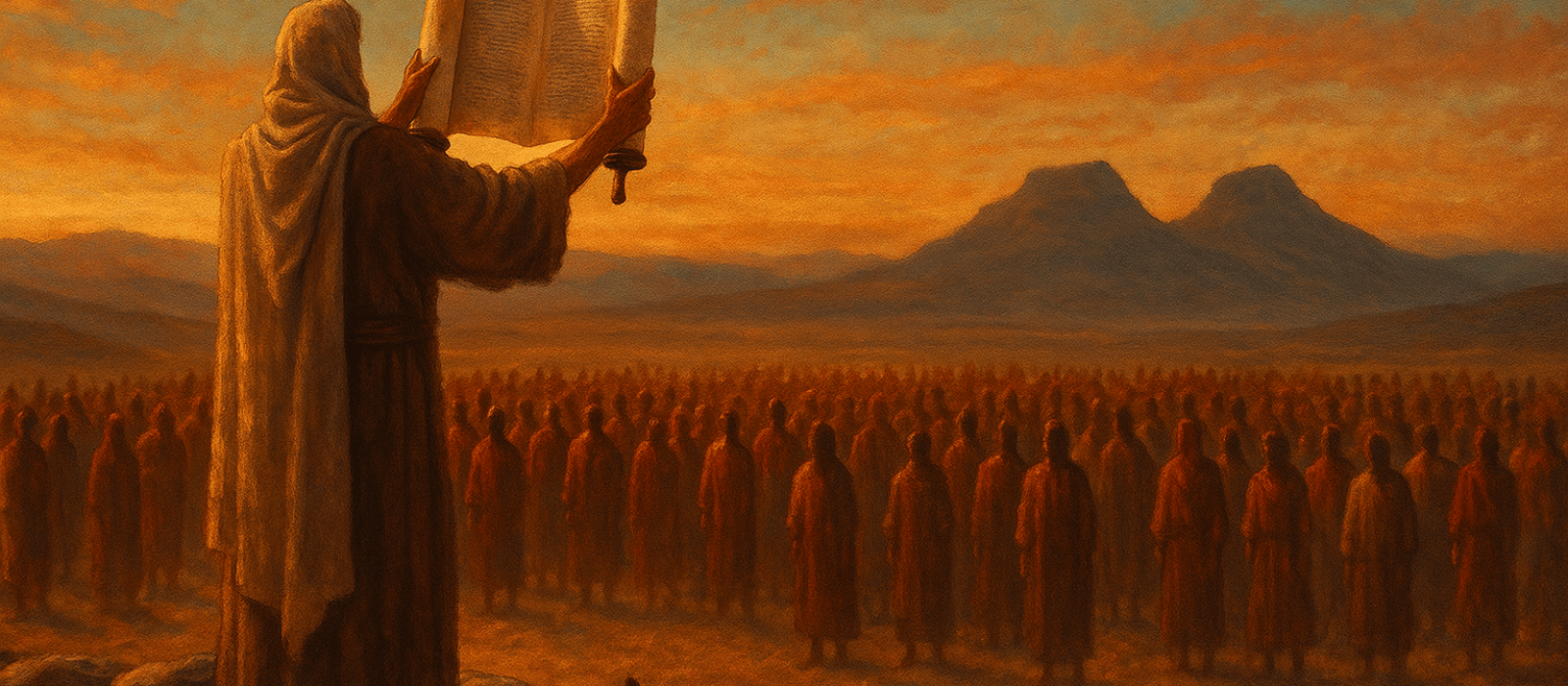
God has given the blessings and the curses to the Israelites—what the blessings will be if they reconfirm the covenant God made with the Patriarchs, for themselves and their posterity, and the penalties if they fail to act in accordance with the covenant and rebel against God. He is so emphatic about impressing them with the benefits of honorably performing their part in it and the penalties for non-performance that He has Moses split up the people, sends half to Mount Gerizim to proclaim the blessings, and the other half to Mount Eival to declare the curses! This is so critical to G-d’s relationship with us that in addition to the inspiration of the blessings declared from Mount Gerizim by half the tribes of Israel, and the severity of the curses being so dramatically expressed by the other half, the story is told in both this and the preceding parashah!
God knows what He is doing. The Hebrews have already demonstrated ten times that they have a tendency to forget the miracles God has performed on their behalf in bringing them to the border of the land of Israel, the climax and fulfillment of the promises God made to Abraham, Isaac, and Jacob.
Ten Times the People Tested God
They lost faith before crossing the Red Sea and were seemingly trapped between the Red Sea and the approaching chariots of Pharaoh. “Is it because there are no graves in Egypt that you brought us out here to die in the desert.” [Exodus 14:11–12]
They complained about the bitterness of the water at Marah. “And the people grumbled against Moses, saying, ‘What shall we drink?’” [Exodus 15:24]
They complained about being hungry in the Desert of Sin. “Would that we had died by the hand of the LORD in the land of Egypt… for you have brought us out into this wilderness to kill this whole assembly with hunger.” [Exodus 16:3]
They collected more manna than necessary and left it overnight, ignoring Moses’s instructions. “Some left part of it till the morning, and it bred worms and stank. And Moses was angry with them.” [Exodus 16:20]
They tried to collect manna on the Sabbath. “On the seventh day some of the people went out to gather, but they found none… ‘See! The LORD has given you the Sabbath…’” [Exodus 16:27–29]
Complaining about the lack of water at Rephidim. “Why did you bring us up out of Egypt, to kill us and our children and our livestock with thirst?” [Exodus 17:2–3]
Becoming idolatrous regarding the golden calf episode. “They have made for themselves a golden calf… these are your gods, O Israel.” [Exodus 32:7–10]
They complained more at Taberah. “When the LORD heard it, his anger was kindled, and the fire of the LORD burned among them… and the fire died down.” [Numbers 11:1–2]
They grumbled over not having enough to eat. “Oh that we had meat to eat!” [Numbers 11:4]
They failed to trust God and feared defeat when directed to enter the Promised Land. “Would that we had died in Egypt… let us choose a leader and go back to Egypt.” [Numbers 14:1–4]
God doesn’t want to lose any of them (like He doesn’t want to lose any of us!), but He gave them free will and they have to want to continue in the relationship God wanted with them in the beginning of their journey when He asked them to be His people and told them He would take care of them if they agreed. But human nature (mostly, the ego) takes God for granted and substitutes itself for God! It thinks the gifts of God are not from Him at all, but come from a person’s own abilities. The end result of believing this way makes you a legend in your own mind.
I have a show-business background. One of the phrases that was a warning to me was to avoid my ego from taking control of who I think I am: “Don’t believe your own press notices” was the way the warning was given.
The life cycle of the Hebrew relationship with God is: (1) God grants the blessings, (2) The people take them for granted, (3) They eventually create the self-misperception that their blessings are of their own making, (4) They become their own god and follow their own advice, (5) They get into trouble, (6) Wake up, (7) Repent, (8) Turn to God who forgives them, (9) God restores their blessings, (10) The cycle repeats. It has been happening that way since Adam and Eve.
We are in that cycle now, at the taking God and His blessings for granted and forgetting what the source of these blessings really are! We need to recognize this treadmill for what it is. If we don’t, we will be bringing down the curses in this parashah, and in other places throughout the Scriptures.
God still wants this relationship today, but the people are succumbing again to exactly what God predicted thousands of years ago. Why do you think we are seeing the same old movie again? You’d think that any disbelief and/or rebellion should have been eliminated by all the miracles that have been witnessed. You might wonder why the Israelites expressed so much resistance to the counterintuitive acts they observed God accomplish. Were His miracles not profound enough? They should have wiped out any fears that drove them to all these testings.
It was a problem for the Israelites and their relationship with God then, and it is a problem in our relationship with God now.
Two Ways of Thinking, One Call to Return
The Western way of thinking is linear. God created man for an eternal relationship with Him. Man failed. God sent Jesus to right this relationship and repair the breach caused by Adam’s fall from grace. Man rejected God’s son, the sinless man Jesus, yet the Master of the Universe will send Jesus one more time to cleanse the world and prepare it for God and His glory to return. And make no mistake about it: the Father will return. He will walk again with Man in the New Jerusalem, the restored Garden of Eden. As it was in the beginning, so shall it be in the end.
The Hebraic way of reasoning is circular. God created man for a relationship with Him. Man failed. Man repented. God forgave him. This keeps happening throughout biblical history—throughout the Tenach (Older Testament) and into the Brit Chadashah (the Newer Testament). God sent Yeshua to teach us G-d’s attributes and the depths of His love. Man rejected the Son, and was complicit in his sacrificial death. See the Parable of the Bad Tenants (also known as the Parable of the Wicked Husbandmen) in Matthew 21:33–46, Mark 12:1–12, and Luke 20:9–19. The parable describes recurring wickedness including theft and murder culminating in the death of the son of the owner of the vineyard rented by these evil tenants. The parable ends with the tenants receiving the judgment they deserve. One interpretation is that the tenant/husbandmen represent the Jewish rejection of God and His Son.
In the world-to-come, Man repents and Yeshua’s Jewish brothers and sisters ask Him to return. The resurrected Yeshua will return when God wills Him to do so, and He will become the vehicle for God’s restoration of His relationship with Man, and God’s forgiveness in the final redemption and salvation of mankind. We know this because the Bible tells us so.
Letting Go of Ego, Embracing Trust
Just as it is counterintuitive to believe in a reality beyond our five senses, it is ultimately man’s highest calling to overcome his reluctance to take the free will God gave him and willingly, lovingly, return it to Him in the ultimate act of trusting God completely and surrendering to His will.
Doing this requires the complete self-subjugation of our own will, but mostly the total surrender of our own ego. This is the supreme challenge: we do not want to give up control of our lives in sacrifice to G-d. For ego substitute pride. If we understood what G-d has done for us, giving us EVERYTHING, including our lives, this would be much easier. Easier or not, unless we overcome the self-creation of ourselves by our egos, surrendering to G-d is perceived as committing suicide!
But the ego is a strange element in our psyche. It does not want to die; it wants control, yet pride and God are incompatible. The recognition that we have committed grievous acts against God is like committing suicide of the self-image when it is inflated by pride. And in this life, if we are to rule over our ego and ultimately conquer it, we must be ever watchful for its resurgence. Kinda like the game of “Whack-a-Mole.”
“The heart is deceitful above all things and beyond cure. Who can understand it?”
The prophet spoke to the people of Judah and Benjamin but they didn’t want to hear what God (through the prophet) wanted them to know. They were taken into exile because they preferred to listen to the false prophets who tickled their ears with lies. Are we going down the same path: into a dark time, which our pride and ego allowed because it was easier than hearing God’s truth?
“For many are called but few are chosen.”
Will God choose you as being one of His own, or leave you to your own devices, reaping the reward of separation from God: the skewed self-image your ego created?
Self-Awareness, Then Transcendence
Psychology’s goal is self-awareness—coming to know the real you. Spiritual growth cannot be achieved until this has been achieved. The goal of Jewish philosophy includes self-awareness or what is also called self-actualization, but goes way beyond that. The Jewish goal of man’s self-examination and education is his transcendence of self.
M. Scott Peck, M.D., wrote a very popular book called The Road Less Traveled. In the book, he describes life as a series of disappointments. We start out thinking we are the center of the universe, but as we grow, we realize that this perception is inaccurate. Disappointments like this continue, but if one learns the lessons of pursuing personal and spiritual growth, eventually, that person will achieve peace and security through the acceptance of the counterintuitive. He also says, “Be bold enough to live life on your terms, and never, ever apologize for it.” And: “Once we truly know that life is difficult—once we truly understand and accept it—then life is no longer difficult.” And this quote: “The only real security in life lies in relishing life’s insecurity.”
The book’s title comes from the Robert Frost poem, “The Road Not Taken.” In the poem, Frost says: “Two roads diverged in a wood, and I—I took the one less traveled by, And that has made all the difference.”
I agree with Dr. Peck up to a point, and that point is that peace and security comes from living life on your terms. The peace I have found in being bold enough to live life on my terms, and never, ever apologizing for it—I disagree.
His ideas are limiting: His approach to life does not compare to the peace I have found in doing what the Father of Everything wants me to do, not what I want to do. To be bold, yes, but not to live life on my terms, but to live life in God’s will, on His terms.
The old self-help axiom, “If it’s to be, it’s up to me,” is how I lived my life UNTIL I found out that things happened to me that I was completely powerless to prevent. So long as I keep giving myself away in service to God, not even the things I cannot control are an issue because I KNOW who IS in control, and trust Him to direct me in the best way for me.
A Friend on the Brink of Trust
I know a man who has witnessed, or been a part of, miracles that cannot come as coincidences or accidents but originate from God. He knows God exists. He wants a relationship with Him and is somewhat envious of others who seem to have achieved it. To me, he has three problems that stand in his way:
He thinks he knows himself, but it is his ego that is telling him this.
He is Jewish and resists things that have a Christian aroma to them. In this case, the issue is sin: that everybody is a sinner except the one perfect sinless man, Yeshua the Messiah. He knows his life is not what he would like it to be, but he thinks his dissatisfaction comes from things he cannot control. He has a hard time understanding and admitting that sin in his life is causing this. Yeshua says the transgression of the law is sin. He does not accept Yeshua’s truth, even though what Yeshua says is truthful. He does not understand that Old Testament sin is a rebelling against God and impairs the relationship between God and himself. He thinks he is okay, but his ego is in charge and he is blind to what God is calling him to do to make things better for himself and his relationship with God. He thinks fulfilling what HE wants is what life is all about. What he misses is that trusting God means wanting for himself what GOD wants for him and seeking that out. As was said earlier, many are called, few are chosen. I believe God is calling him through these miracles, but he wants God his way, not God’s way.
The necessary things he must do are counterintuitive and he cannot grasp that knowing of God’s existence is just the beginning, and seeking and finding a relationship with Him can be the great journey of his life. To do this requires giving up all he thinks he is. The truth is giving it over to God will lead to the true and clear image of who he is and who God created him to be. That the God of the Older Testament is the one who cares for him and yearns for him to accept His offer to enjoy His divine intimacy; that it is available and real and he can truly have a relationship with God Almighty, the best Father he could ever know! He wants to hold on to himself. Things won’t happen for him until he trusts God, lets go of what he thinks is best for him, and risks EVERYTHING for the Fatherhood of God.
I know I said three problems, but since originally putting my thoughts on him to paper there may be one issue that is his greatest obstacle in truly receiving and accepting G-d’s call: I now believe this man was sexually abused by at least one if not both of his parents. I believe his primary challenge is to realize his blindness to his sin is to cover up his misunderstanding about his sinful parental relationship(s). To see the truth of this sin is to reveal to himself that he was not the sinner but the innocent victim. You cannot know the Almighty in any way when you don’t know yourself. He will be on the path to answering G-d’s call when he acknowledges this enormous elephant in his closet.
Be Strong and Courageous
Coming to know God, we first fear Him because we see a glimpse of the magnitude of His awesomeness. However, if we keep going, as the Psalmist says, the fear of the LORD is the path to wisdom. This wisdom brings a person and his loving God closer and closer. We can meet Him and know Him and come to love Him more completely when we go beyond ourselves and seek to live in His presence. Faith in God is simply counterintuitive, and it is so worth the risk that reaps the benefits of the boldness and nobility of risking it all for divine awareness.
The NIV has 21 entries with the word “bold” and 33 entries with the word “courage” or “courageous.” We need to act boldly, courageously, seeking God, gambling everything we think is true for the prize of G-d and His truth. At the end of every book of the Torah, observant Jews and Messianic congregations declare:
Hazak, hazak, v’nit’chazek!
Be strong, be strong, and let us be strengthened!
The Torah will strengthen you and encourage you and bring you into this counterintuitive relationship with the One who loves you more than your wife, husband or any of your children. And He sent Yeshua to lead us in our journey to rest completely in the love of the One who made us, gave us life, and everything else!
May God use these words toward the restoration and final redemption of all who hear or see them. Amen.