
Parashah Metzora Comments 2024
God is life. He is the Creator of life. He is pure. He is holy—meaning that He is separate from everything else. He is unique. He will not allow His Presence to be defiled by anything that does not reflect these qualities.
Sin is a disease leading to death. The serpent said to Chava (Eve) in the Garden of Eden, “Surely you will not die.” When he encouraged her to eat the fruit of the tree of the knowledge of good and evil, the serpent blended truth with a lie: Eve would NOT die at the moment she tasted the fruit; however, she and Adam became “infected” by their disobedience to God, which led to pain, suffering, and eventual death. Uncleanness begets disease and can come to the same end as sin.
This week’s parashah (Torah portion) is called “Metzora.” The word is Hebrew for a person afflicted with “tzara’at.” “Tzara’at” is called “leprosy” in many English Bibles. It is also translated as “a skin disease,” “harmful skin disease,” “a serious skin disease,” and “a scaly infection.” “Metzora” is usually translated as “leper” or “the person afflicted with a skin disease.” A few English versions describe “tzara’at” as “any skin disease.” As skin diseases go, leprosy is a better description than most of the 30 translations I looked at; however, leprosy (Hansen’s disease) is NOT “tzara’at.” “Tzara’at” is “tzara’at.” It is a skin disease that the Sages of Judaism saw as God’s judgment on a person’s sinful condition.
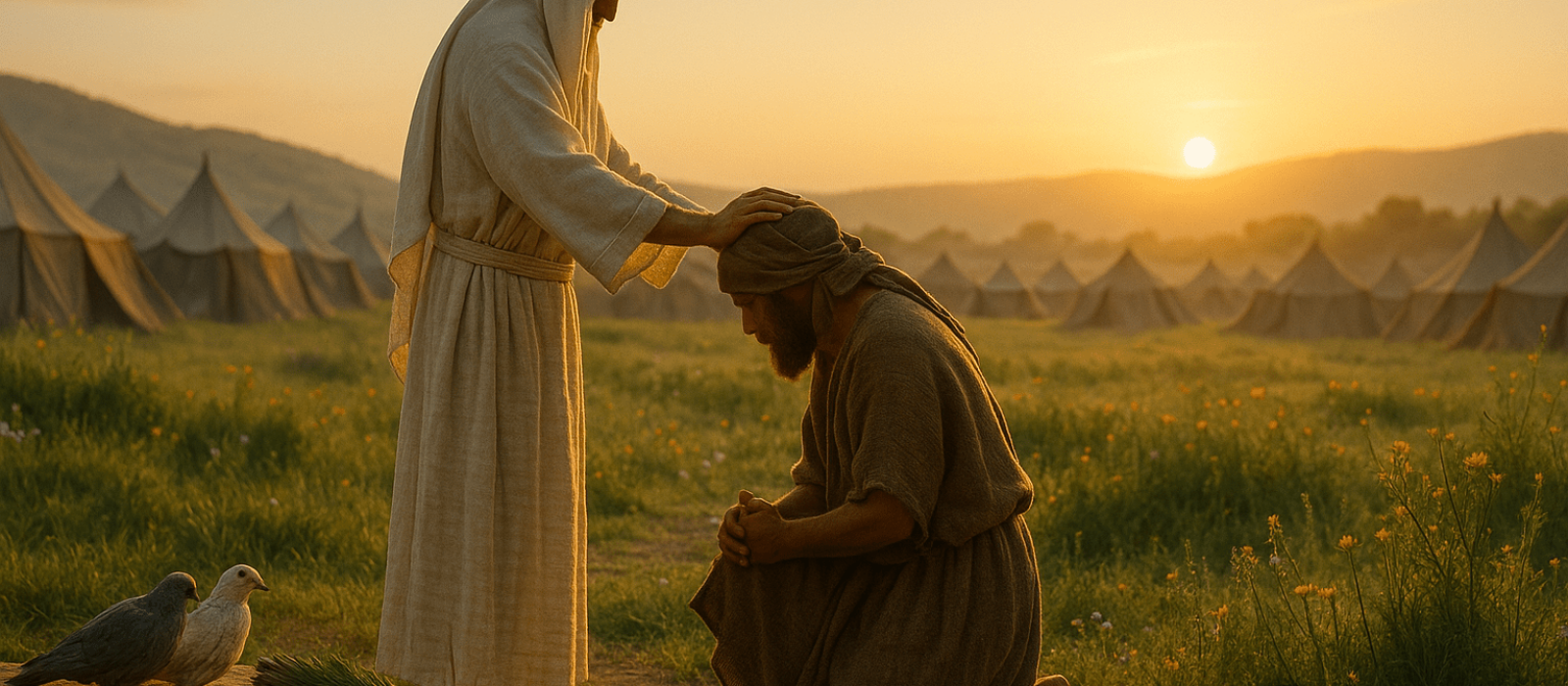
“Tzara’at” was synonymous with sin. It was a public declaration by God that the person so afflicted had moved away from God by sinning. He was to be separated from the rest of the people until and unless the disease left him. His separation from the camp gave the afflicted person time for introspection and self-evaluation—an opportunity to search within him/herself to uncover the source of uncleanness. If they sincerely repented and turned to God, they would be “cured” of the condition and allowed to return to fellowship with the community. God’s atonement and restoration of the metzora brought the afflicted one closer to the Almighty. The restoration of our relationship with God comes when we turn back to HaShem and strive toward holiness. The more we try to obey Him and strive to be holy (“Be holy, for I am holy,” God says repeatedly), the more we rid ourselves of sin and uncleanness, the more intimate our relationship with Him becomes. This is our purpose in life.
19 “I call on heaven and earth to witness against you today that I have presented you with life and death, the blessing and the curse. Therefore, choose life, so that you will live, you and your descendants, 20 loving Adonai your God, paying attention to what he says and clinging to him — for that is the purpose of your life! On this depends the length of time you will live in the land Adonai swore he would give to your ancestors Avraham, Yitz’chak and Ya‘akov.”
The better our relationship with God, the more He is blessed and the more WE are blessed as well! Therefore, our best strategy for a good life is in the striving to enhance our relationship with God.
Tzara’at is an indication of spiritual dysfunction and God’s judgment. It is one kind of uncleanness. If you are ritually unclean—spiritually unclean—you cannot be in the Presence of HaShem. We learn this in this week’s parashah: Metzora.
Tradition, Messiah, and the Leper Motif
The traditions of Judaism can also teach us about our relationship with God. These traditions are helpful; but Messianic Jews and Christians do not elevate them to a divinely inspired level, as much of Orthodox Judaism does. Much of modern spiritual Judaism has become entrenched in dogmatic adherence to a large portion of Jewish thought called the “Oral Torah.” It is a collection of rabbinic commentary, now written down, that has been elevated to the level of Torah by many Orthodox Jewish sects. In some cases, by some rabbis, the “Oral Torah,” known as the Talmud, is regarded to be MORE authoritative than Torah! Nevertheless, these commentaries, and other writings that express Jewish thinking, understanding, and wisdom, can aid in understanding what God is revealing about who He is and how we are to respond to His calling on our lives.
Ironically, the Jewish Holy Scriptures themselves speak indirectly about a Messiah:
The earth’s kings are taking positions,
leaders conspiring together,
against Adonai
and his anointed.
You make me know the path of life;
in your presence is unbounded joy,
in your right hand eternal delight.
Adonai says to my Lord,
“Sit at my right hand,
until I make your enemies
your footstool.”
rest on the man at your right hand, the son of man you have raised up for yourself
The Spirit of Adonai Elohim is upon me,
because Adonai has anointed me
to announce good news to the poor.
He has sent me to heal the brokenhearted;
to proclaim freedom to the captives,
to let out into light those bound in the dark;
Who has gone up to heaven and come down?
Who has cupped the wind in the palms of his hands?
Who has wrapped up the waters in his cloak?
Who established all the ends of the earth?
What is his name, and what is his son’s name?
Surely you know!
Believers in the Messiah Yeshua recognize these verses as pointing to Him.
Hebrew readings of the Older Testament use the terms “anointed” or “son of God”; but despite many interpretations and translations to the contrary, the specific term “Messiah” or “Moshiach” is not explicitly used in the Tanakh.
Despite no explicit “Moshiach,” throughout Jewish history and culture much has been written about the Messiah. Essentially, the Messiah would be the One who, in the End Times, saves God’s people and ushers in the Kingdom of God.
Messiah ben Yosef & Messiah ben David
Two central descriptions are Messiah Ben Joseph and Messiah Ben David. Ben Joseph was to come in humility and take the suffering of the people on Himself—likened to Joseph, son of Jacob and Rachel, despised by his brothers, sold into slavery, falsely imprisoned, and ultimately the one who saved Egypt and the world from famine.
The suffering of Joseph in his early life led to salvation later in his life. This salvation included Joseph’s father Jacob and the rest of his family—who would become “Am Yisrael,” the Nation of Israel. It can be said that the suffering of Joseph, a servant of God, preserved the family of Jacob and, through his descendants, the Nation of Israel and the entire world.
Messiah Ben David is the conquering King who saves His people through the political and royal establishment of the Kingdom of God—“New Jerusalem,” the “Messianic Age.” In Yeshua’s time, both expectations were alive, though the Sages generally did not unify them. One tradition said Messiah Ben Joseph would die in the battle between good and evil and his death must precede the arrival of Messiah Ben David—linking the figures without fully merging them.
People despised and avoided him,
a man of pains, well acquainted with illness.
Like someone from whom people turn their faces,
he was despised; we did not value him.
In fact, it was our diseases he bore,
our pains from which he suffered;
yet we regarded him as punished,
stricken and afflicted by God.
Rejoice with all your heart, daughter of Tziyon!
Shout out loud, daughter of Yerushalayim!
Look! Your king is coming to you.
He is righteous, and he is victorious.
Yet he is humble—he’s riding on a donkey,
yes, on a lowly donkey’s colt.
An extension of this concept is discussed in articles such as “The Leper Messiah” (see Hebrew4Christians), drawing on the Babylonian Talmud:
“When will the Messiah come? … By what sign will I recognize him?” Elijah replies: find him among the poor lepers at the city gate. “The sages say, his name is ‘the Leper Scholar,’ as it is said, ‘Surely he has borne our griefs… yet we esteemed him stricken…’”
Teshuvah, Healing, and the Cure Before the Plague
The Babylonian Talmud, Berakhot 54a, notes that teshuvah (repentance) was created at twilight just before the first Shabbat—corresponding to Adam and Eve. Teshuvah responds to sin: sin is a disease that leads to death, the greatest uncleanness that separates us from God. Repentance is the cure for sin and, by extension, the cure for tzara’at.
When we repent, HaShem is ready to forgive. God’s forgiveness is tied to healing and redemption:
Bless the Lord, O my soul, and forget not all his benefits,
who forgives all your iniquity, who heals all your diseases,
who redeems your life from the pit, who crowns you with steadfast love and mercy.
…by his bruises we are healed.
It is written that “God provides the cure before the plague.”
In the beginning was the Word, and the Word was with God, and the Word was God.
God provided the cure for the sickness of our sin when Adam and Eve allowed sin to enter their lives. He is at God’s right hand. He is the healer of the brokenhearted in Isaiah 61:1.
The Father gave us the cure for our own version of tzara’at. Frankly, we are all metzorot living in the “leper colony” of this world—separated from the Father because of our uncleanness, unable to undo the disobedience of Adam and Eve. Our Father in heaven is the Father of all things, including time. He knew we would be afflicted and He provided the cure. Because He is pure, holy, separate, He cannot defile Himself. The Torah reveals HaShem as spirit, not a physical entity.
So He made a way to cure our sinful nature by sending His Son as one of our own to exchange our sinfulness for His righteousness. Through the obedience of the Son to the Father’s will—even to death—the sending of Yeshua by His Father restored our relationship with the Father, like the relationship Adam and Eve enjoyed before they disobeyed.
Why Yeshua Healed the Metzorot
Perhaps this is why Yeshua’s ministry often focused on healing the metzorot:
“…go rather to the lost sheep of the house of Isra’el. As you go, proclaim, ‘The Kingdom of Heaven is near,’ heal the sick, raise the dead, cleanse those afflicted with tzara’at, expel demons.”
Moses is considered a picture of Messiah and there are many similarities between Moses and Yeshua. When Israel sinned, Moses interceded, even offering himself:
“Please! These people have committed a terrible sin: they have made themselves a god out of gold. Now, if you will just forgive their sin! But if you won’t, then, I beg you, blot me out of your book which you have written!”
God did not permit Moses to make this sacrifice. Instead, the honor went to Yeshua of Nazareth.
Jesus has been found worthy of greater honor than Moses, just as the builder of a house has greater honor than the house itself.
The woman with the issue of blood was made clean by trusting that touching Yeshua’s garment would heal her:
…“Daughter,” he said to her, “your trust has healed you. Go in peace, and be healed of your disease.”
King Messiah and the Coming Restoration
The tradition of Messiah Ben David comes from passages like Daniel 7:13 and Genesis 49:10:
“I was watching in the night visions, And behold, One like the Son of Man, Coming with the clouds of heaven! He came to the Ancient of Days, And they brought Him near before Him.”
“The scepter or leadership shall not depart from Judah, nor the ruler’s staff from between his feet, until Shiloh [the Messiah, the Peaceful One] comes to Whom it belongs, and to Him shall be the obedience of the people.”
All believers in the Messiah look forward to His coming. Many of our traditional Jewish brothers and sisters hope He will bring peace—whether in the spirit of Joseph or David. Messianic Jews and Christians know the suffering servant of Isaiah 53 will return as Messiah Ben David, King Messiah.
Messiah Ben Joseph came to exchange the Just for the unjust—Himself for the metzorot (us “lepers,” to use the familiar term). While He prepares a place for His bride, He is also building His army of the repentant and redeemed who will accompany His return.
Messiah Ben Joseph sacrificed Himself so He can return as Messiah Ben David to complete the work His Father gave Him: to save all mankind with the army of believers He has gathered through His redemptive sacrifice.
Yeshua tells in the parable of the ten virgins that only the Father knows the day and hour. Yet we glimpse His arrival with His saints:
“Behold, the Lord comes with ten thousands of His saints, to execute judgment on all…”
Take the Cure
If you’ve got tzara’at, God has provided the cure. Jewish tradition pictures the sinner with his back toward God, imagining God has turned away as well. When the sinner experiences teshuvah—repentance—he turns around to find God facing him, waiting with open arms.
The sinner paves his own road to death, when at any time he can have the peace of forgiveness—by turning to the Source of all Eternity and asking to be forgiven. How often will God forgive us? Ask yourself: when do you give up on your children? The answer: NEVER. We are God’s children. Therefore, God will never give up on His children either.
The doctor can provide the medicine, but the patient must be willing to take it. Yeshua will cure your “skin disease.” He’ll take care of the rest of you, too, if you surrender to Him and, through Him, to His Father.
The Leper Scholar at the Gate
The Talmud (Sanhedrin 98a–b) tells a story about how the Messiah would be found caring for lepers:
“His name is ‘the leper scholar,’ as it is written, ‘Surely he has borne our griefs and carried our sorrows: yet we did esteem him stricken…’ ‘When will the Messiah come?’ ‘Go and ask him.’ ‘Where is he sitting?’ ‘At the entrance… among the poor lepers.’”
The truth of God is everywhere. God can speak through any means He chooses—Scripture, classic texts like the Talmud, and even people who believe differently than we do.
Prayer
Father in Heaven, thank you for sending your Son, Mashiach Ben Yosef, to lead each one of us out of our own isolation—our own tzara’at—to cleanse us and lead us into fellowship with our brothers and sisters, and most importantly with You and Your Son. And, Father, we also thank You in advance for sending Your Messiah a second time as Mashiach Ben David, who will purify and redeem the whole world and return us to the Garden in which You will be pleased to have us live with You in the fullness of the intimacy You desired with Adam and Eve.
Amen!