
2847 AM (913 BCE) – AND ALL THIS FOR WHAT?
Despite all the signs and wonders that Adonai had shown, Jeroboam stubbornly refused to leave his wicked ways. In fact, he redoubled his efforts. Sure, it was radical. But didn’t his own effective rebellion against the establishment at least win him his own kingdom? Sure, there were setbacks, though. But, if the news was to be believed, Shamaia would no longer be a problem. Thus, Jeroboam appointed anyone who wanted to be a priest to serve, performing sacrifices, not realizing that Adonai would ultimately cut off his lineage.
As it came to pass, Jeroboam and his wife, Tiferet, had a child. In honor of Ahijah (whose name means “Adonai is my brother”), they named their son Abijah (“Adonai is my father”). The child was kind and amazing, and always seeking justice and truth. Often, to Tiferet’s delight, Abijah would frustrate Jeroboam with simple questions like, “Well, if Adonai says not to, why do you do it? It doesn’t seem right!” or “Just because you are King, Daddy, doesn’t mean you don’t treat people with dignity and respect. That’s how you want to be treated, right?”
But Jeroboam would not listen to his son any more than he would listen to Adonai, and he continued in his direct rebellion against Adonai. As a result, Jeroboam’s beloved Abijah fell seriously ill.
“We have to do something!” Tiferet said in utter desperation. “If it were a normal illness, he would have been better weeks ago.”
The nagging of Tiferet was annoying, to be sure, but his son was his heir. None of the people of medicine, nor the enchanters, could do anything to help. Tiferet was insisting that they go see a prophet of Adonai.
“Superstition!” Jeroboam rebuked. “Utter superstition! The only magician claiming the name of Adonai is dead, at no fault of my own, and the only other is Ahijah the seer, even though I don’t know what he could possibly see—he’s been blind for years.”
The King laughed haughtily at his own humor, but then continued, “And, anyway, while I love him dearly for prophesying that I would be King so that the people would appoint me King, I am pretty sure that he will be grumpy at how I blasphemed his fake god.”
“Well, maybe if you did not make it your mission in life to singularly take responsibility for convincing all of Israel that Adonai is a fraud, we might not be in this situation!”
Tiferet was standing by the window looking out across the landscape. She could not bear to look at her son. He looked dead. It was only his breathing that convinced her otherwise.
“What if,” Jeroboam started, “he’s blind, right? What if he doesn’t know it is us? What if he thinks you are just some random woman from Judah, asking about your son?”
Jeroboam thought silently for a moment and then suggested, “After all, since Adonai is likely just a figment of Judah’s imagination, then, perhaps Ahijah could help us without realizing he is helping us.”
Tiferet was desperate. There were so many holes in Jeroboam’s logic and reasoning that it was just painful to listen to him anymore. But if she agreed to dress up and pretend to be someone else, at least he would allow her to go to him.
“Okay. Let’s at least try,” she said with a heavy heart.
“Here’s what you do,” Jeroboam started, “take ten loaves of bread, some cakes, and honey—lots of honey. He might be able to tell you what happened to our son, and then we will know how to get him better.”
Tiferet reluctantly agreed, dressed up, loaded some animals with the gifts, and then headed toward Shiloh.
☼ ☼ ☼
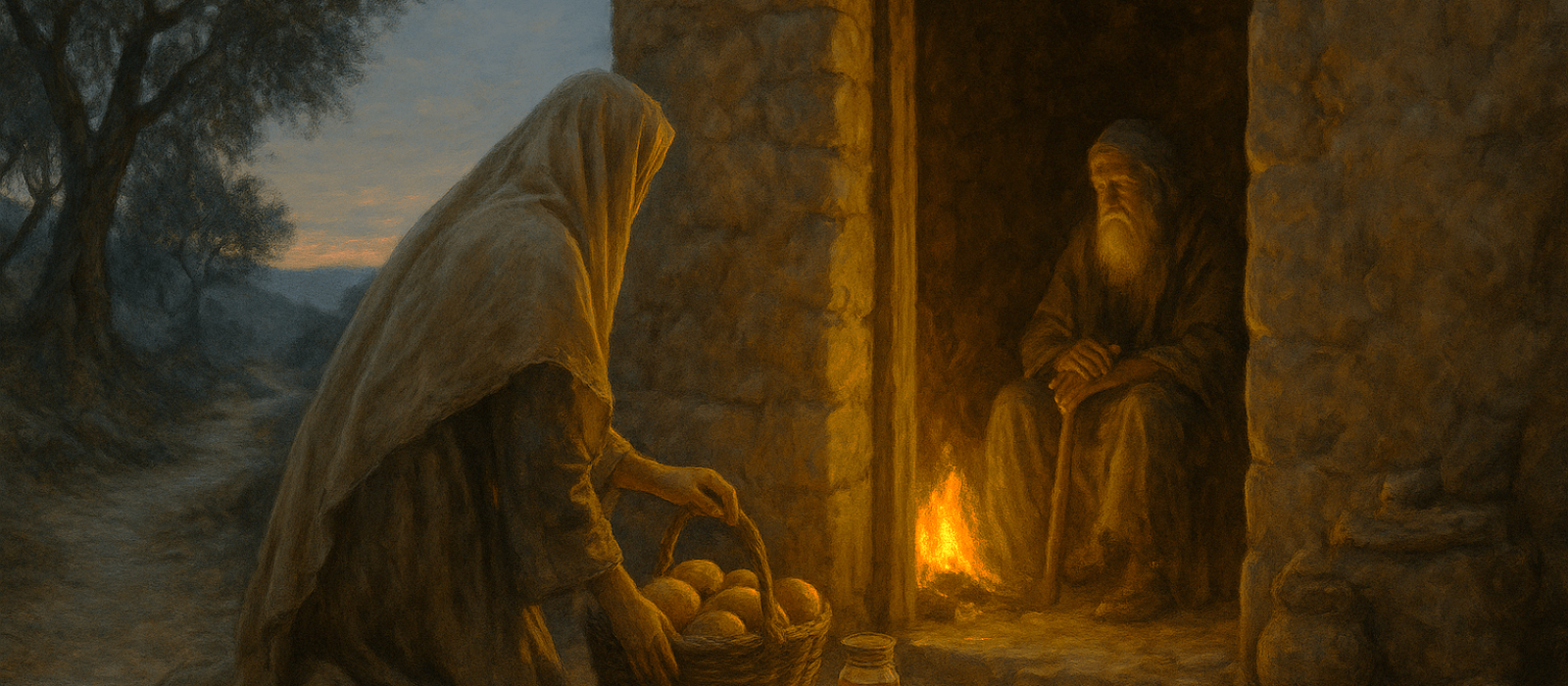
Just under half a day later, Tiferet tied up the animals, taking the bread, cakes, and honey in her arms, as she quietly approached his dwelling.
“Come in, Tiferet, wife of Jeroboam,” a voice announced from inside the home. But not just any voice—it was his voice, the voice of Ahijah. The voice continued, “You come in disguise? And all this is for what? Keep your offerings. Adonai does not delight in words that are like honey and sweet cakes but lead to death. Come in and listen to me, O Tiferet, wife of Jeroboam.”
Tiferet was shaking. She clumsily set everything down on the path and opened the door. She walked in. Ahijah was facing a fire, whose radiant flames warmed the whole room.
“Sit,” he commanded, and she complied. “Adonai means to send you back to your husband with a very harsh message. Be sure to tell him everything.”
Ahijah let the words fill the air as he grabbed a long wooden stick and stirred the coals.
“Adonai has exalted Jeroboam from among the people. Adonai made Jeroboam the leader of his people in Israel, after tearing the kingdom away from Rehoboam and the house of David and handing it to you. Yet, you have been nothing like my servant David, despite the warnings that Ahijah gave you from the very beginning, and despite the warnings Shamaia gave you at the cost of his own life. In contrast, Jeroboam has done more evil than all the kings before him combined, making cast-metal images of fake gods, going out of your way to provoke me, and trying to get all of Israel to turn its back on Adonai.”
Ahijah could hear sobs coming from Tiferet. She dabbed her eyes with a cloth, agreeing, “That is all true. It’s … and I am so ashamed…”
Ahijah nodded and then continued Adonai’s rebuke: “Therefore, the consequences of Jeroboam’s behavior, as was told to him from the very beginning, is that Adonai will bring disaster on the house of Jeroboam. Not one male will survive, as Adonai will cut off the line of Jeroboam, cleaning his house as if cleaning up dung. If the men of the household die in the field, the birds will pick their bones, and if they die in the city, the dogs will devour their flesh. For Adonai will uproot Israel and scatter it beyond the Euphrates River, because they have worshiped their gods, provoking Adonai to anger. I will give up Israel because of the evil Jeroboam has led Israel in.”
Tiferet’s sobs began to turn into wails. “But what about Abijah?”
“Ah,” Ahijah said, his voice softening a little, “Abijah will be spared, for Abijah is the only good found in the house of Jeroboam, and for that, Adonai will allow you to bury him, and for all Israel to mourn for him alone. Take this message back to Jeroboam, for Adonai has already set everything in motion. When you cross the boundary of your city, your beloved son, Abijah, will pass on to sleep with his fathers.”
☼ ☼ ☼
The anger of Rehoboam never subsided. In his anger, he would lash out militarily at Israel, and then Israel would reciprocate, making Rehoboam even that much angrier. In his anger, Rehoboam did not lead Judah in righteousness, but he gave in to his self-centered impetuousness and led Judah in all the evil abominations that Jeroboam led Israel in, plus Rehoboam encouraged male prostitution as a form of worship in addition to the female prostitution of Ashtoreth and other fertility worship (which seemingly never led to the procreation of the human race).
Adonai would not remove Rehoboam from the throne as he planned to with Jeroboam, for the sake of his servant David, but there would be consequences. In the fifth year of Rehoboam’s reign, King Shishak of Egypt invaded Judah. He took away all the treasure of Solomon’s palace and all the treasure from the temple. They even took away all the large, heavy gold shields, each one having to be carted away with a team of horses.
Judah was powerless to stop them. In utter humiliation, Rehoboam made bronze shields to replace them. However, because they were so much smaller and lighter, and so much easier to steal than the extremely large and heavy gold shields, they were kept under guard and only brought out when Rehoboam was to visit.
And Jeroboam would send word mocking Rehoboam’s humiliation, and Rehoboam would attack an outlying area of Israel, and Jeroboam would retaliate. And so, this petty feud went on, never to end until the death of Jeroboam and Rehoboam—two men torn from the same cloak, as they say. People say that…
☼ ☼ ☼
There were 19 kings from Jeroboam to Hoshea, who was the last King before Israel would fall to Assyria and the northern ten tribes would be lost to history. Not one of them was righteous.
Here is a quick summary of those 19 kings—none followed the example of David, despite many prophets and interventions from Adonai to convince them otherwise—and they led Israel astray, into idolatry, and even to sacrificing their own children (dates are all approximate):
1. Jeroboam I (reigned around 2871–2892 AM) — he introduced idolatry and established unauthorized places of worship.
2. Nadab (reigned around 2892–2893 AM) — he continued the sinful practices of his father Jeroboam.
3. Baasha (reigned around 2893–2916 AM) — he continued the sins of Jeroboam and even wiped out Jeroboam’s entire family.
4. Elah (reigned around 2916–2917 AM) — he followed the sinful ways of his father Baasha.
5. Zimri (reigned for only seven days in 2927 AM) — he usurped the throne through violence and committed suicide shortly afterward.
6. Omri (reigned around 2917–2928 AM) — he continued the idolatry introduced by Jeroboam and established the capital at Samaria.
7. Ahab (reigned around 2928–2949 AM) — he, along with his wife Jezebel, promoted Baal worship and persecuted the prophets of the Lord.
8. Ahaziah (reigned around 2949–2950 AM) — he continued the idolatrous practices of his father Ahab.
9. Jehoram (reigned around 2950–2961 AM) — he married Ahab’s daughter and followed the sinful ways of the house of Ahab.
10. Jehu (reigned around 2961–2988 AM) — although he executed judgment upon the house of Ahab, he continued in the sins of Jeroboam.
11. Jehoahaz (reigned around 2988–3004 AM) — he continued the idolatry introduced by Jeroboam.
12. Jehoash (reigned around 3004–3020 AM) — he continued the idolatrous practices of his predecessors.
13. Jeroboam II (reigned around 3009–3049 AM) — he continued the sins of Jeroboam.
14. Zechariah (reigned around 3049 AM) — he was assassinated after only six months on the throne.
15. Shallum (reigned around 3049–3050 AM) — he usurped the throne through violence but was quickly overthrown by Menahem.
16. Menahem (reigned around 3049–3059 AM) — he maintained the idolatrous practices of previous kings.
17. Pekahiah (reigned around 3059–3061 AM) — he continued the sins of his predecessors.
18. Pekah (reigned around 3061–3081 AM) — he followed in the footsteps of the sinful kings before him.
19. Hoshea (reigned around 3081–3091 AM) — he was the last King of Israel before the kingdom fell to Assyria.
☼ ☼ ☼
The King (pick one from the above list—seriously, it hardly matters) watched with wicked anticipation. He was excited, aroused, as the many colors of the flames reflected in his moist, glistening eyes.
The flames heated the hands of Molech to a white-hot color, and one could almost mistake the molten iron hands for gold, due to their bright hue. They were so hot, in fact, that when the King’s firstborn son was laid on them, the infant burst into flames instantly, his cries silenced forever as a sacrifice to Molech. The hope was in Molech’s promise to provide a lust-filled life of wealth and immediate gratification.
Within minutes, the murdered infant was nothing but blackened, scorched bones. But the celebration did not end there. The temple prostitutes invited the King to copulate with them… in public… in front of everybody. They were like unbridled animals, donkeys in heat.
This was an abhorrent abomination to Adonai that he could not forgive—would never forgive. The destruction of Israel was sealed from acts like these and many, many others. They built high places and Ashtoreth poles, along with various memorial stones. They burned incense and did many evil things to provoke Adonai, including serving idols like Baal, Astarte, and Molech.
Adonai had brought them out of Egypt with a mighty hand and an outstretched arm, along with many signs and wonders. He fed them in the desert with manna and gave them commandments that were not so far away that the Israelites would have had to traverse dangerous seas to learn what Adonai wanted them to do to be righteous.
Nor were Adonai’s commandments up in the heavens, where they would have had to traverse the sky to bring down Adonai’s truth. They were in their very hands, in simple words, such that a six-year-old could understand what it meant to be obedient to Adonai. The Torah was given to them when they were just a young nation standing at Mount Moriah, the mountain of teaching.
“Today,” Moshe was remembered as saying, “Adonai has put before you a choice: life or death, blessing or cursing. But he begs of you, please! Choose life!”
Sigh. Mic drop.
Used with permission by the author. Find the author’s complete works online: Complete Works of Mack Samuels