
See also: Exodus 2:22 (Gershom), Exodus 4:27 (Aaron meets Moshe).
2447 AM (1313 BCE) – EIGHTY
Moshe watched the sheep of his father-in-law Jethro. He eyed one particular sheep he called Dinner, because he was the sheep who looked most fattened. As a forty-year anniversary gift, Jethro said to bring one sheep home for tonight’s festivities, so Moshe named the most fattened sheep, Dinner.
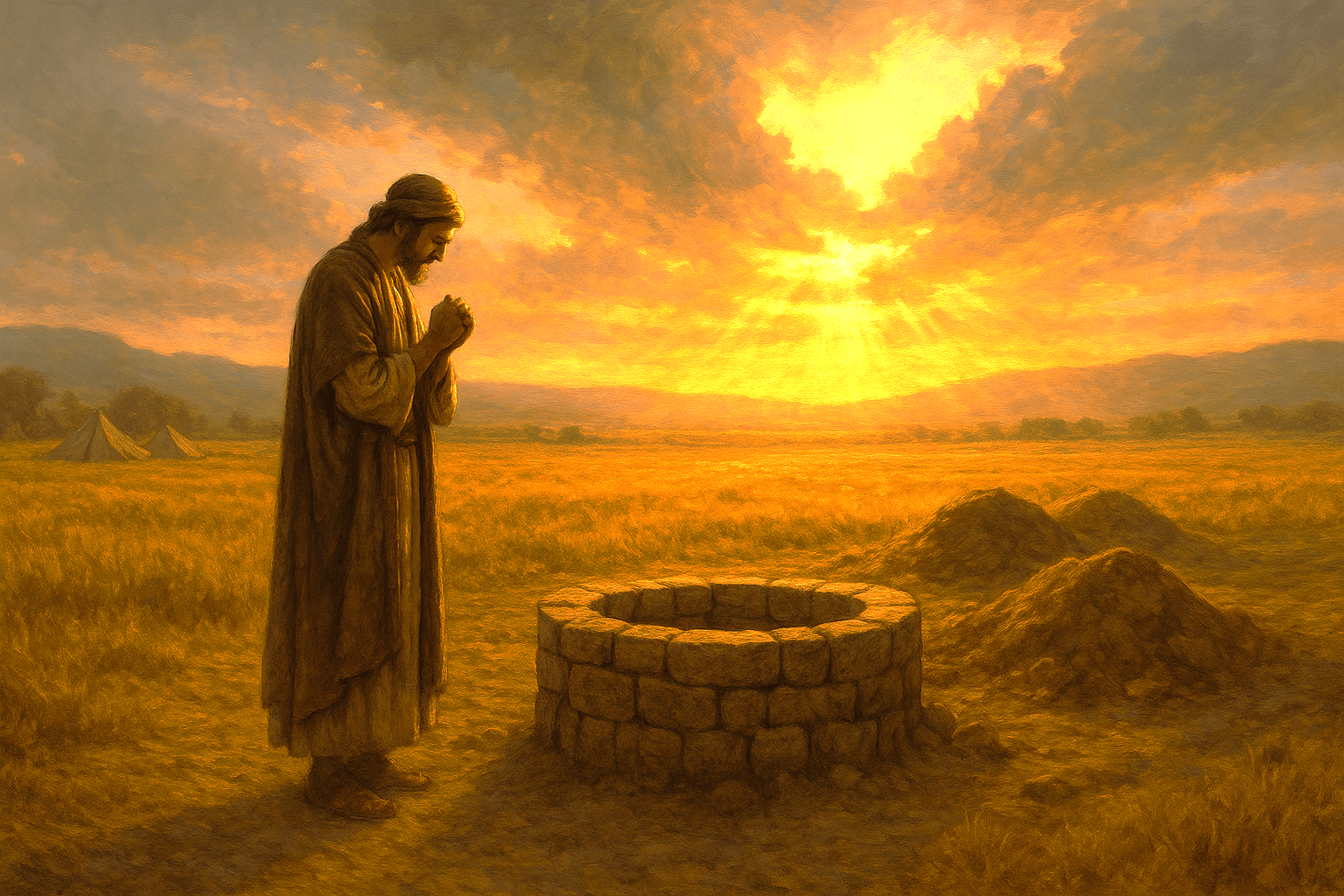
That evening, Moshe and his wife Tzipora would be celebrating their 40th anniversary. From the day they met at the watering hole, he just knew. He would be hers and she would be his. She had given him a family and a people and a name, to replace all that which was lost in Egypt. She gave him a son, who he named Gershon to honor these many blessings. Even his brother Aaron had managed to get leave to come and celebrate with his brother, as estranged as they were, living in separate lands, Moshe in Midian and Aaron still in Egypt.
And Moshe truly felt blessed as his gaze wandered among the many bleating animals grazing before him. He knew nothing of being a shepherd in Egypt. And now, watching, caring, and providing for the herd, was some of the most meaningful work and most fulfilling time spent.
Moshe looked up and saw the sun was now dropping low toward the horizon. He knew it was drawing close to the time he needed to return. He counted the sheep one last time, but he came up short. Moshe frowned. He had counted the herd a dozen times today, and it is now he comes up short?
After another quick count, he was not only certain he was short, but he knew exactly who it was that was missing. Slightly annoyed and slightly bemused, Moshe sighed deeply. It was Dinner, his fattened anniversary gift, who had wandered from the herd. Moshe pondered whether this sheep somehow knew this would be his last day among those who drew breath.
☼ ☼ ☼
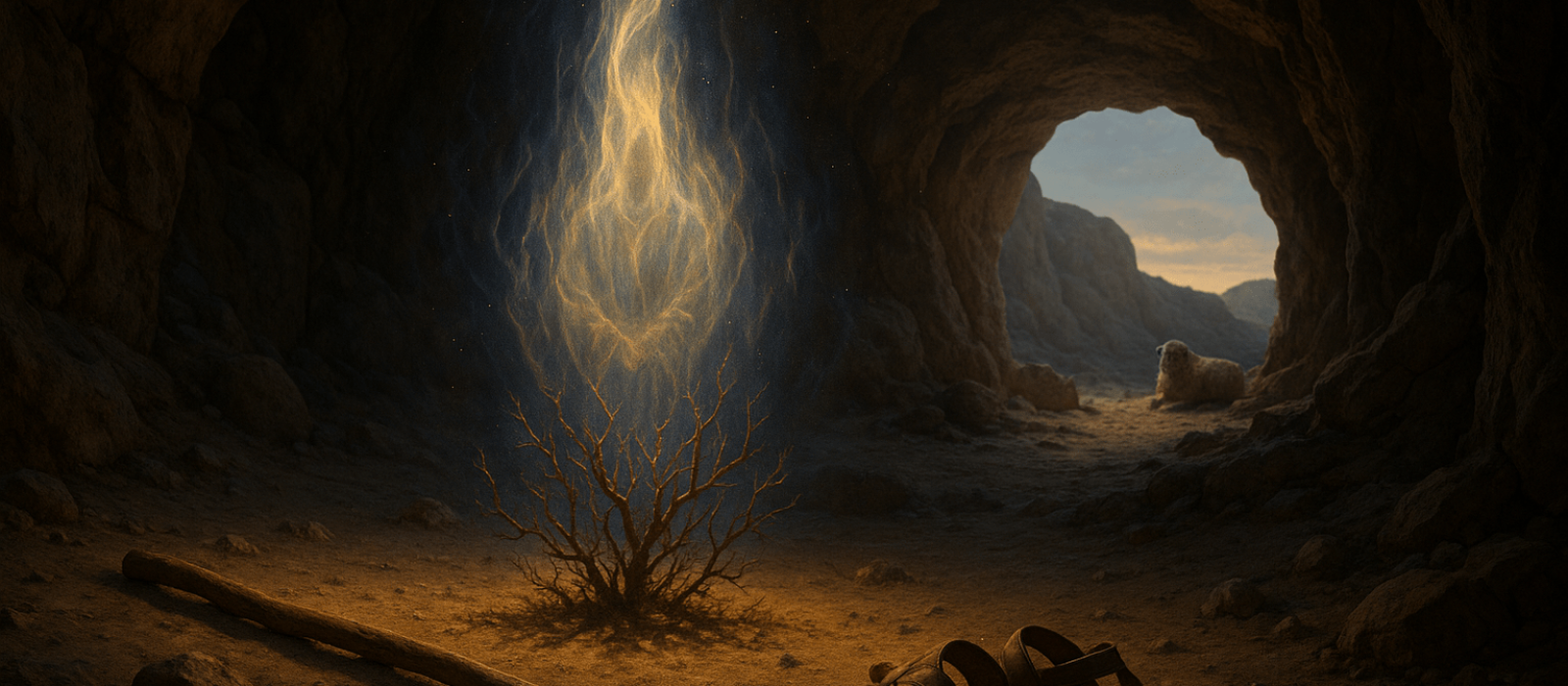
As Moshe walked among the bluffs, he would occasionally throw stones in some of the larger caverns and listen to see if anything stirred. But suddenly, as Moshe rounded a bend, he saw Dinner laying down just in front of a larger cavern. When Moshe approached his beloved lost sheep, he noticed a glow coming from inside the cave. A sense of foreboding flooded his awareness, as he slowly proceeded in.
A small unremarkable shrub grew a little way inside the cave, its existence tenuously perched between the strong eastern sun that baked the cave’s opening in the morning, and the condensation that dripped from the cool cave walls throughout the evening.
And as remarkable as all that was, there was what looked like, for lack of a better description, a bright light encompassing the entire bush. It looked somewhat similar to a fire, but there was no heat. The bluish-gold color was also wrong for flames, and the bush was entirely unharmed. Certainly, real fire would render this sad foliage to ashes in but moments. Moshe just could not process what he was seeing, but he also could not look away.
Curiosity and wonder drew Moshe ever closer to the bush before a voice called out, “Moshe, take off your sandals for under your feet is holy ground.”
As Moshe quickly complied, the voice continued, “I am the Elohim of your father Abraham, Isaac, and Jacob. I am your Elohim, the one who put you into the basket and set afloat in the Nile, and I am the one who drew you out again. I am the one who enflamed your indignation against the oppression of your people, and it was I who severed your future from Egypt and brought you here to Midian. And I am the one who will use you to bring your people out of the land of Egypt, to a land flowing with milk and honey, for they are also my people, my first born. They are the apple of my eye and the future of all humanity.”
It was like a veil had been removed and suddenly, Moshe realized it was not a flame that encompassed the bush, but the messenger of the Elohim, an Angel, who was standing there addressing him. He looked at the angel of the Elohim, and spoke humbly and most sincerely, “Huh-huh-who am I, that I should go to Egypt, tuh-tuh-to Pharaoh? Tuh-tuh-to lead the peh-peh-people out of Egypt?”
Elohim responded, “Will I not be with you always, wherever you go? Those seeking your life in Egypt have passed on to be with their fathers, so you are not a wanted man. Still, Moshe, I will give you a sign, and you will see this sign and proclaim this sign. When you have led the people out of Egypt, for it will happen and it will happen soon, you will worship me on this very mountain, this mountain of teaching, and I will teach you my ways and you will walk in my path.”
Moshe visibly shook. Talk to Pharaoh? Return to Egypt? Leave his family? His wife? His son? Where was he even to start? Moshe blurted, “Suh-suh-so, what is yuh-yuh-your nuh-name?”
“I am Adonai. I am what I will to be. I will be what I am. Tell them that ‘I am what I will to be’ has sent you. Tell them that the Elohim of your fathers Abraham, Isaac and Jacob has sent you. Tell them that this is how I am to be remembered. I will be your King, and you will be my people. I want you, all of the Hebrews, with your livestock, women, and children, to come out to me, a three-day’s journey, to worship me and to make sacrifices. For I will fulfill the promise I made to your father, Abraham, and I will make you into a great nation. Not like the nations of the world, but a nation chosen and set apart by me and for me.”
Moshe felt dizzy. He felt sick. He felt anxious. It was all too overwhelming. He looked down at his sandals sprawled haplessly on the ground. He leaned heavily on his shepherd’s crook and steadied himself. He tried to control his breathing, but he was still faint.
Adonai continued, “I know the Egyptians will not let you go, not without me showing them my wonders and my power. I created the heavens and the earth in six days, and I rested on the seventh. Not only will the Egyptians let you go, but I will make it so that they will bless you with their wealth, and you will plunder the Egyptians and receive your wages for the work you have done and the suffering you have endured. But it will not be easy to convince the Egyptians nor Pharaoh. You will have to show them my wonders. Do what I ask when I ask it, say what I tell you to say when I tell you to say it. Do not fear about what happens around you. You and your people will be protected, for you and your people are my people.”
“Now,” Adonai commanded, “throw down the staff in your hand.”
Moshe lifted up the crook in both hands and looked at it, and then looked at the angel still illuminating the humble bush. Moshe threw the staff down with both hands, and immediately it turned into a vicious, venomous snake.
“Now,” Adonai commanded again, “grab it by its tail.”
Moshe, not being fond of snakes, looked back to the fiery bush and then to the snake. He summoned all the courage he figured he had remaining and grabbed the snake’s tail. But as he lifted it, it wasn’t a snake, it was his crook. He looked back at the angel of Adonai as he felt his crook. It was solid. He looked it over. It was his. There was no doubt. It had the scratches and scars from four decades of use.
“Now,” Adonai commanded a third time, “put your hand in your tunic.”
With a sigh of obedient resolve, Moshe stuck his hand in his tunic. When he brought it out, it was like snow, leprous and without feeling. He wiggled his fingers, but they barely moved, his skin thin and sickly opaque. Faint tinges of pain and sensation flowed up his arm as he tried to move his fingers. His hand was completely leprous. It was awful. Tears began to well up in Moshe’s eyes.
“Wha-What is thuh-thuh-thuh-this?” he said gently.
“Now,” Adonai commanded, “put your hand back into your tunic.”
Against all reason and caution, Moshe did as he was requested. When he pulled his hand out, it was fully restored. Moshe let out a small wail, as tears of relief began to stream down his face.
“These are but a few of the smallest of things you will show Pharaoh. Perhaps he chooses to listen, perhaps not. If he doesn’t listen to even these, take some water from the Nile and pour it on the land. It will turn to blood. Moshe,” Adonai said, “understand, this is but a taste of what will come if Pharaoh refuses. But you and yours will be protected.”
Tears were still streaming down Moshe’s face, “I kuh-kuh-can’t spuh-speak. Who would lah-lah-listen to meh-me?”
The angel of Adonai roared, “Who created the mouth and the tongue and speech and your mind? Who created the words you say and think and write? Who gave you breath and lips to form words? Do I not also give and take sight and hearing?”
“Moshe, you cannot speak well because of your time in hiding. You cannot speak well because of Pharaoh’s directive to kill the Hebrew boys and your parents teaching you silent tears. Rest assured, this will be addressed, though it is an issue for another time.”
“Do you not think I have accounted for all of this and even much more? Do you think I somehow overlooked you? Did I not know you from when you were conceived in your mother’s womb? Did I not have you in mind since the time I laid the foundations of the heavens and the earth?”
Moshe just stood, pathetically, loudly crying the tears that, for so many years, he was forced to cry silently. Now, he cried them aloud.
Finally, Adonai spoke, “Your brother Aaron speaks well. You may use him until you are comfortable doing it yourself. I will give you what to say, and you put my words in his mouth. He will speak on your behalf. He is already on his way here to you now. So, go and make arrangements. The two of you will free my people.”
Moshe looked at the angel of Adonai. With a long sigh of resolve, he finally relented and said, “Ah-ah-as yuh-you wah-wish, Ad-duh-duh-donai. As yuh-you have ruh-ruh-ruh-requested, so I will also duh-do. As you have kuh-commanded, it will be done. You have buh-buh-been faithful to your people, and I know you will continue to always be fuh-faithful. Your promises never go unfulfilled. Obedience is how we will show you our love, and faithfulness will be our legacy to you. For to hear you is to obey you, and it is you, alone, that we will listen to and hear. Here, oh Israel, Adonai is our Elohim, Adonai alone.”
Used with permission by the author. Find the author’s complete works online: Complete Works of Mack Samuels