
Main setting: Genesis 10:25; 1 Chronicles 1:19 (Peleg: “in his days the earth was divided”)
Dispersal backdrop: Genesis 11:1–9 (Babel and scattering of the nations)
Nations mentioned: Genesis 10:6–14 (Mizraim, Cush, etc.)
Leviathan motif (by name/theme): Job 41; Psalm 104:26; Isaiah 27:1
1995 AM (1765 BCE) – LEVIATHAN
The ship creaked under the massive pounding of the storm. Peleg had gone below deck just to shelter for a bit. The storm had been raging for just over two days now, and the rain was cold, the wind fierce, and it stung like a thousand tiny stings. It was torturous. He had just completed an inspection above deck to make sure no rigging was loose and all the ropes were tethered.
Peleg joined his crew below. His crew consisted of half a dozen very loyal friends. Many had accompanied Peleg when he went to map the divides or made trades along the water routes. It was just the last new moon when Peleg had announced his crazy plan to sail out to reach the other side of the watery divide. His friends demanded to go along. It would be dangerous, and Peleg would need people to rotate watches, etc. He just had to let them go.
It was the larder that was Peleg’s greatest concern. He did not know how long they would be out. Sure, they could probably fish, but how would they fit enough for everyone for who knew how long? They decided that if they had reserves for one year, they could turn back in six months.
The cabin was dark and wet, but there were seven of them crammed in there, out of the wind and rain, and that, at least, made it warm.
Kochav was their navigator. Where Peleg saw nothing but random dots, Kochav had learned to look out and see patterns in the stars. He even contrived stories that explained their appearance and helped you remember them. Kochav had tracked how they moved between the seasons, and, of course, several of the brightest “wandering” stars that seemed almost out of place in how they moved.
There was a bright star in the north that seemed to just hang in the sky, like it was always meant to be an anchor point for all Kochav’s navigation. And of course, there was the star that arrived most mornings and evenings—always bright, always faithful. Then there was this swift star and another red star. All of these special stars didn’t move like the normal stars, and Kochav used most of the mappings plus these to be able to correlate his position. Peleg had no idea how Kochav did it.
Chiram and Oren also had no idea how the mind of Kochav worked. But neither could Kochav understand how Chiram and Oren were apt at planning their critical year-long larder. Nor was he able to explain why their choices would keep them strong, or why it would be a sufficient amount.
And not only food! Chiram and Oren also had a knack for seeing other needs they would have, being completely cut off from resupply. They could see the kinds of repairs their ship would need, inside and out, and even ways to store water from rain. Oren even came up with a scheme that used metal containers over a fire to get the salt out of sea water, if they had to. But that would be an expensive process in terms of fuel, not to mention a dangerous task to do on a ship. But it could be done.
“I’ll go out next, Peleg. You look beat!” Maoz said.
“Yeah, like a soggy tree!” Yam added heartily.
That was good for a laugh. Maoz and Yam were seasoned sailors. They made the journey between the shores of the ever-increasing divide many, many times, until the stories started to return with broken vessels. Since then, Maoz and Yam searched for an opportunity to cross the divide, even if it was just one last time. Love of the sea and curiosity of this “Leviathan” was their sole focus. When they heard that Peleg was heading out, they, too, insisted on going.
And then there was Nirav. He was the quiet, introspective one of the bunch. He rarely spoke, but when he did, it was like listening to the wisdom of Adam, Seth, Enoch, and even Noah—at least, if their stories are to be believed. Personally, Peleg never had an encounter with Adonai, like their fathers of old. But then again, Peleg never felt the need to. He believed simply in the words of Adonai because the alternative would, indeed, be unmanageable social chaos. They were a good way to live.
Besides, many of the more distant settlements, like Mizraim and Cush, were already pretty horrible with what they were doing. It seemed that the further away from the Hebrews one got, the further away from the positive influence of Adonai one got as well.
A shudder ran down Peleg’s spine. He suddenly wondered if they were leaving the protection of Adonai. Hence the storms?
Peleg turned to Nirav—at least, he was sure he was turning to Nirav; it was so hard to tell in the dark—“Nirav,” Peleg said, looking to his left.
“Yes?” Nirav responded from Peleg’s right.
Turning his head to the voice, Peleg proceeded, “Ah, yes, so, you are sure Adonai is ok with us doing this?”
“Huh? Oh. Well, as I said before,” Nirav confirmed, his smile audible in his words, “He said not to worry. He would be here with us. Why do you ask?”
“Well,” Peleg hesitated to answer—he hesitated to show fear—“the storm, mainly. It’s been days. It has to be similar to what Noah experienced.”
“Naw,” Yam cracked with a laugh, “they had way more room.”
Chiram once again offered his apologies, “Well, I mean, half of you should be above deck, while the other three are sleeping, and—”
But Maoz interrupted him, “Don’t worry, Chiram, Yam doesn’t mean anything. Just trying to pass the time. Besides, do you hear that?”
Peleg looked up and around, scanning silhouettes. Dawn was upon them. “Yup,” he agreed, “the rain stopped. Just a drizzle. I think—”
Suddenly, a firm impact caused the ship to keel hard. Some items clattered to the floor, and Yam cried out in pain. The ship righted itself and swayed heavily for a time.
Peleg commanded loudly, “Yam, are you ok?”
“Yeah, just a conk on the noggin,” he said, indicating clearly that he was fine.
“Alright,” Peleg said, “you and Maoz help me check for damage up top. Kochav, see if you can still make any bearing and find out where we are before it gets too light outside. The rest of you, make sure things are secure down here. We don’t want any more accidents.”
The four of them filed out, while the other three remained below, taking the opportunity to stretch their legs. Peleg stepped out and looked around. The waves churned in a calming, sinusoidal motion—still fairly placid, compared to the last two days.
Peleg looked out and could see that the storm clouds were in the distance, moving rapidly away.
Suddenly, Maoz shouted, “Leviathan!”
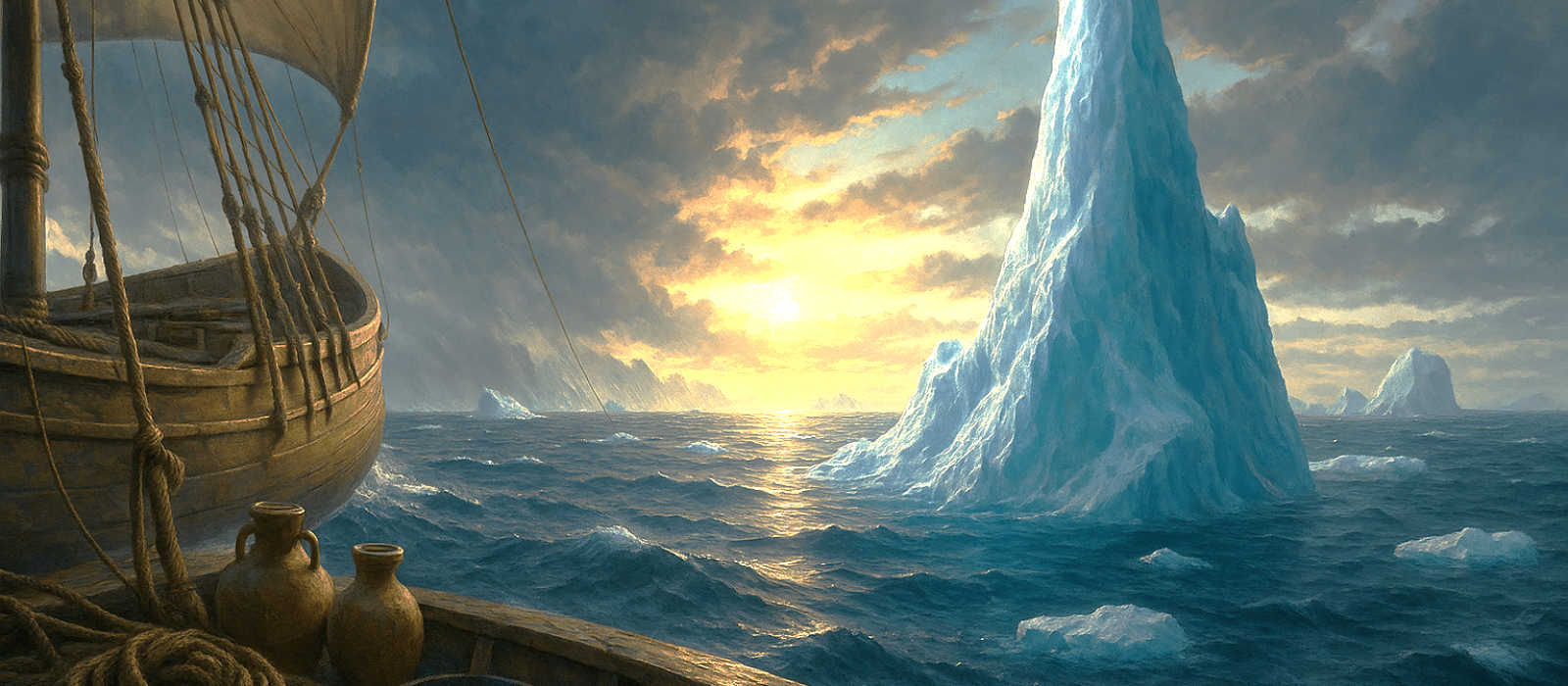
Peleg and Yam turned to join him. He was looking over the edge of the boat at what looked like a large spike or tooth floating in the water. It was what the ship had impacted. They didn’t see any significant signs of damage.
“Do you think it’s alive?” Yam wondered aloud.
“I don’t think so,” Peleg reassured, “it’s not moving. But it’s big. It’s also floating, but it’s, I don’t know, it’s just there. Maybe a rock? Maoz, don’t take this the wrong way, but jump in and see how far down it goes. I assure you it is not alive.”
The grin across Yam’s face was hysterical, although Maoz did not feel that humorous at the moment.
“Yeah, sure boss,” he said as he dove from the side of the ship into clear water. He popped up with a gasp, “wow, that will wake you up in a snap!”
He dove back under the water and swam completely around the “Leviathan” and then approached it. It certainly did not move. As he got closer, he reached out and touched it, but then pulled his hand back with a shout, “It bit me!”
“What do you mean?” Peleg shouted back.
Maoz touched it again, but this time he held his hand there, “I mean, it’s cold. It’s very cold. And slippery. And wet. Hold on.”
Maoz grabbed a pair of stone blades and struck them hard into the “Leviathan.” The blades stuck, and Maoz was able to use them to pull himself more on top of it. He liberated his knives, sheathed one, and tried chipping off a piece with the other. He was successful. He held the chunk in his hands, moving it from hand to hand, “Woah, it’s cold … and wet. I keep shaking the water off, but it is still wet.”
“What does it taste like?” Yam called out, “does it taste like the sea? Or like sea life?”
Without hesitation, Maoz sucked on it. “It has no taste. It is not salty. It tastes like water. I don’t know. Maybe this is a water rock,” he suggested, as he continued to suck on it, “but, unless I am missing something, it is just made of water. I mean, sweet water, to be sure, not brine, but it is simply a chunk of hard water. Have you ever heard of anything like this?”
“Water rock? No, I haven’t,” Peleg responded to his shivering friend. “Ok, get back here and warm up.”
Maoz started to swim back, when Kochav interrupted, “Peleg?”
Peleg had almost forgotten he was above deck. Turning to Kochav, Peleg immediately saw consternation in his face. “What is it, Kochav?” Peleg walked nearer to his navigator.
“Bad news, and worse news, I’m afraid,” Kochav said. “We are very far south. Very, very far south. I won’t know exactly until I get a clear look at the evening sky. And the worse news,” he added, pointing his finger to things floating all around them.
They were surrounded by Leviathans—by water rocks—in every direction. The others joined them above deck when they heard Kochav say, “Bad news.”
“The storm blew us very far south,” Kochav repeated to the others joining them. As Maoz was just climbing aboard, Kochav inquired of him, “How’s the water out there?”
“Wow, yeah, it’s a bit bitey. Coldest water I have ever swum in. Almost as cold as the water rock.”
“Yeah, I figured as much,” Kochav said unenthusiastically. He pulled out some scrolls made of animal hide, “Here, look at this. These are some of Noah’s journal scrolls—well, copies actually. See here? They talk about after the forty days of rain, that the rain got very cold. It turned solid, like little pebbles, and then it turned into flakes. After a while, the solid rain began to stick to the top of the ark and got even harder, as the air outside got colder.”
“Noah eventually called that ice, see here? And then, see here? When the rains stopped, the clouds parted, the greater light reappeared, and the air began to warm, then the ice began to soften and turn back into rain. Or, I guess, just water at that point. We have never seen anything like this because we have always lived where it is warm year-round. We have never experienced cold or snow or ice. I am sure this is the first time you have ever heard of these words. But see, here they are in Noah’s journals.”
Each of the crew took turns looking at the images on the page that told the story that Kochav was summarizing.
Peleg just rubbed his beard in contemplation, “Well, I understand why people thought this was a Leviathan. They did not have our boy Kochav here!”
Everyone chuckled and chortled, except for Peleg, that is.
“They might as well be Leviathans, though,” Peleg announced, “since we are surrounded by them, and we can’t risk damaging our ship. It will be difficult to sail around them or through them.”
Peleg scanned the horizon, “Definitely looks like we have to head back north. Can’t keep going south. This means we will likely be near, where? The area where Ham settled?”
“Yeah,” Kochav agreed, “sounds about right.”
“Well, there is no time to waste,” Peleg said. He was in full captain mode, “Oren and Chiram, use that water rock and fill any empty water containers we have. Yam and Maoz, go collect it for them. Kochav, figure out how to get us to land … any land will do at this point. And Nirav—”
“Yes?” Nirav answered, astonished that he was of need, “How can I help?”
“You need to pray to Adonai and ask Him for deliverance.”
Used with permission by the author. Find the author’s complete works online: Complete Works of Mack Samuels