
Scripture References: Matthew 24; Luke 21:5–24
3821 AM (61 CE) – A TRIAD OF ZEALOTS
An older Eleazar really was an effective zealot, as were his friends Yochanon ben Levi and Simon ben Giora. They had all managed to become commanders of large Zealot armies. It was not so much any kind of promotion within the ranks of the Zealots, as it was a devoted following to each of their zealous causes. Those that flocked to Eleazar shared his concern for the protection and purification of the Temple, especially after that hedonist, pagan Caligula had threatened to erect a statue of himself on the Temple grounds.
Eleazar ben Simon was not merely a zealot – he was a guardian of the Temple, a man whose life revolved around the sacred duty of protecting what was, to him, the last vestige of Jewish identity under Roman occupation. He had once driven out the Romans from the Temple Mount, halting the daily sacrifices for the emperor, a bold and dangerous act that had sparked the rebellion in Jerusalem. He was not alone in his conviction, for Yochanon ben Levi, his childhood friend from Galilee, and the fierce Simon ben Giora from Judea, had risen alongside him, each commanding their own armies, with followers dedicated to their causes. But Eleazar’s cause was different – his was the Temple, the holiest of holies.
It had been decades since Caligula had threatened to erect his statue in the Temple, and the memory of Antiochus Epiphanes’ desecration centuries earlier still echoed in every corner of the Jewish soul. These events had shaped Eleazar’s unwavering determination to preserve the purity of the Temple at all costs. Now, with the Romans gone from the Temple’s grounds, his men had secured a fragile peace, though Eleazar knew it would not last.
The storm was gathering, this much he knew. He and his forces had expelled the Romans from the Temple Mount and the immediate vicinity. And for the most part, just the presence of his army had been enough to peaceably secure the area.
Eleazar’s friend, Simon ben Giora, had forces drawn from the peasantry, living off plunder – treasures, weapons, and food supplies looted from Roman outposts and sympathizers. His methods were ruthless, but effective. He kept the countryside in chaos, ensuring that Roman forces were stretched thin, unable to respond swiftly. Yet Simon had his own ambitions. He was no mere protector; he fancied himself a leader of men, one who might even unite all of Judea, if only given the chance.
Lastly, Eleazar’s friend, Yochanon ben Levi, the Galilean with his growing army in Giscala. He, too, had garnered a large following, but his interests lay in power. His ambitions were vast, and while he shared Eleazar’s hatred of Rome, he saw the rebellion as a chance to solidify his control over Jerusalem, not just as a religious stronghold, but a political one. Unlike Simon, who reveled in the fight, and Eleazar, whose cause was spiritual, Yochanon thirsted for control.
As a result of the Zealots, most of Judea had been largely liberated from Roman control. It had been a gradual process, and all involved counted on the status quo. As successful as they had been, they still needed more time to consolidate forces and supplies, organize strategies, and truly begin to liberate Israel from the oppressive bondage of Rome.
Despite their shared hatred of Roman rule, the three leaders could not agree on a unified plan. Eleazar focused on fortifying the Temple, Simon on harassing Roman supply lines, and Yochanon on consolidating political control. What should have been their strength – three powerful forces aligned against a common enemy – quickly became their greatest weakness.
☼ ☼ ☼
As Eleazar sat in the Temple courts, contemplating the next phase of the revolt, his second-in-command, Thomas, approached.
“The followers of The Way are causing trouble again,” Thomas said with a sneer. Eleazar waved his hand dismissively but could not hide his frustration. He had heard enough of these reports – Jews who followed this Yeshua of Nazareth, the so-called Messiah, a man who had been crucified years ago but whose followers now claimed he had risen from the dead.
“The Way?” Eleazar blurted cynically, “The way of what?” Eleazar looked to his number two, but it was a rhetorical question. Besides, Eleazar already knew the answer; he just didn’t like the answer. The rumors of “The Way” persisted, despite the rumors from the Sanhedrin that were meant to counteract any nuisance notion of a resurrection. And how many of the disciples had been killed for their belief? It was frustrating, especially since the movement was growing.
“They’re filling the Temple courts, speaking of resurrection, of peace,” Thomas continued, “when we’re preparing for war.”
Eleazar gritted his teeth, “They don’t understand,” he muttered, “They think the Messiah will come and bring peace? Look around. There is no peace – not with Rome. We are the sword. We will carve out our own freedom.”
The truth was that “The Way,” as they annoyingly called it, was growing, and Eleazar feared it was dividing the people at a time when they needed to be united. He had no time for their message of forgiveness when the Romans were at the gates, preparing to crush them all.
“They won’t listen,” Thomas added, “and I doubt they’ll fight.”
Continuing his dry rhetoric, Eleazar said with a wave of the hand, “Doesn’t matter. The bigger issue is that ‘The Way’ always seems to be getting in the way! I can’t have them complicating our plans. Not now, of all times.”
Eleazar was annoyed that the “true believers” of “The Way” were crowding the Temple, even though it was his men who had secured that freedom for the Jews to worship at the Temple without being harassed by the Romans.
Thomas chuckled, “Funny. Don’t they know they are just stoking animosity with all the sects? And possibly even the Romans? It’s like they are trying to get themselves killed for their cause.”
“Indeed,” Eleazar agreed, “Well, we have our plans to antagonize the Romans. We can’t afford for them to get in the way. I certainly cannot assure their protection.”
Eleazar sighed, “They’ll just be swept aside when the fighting starts. We have no time for their weakness.”
☼ ☼ ☼
The “Revolt” began in Jerusalem on schedule. It began with Eleazar’s army expelling the Romans in the name of over-taxation – as if the Jews needed an excuse. Many of the Romans fled, which was unfortunate. Eleazar hoped to leave none alive for Simon, who was lying in wait. The fighting was not terribly fierce, as they had managed to catch the Romans off-guard.
Eleazar could see in the distance that as many Romans were fleeing, there was no Simon to be found.
“Idiot,” Eleazar muttered to himself, as he could see Simon’s forces had prematurely engaged other Romans, “Fool!” he muttered again, “This was supposed to be quiet!”
Still, he could see many of his Zealot army leaving Jerusalem to support Simon and Yochanon, who, by now, had the Galilee in flames – at least, the Roman garrisons. By the end of the day, the whole of Judea would be in turmoil, with all Romans being expelled or killed. They were extremely effective in achieving this goal.
Things seemed to be going their way, with Rome on the defensive, but they all knew it couldn’t last.
☼ ☼ ☼
Nero, the emperor of Rome, looked at the envoy of broken commanders standing before him. The dilemma was a difficult one. Should they die? Should they live? Should they be slaves? How could they lose control of Judea? None dared speak to, nor even look at Nero.
The heads of the commanders hung low. Still, their loyalty was absolute, which is why they stood here so, without guard, without coercion. And, if Nero asked them to open their own veins for Rome, they would do so immediately before him.
This Nero knew for sure. So, being a man of logical disposition, though certainly favoring the Roman gods over the Greek ones, he sent for his most trusted Legatus Augusti pro Praetore, named Vespasian.
As Vespasian entered, taking in the scene splayed before the king, Nero spoke, as if pronouncing a eulogy, “Great Praetor, Vespasian.”
Vespasian bowed, knowing that the compliment was as much a veiled threat as an accolade, “My God and my King,” Vespasian responded.
“Judea is in revolt,” Nero said tiredly, “and these men are the aftermath.”
“I see,” Vespasian responded, “Your will?”
“Take these men and put them to use. Go, quell Judea. Press in from all sides. Do it quickly.”
Vespasian bowed, and with a hard salute, pointed to the commanders, “Go, get prepped. I will be right with you.”
Vespasian watched them leave, and then turned back to the king, “Birds will be picking my flesh somewhere in a Judean field, should this not be done immediately.”
“Very good of you,” Nero regally retorted, “Keep me posted.”
☼ ☼ ☼
The onslaught began in the little town of Giscala, which Vespasian was informed was a major stronghold. Yochanon and his army were agile and able to flee. Systematically, the Romans, with many legions, kept pushing the various Zealot detachments. Once most of Yochanon’s strongholds had been taken, Yochanon took his army back to Jerusalem.
The greeting from Eleazar was not the hero’s welcome of his great sacrifice, but was rather cool at best, if not downright frigid. Yochanon’s army occupied much of lower Jerusalem, as Eleazar pulled his men back to the Temple. While they both agreed that they needed to start preparing for a Roman siege, that was about the last thing they agreed on.
For the next two years they monitored the progress of the Romans. It wasn’t good. Simon was finally flushed from the wilderness, and his remaining army was much less than it had been, a point Yochanon would remind Simon about fairly regularly. But had Yochanon and Eleazar helped Simon for those two years he had kept the Romans busy, perhaps they would not need to be holed up in the city.
These jabs, along with differences of opinion on fortifications, rations, and defense, meant Eleazar, Simon, and Yochanon fought endlessly. At first, Simon’s men largely kept to the upper part of Jerusalem, with Yochanon in the lower parts of the city, while Eleazar remained staunchly at the Temple. However, contention flared, and armed conflict constantly broke out among the factions of Zealots.
Yochanon was largely to blame, as he vied for power and control of all three armies, going so far as to occupy the royal residence and make royal banners with his faction depicted on them. Eleazar knew this, too, was idiotic. How long would it be before they were surrounded by Romans? And just as idiotic was Yochanon not allowing the non-combatants to leave.
“We will live as Zealots, or we will die Jews defending our homeland from Rome!”
Many tried to escape, and they were slaughtered by Yochanon. Eleazar could not imagine things could go on as they had. Hadn’t they learned enough from the Hasmoneans? Should they survive just to recreate that hell in Jerusalem again? How long before there was nobody left? Could they wait that long?
Luckily, Eleazar did not have to wait very long at all before Titus, the son of Vespasian, came… with four legions of Romans, plus legionaries and auxiliary troops like cavalry, archers, and light infantry, for a total of nearly sixty thousand men.
Apparently, while they were locked away in Jerusalem bickering, Nero had died and Rome went through a minor civil war, until Vespasian became emperor and sent his son Titus to finish what he had started.
This was not good.
The siege was tremendous.
☼ ☼ ☼
As the months passed, siege vehicles were slowly built and encroached on their position, just out of their reach. Their food supply was systematically depleted. Then the walls of Jerusalem were systematically compromised. And even though Eleazar, Yochanon, and Simon tried to rally their forces in defense of the city, they, too, seemed systematically compromised, as the constant infighting destroyed morale and effectiveness.
As the overwhelming number of Romans overwhelmed the dwindling and chaotic forces of the Zealots, Yochanon and Simon fell back with Eleazar in the Temple for a final defense. It, too, was fraught with struggle and infighting – even when their certain doom loomed so near.
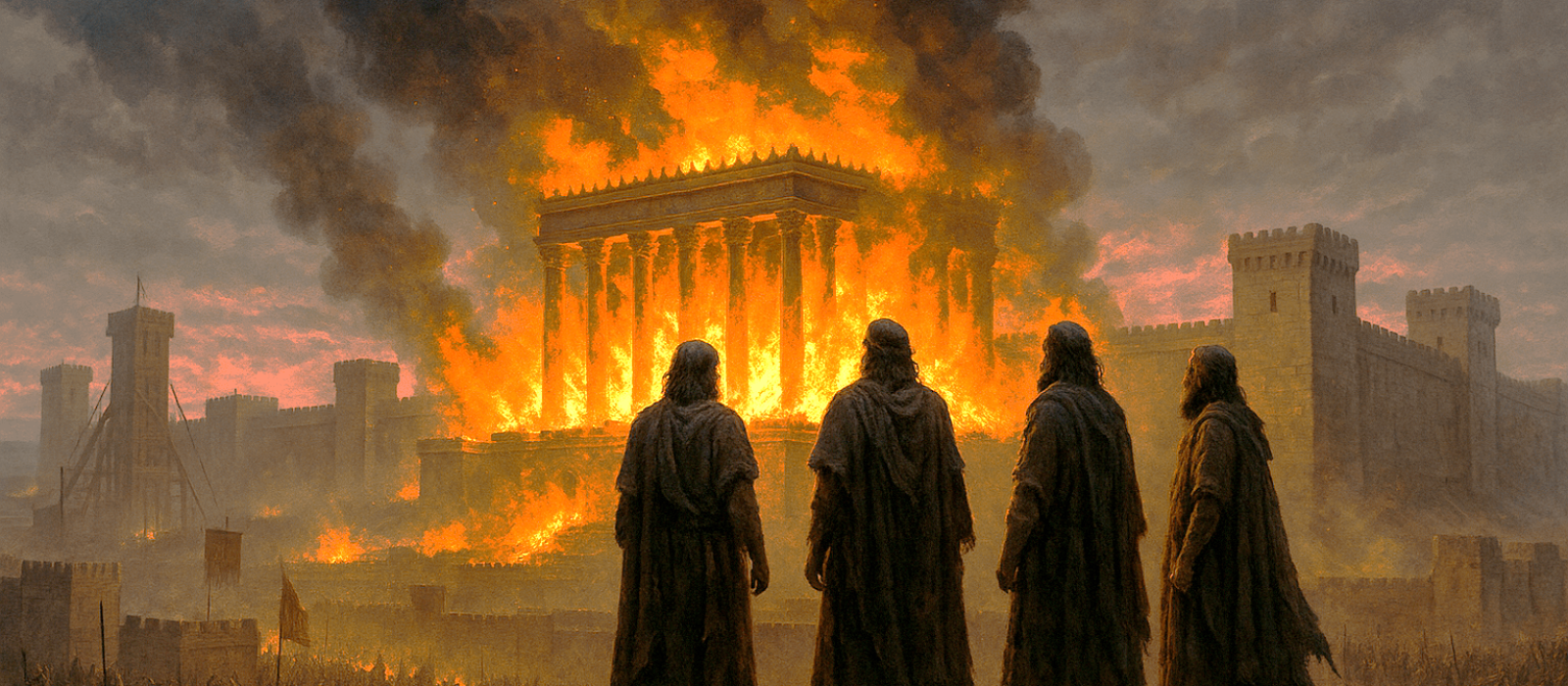
The Romans were determined to end this ludicrous saga of man. Titus had commanded that they preserve the Temple, so they stormed the Temple Mount at great cost, securing all but the Temple. In an attempt to smoke out the Zealots, many torches were tossed in. In the shuffle, lanterns were knocked over and the olive oil from the lamp spread to many of Herod’s ornate curtains, and then to the dried-out wood beams of the ceiling. Ultimately, it wasn’t the smoke that forced the Zealots into the hands of the Romans, but the intense heat of the flames that soon engulfed the entire Temple.
It took much effort from the Romans to contain and extinguish the flames, but not before the Temple was a total loss. Yochanon tore his clothes as he yelled blasphemies at the Romans. He was captured and spent the rest of his life in a Roman prison. Simon, on the other hand, quietly fled into the hills, only to be captured and executed by the Romans for his cowardice.
Eleazar never made it out of the Temple. Maybe he couldn’t bear to see it destroyed, or maybe he wouldn’t abandon his post. Regardless, his remains were never recovered. The flames were so hot, nothing was left but some of the walls.
The ornateness so carefully crafted by the Herods went up in flames, taking the gold of the Temple with it, which melted down all along the floor and even into the subflooring – filling even the smallest gap in the stones.
In typical Roman fashion, they began to search through the rubble looking for the melted gold. Melted piece by melted piece, the Temple was plundered slowly. They would follow where the gold had melted and remove stones until they got every last ounce.
By the end of the effort, not one stone was left on another.
Used with permission by the author. Find the author’s complete works online: Complete Works of Mack Samuels