
Sulam Ya’akov: The Ladder of Jacob
by Rabbi Bonney Cassady and Rabbi Myron Slobin
“Sulam Ya’akov” (“The Ladder of Jacob”) refers to the vision God gave to the patriarch Jacob (Ya’akov) in Genesis 28:10–22. In this moment at Bethel, heaven and earth touch, and Jacob is given promises that echo through Sinai, the Temple, and ultimately the mission of Messiah.
Genesis 28:10–12 (NKJV)
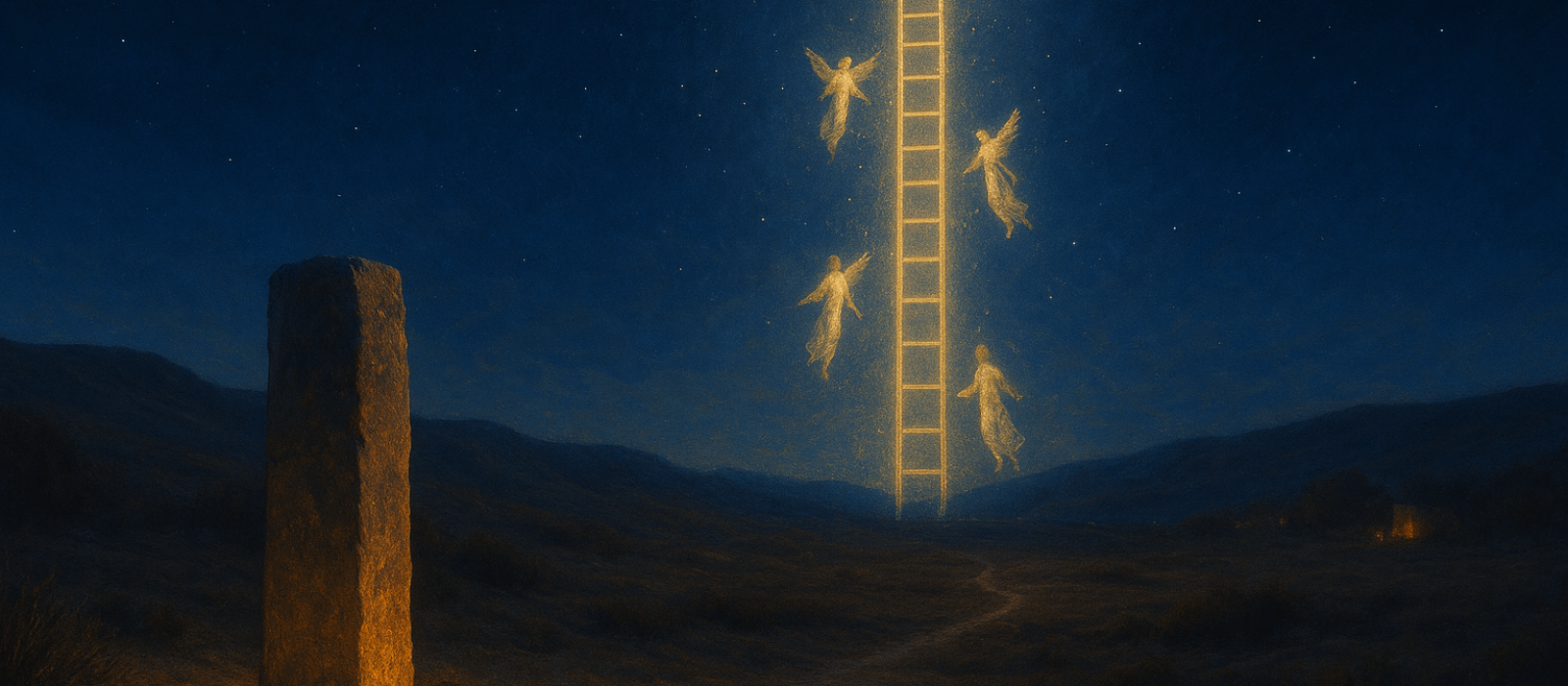
Now Jacob went out from Beersheba and went toward Haran. So he came to a certain place and stayed there all night… Then he dreamed, and behold, a ladder was set up on the earth, and its top reached to heaven; and there the angels of God were ascending and descending on it.
Genesis 28:13–17 (NKJV)
And behold, the Lord stood above it and said: “I am the Lord God of Abraham your father and the God of Isaac; the land on which you lie I will give to you and your descendants… in you and in your seed all the families of the earth shall be blessed….” Then Jacob awoke… “How awesome is this place! This is none other than the house of God, and this is the gate of heaven!”
Genesis 28:18–22 (NKJV)
Then Jacob rose early… took the stone… set it up as a pillar, and poured oil on top of it… and called the name of that place Bethel… “then the Lord shall be my God… and of all that You give me I will surely give a tenth to You.”
Prayer and “The Place” (HaMakom)
A classic Jewish insight captures the heart of the vision: “A ladder stood on the earth and the top of it reached to heaven. This is prayer.” (Tikkunei Zohar 43 on Gen. 28:12) Prayer is the living link between worlds.
Rashi (R’ Shlomo Yitzhaki, 1040–1105) notes that “HaMakom—The Place” refers to Mount Moriah, the Temple Mount: “The Place is Mount Moriah, where Abraham bound Isaac and where Solomon would erect the Temple.” (Rashi on Gen. 28:11)
Another midrash adds: “Why is God called Makom? Because He is the place of the world and the world is not His place.” (Yalqut Shimoni Vayetze §117) Jacob’s language—“house of God… gate of heaven”—anticipates God’s dwelling among His people.
Four Revelations Flowing from Bethel
1) Bethel Anointed: The House and the Gate
Jacob’s awe leads him to anoint the stone and vow faithfulness. Bethel becomes a prototype of God’s dwelling and a signpost that a heavenly gate can open upon earth when God’s word and worship meet.
2) Sinai and the Ladder: One Voice
By gematria, Sinai (סיני) equals 130; so does sulam (סלם) “ladder.” The sages connect the two scenes: Israel “stood at the nether part of the mount” (Ex. 19:17), and the mountain “burned… to the heart of heaven” (Deut. 4:11). Angels ascending and descending mirror Moses ascending and descending (Ex. 19:3, 19:14). As Genesis Rabbah 68:12 reads the scene, Sinai is the living “ladder” by which Torah descends and Israel ascends in covenant.
3) Temple and the Heavens: Dwelling in the Thick Darkness
At the Temple’s dedication, Solomon proclaims: “HaShem has said that He would dwell in the thick darkness” (1 Kings 8:12). The sages identify “araphel” (thick darkness) with the first of the seven heavens and “zevul” (habitation) with the fourth—imagery that places the Temple at the nexus of heaven and earth. The “house” on earth corresponds to God’s “habitation” above (1 Kings 8:13).
4) The Messiah and the Ladder
Messiah ben Yosef—Prayer Revealed. Jacob’s ladder has long been associated with Joseph’s quality of connection and preservation (cf. Kol HaTor 2:97). The tzaddik reveals prayer—“And I am prayer” (Ps. 109:4)—becoming a conduit for divine compassion.
Messiah ben David—Heaven Opened. Yeshua applies Jacob’s vision to himself: “You will see heaven opened, and the angels of God ascending and descending upon the Son of Man” (John 1:51). The title “Son of Man” echoes Daniel’s vision (Dan. 7:13) and the psalmist’s prayer (Ps. 80:17). Zechariah foretells the Branch (Tzemach) who will build the Temple of HaShem and rule in harmony with priestly mediation (Zech. 6:12–13).
In the ascending and descending of the messengers we witness unbroken communion: the Father’s will revealed and enacted on earth. In Yeshua, heaven’s traffic becomes personal—God’s love communicated, obeyed, and modeled for us. As Jacob’s ladder bound Bethel to heaven, so Messiah binds humanity to God’s heart.
Living the Vision: Relationship and Response
HaShem desires relationship; the essence of relationship is communication. Sulam Ya’akov pictures this in Genesis, is amplified at Sinai and in the Temple, and reaches its fullness in Yeshua the Messiah. He is our “ladder”—the living connection by which we ascend in prayer and obedience and by which God’s presence and blessing descend into our lives.
May we anoint our “places” with faith as Jacob did—raising stones into altars, moments into meeting places—so that the house of God and the gate of heaven are found wherever we call on His Name.