
3833 AM (73 CE) – Whatever Happened to the Sicarii?
“Masada is very much like Petra,” Eleazar ben Yair shouted to all who surrounded him.
The crowd around ben Yair amounted to nearly everyone not at the walls standing guard, and they were enraptured with his words. The Sicarii had fled to Masada when the Zealot revolt failed in Judea. Many of the surviving Zealots, though there were not many, fled with them.
“Masada is both a stronghold and a tomb. A fortress that is easily defensible, but not indefinitely. Look around you.”
Ben Yair waved his hands toward the walls. From where they stood, no Romans were in sight. But everyone knew they were there. Faint sounds of horses and siege work gently interrupted the serenity of their fortress.
“Yes, the Romans will come, eventually, when our food stores are exhausted, and we are nearly dead anyway. They will break down some wall somewhere. Like roaches or rats, they will pour in. And what will they find? Cowards, whom they can rape and abuse, and ultimately sell into slavery? Warriors, whom they will ultimately overwhelm and cut down, no matter how many of them we slaughter? And what of our children? To be raised as Romans? Or Roman slaves? The girls prostituted and the boys violated by the worst of their men?”
Ben Yair’s voice was bleak, and he allowed his words to linger. Gentle sobs began to fill the air.
“No!” Ben Yair yelled. “Did you hear me?” His voice seemed to echo forever. “I said no! We are not weak, and we are not cowards. They will take us alive, and we must not allow it! You have to understand: we cannot be defiled by them. We cannot allow ourselves to be captured and tortured. We cannot capitulate to compromise after so many years of fighting.”
The fortress was on a very steep hill, high above the Romans. The wind, hot and scorching, blasted Ben Yair’s own hot and scorching words among the people.
“Everybody dies. It is a blessing when you get to decide when and how, and not leave it to the whims of filthy pagans, who will try to corrupt our hearts and turn us away from Hashem. No, we all have to die, but it is better to believe in Hashem than to live even another ten decades as a faithless pagan. Because that time, too, will end, and you will have to face Hashem. And how shall you stand, then?”
Above them, vultures circled ominously, as if they already knew what decision was about to be made, as if they were ready to render the service for which Hashem had created them to perform.
Yair continued, “When the Romans come, it is not starving, half-dead Jews they will find, but bodies sacrificed unto the sanctification of the name of our Adonai, our Elohim. Shma Yisrael, Adonai Eloheinu, Adonai Echad! Let the Romans find us in peaceful slumber, with ample food stores, so they know we did this final act of defiance with a sober mind, and a resolve of strength that they could never know. We all have to die, but we can die free.”
☼ ☼ ☼
“But I am scared!” Shira pleaded with her husband, Benaya, a young Sicarii soldier, loyal to Eleazar ben Yair, “and we are so young… our lives still fully ahead of us.”
“We all are scared,” Benaya replied, trying to comfort her, “but it is much better than dying at the hands of the Romans.”
“Is it?” Shira pleaded once again out loud. “I suppose you are right. And if it were just me, I mean, if I were making this choice just for myself, I could do it with a clear conscience.”
Benaya was confused. “What do you mean? It was a community decision. Our duty is to our community. Besides, I can speak for myself.”
“I don’t mean you.”
Shira could not look her husband in his eyes, as tears filled her own.
“What do you mean, Shira?”
Benaya moved to Shira and gently laid his hand on her shoulder. “What do you mean?”
Shira looked up. “I am with child.”
☼ ☼ ☼
Benaya was angry with himself. He was angry with Shira. He was angry with his own folly following Eleazar ben Yair. Somehow, somewhere in his wife’s words, “I am with child,” the Sicarii spell had been broken.
It was dark now. They had to be quiet. It wasn’t that the Sicarii doubted the loyalty of the people who committed to this horrible decision, but Benaya was sure they were not the only ones having second thoughts. When the community’s suicide began, it would be swift and painless, but if you were caught outside, trying to escape into the night, as they were doing now, the Sicarii could make death more painful than the Romans ever could.
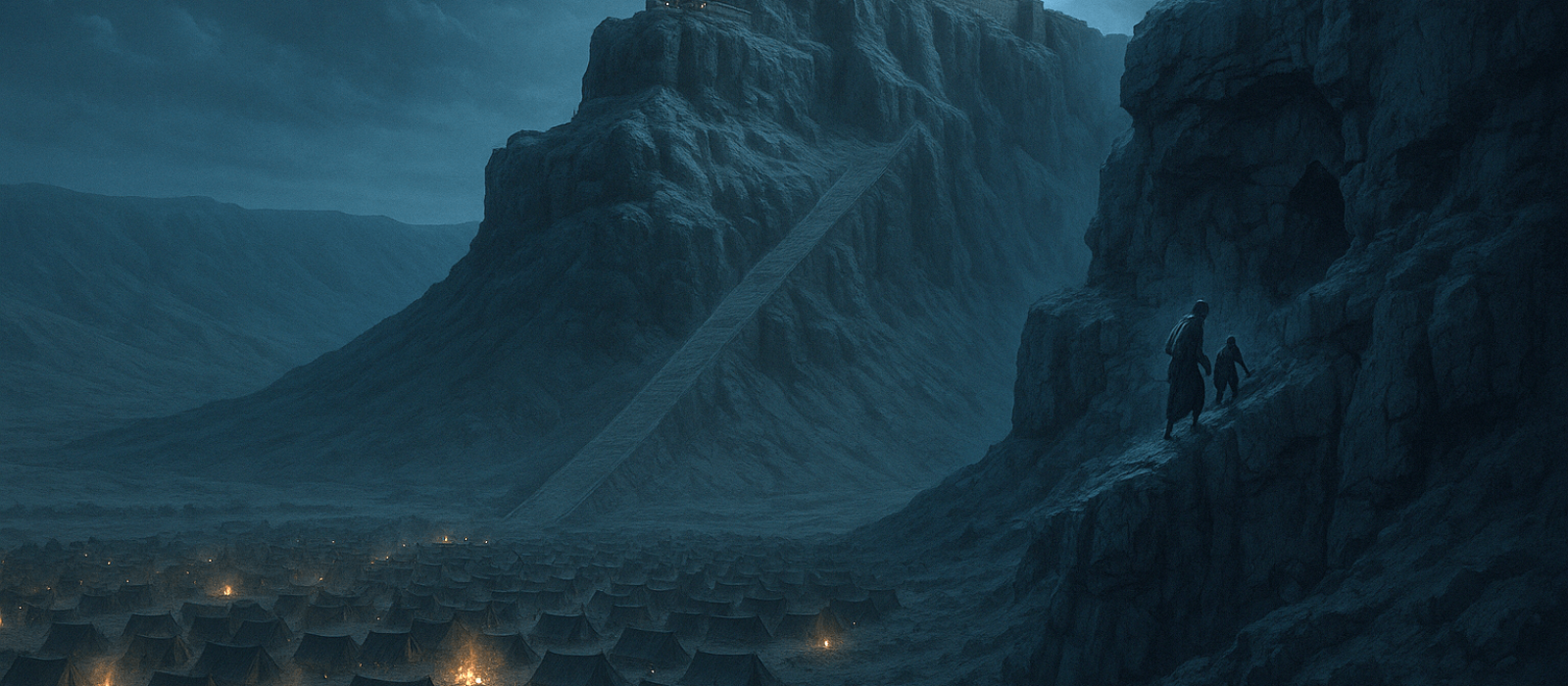
Benaya moved silently, and Shira followed. It was just outside the walls, and if they were careful, they could reach it unnoticed. It was a cave. Not entirely obscure, but not likely to be found or searched if the Romans believed that everyone had died willingly. But one false step, and it would be a long drop to the bottom.
Shira held his arms with both hands, as he leaned over the wall, and set her on the ledge. She had just a hand’s width for her foot. The moon was out, but it had waned the last couple of weeks to almost nothing. Still, they could make out the ledge, and her foot made contact.
She moved toward the cave opening, moving slowly. Benaya said to be utterly silent. Don’t kick any rocks, move slowly, and don’t make a sound. She took his words deadly seriously. Benaya lowered himself down, hanging from the ledge of the wall, but he was short nearly a cubit from the edge.
With a deep breath, he let go, trying to keep contact with the wall. Shira had to cover her mouth to stifle her fear. Benaya landed hard and started to fall back into the nothingness of space, grasping desperately for the wall.
Suddenly, Shira reached out to him. They both teetered on the precipice, pushed and pulled at each other, until finally they were still. With hearts pounding, Shira and Benaya continued their silent exodus to the cave. They had brought nothing with them. They would survive at most two or three days, but if they had stayed, they would not have survived the night.
☼ ☼ ☼
The Sicarii were a menace to the Romans. They would often sneak in and out of Masada and terrorize surrounding Roman villages. Rome honestly couldn’t care less about the Sicarii holed up in Masada, but they would just not leave well enough alone.
The Romans would normally have prepared to lay siege for months, knowing the vast store of food and supplies Masada could hold. But after three years of resistance, even after the fall of Jerusalem – the Sicarii were a blight on the greatness of Rome.
There would be no siege, except to prevent escape or resupply.
Rome brought its weapons of war against the entrances, building an enormous ramp. They would fight their way to the heart of the Sicarii, no matter how many Romans fell. This would be the end of the Jewish resistance to Rome.
And as predicted by Eleazar ben Yair, they destroyed a section of the wall and filtered in like rats or roaches. And, yes, they looked to prey upon whomever they could devour. But nobody could be found until they suddenly found everybody. The Romans, who were no stranger to death, were aghast, and maybe even a little relieved.
As the Romans walked further into the structure, a grisly story began to unfold. Children and women slain by their fathers and husbands. Lots were obviously cast to see who had to be the last man standing, who had to ultimately open his own veins.
Lucius Flavius Silva, the commander of the Roman army, perched upon his steed, surveyed the death. His men pointed out the provisions the Sicarii had stacked out in the open for the Romans to find, as if to make some profane gesture appropriate for the time, as if to say they could have held out longer had they wished.
Then a sound, an echo, as if from a cavernous room. Others heard it as well, and Lucius pointed. Several soldiers headed toward the edge of the city and peered at what looked like a cave. It was a cistern. With some rope, two women and five children were liberated from one of the city’s cisterns.
Lucius commanded, “Search around. Make sure nobody else is hiding out.”
The whole perimeter was searched, as were the edges of the cliffs beyond the walls. Many caves were found, but there were no signs of any other life.
Used with permission by the author. Find the author’s complete works online: Complete Works of Mack Samuels