

Parashah Lech Lecha (2024): Shema and the Oneness of G-d
HaShem gave me two articles that speak to the Oneness of G-d and bear on this week’s parashah: Lech Lecha (“Get Yourself Out”). The first came through the current issue of Petah Tikvah Magazine and was originally published by TheIsraelBible.com on February 15, 2024. Written by Shira Schechter, content editor for TheIsraelBible.com and Israel365, it is entitled, “A Prayer Across Time.”
A Prayer Across Time — an excerpt
In 1946, shortly after the end of World War II, Rabbi Isaac Halevi Herzog, the Ashkenazi Chief Rabbi of Mandatory Palestine, traveled to Europe in hopes of finding Jewish children who had survived the war. He visited a monastery known to have sheltered Jewish children from death at the hands of the Nazis. Rabbi Herzog sought to reunite these children with their people.
While the Reverend Mother was willing to give the children back, she was not sure how to identify which among the hundreds were, in fact, Jewish. Rabbi Herzog asked her to gather all the children in a large room. When they were all assembled, he cried out, “Shema Yisroel Adonai Eloheinu, Adonai Echad.”
“Hear, O Israel! The LORD is our God, the LORD alone” (or “the LORD is One”).
Known as the Shema, this fundamental Jewish prayer prompted an emotional reunion as dozens of children recognized the words and ran toward him. Though few remembered much of their early lives, the sound of the Shema brought back memories of reciting these Hebrew words with their parents before bedtime.
This account illustrates how deeply embedded the Shema is within the Jewish soul. In fact, it is so fundamental that, according to Jewish law, it is one of two verses taught as soon as a child learns to speak. Why is this verse so significant?
The Shema acknowledges that G-d exists and asserts that He is the sole divine authority. Reciting it daily embraces His sovereign role in our lives. But “G-d is One” reaches beyond mathematical singleness: it affirms G-d’s omnipresence and the inseparable unity between the Creator and creation. All things exist by His sustaining word; were His sustaining energy withdrawn, creation would cease.
Because of its significance, the Shema is recited morning and night, again before bed, and proclaimed three times at the close of Yom Kippur. It is also a sign of identity and trust. Former Mossad head Zvi Zamir recounted how, during a mission to evacuate Jews from Lebanon and Syria, the Shema reassured an elderly woman to trust him and board an Israeli Navy ship. In our own times of conflict since October 7, proclaiming the Shema has identified rescuers to those in hiding and helped prevent friendly fire among soldiers.
Lech Lecha: From Creation’s Vastness to a Family’s Calling
Almost 6,000 years ago, HaShem, in His omniscience, gave us this prayer and dictated it to Moses. It is central to Israel and, I believe, of growing importance to Christians, too. The final word, echad (“one”), can denote a composite unity (as with a “cluster of grapes”), pointing to the mystery of G-d’s oneness as Christians understand His triunity—without compromising the Torah’s absolute monotheism. G-d draws all of us closer to Himself, in His way, not ours.
“Your Father in heaven is not willing that any of these little ones should perish.”
The Second Article: Creation and the Patriarchs
The second piece HaShem sent to me arrived anonymously over a year ago. It distinguishes two creations: the creation of mountains and valleys, stars and cells—and the creation of a people who give meaning and purpose to the universe they inhabit. Although Genesis opens with the six days of creation, the book’s larger burden is how the Patriarchs formed a family destined to become a nation—the chosen instrument of blessing.
Our sages juxtapose: “With ten utterances the world was created,” “ten generations from Adam to Noah,” and “ten generations from Noah to Abraham—until Abraham came and received the reward of them all.” Ramban (Nachmanides) notes that the events in the lives of the Patriarchs prefigure Israel’s future. Abraham’s tests were not for G-d to learn, but for Abraham to actualize his potential and set precedents for Israel’s tenacity in G-d’s service.
Lech Lecha: The Call and the Promise
The second half of Genesis focuses on Abraham and his family, beginning with our parashah.
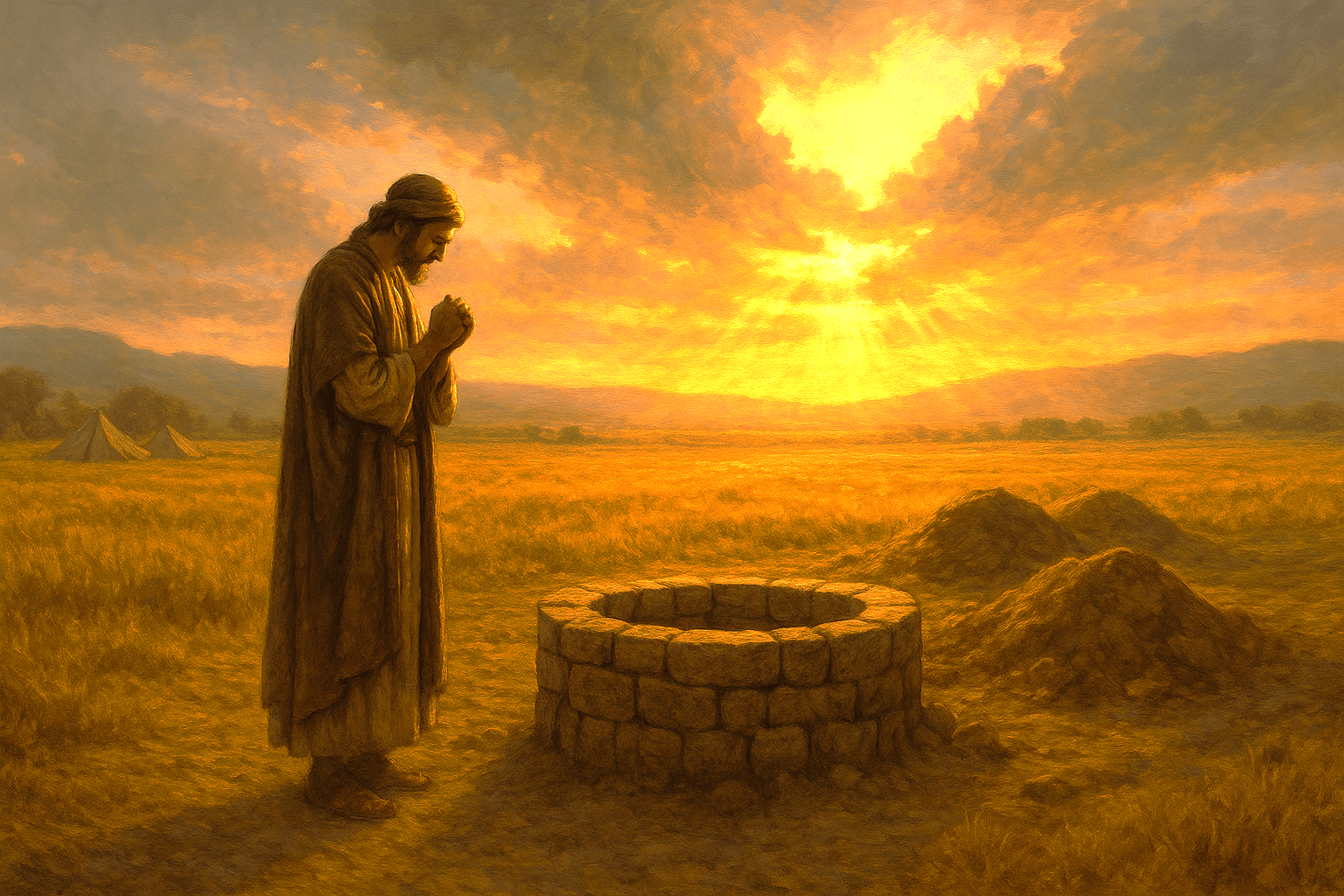
Now Adonai said to Avram, “Get yourself out (Lech Lecha) of your country, away from your kinsmen and your father’s house, and go to the land that I will show you.”
This is the first of ten tests Abraham would pass. A midrash likens him to a sealed vial of myrrh whose fragrance filled the world once opened by G-d’s call.
“I will make of you a great nation, I will bless you, and I will make your name great; and you are to be a blessing. I will bless those who bless you, but I will curse anyone who curses you; and by you all the families of the earth will be blessed.”
We see these promises unfolding in Israel’s history and present. The very resurrection of Israel in 1948 stands as a sign of G-d’s fidelity. The adversary (ha-satan) seeks to obscure, delay, or destroy, but Revelation assures us that G-d will wipe away every tear and make all things new.
“He will wipe every tear from their eyes… ‘Behold, I am making all things new.’”
Blessing and Curse: A Sobering Warning
The Torah reiterates the blessing for those who bless Israel and the curse for those who curse her.
“I will bless those who bless you, and the one who curses you I will curse.”
“Cursed be everyone who curses you, and blessed be everyone who blesses you!”
“Blessed are those who bless you, and cursed are those who curse you.”
In our time, with antisemitism resurging openly in academic, political, and street movements, we must take these words seriously. The Holocaust is historical fact. The October 7 atrocities made plain another face of evil. Lech Lecha calls us not to resignation but to responsibility.
Salt and Light in a Darkening Age
Yeshua’s words summon us to public faithfulness—not retreat.
“You are the salt of the earth… You are the light of the world… let your light shine before others.”
Proverbs likewise calls us to resist passivity and rescue those being led away to death.
“Rescue those being led away to death… Does not He who weighs the heart perceive it?”
Our greatest needs are responsibility and repentance. We cannot outsource courage. We must choose whom we will serve.
“As for me and my house, we will serve the LORD.”
When Mordechai challenged Esther, he framed a question for every age: have we come to our position “for such a time as this”?
“…Who knows whether you have not come to the kingdom for such a time as this?”
After national shocks, sanctuaries fill—for a few weeks. Lech Lecha urges something deeper than a spasm of resolve: a sustained re-turn to the G-d who renews mercies every morning.
“Through the Lord’s mercies we are not consumed… Great is Your faithfulness.”
Prayer
Father in Heaven, give us clarity to repent of blindness and do Your will wherever You choose. Prepare us to be a blessing to Your people and a rebuke to Your enemies. Call each of us to our assignment; give us ears to hear, eyes to see, hearts to feel, and wills to obey. B’Shem Yeshua, ormein.
Attachment: The Ten Utterances (Pirkei Avot 5:1)
Pirkei Avot 5:1 teaches that the world was created with ten “utterances” (ma’amarot). In Genesis 1, “And God said” (vayomer) appears nine times, with “Bereishit” counted as the tenth by our sages to complete the number of fullness. G-d could have created with one utterance; ten teaches the gravity of our stewardship and the weight of destroying or preserving His world.
Occurrences of vayomer in Genesis 1: verses 3, 6, 9, 11, 14, 20, 24, 26, 28, 29.
See discussion: What are the 10 utterances in Pirkei Avot 5:1. Original article: “A Prayer Across Time,” TheIsraelBible.com.
Notes on Sources
(1) Shira Schechter is content editor for TheIsraelBible.com and Israel365, with master’s degrees in Jewish Education and Bible from Yeshiva University; she made aliyah in 2013.
(2) Anonymous summary on Genesis and the Patriarchs cited with gratitude.