

Parashah Chayei Sarah Comments (2022)
I am indebted to Tony Robinson and Restoration of Torah Ministries for much of what I have for you today.
The Hebrew Bible (the Tenach) and the Brit Chadashah (the Newer Testament) are a unity. We see many connections throughout Scripture confirming that. Sometimes the links between the Older and Newer Testaments are clearly described in the weekly Torah portion (parashah). We can see in the Tenach an outline or shadow of Messiah and His work of salvation, and in the Brit Chadashah the amplification or fullness of that picture. Some connections appear only when we step back from the week’s specific reading. This week’s portion includes at least two Messianic portraits, both concerned with the marriage of Isaac.
Isaac’s Bride: A Mission of Faith
This Torah portion focuses on the mission Abraham sends his servant to accomplish—finding a suitable wife for the son who will inherit all he has: “his only son,” the seed of the promise, Isaac.
We can reasonably surmise that the servant is Eliezer, Abraham’s longtime steward. Earlier, Abraham told God he would have to leave his estate to Eliezer in the absence of an heir.
The name “Eliezer” joins two words: El (God) and ezer (help), meaning “God’s help” or “God’s helper.”
From the Akeidah to Intercession
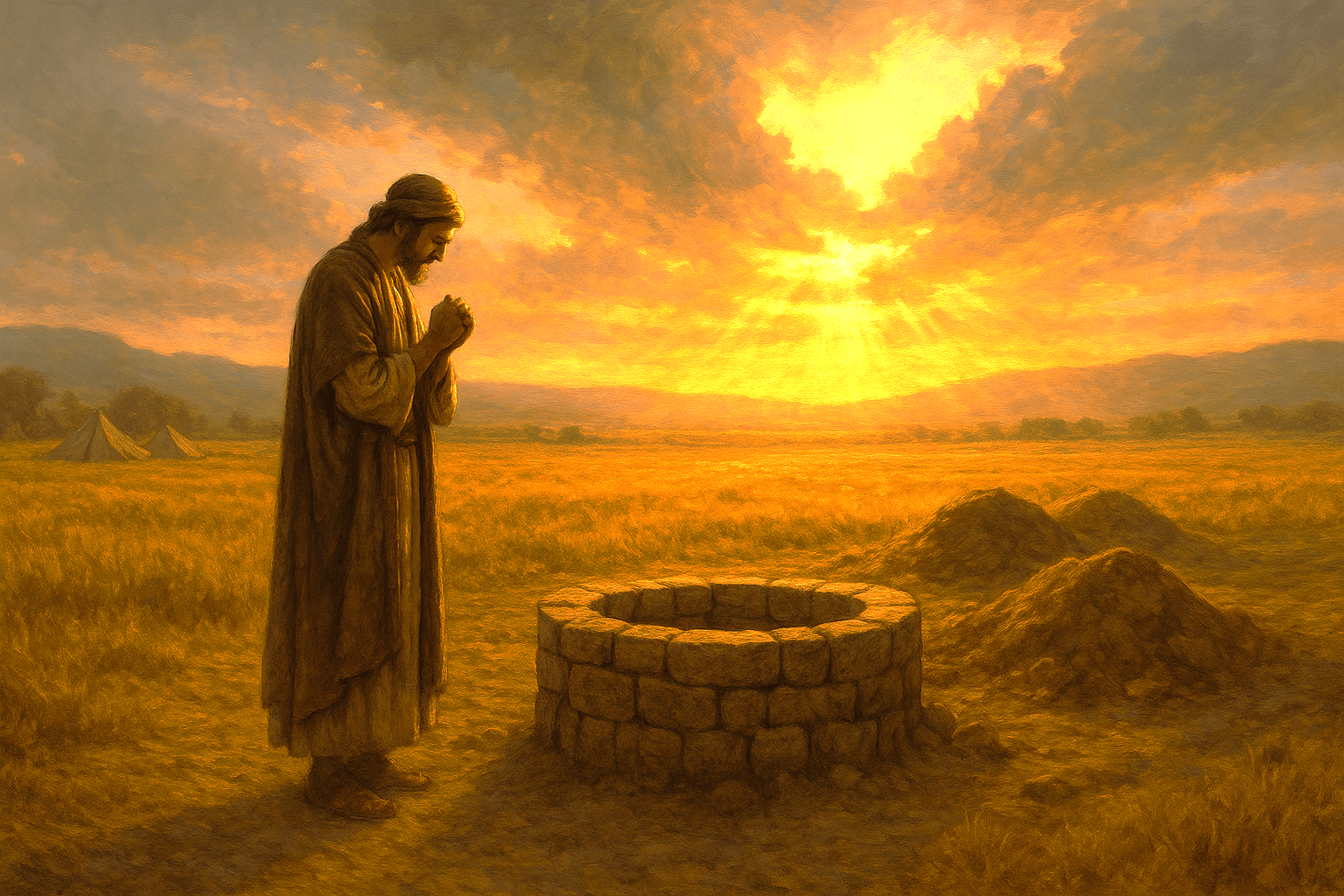
Looking back to last week’s reading, the binding of Isaac (Akeidah)—a picture of the Father’s willingness to offer His “only son”—points forward to Yeshua’s sacrifice. The next time we hear of Isaac, he is in the field at evening, bowed in prayer.
Isaac was thirty-seven when Sarah died and he grieved deeply. It is likely he knew of the servant’s mission. Given the timing—Isaac’s sustained intercession followed by Rebekah’s arrival—the narrative strongly suggests that Rebekah is the answer to Isaac’s prayers.
Rebekah’s Character: Hospitality and Faith
Who is Rebekah? She is family to Abraham. Like Abraham, she demonstrates generous hospitality—hurrying to water Eliezer’s camels. Eliezer asks only for a drink, but he is testing whether she will freely offer more. Abraham offered “a morsel” but served a banquet; Rebekah is asked for a sip and delivers abundantly.
Consider the scale: ten camels at roughly twenty-five gallons each is about 250 gallons drawn from a well—plus water for the men. And she does it willingly and eagerly. Rebekah also leaves her home for a land she does not know, echoing Abraham’s step of faith. Like Sarah, she is described as beautiful and endures years of barrenness before giving birth. The Torah paints Rebekah as mirroring the faith of Abraham and the beauty and perseverance of Sarah.
A Messianic Pattern: Sacrifice, Intercession, and Union
Seen together—Isaac’s near-sacrifice, his fervent prayer for a bride, and his marriage—we have a picture of Yeshua’s atonement, His present intercession at the right hand of the Father as our High Priest, and His future coming when He will be united with His Bride—those who trust in Him.
“And He Loved Her”: Love After Marriage
Modern Western culture insists that we must fall in love before marriage, but Scripture highlights covenant love that grows within marriage. The older Jewish tradition emphasizes lifelong devotion and affection that deepens after the vows. The better way is to let God lead—as He did with Isaac and Rebekah.
Eliezer as a Picture of the Ruach HaKodesh
Eliezer also frames a second Messianic image. Notice the closing line of the chapter: Isaac “was comforted” after his mother’s death. In John 14–16, Yeshua teaches extensively about the Ruach HaKodesh (the Holy Spirit)—the Helper, Comforter, and Teacher.
Who convicts and convinces us of Messiah? It is the Spirit of God who finds those open to receive atonement, calls them to repent and follow Yeshua, and joins them to His Body—the Bride-to-be.
Eliezer tells Rebekah of her calling to become mother of a great nation. Likewise, the Comforter speaks of Yeshua’s call upon our lives. In carrying “all his master’s goods in his hand,” Eliezer likely bore legal proof (as Rashi suggests) that Isaac was Abraham’s sole heir—powerful testimony to reassure Rebekah of the future before her.
Eliezer does not speak for himself but for his master’s son—just as the Spirit speaks what He hears and testifies of the Son. He also tells of “things to come.” Taken together, Eliezer (“God’s helper”) depicts the work of the Ruach HaKodesh in the believer during the season when Yeshua intercedes for us with the Father.
Finding Messiah in the Tenach
For the early Messianic believers, the Jewish Scriptures confirmed Yeshua’s Messiahship. We are invited to search the Tenach diligently to see Him there.
Yeshua assures us that if we seek Him, we will find Him. We owe it to ourselves to seek Him in the Scriptures and to share the Besorah—the Good News—with all who sincerely desire the truth of God’s reality.
May all who seek the truth find joy in His word.
Amen!