
What Is the Significance of Chanukah?
Jewish holidays are often summarized this way: “They wanted us dead. God rescued us. Let’s eat!” Chanukah (Hanukkah) fits this pattern. It recalls the uprising of a priest named Mattathias and his five sons. When King Antiochus IV attempted to erase Jewish faith—including desecrating the Temple altar with a pig—Mattathias’s son Judah led a successful revolt. Judah earned the name Maccabee (“the hammer”), and the Temple was cleansed, restored, and rededicated. The Hasmonean family then ruled Judea for nearly two centuries.
The Miracle of the Oil and the Chanukiyah
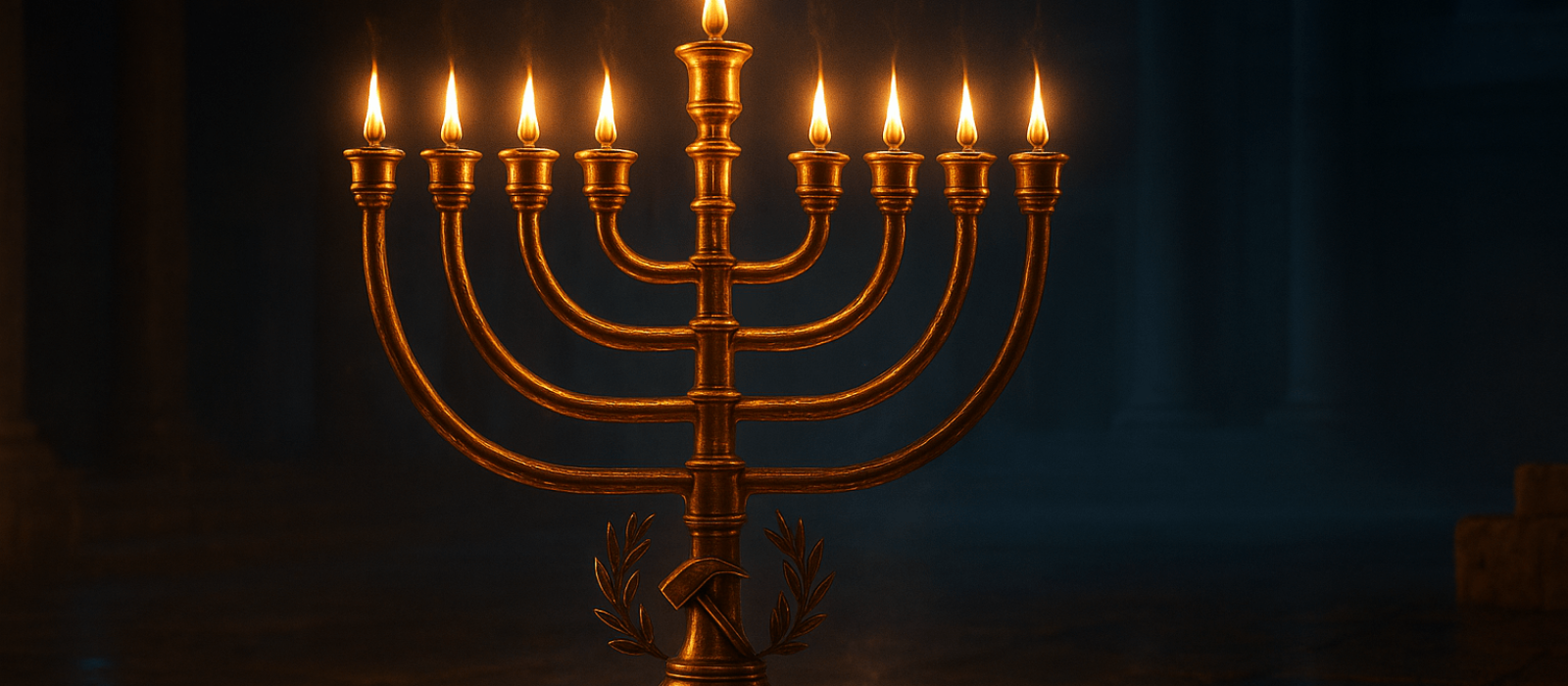
The Talmud recounts that, during rededication, only one day’s supply of pure oil was found for the Temple lamp—yet it burned for eight days, long enough to prepare more. In remembrance, Jews light a special menorah called a chanukiyah: eight lights plus the shamash (servant) that kindles the others.
Traditional Blessings
Blessed are You, Adonai our God, King of the universe, who has set us apart by Your commandments and commanded us to kindle the light of Chanukah.
Blessed are You, Adonai our God, King of the universe, who performed miracles for our fathers in those days at this season.
Why Chanukah Matters to Jewish People
Chanukah proclaims that, when we trust in God, no power can finally stand against His purposes. He delivers those who follow Him.
Prophetic Threads in Daniel 8
“The shaggy goat is the king of Greece, and the large horn between his eyes is the first king. The four horns that replaced the one that was broken off represent four kingdoms that will arise from his nation but will not have the same power.” — Daniel 8:21–22
This points to the breakup of Alexander’s empire into four lesser kingdoms.
“In the latter part of their reign… a stern-faced king, skilled in intrigue, will arise… He will destroy the mighty and the holy people… Yet he will be broken, but not by human power.” — Daniel 8:23–25
Many see in this a foreshadowing of Antiochus’s persecution, his self-exalting blasphemy, and God’s deliverance of Israel.
Yeshua at the Feast of Dedication (John 10)
“Then came the Feast of Dedication at Jerusalem. It was winter, and Yeshua was walking in the Temple, in Solomon’s Portico… ‘My sheep hear My voice… I give them eternal life… My Father and I are one.’” — John 10:22–30
Ironically, the only explicit biblical mention of Chanukah by name appears in the New Covenant writings. For Messianic believers, this affirms the festival’s relevance.
Why Chanukah Matters to Messianic Believers
Had Antiochus succeeded, there might have been no Temple, no Solomon’s Portico, and no Jewish people gathered in Jerusalem for Yeshua to address. The rededicated Temple also frames Luke’s account of Yeshua’s presentation.
Luke 2 and the Dedicated Temple
Luke 2:22–39 (TLV excerpt)
“And when the days of their purification were fulfilled, according to the Torah of Moses, they brought Him to Jerusalem to present to Adonai… ‘Every firstborn male… shall be called holy to Adonai’… A man named Simeon… came into the Temple… ‘My eyes have seen Your salvation… a light for revelation to the nations and the glory of Your people Israel.’ … And there was Anna… who never left the Temple, serving night and day with fasting and prayers… And when Joseph and Miriam had completed everything according to the Torah of Adonai, they returned to the Galilee…”
Messianic Practice: Prayers and Customs
Messianic believers often adapt the traditional blessings to honor Yeshua, the Light of the world:
Blessed are You, Adonai our God, King of the universe, who has sanctified us in Yeshua—in whose name we kindle the Chanukah lights.
Baruch atah Adonai, Eloheinu Melech ha-olam, asher kid’shanu b’Yeshua—asher b’shmo madlikim anachnu ner shel Chanukah.
After lighting the chanukiyah and saying the blessings, families enjoy oil-fried foods (latkes, sufganiyot), play dreidel, and reflect on redemption.
Hope and Identity
“For Adonai-Tzva’ot… says: Anyone who injures you touches the apple of His eye.” — Zechariah 2:12 (Eng. 2:8)
Whether Jewish or “grafted-in,” we are precious to Him. May we be echad—one—in the light of God as we celebrate Chanukah and look to the ultimate Deliverer.