
Scripture References: Genesis 6–9
5765 AM (2005 CE) – HAMAS AND HEZBOLLAH
The sounds of Gaza filled the war room. Grainy drone footage rolled across the screen, a live feed of smoke plumes rising from a building near Khan Younis. Across the room, an intelligence officer pressed a finger to his earpiece, listening intently to the intercepted call playing through his headset.
Nadir leaned back in his chair, rubbing his temples, watching the grainy feed. “It’s always the same, David,” he muttered. “They launch rockets, we bomb a building, and a dozen different news agencies rush to tell the world how cruel we are.”
David, sitting beside him, didn’t answer immediately. He tapped his fingers against the table, his gaze fixed on the shifting heat signatures on the screen. The building had already been marked for a strike. Another Hamas hideout. Another day in this war that wasn’t supposed to be a war.
The officer at the front turned toward them. “We’ve confirmed Hamas is inside. They’re coordinating the next round of attacks. We take it out now, or we lose the window.”
David exhaled. “How many civilians?”
“Six, maybe seven. Two families live on the ground floor,” the officer answered, hesitating before adding, “We’ve sent them warnings. Calls, text messages, leaflets. Some of them have already evacuated.”
David hated this part. He hated that this had become normal. Warnings. Collateral damage. The world turning against Israel no matter what they did. Part of him could forgive them for killing the children of Israel, but another part of him could not forgive them for forcing Israel to kill their children.
Nadir, however, was unmoved. He reached for the radio. “Send it,” he said.
The officer relayed the order. Moments later, the screen lit up in a flash. When the smoke cleared, the building was gone.
David sighed, leaning forward, resting his elbows on the table. “And tomorrow, another one will pop up. More weapons. More dead civilians.”
Nadir scoffed. “You act like we have a choice.”
David glanced at him. “Do we?”
Nadir’s expression hardened. “We do what we must.”
☼ ☼ ☼
Months later, David stood at the edge of the Knesset’s intelligence briefing room, arms crossed as he watched the live footage of Israeli soldiers pulling settlers from their homes in Gush Katif. The scenes played out in shades of muted color, but the emotions were raw and sharp. Some families left quietly, their heads bowed, carrying what little they could. Others clung desperately to doorframes, their fingers pried loose by soldiers who had sworn to protect them. Some fought. Some screamed. Some simply wept.
“The withdrawal is happening, whether we like it or not,” the defense minister announced to the room, his voice carefully measured. “Hamas is treating this as a victory. We need to prepare for what comes next.”
David glanced across the table at Nadir. He wasn’t gloating, but he wasn’t exactly mourning either. He just sat there, arms folded, his face unreadable. David knew that Nadir had supported the disengagement – not because he believed in peace, but because he believed in clarity. In Nadir’s mind, this move would force the Palestinians to either govern themselves or expose their true nature. No more excuses. No more blaming Israel. Either they would build something, or they would burn Gaza to the ground.
David wasn’t so sure.
He turned back to the screen, watching as an IDF soldier lifted a weeping mother from her doorstep. Her two young sons clung to her legs, wailing in terror. The soldier’s face was a mask of stone, his jaw clenched as he carried her down the steps.
David took a slow breath, his voice quiet but firm. “We just abandoned thousands of our own people.”
Nadir exhaled, shaking his head. “We had no choice.”
David turned to him. “No choice?” His voice was sharper than he intended. “Nadir, we just handed Hamas a victory on a silver platter. They didn’t have to fire a single shot. We just walked away.”
“And what was the alternative?” Nadir shot back. “Keep bleeding? Keep sending our sons into Gaza, house by house, alley by alley? Keep sacrificing our soldiers to protect a few thousand settlers? You think we could hold that land forever?”
David’s hands tightened into fists. “It wasn’t about holding the land. It was about standing firm. About not giving in.”
Nadir’s expression hardened. “Standing firm is meaningless if all it does is get us killed. You think those people,” he gestured toward the screen, where more settlers were being dragged from their homes, “would have lasted another decade in Gaza? How many more attacks before we’d have to go back in force? Another decade of body bags? No, David. Now it’s their problem.”
David stared at the screen, watching a teenage boy – maybe fifteen, maybe younger – shove an Israeli soldier with all his strength, tears streaming down his face. The soldier barely flinched. He simply grabbed the boy’s wrists, held him still until his rage dissolved into sobs.
David let out a long breath. “I have a feeling,” he muttered, “that it will never be that simple.”
For a long moment, neither of them spoke.
Then, finally, David turned to Nadir, his voice quieter now. “You really think this will end well?”
Nadir hesitated. For the first time, David saw a flicker of uncertainty in his eyes.
“No,” Nadir admitted. “But at least now, when it burns, we won’t be the ones standing in the fire.”
David looked back at the screen, watching as another family was led away from their home, their faces filled with grief.
It was, at best, a cold comfort.
☼ ☼ ☼
By the next year, it became painfully clear that David had been right.
Nadir strode into the office, a newspaper in hand, and with an exaggerated motion, he dropped it onto David’s desk. “Congratulations, David. You called it.”
David barely glanced at him before his eyes drifted down to the bold headline:
HAMAS WINS PALESTINIAN ELECTIONS. ABBAS GOVERNMENT WEAKENED.
David sighed and picked up the paper, skimming the details. It was all there. The “democratic” elections. The overwhelming support for Hamas. The Fatah faction, humiliated, losing control. The world, watching in a mixture of shock and convenient amnesia, as if they hadn’t seen this coming. He let out a dry, humorless chuckle.
“Fantastic,” he muttered, tossing the newspaper aside. “We pulled out of Gaza, and now Hamas is in charge. You still think it was a good idea?”
Nadir sat down across from him, rubbing his hands together. “I never said it would make things better,” he admitted. “I said it would make things clearer.”
David frowned. “Clearer? How exactly is this clearer?”
Nadir leaned forward, his face losing its usual smirk. “Before, they hid behind Arafat, behind the PLO, behind international sympathy. Now? The world has to look at the truth. They voted for terrorists, David. This isn’t about land. It never was.”
David exhaled, rubbing his temples. “I know that. You know that. But does the world?” He gestured vaguely to the international newspapers spread across his desk. “How long before they start explaining it away? ‘Oh, Hamas was the only real alternative to Fatah.’ ‘Oh, they were elected for social programs, not terror.’ How long before they just… forget?”
Nadir sighed. “They already have.”
David clenched his jaw. The so-called “peace process” had always been a farce, but this? This was a whole new level of delusion. “So now what? Another war?”
Nadir exhaled, his smirk fading. “Maybe. Hopefully not. Hamas still has to consolidate power. They’ll need time.”
David shook his head, tossing the newspaper aside. “Then I suggest we use that time wisely.”
Nadir nodded. “Agreed.”
They sat there in silence, two men who had fought too many wars, trying to figure out how to avoid the next one.
After a moment, David leaned back and let out a bitter chuckle. “You know what ‘Hamas’ actually stands for?”
Nadir smirked. “Harakat al-Muqawamah al-Islamiyya. Islamic Resistance Movement. Why?”
David shook his head. “No, no. I mean in Hebrew.”
Nadir raised an eyebrow, waiting.
“In Hebrew, HAMAS literally means ‘violence’—as in the exact reason Hashem brought the Flood. ‘The earth was filled with HAMAS.’” David leaned forward, his voice quieter now. “Their hearts and minds were full of violence, continually.”
Nadir leaned back, processing that. His smirk returned, though it was more subdued this time. He glanced toward the window, at the city, riven by violence, stretching before them. “Well, David,” he said dryly, “I suppose we should thank Hashem for that rainbow.”
David exhaled, rubbing his temple. “I don’t know, Nadir, I just wonder how much violence Hashem will tolerate in the land and in the minds of everyone in the land. Yeah, ok, so the rainbow means He won’t send another flood.” David glanced at Nadir, his voice quieter now. “But He never really said anything about fire.”
☼ ☼ ☼
The intelligence office in Jerusalem was always cold, no matter the season. David sat hunched over a map, marking suspected smuggling routes with a red pen, while Nadir leaned back in his chair, flipping through intercepted Hezbollah communications.
A junior officer rushed in, breathless, holding a report. “It’s happened.”
David looked up, tired. “What’s happened?”
“Hezbollah ambushed a patrol near the border. Two IDF soldiers kidnapped. Three others dead.”
Silence.
David set his pen down. Nadir sat up straighter. They didn’t need to be told what this meant.
The officer continued, voice grave. “Command is calling an emergency meeting. They’re saying… this is it.”
Nadir exhaled sharply. “Of course it is.”
David already knew what was coming. “We’re going to war.”
By the next morning, Hezbollah had fired dozens of rockets into northern Israel, and the IDF had already begun retaliatory airstrikes.
David and Nadir sat in a high-level briefing with top intelligence officials. The screen at the front of the room displayed live satellite footage of Beirut – specifically, the southern district of Dahiya, Hezbollah’s stronghold.
General Halutz stood at the podium, addressing the room. “This will not be another border skirmish. This is an act of war. We are launching operation ‘Just Reward’. The objectives are simple: weaken Hezbollah’s military capabilities, force the return of our soldiers, and reestablish deterrence.”
David and Nadir exchanged a glance. This wasn’t going to be simple at all. From their intelligence outpost in Tel Aviv, David and Nadir worked behind the scenes – tracking Hezbollah’s movements, intercepting communications, and identifying high-value targets.
“This is different,” Nadir muttered one night, scrolling through surveillance feeds. “This isn’t the PLO. It’s not Hamas. Hezbollah isn’t just some ragtag militia throwing rocks and RPGs. These guys are trained, disciplined, and armed to the teeth.”
David nodded, watching a heat signature of a Hezbollah convoy moving south through the Bekaa Valley. “And they’re backed by Iran.”
“Exactly,” Nadir muttered. “This isn’t an uprising. This is a full-scale proxy war.”
The tension was different this time. Unlike Gaza, this war wasn’t contained. Missiles rained down on Haifa. Civilians fled to bomb shelters. The north was burning.
The footage from Metula, a small Israeli town near the border, played in loops on every screen. Homes reduced to rubble. Smoke rising from where Katyusha rockets had landed.
David ran a tired hand over his face. “This feels like the Yom Kippur War again.”
Nadir shook his head. “No. In the Yom Kippur War, we fought armies. This? This is shadow warfare.”
David sighed. “That’s what makes it worse.”
☼ ☼ ☼
The war dragged on, each day bleeding into the next in an endless cycle of retaliation and counter-retaliation. Hezbollah was deeply entrenched, launching rocket barrages from civilian neighborhoods, daring Israel to respond. It was a well-rehearsed game – one they had perfected. Fire from a school, a hospital, a mosque, and then when Israel struck back, parade the bodies of the innocent before the world.
And the world was watching.
Every headline, every news report framed the battle the same way, “Israeli Airstrikes Devastate Lebanese Civilians.” “Children Killed in IDF Bombing.” “Another Massacre in Beirut’s Southern Suburbs.” The fact that those same suburbs housed Hezbollah’s command centers, weapons caches, and rocket launch sites was always mentioned as a footnote – if it was mentioned at all.
Late one evening, David and Nadir sat in a dimly lit intelligence office, their eyes heavy with exhaustion, sifting through reconnaissance footage. The grainy black-and-white images from the surveillance drones showed the labyrinth of Beirut’s southern district, Dahiya, a stronghold for Hezbollah.
“More rocket fire from here,” the analyst muttered, circling a building on the screen. “They’re using an apartment complex as a launch site. Again.”
David rubbed his forehead, his jaw tight. “If we hit it, what’s the collateral?”
The analyst hesitated. “Too many. Families still inside. Hezbollah is keeping them there on purpose.”
David exhaled sharply, tapping his fingers against the table. “Of course they are.”
Before he could dwell on it further, another officer rushed into the room, clutching a fresh intelligence report. “We have something bigger.”
David and Nadir both straightened.
The officer placed the document on the table, pointing to a building marked on the map. “Imad Mughniyeh’s second-in-command is here. We have confirmed intel that he’s in the basement. We can take him out.”
David narrowed his eyes, looking at the footage. The building was a modest structure, wedged between other residential complexes. Laundry lines stretched across the balconies, satellite dishes jutted from the rooftops. It looked like any other civilian dwelling.
“Where exactly?” David asked.
“Underground,” the officer confirmed. “He’s using the lower levels as a command center. There are other fighters with him, but—” He hesitated.
David’s stomach twisted. “How many civilians?”
The officer shifted uncomfortably. “At least fifteen. Maybe more.”
The room was silent.
David glanced at Nadir. He didn’t have to say it out loud. They both knew how this played out.
“We hit that building,” David murmured, “and tomorrow’s headlines will be ‘Israel bombs children in Lebanon.’”
Nadir’s face remained unreadable, but there was something in his eyes – something colder than usual. “We don’t hit it, and he walks free to plan another attack. Maybe something worse. Maybe something we don’t walk away from.”
David clenched his jaw, staring at the grainy image of the building on the screen. It always came to this. A choice between bad and worse. Between death now or death later. The calculation never changed. The only thing that changed was how much blood stained their hands afterward.
He thought of Rivkah, of their children. Of the funerals he had attended, the faces of wives and mothers who had lost their husbands and sons. He thought of the civilians in that building, the ones who would die because Hezbollah had chosen them as shields.
He hated this war.
And he hated that he was about to say what he had to say.
After a long moment, he exhaled. “We take the shot.”
The officer hesitated for only a second before relaying the order.
On the screen, the footage flickered as the missile struck.
The building erupted in a fireball. The camera feed cut out for a moment, then returned, showing a smoking crater where the structure had stood. The radio crackled.
“Target eliminated.”
David didn’t feel any relief.
Another voice came over the comms.
“Twenty confirmed dead. Civilians included.”
Silence.
Nadir took a slow sip of his tea, his face grim, watching the smoldering remains on the screen. “You always ask me where the line is, David.” He glanced sideways at his friend, his voice quieter than before. “You think we crossed it this time?”
David didn’t answer. His throat was too tight.
But the tears that welled in his eyes betrayed the truth.
☼ ☼ ☼
The war had reached a grinding halt. Hezbollah’s guerrilla warfare was proving more effective than anticipated. Israeli air superiority meant nothing when their enemy was buried deep in fortified tunnels, blending into civilian populations, striking at will, and vanishing before retaliation could be exacted. Every airstrike eliminated a target, but every target seemed to be replaced by another within hours.
Israel’s ground invasion into Southern Lebanon was advancing at a painful crawl. The rugged terrain, the well-laid ambushes, and the dense urban fighting had turned every street, every hill, into a battleground.
And the worst part? The war had gone on just long enough for the world to start shifting its focus.
The early days had been in Israel’s favor – international sympathy after Hezbollah had kidnapped two Israeli soldiers and fired rockets into northern cities. But with each day, with every news report showing civilian casualties, the narrative was changing. Hezbollah’s leaders understood the long game. They weren’t just fighting with weapons; they were fighting with optics.
And Israel was losing.
David and Nadir sat at a long table in a classified intelligence meeting, the air in the room heavy with cigarette smoke and frustration. Generals, defense ministers, and intelligence officials were gathered around a digital map projected onto the wall, marking Hezbollah strongholds and Israeli troop positions.
A senior officer leaned forward, rubbing his temples. “We’re not making progress,” he admitted. “Hezbollah is too entrenched. If we don’t escalate, they’ll declare victory.”
The words hung in the air. No one responded immediately, because everyone knew what escalation meant.
“We could flatten Beirut,” Nadir mused, arms crossed, “but something tells me that’s not an option.”
The room was silent.
David shook his head. “We need a decisive strike. Something that forces them to the table. Something that leaves them no choice but to negotiate.”
General Halutz, the Chief of Staff, turned to him. “What do you suggest?”
David hesitated, glancing around the room. Then he spoke. “We take out the leadership. Hassan Nasrallah.”
The reaction was immediate.
The room stirred – some men whispered to one another, others exhaled sharply. The idea wasn’t new, but it had always been considered impossible.
An intelligence analyst, a man David knew to be competent but cautious, spoke up. “That’s not easy,” he said flatly. “Nasrallah is underground, literally. He moves constantly, never staying in one place long enough for us to track him. And when he does appear, it’s always in pre-recorded broadcasts. We haven’t seen him in person since this war started.”
David nodded. “Then we bait him out.”
Nadir raised an eyebrow. “You have a plan?”
David smirked. “We leak false intelligence. We make him think we’re withdrawing. We make it seem like Israel is pulling back under pressure – like we’re losing our nerve. He’ll come out to declare victory. And when he does—”
Nadir’s grin widened. “We cut the head off the snake.”
The room was quiet, but the idea had sunk in.
One of the generals tapped a finger against the table. “It’s risky. If he doesn’t take the bait, we’ve exposed our strategy for nothing. And honestly, it’s the kind of suggestion that could force both of you into retirement, if only for political damage control. Are you really willing to risk it?”
David glanced at Nadir and exhaled. “I know, but… we’ve been playing their game for too long. It’s time we make them play ours.”
Halutz exchanged glances with the other officers, considering.
After a long pause, he nodded. “Then, if you think you can, do it.”
☼ ☼ ☼
The plan was daring, calculated, and had all the makings of a strategic masterpiece—except it didn’t work.
David and Nadir had spent days orchestrating the deception. They fed false intelligence through controlled leaks, using known informants, Hezbollah’s own surveillance patterns, and even international news agencies to sell the idea that Israel was reconsidering its military strategy.
Official Israeli statements remained defiant, but beneath the surface, the leaks suggested something different: war fatigue, political divisions, and growing pressure to de-escalate. A well-placed story in an Arabic-language paper hinted at backdoor talks between Israel and Lebanon, while another leak suggested the IDF was shifting resources away from southern Lebanon in anticipation of a diplomatic solution.
The hope was that Hassan Nasrallah, the Hezbollah leader who had spent the entire war buried in a bunker, would be emboldened by the idea that Israel was withdrawing under pressure. That he would step out, make a triumphant speech, and declare Hezbollah the victor.
And the moment he did, Israel would be waiting.
But Nasrallah wasn’t a fool.
He didn’t take the bait. He didn’t even flinch.
“He’s too paranoid,” Nadir muttered, shaking his head as another intercepted transmission confirmed that Nasrallah had no intention of leaving his underground hideout. “We underestimated him.”
David sat at his desk in the intelligence room, rubbing his temples, the weight of the war pressing down on him. “We didn’t underestimate him,” he said. “We overestimated how much he cares about public appearances. He doesn’t need to show his face to declare victory. He just needs to survive. It’s a war of attrition—slow, painful, petty. I just…”
He trailed off. There weren’t words big enough for the weariness.
Across from him, Nadir was clearing the contents of his desk into one of several sturdy cardboard boxes. A photo, a coffee mug, a stack of dog-eared files—decades of service reduced to objects that fit in a box.
“Look, it’s okay,” Nadir said quietly. “We gambled, we lost. We had a good run. Besides, you know as well as I do, they let us stay on longer than most. Retirement… it’s just a new season. La’zman hazeh. Am I right?”
David sighed, his face flushing with frustration and something close to shame. “I am just so angry at it all. This is Israel. Do we really get to retire?”
Nadir gave a small, tired smile. “Maybe not from caring,” he said. “But from the desk? From the twenty-hour days? At some point they take your badge, whether you’re ready or not.”
David looked past him, past the boxes, to the wall of screens and maps. Red circles, lines of trajectory, clustered icons marking impacts and launch sites. The war did not pause because two old analysts were being rotated out of the room. The rockets would still fall. The statements would still be drafted. Nasrallah would still be alive, somewhere beneath the concrete.
Retirement was a word for paperwork. The war went on with or without their signatures.
And that was exactly what Nasrallah was doing. He was content to remain in hiding, letting his fighters do the talking with rockets and guerrilla ambushes while the world watched, waiting for Israel to slip up. And while Hezbollah was losing men and infrastructure, they were winning the real war—the war of perception.
International news outlets, which had originally condemned Hezbollah’s aggression, began shifting their focus as the war dragged on. Every airstrike, every IDF operation in civilian areas, became another headline about Israeli brutality. The world had seen images of charred remains of buildings in Beirut’s Dahiya district, where Hezbollah’s command centers had been embedded in apartment blocks. The media didn’t show the weapons caches buried under those buildings, or the fighters who had used civilians as shields.
Instead, Israel was cast as the aggressor. David had seen this before.
It was the same pattern—Israel expected to fight with one hand tied behind its back, held to a moral standard no other nation was ever held to. The UN issued resolution after resolution, condemning Israeli airstrikes but saying little about Hezbollah’s use of human shields or its deliberate targeting of Israeli civilians with Katyusha rockets.
Over 4,000 rockets had rained down on northern Israel. Haifa had been bombed, dozens of civilians killed, and yet the global outrage was directed at Israel’s response—not at the attacks that had started the war in the first place.
☼ ☼ ☼
“Tell me again why we’re in the UN?” David muttered.
It was late, the kind of late that made the clock numbers blur. The war footage had been replaced hours ago by talking heads and diplomatic theater, but the tension on the screen felt no different from the tension on the front lines.
He and Nadir sat in David’s living room now, not the intelligence office. The maps and live feeds were gone, replaced by a modest bookcase, family photos, and a brand-new HDTV that still had the thin plastic strip clinging to one edge of the frame. A retirement gift from his children. “So you can watch something other than war,” they’d said.
Instead, the two old analysts were watching a UN Security Council meeting.
On the screen, a European diplomat was passionately condemning Israel for “excessive use of force,” his voice rising in moral outrage as he gestured over a stack of papers he clearly had not written. Beside him, a representative from an Arab nation leaned into the microphone to demand that Israel be sanctioned for “war crimes,” as if reciting a line that had been rehearsed years in advance.
Nadir scoffed. He shifted on the couch, found the ashtray David had set out on the coffee table—an old ceramic souvenir from Eilat—and lit a cigarette. Smoke curled up toward the ceiling, catching the blue light from the TV.
“I have no idea,” he said, narrowing his eyes at the screen. “Maybe to give the world a place to yell at us in an air-conditioned room instead of on a battlefield.”
David let out a tired laugh, but it was thin, without joy. “Every time we defend ourselves, we’re the villains,” he said. “Every time they attack us, the world makes excuses for them.”
The camera cut to another delegate shuffling notes while the translator’s voice droned through the speakers, condemning Israeli “disproportionate response” in measured, clinical English. David’s eyes flicked toward a framed photo on the wall—his son in uniform, his daughter holding a sparkler on Independence Day, the Mediterranean behind her. The kind of normal life the men in that room knew only as a talking point.
“It’s because they expect more from us,” Nadir said dryly, exhaling smoke toward the open window. “They think we should be better.”
David shook his head slowly. “No. It’s because they think our enemies are too weak, or too pathetic, or too ignorant to be held accountable.” He watched as the UN camera panned to the Lebanese ambassador, face solemn, voice righteous. “That’s the real insult. Our enemies know exactly what they are doing, and they always have.”
The volume dipped as the translator paused. For a moment, the only sounds were the faint hum of the refrigerator in the kitchen and the distant traffic outside.
“Look at them,” David went on, nodding toward the screen. “They talk about us like we’re the only adults in a room full of children. As if the rockets just fell from the sky on their own. As if the launchers weren’t rolled into civilian neighborhoods, parked next to schools and hospitals, set up behind human shields. As if that takes no agency, no intent.”
Nadir tapped ash into the tray, his gaze fixed on the televised chamber with its polished wood and blue UN emblem. “It’s easier for them,” he said. “If we’re the problem, they don’t have to rethink anything. Their alliances, their oil, their narratives. We stay the villain, they get to stay pure.”
David snorted. “Pure,” he repeated, the word bitter in his mouth.
On the screen, the Israeli ambassador finally appeared, waiting his turn to respond to an accusation he hadn’t heard yet but could probably recite by heart. David reached for the remote, thought about turning the TV off, then didn’t.
“You know what the UN is?” he said, more to himself now. “It’s the one place where they can pretend the war is about language. About adjectives. ‘Excessive.’ ‘Disproportionate.’ ‘Aggressor.’ They change the words and think they’ve changed reality.”
Nadir glanced at him. “And yet,” he said, “here we are. Watching them anyway.”
David gave a small, humorless shrug. “Old habits,” he said. “We spent our lives trying to see the whole board. Hard to stop just because someone took our badges.”
On the TV, the Israeli ambassador began to speak into the microphone, calm but tight around the eyes. David leaned back into the couch, feeling the familiar mix of anger, exhaustion, and something like grief settle in his chest.
Retired or not, the war played on in his living room, framed by family photos and soft lamplight. The setting had changed. The script had not.
☼ ☼ ☼
By early August, it was clear that Israel couldn’t continue the war much longer—not because of military failure, but because of political pressure.
Hezbollah had taken serious losses. Israeli airstrikes had crippled much of its infrastructure, and its fighters had been pushed back from strategic positions. But it hadn’t been decisively defeated.
And that was a problem.
The Israeli government was split. The public was growing restless. The war had not gone as planned. Hezbollah had fought harder than expected, and while the IDF had won every engagement, the perception was that Israel had failed to deliver a knockout blow.
Then, on August 11, 2006, the UN Security Council passed Resolution 1701, calling for an immediate ceasefire.
Three days later, on August 14, it went into effect.
☼ ☼ ☼
“So that’s it?”
David’s question hung in the low murmur of their favorite coffee shop. It was the middle of the afternoon, the kind of hot, washed-out August day when even the air felt exhausted.
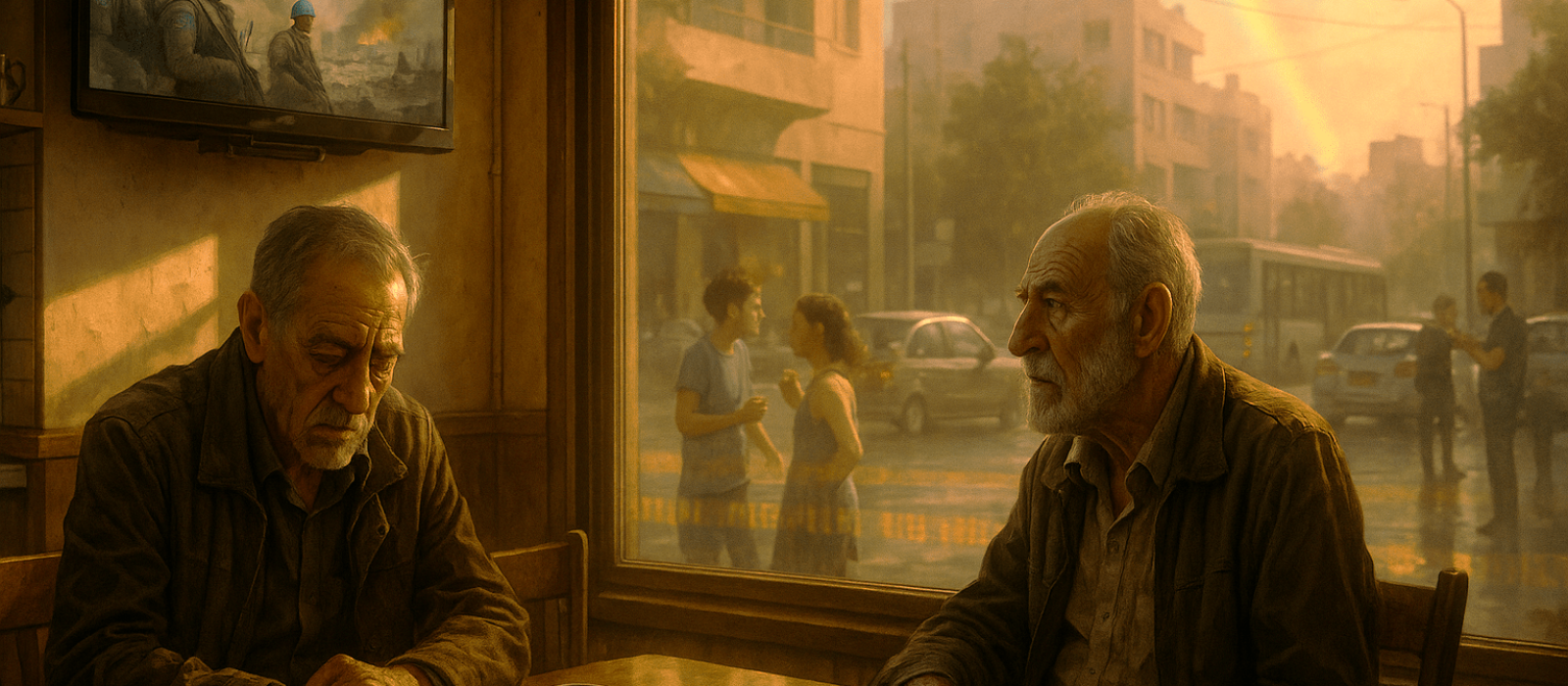
They sat at a small table in the corner, facing a wall-mounted TV above the counter. The volume was low, subtitles crawling along the bottom of the screen as a news anchor summarized the ceasefire and the deployment of UN peacekeepers to southern Lebanon. A blue-helmeted patrol rolled past a ruined village in grainy footage.
The ceasefire was holding—for now. The IDF was pulling back. UN forces were being sent in to “ensure” Hezbollah didn’t rearm.
David already knew how that would go.
“How long before they start smuggling in weapons again?” he asked, fingers wrapped around a cooling espresso he’d barely touched.
Nadir didn’t even look up from his coffee. He stirred it absently, watching the swirl more than the television. “A week, maybe two?” he said.
David sighed, leaning back in his chair, letting his gaze drift past the TV to the street outside, where life went on—people arguing over parking, kids licking melting ice cream, a bus groaning past. “So that’s it? We just let them rebuild?”
“Welcome to war,” Nadir muttered. He took a sip, grimaced at the bitterness, and set the cup down. “Where winning just means fighting again later.”
There were no celebrations. No parades. Not for men like them.
Just a bitter understanding that nothing had really changed.
Nasrallah had survived. Hezbollah was weakened but not destroyed. Israel had fought fiercely, but the world had painted it as the villain yet again. The Lebanese government, as always, was powerless to control the terror group that operated within its borders.
And in a year, or two, or five—there would be another war. Another round of rockets. Another ambush. Another UN resolution.
David rubbed his eyes with the heel of his hand, suddenly feeling every year of his age. “I swear, it’s like Groundhog Day with these people.”
Nadir snorted. “Yeah, except with rockets. And every time the alarm clock goes off, we’re the ones who wake up with new scars.”
On the screen, a commentator was already pivoting to “reconstruction efforts” and “regional stability,” as if the story had a neat, hopeful ending. The footage cut from burning craters to a graphic of handshake silhouettes.
David exhaled slowly, watching the images change. “And the world moves on,” he said, more to himself than to Nadir, “waiting for the next time they can blame us for existing. What did we gain, Nadir?”
Nadir leaned back, stretching his arms until his shoulders popped. “Hezbollah is wounded,” he said.
David scoffed. “But not dead.”
Nadir nodded in agreement, eyes drifting up toward the scuffed ceiling tiles. “But they never will be,” he said. “That would be an act of genocide.”
Silence settled between them, broken only by the hiss of the espresso machine and the soft clink of cups behind the counter.
“So,” Nadir asked finally, still staring upward as if the answer might be written there, “what do we do now?”
David pushed his chair back and stood, reaching for his worn jacket draped over the back. The TV continued to chatter behind him—maps, arrows, expert panels—but he didn’t look up at it again.
“We do what we always do, Nadir.” He slipped one arm into his sleeve, then the other. “We survive.”
☼ ☼ ☼
Used with permission by the author. Find the author’s complete works online: Complete Works of Mack Samuels