
Genesis 15–17; Exodus 12:48–49; Numbers 15:14–16;
1 Samuel 17; 2 Samuel 15–18; Romans 11; Zechariah 12:10.
Out on the ridge in Judea and Samaria, life, politics, and Scripture collide in very practical ways. Even the birth of a baby or the wording on a passport suddenly becomes a statement about whose land this is and whose promises still stand.
Someone asked a simple but loaded question: what happens if a Jewish mother gives birth right here in Judea and Samaria? How is that baby registered? And what about a Gentile visitor who happens to deliver a baby on this hilltop—what would their child’s papers say?
One of the team, Nate, answered from experience. He and his wife have six children, five of them born right on this mountain. Because they are American citizens, their paperwork is processed through U.S. systems, not Israeli ones. So when the passports come back, the birthplace line almost never says “Israel.”
Some of his kids’ passports simply say “West Bank.” Others say “Har Bracha – no country.” Never “Israel.” The exact wording has even shifted depending on which administration was in power at the time. The same mountain, the same family, the same covenant land—yet a child can be listed as if they were born in a territory without a country.
Those little lines on a passport expose a much bigger question: who does this land belong to, and who has the right to live here?
Is This Really the Land of Covenant?
Nate was blunt. He’s not trying to be politically correct. He’s faith-based. The Bible is his textbook.
For him, the question of borders and ownership comes down to something very simple and very uncomfortable: “Do we believe that God made a covenant and a promise to the Jewish people that this is their land forever?”
If the answer is “no,” then everything becomes a negotiation: international law, human politics, and shifting majorities. But if the answer is “yes,” then we have to wrestle with the reality that God has spoken about this land, and He hasn’t changed His mind.
That doesn’t erase the Arabs, the Palestinians, or anyone else here. In fact, Nate believes the Arabs have an enormous opportunity precisely because they are so close to the covenant. He turns to the Scriptures and shows two very different Philistines—two very different men from the same people and the same region we now call Gaza.
On one side stands Goliath, the “biblical Hamas”—taunting Israel, rallying his people to slaughter, driven by hatred and violence. On the other side stands Itai the Gittite, a Philistine who came to King David when David was fleeing Jerusalem. David told him, “Go home, this is a family matter.” But Itai refused. He said, in effect, “Wherever you go, my king, I’m with you. I’m aligning myself with you and with your throne.”
Two men from the same people. One resisted God’s covenant with Israel. The other chose to stand under it. Itai ends up a general in David’s army.
That, Nate says, is the choice facing the nations—and especially the Arabs—today. It is not ultimately “pro-Israel” versus “pro-Arab.” It is “pro-covenant” versus resisting the covenants and promises of God. Arabs and Druze who serve in the IDF, Arab pastors who preach the gospel and still affirm God’s promises to Israel—these are modern Itais, choosing to align with what God has spoken.
Even if Gaza’s rulers suddenly became perfectly humanitarian, if they still claimed a right to uproot God’s people from God’s land, Nate would still have a problem—because the issue is not whether they are “nice,” but whether their claims align with God’s covenant.
Friendship That Never Touches Ideology
This doesn’t mean Jews are called to hate Arabs. Far from it. The Torah commands Israel to welcome the ger, the “stranger” who joins himself to the covenant. Anyone from any nation who chooses to stand under the God of Israel and His ways is to be received fully and completely. The issue is not ethnicity; it is alignment with God’s promises.
That’s why “friendship” alone is not enough. Before October 7, there were many places along the border where Jewish and Muslim neighbors interacted peacefully. They worked together, traded together, laughed together. But the underlying ideology—jihad, conquest in the name of Islam—was never challenged. When the day came, those unchallenged beliefs bore their horrific fruit.
Real reconciliation must be rooted in truth. It must be rooted in a biblical narrative, not just in feel-good stories.
That same principle applies in the Church. Many Christians have never met a Jew, never opened the Tanakh with a Jewish friend, never wrestled with Romans 9–11. It is easy in that vacuum to drift into replacement theology, to spiritualize away the Jewish people and the land, and to stand—unknowingly—against the very promises of God.
Two Thousand Years of Pain Between Jews and Christians
At this point, someone else asked an honest question: “Given the last 2,000 years, with all the pain between Jews and Christians, how do we minister to Jewish people? Do we approach them differently than we would other groups?”
Josh shared a story from the day before. A young Jewish man, clearly with a past—earrings up his ears, tattoos on his arms—walked down the ridge to his house. But he was also wearing tzitzit and a kippah. A walking contradiction, at least from the outside.
As they talked, the young man said something surprising: “You sound a lot like Charlie Kirk. You really believe the Bible.” Then he added, “I’m keeping Shabbat today because of Charlie Kirk. It wasn’t from my rabbi. It wasn’t from the Jewish community. It was someone outside Israel who showed me the importance of Shabbat.”
Josh doesn’t believe it was just what Charlie said that changed this young man’s life. It was his life, his actions, the way he treated Scripture as true. With the Jewish people—maybe with everybody, but especially with Jews—it is not arguments that speak the loudest. It is who we are.
“I can’t sit down with a Jewish person,” Josh says, “and try to debate why I’m not the Christianity they think I am. That conversation almost never goes anywhere. The only thing that really changes their perspective is time, relationship, and service.”
Christianity Has Often Come to Conquer, Not to Serve
That is a hard confession, but it’s true. For most of the last two millennia, Christianity has not come to the Jewish people with a basin and a towel. It has often come with a sword, a decree, or a theological hammer.
In 1948 and 1967, the forces fighting against Israel around Jerusalem, Bethlehem, and Hebron were largely Christian Arabs—Orthodox, Catholic, historic churches. The massacre at Gush Etzion, etched in Jewish memory, was carried out by people who wore the name “Christian.”
To the average Jew, there was no difference between a Bible-believing follower of Yeshua and a crusader with a cross on his shield. Christians were the ones who burned their books, expelled them from nations, and killed them in the name of the Messiah they rejected.
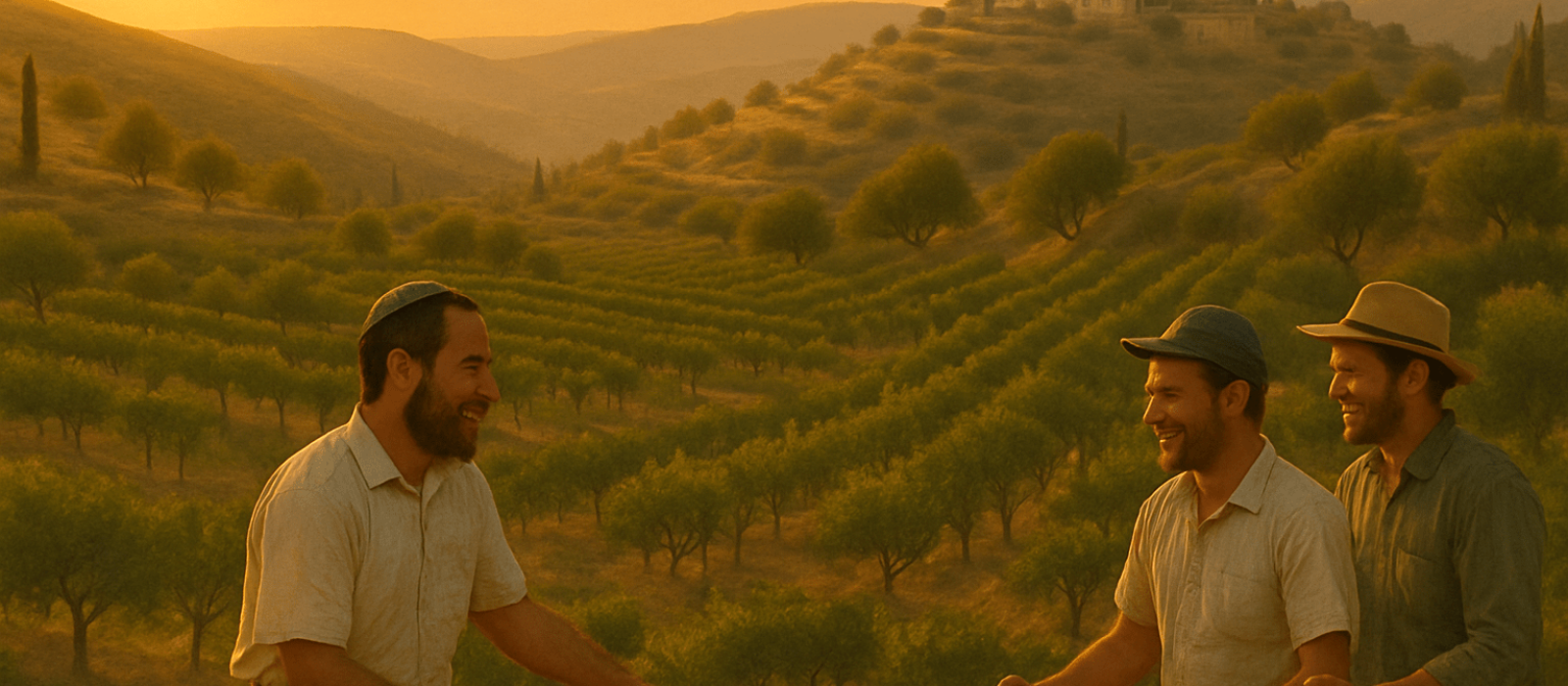
When Josh and the HaYovel team first arrived, the locals simply called them “Catholic.” It didn’t matter what they said they believed; the category for “Christian” was fixed by 2,000 years of history. Only after years of serving in the fields, standing with Israel publicly, and refusing to pray to icons or saints did their Jewish neighbors start saying, “You’re not like the Christians we know. You’re not Catholic.”
That shift didn’t come from clever apologetics. It came from pruning vines, hauling rocks, washing dishes, and staying faithful through fire and rockets. It came from service.
Repentance That Goes All the Way to “Never Again”
A sister from the UK added another crucial piece: repentance.
When she meets Jewish people in her own country, she comes with an apology. “We,” she says, “have been part of what has kept you from following Him.” That posture has opened doors that argument never would.
Josh had just been studying teshuva—repentance—over Yom Kippur. In Jewish thought, repentance has three steps:
First, recognition: we see the wrong for what it is. Second, confession and asking forgiveness. Third, when we find ourselves in the same situation again, we act differently. That third step is what proves the repentance is real.
He believes much of Christianity is stuck between steps one and two. We have recognized, at least in part, the horrors of church history toward the Jewish people. In some places we’ve even asked forgiveness, issued statements, held services of repentance.
But step three—acting differently the next time the pressure comes—that is where we are being tested now.
We say “never again,” but then tolerate new forms of antisemitism and anti-Zionism. We say we love the Jewish people, then quietly side with movements that deny their right to live on their covenant land. We say we honor the roots of our faith, yet embrace theologies that erase Israel’s future or deny that God’s promises still stand.
Real repentance means we will not walk that old road again, even when it is fashionable, even when it is costly. “Never again” cannot just be a slogan; it must become a way of life.
Our Calling: Serving Israel, Blessing Arabs, Reaching the Nations
So what does all of this mean for how we live?
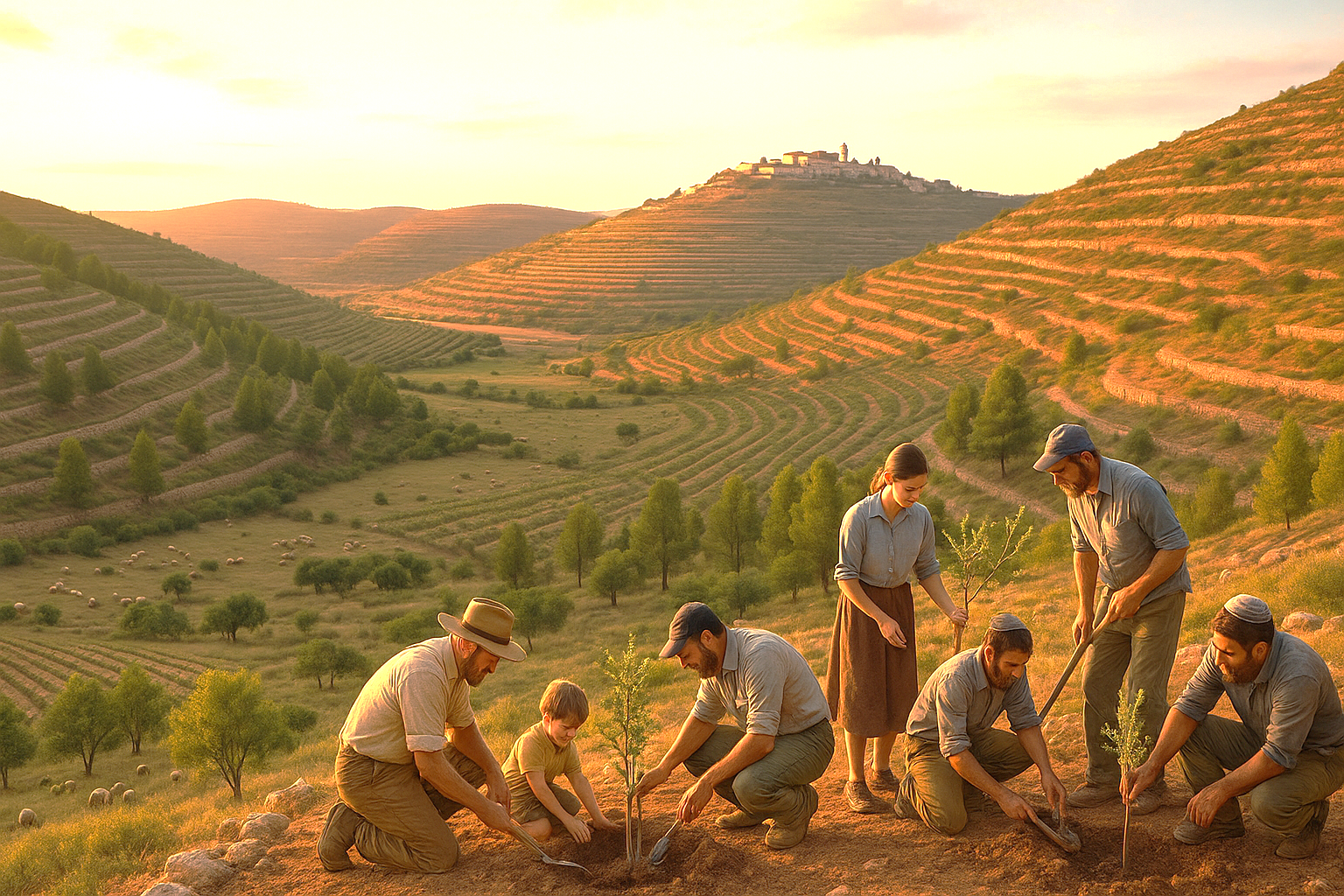
Josh is clear about his own assignment. His primary calling is not to argue theology with Jewish farmers. It is to serve them—planting, pruning, harvesting, showing up year after year in the hills of Samaria. He trusts God to do the deep heart work on the Jewish side as he focuses on his other great mandate: calling the nations to wake up.
Romans 11 speaks of a mystery: a hardening “until the fullness of the Gentiles has come in,” and then a turning of Israel back to her Messiah. We are, Josh believes, on a time clock. The nations have a limited window to repent, align with God’s covenant, and come to Yeshua. As we do that work faithfully among the nations, God will move powerfully in Israel in His time.
At the same time, God is raising up believers Arab pastors who preach the gospel in places like Bethlehem and Nablus, who have been shot and persecuted for defending Israel even as they bring the good news to their own people. Stephen now oversees multiple undercover Bible studies in radical Islamic communities. Recently, men from those groups told him, “We’re ready to meet a Jew.” That is a miracle.
Others run youth camps where kids from Jewish settlements and Palestinian towns meet on neutral ground, play together, and hear a biblical story that challenges the ideology of hate. Friendships are formed, but more importantly, beliefs are confronted and hearts are changed.
Across all of this runs one golden thread: alignment with the covenant of God and a posture of humble service.
For some, that will look like serving Jewish farmers on a mountain whose children’s passports say “no country.” For others, it will look like quietly discipling Arabs in a refugee camp and teaching them that God’s promises to Israel are still “yes and amen.” For many of us, it will mean repenting for what has been done in the name of Jesus and choosing, in our time, not to repeat the sins of the past.
We don’t have to solve the whole Middle East. We do have to answer one question with our lives: Will we stand with God’s covenant, serve His Jewish people, bless the Arabs, and call the nations back to Him before the clock runs out?