
Bereshit (Genesis) 12:1–3; Numbers 22–25; Habakkuk 2:4; Romans 7–8; 2 Timothy 2:13; Philippians 2:5–11.
We do what we see our Father doing, and we speak what we hear our Father speaking. That’s where I want to begin: with dependence. “Lord, we acknowledge that we have need of the Holy Spirit.” When we open our mouths, we need Him to fill not only our words, but our hearts. Without Him, we lean on our own understanding, our own wounds, our own strength—and that never ends well.
In this teaching I want to linger over one Hebrew word: Emunah. Emunah is often translated “faith” or “faithfulness,” but it’s so much richer than mental agreement. It is fidelity, firmness, a life that stands and keeps standing because God Himself is faithful.
Even when we are not faithful, He is faithful. The Scriptures say this plainly: “If we are faithless, He remains faithful, for He cannot deny Himself” (2 Timothy 2:13). Emunah is not first about how tightly we hold onto God; it is about how firmly He holds onto us.
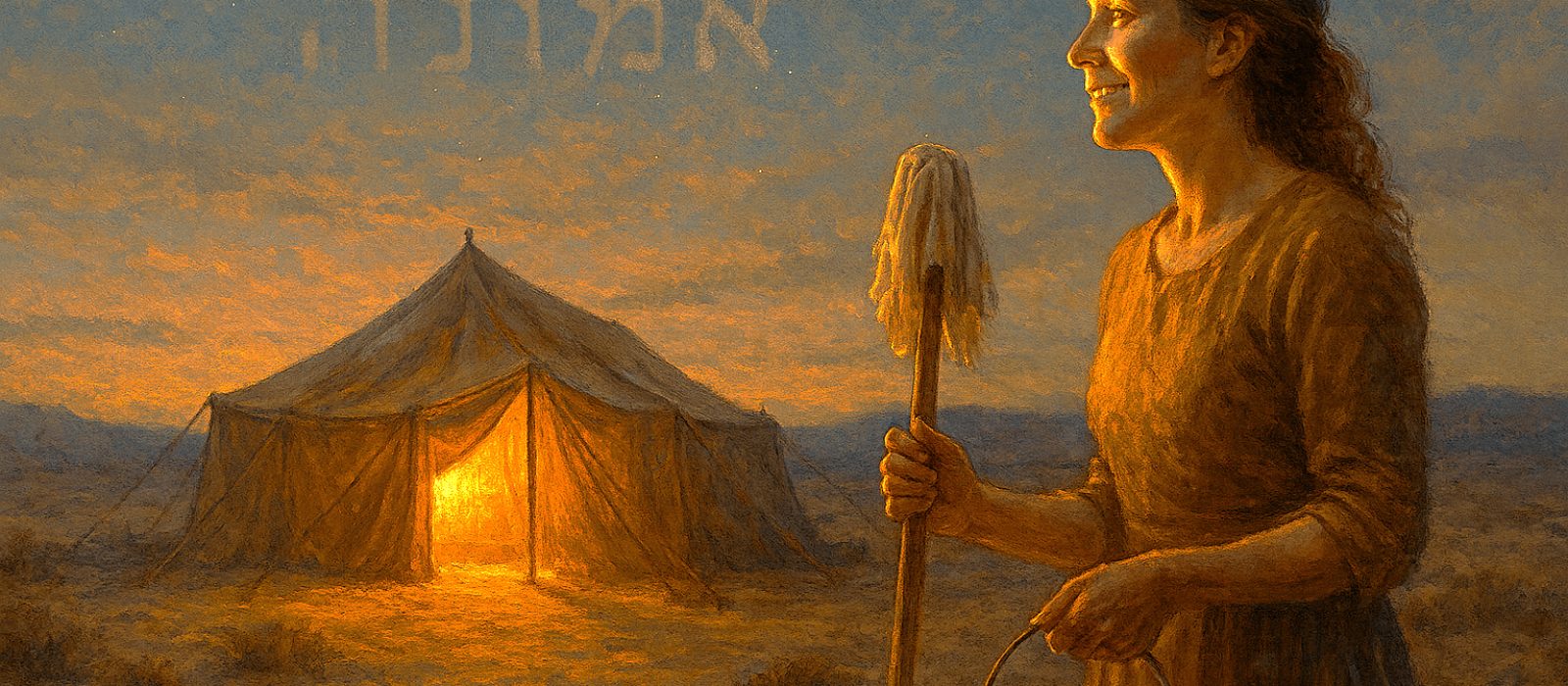
In the ancient pictographs of Hebrew, the letters in emunah tell a story. Alef pictures strength, like an ox with its horns—power and leadership. Mem looks like water. For a nomadic people in the desert, water is life itself, the strength that sustains a camp. Vav is like a nail or a peg, something that fastens and establishes. Nun is like a fish darting through the water, full of movement and life. And Heh is the breath, the window that reveals something, like an open mouth in awe. Together they paint this picture: a strong, life-giving, establishing faithfulness that reveals God’s own heart. Emunah is like a faithful mother who draws water, guards her household, and establishes life day after day.
Now look at Israel’s story. Again and again, Israel falls into sin. In the wilderness, in the land of Moab, they are enticed into sexual immorality and idolatry with the women of Moab, bowing before Baal Peor. Twenty-four thousand die in the plague (Numbers 25). On the surface it looks like a curse.
At the same time, Balak hires Bilaam (Balaam) to come and curse Israel. Balak knows that whoever Balaam blesses is blessed, and whoever he curses is cursed—his words carry weight. But God says “No.” He will not allow Balaam to curse those He has chosen. Why? Because He has already spoken a promise: “I will bless those who bless you, and whoever curses you I will curse” (Genesis 12:3). That covenant over Abraham’s seed does not evaporate just because Israel is stumbling in the wilderness.
So from the outside it looks like Israel is cursed—snakes, plagues, rebellions, a whole generation dying in the desert, even Moses himself barred from entering the land because of disobedience. But the deeper truth is this: discipline is not the same as abandonment. Judgment comes, consequences come, but the covenant stands. God is still saying, “They are blessed, because I am faithful. I am emunah.”
That’s not only Israel’s story; it is ours. Many of us know what it is like to live under “word curses.” Maybe a parent, a teacher, or someone in authority spoke things over you like, “You’re nothing but a loser,” “You’ll never amount to anything,” or “Why can’t you be more like your brother?” Maybe you heard open comparison: “This one is my favorite. I love this one best.” Words like that land in a child’s heart like poison. Life and death are in the power of the tongue, and those who love it eat its fruit.
In my family, I watched how negative words carved deep ruts in my brothers’ lives. One brother was always compared to another who had a “head start”—a year older, a little faster, a little more affirmed. He could never measure up. The shame went so deep that he turned to the bottle. That’s what word curses do. They shape identity. They feel like prophecy, and we start to live as if they are true.
But over all of that, God speaks a different word: “There is therefore now no condemnation for those who are in Messiah Yeshua, who do not walk according to the flesh but according to the Spirit” (Romans 8:1). If you belong to Him, condemnation is not your address, no matter what anyone else has spoken over you. The new covenant is not a self-improvement project; it is God placing His own Spirit within us.
In the wilderness He said, “Build Me a Mishkan, that I may dwell in your midst.” The Hebrew word ohel, tent, is built around the root that also means “to reveal.” God chose to be revealed in a simple tent. How humbling for the Almighty—to dwell in a structure made of animal skins and human hands. But that was His desire: to live among His people.
Today, we are His tent. Our bodies are “tents of skin,” like the coverings over the Mishkan. He chooses to dwell in us by His Ruach HaKodesh, His Holy Spirit. We are walking ohalim, living tents in which God desires to be revealed. That is staggering. And yet this glorious reality lives inside a constant struggle, just as Paul describes in Romans 7: “The things I want to do, I don’t do; the things I hate, these I keep on doing. Who will rescue me from this body of sin and death?”
Meekness is the word that keeps coming back to me. Scripture calls Moses the meekest man on earth, and our Messiah Yeshua describes Himself as “gentle and humble in heart.” Meekness is not weakness; it is power under control—the Holy Spirit governing our strength, our tongue, our reactions.
Contrast that with Balaam. Balaam is gifted, prophetic, and in demand—but he is greedy. He is “for hire.” He keeps coming back to God, trying to get permission to go with Balak’s messengers because he wants the reward. No means no, but Balaam keeps pushing. That is the opposite of meekness. And if we are honest, many of us recognize that same stubbornness in our own hearts.
The Lord has been showing me how often my lack of meekness rises up not from raw rebellion, but from old wounds. I remember a season in my life when I desperately wanted to be chosen to lead the women’s ministry at my church. I was already overseeing all the children from infancy through age twelve, and I had plenty on my plate. But my heart whispered, “You could do that. You deserve that. You’d do a good job.”
They chose someone else.
On the day of a big women’s ministry luncheon, all the ladies were gathered in the kitchen, laughing and fellowshipping over their food. I was out in the restrooms with my mop and cleaning supplies, making sure everything sparkled for Sunday. “Come join us, Jeri!” they called. But inside I was seething. Pride rose up from a place I didn’t even know existed. “No, I’m busy,” I said, and kept scrubbing floors while tears mixed with the cleaning water. Every time someone walked in with wet shoes, I had to mop the same spots again. The smallest things suddenly hurt like salt in an open wound.
As I cried, I heard a mocking voice in my mind: “You’re nothing in the body of Messiah. You’re just Cinderella, the stepchild in the Kingdom. You’ll never be more than the one who cleans up after everyone else.” It echoed my childhood. I had a stepmother. I knew what it was to feel like the child who doesn’t get chosen.
When I was young, I begged my father for piano lessons. I longed to make music. The answer was no. No piano, no guitar, no lessons. But after he remarried, he bought a piano and lessons for my stepsister—who didn’t even really pursue it. The message I heard in my little girl heart was clear: “She matters more than you. She gets what you’re denied.” The wound went in deep and stayed there for years, buried but alive.
Standing in that church bathroom with my mop, it all came rushing back: the rejection, the comparison, the belief that I was always going to be passed over. And then, right in the middle of that swirl of accusation, the Lord’s voice cut through—gentle, but unmistakably different from the mockery.
“So, Cinderella…” He said. And I knew it was Him, not the enemy. “Tell Me—who got the prince?”
I laughed through my tears. “Well, Lord…Cinderella got the prince. She had the smallest feet in the kingdom.”
“Be careful,” He said to my heart. “Pride rises up out of the wound.” It was like He put His finger right on the infection. The real issue wasn’t just hurt feelings; it was an idol. I had formed a picture of God that looked suspiciously like my earthly father: a God who would always choose someone else before me, who would bless others more, who kept saying no to my deepest desires while saying yes to someone else’s.
That picture was not the true God. It was an idol, a false image built out of pain and word curses and misunderstandings. And the Lord was saying, “I am nothing like your earthly father. I need to re-parent you. I need you to let Me show you who I really am.”
Sometimes idolatry looks like a golden calf. Sometimes it looks like a thought about God that simply isn’t true. When we relate to Him as if He is cold, distant, always disappointed, always preferring someone else, we are bowing down to a false image. That “god” is not the God and Father of our Lord Yeshua HaMashiach.
These inner idols and wounds are often built on top of word curses, or even on the absence of blessing. Some people grew up with outright destructive words; others grew up with silence where blessing should have been. Our fathers and mothers were meant to speak identity over us, to call out who we are and who we can become. When they don’t know the Lord, they often don’t know how to do that. And the enemy rushes into the vacuum with his own narrative of rejection and worthlessness.
But Yeshua came to break every curse—spoken and unspoken—and to reveal the true face of the Father. He came to show us what God is really like: the One who bends low to wash feet, who takes the lowest place, who empties Himself in radical humility (Philippians 2), who prefers to dwell in a tent and in fragile humans rather than in unreachable splendor far away.
So what does Emunah look like in this light? Habakkuk says, “The just shall live by his faith” (Habakkuk 2:4). Our faith is shaped by what we believe about God’s character. If we secretly believe He is harsh, stingy, or indifferent, we will have little courage to trust Him. But if we let Him dismantle the idols in our minds and hearts—the false images built from our wounds—then our faith can rest on the rock of His faithfulness, not the sand of our performance.
Many of us quietly live as if our blessing depends on us: “If I just pray more. If I fast enough. If I witness enough. If I give enough.” That driving religious spirit whispers, “It’s never enough.” But the gifts of God are given freely. We cannot buy the anointing with effort or out-give the Giver. We are called to be faithful, yes—but our faithfulness is always a response to His, not a prerequisite to it.
Here is where meekness returns. True meekness is not conquering others; it is letting the Holy Spirit conquer us. It’s surrendering our reactions, our anger, our insistence on getting our way. I wish I could say I have mastered that, but I haven’t. I am tested on every side, especially as I care for my aging mother. My impatience, my sharp words, my desire to “win” in a conflict—they all show me how much I still need the Spirit to harness my heart.
Maybe you recognize that in yourself too: the flash of anger, the instant defensiveness, the quiet resentment. Maybe you can feel old memories stirring as you read this—times when you were overlooked, compared, rejected, or simply not blessed. Don’t waste those memories. Let the Master Surgeon do what only He can do. Invite Yeshua to lay His hand on those hidden places, to expose the lies and uproot the idols.
Ask Him: “Where did I begin to think You were like this? Whose voice have I confused with Yours? What word curses do You want to break? What blessings did I never receive that You want to speak over me now?” Then wait. Let His Ruach speak. Let Him re-parent you. Let Him show you that you are not a stepchild in the Kingdom—you are the bride He is coming for.
Israel’s story in Numbers 22–25 shows us that God’s people can look cursed and still be deeply blessed, because He is faithful. Your life may have chapters that look like wilderness and judgment and loss. But if you belong to Yeshua, His covenant love is still the truest thing about you. “Every promise of God is yes and amen” in Him. He is Emunah—the Faithful One—like a mother who never stops drawing water for her household, like a Father who never stops calling His children home.
May we turn from the idols in our thinking, break agreement with every word curse, forgive those who wounded or failed to bless us, and receive the healing of the One who cannot deny Himself. May we learn to live not from our wounds, but from His faithful heart. And may the world see, through these fragile tents of skin we call bodies, the glory of the God who dwells within.